
CLICILC BDS MDI work Strategy CLIC and ILC
CLIC-ILC BDS & MDI work
Strategy • CLIC and ILC colleagues are looking forward to work together • Consider this as a natural continuation of long and fruitful collaboration • Expect that challenging scientific tasks will benefit ILC and CLIC research, and both short and long term program of involved institutions • Expect that ideas and solution would have broad applicability and we will be proactive in search of such opportunities
Optics Design and Optimization • Design concepts and strategy – Collimation system – Final focus system – Diagnostics sections – Extraction lines • Optimisation tools – Share and cross apply • Tracking tools • Beam based correction/tuning/feedback
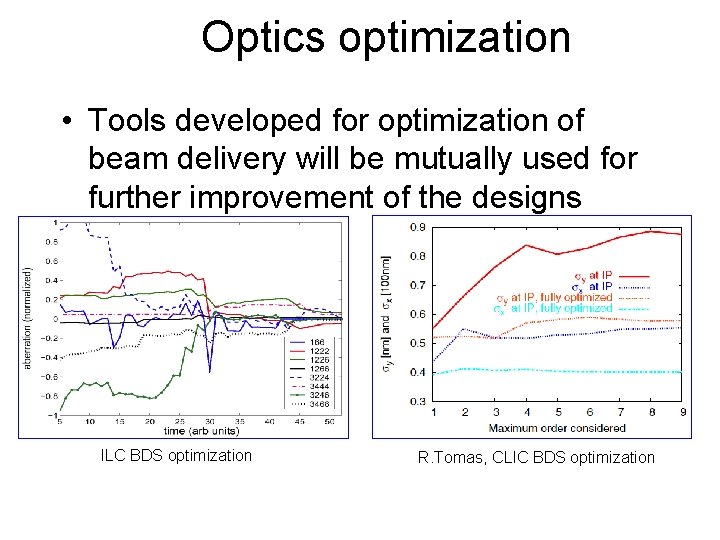
Optics optimization • Tools developed for optimization of beam delivery will be mutually used for further improvement of the designs ILC BDS optimization R. Tomas, CLIC BDS optimization
ATF 2 • Almost everybody is involved • Already a global collaboration with both projects • Tuning procedures • Flight simulator • Commissioning
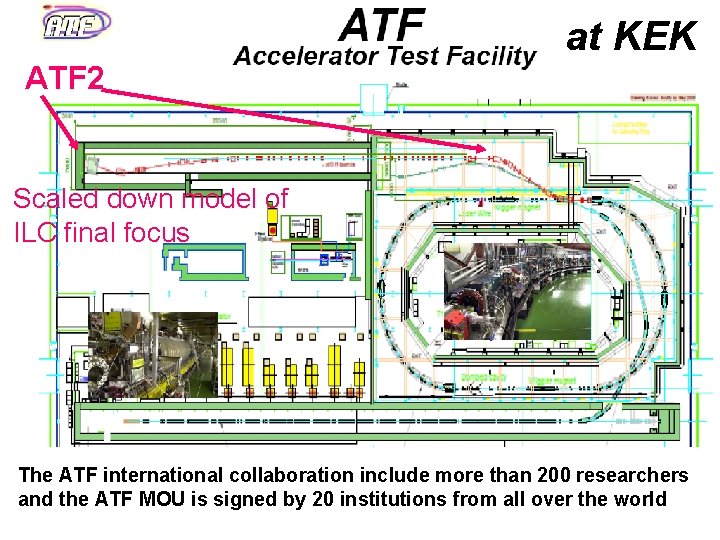
at KEK ATF 2 Scaled down model of ILC final focus The ATF international collaboration include more than 200 researchers and the ATF MOU is signed by 20 institutions from all over the world
Collimators • UK, CERN, SLAC • Collimator survival is likely critical and limits system design – Collaboration LHC/ILC/CLIC on collimator hardware • Collimator tests at ATF 2/SLAC • Extends beyond BDS – Machine protection – Other machines (LHC, . . . ) • Generic work on collimator materials – E. g. cristal collimation • Wakefields
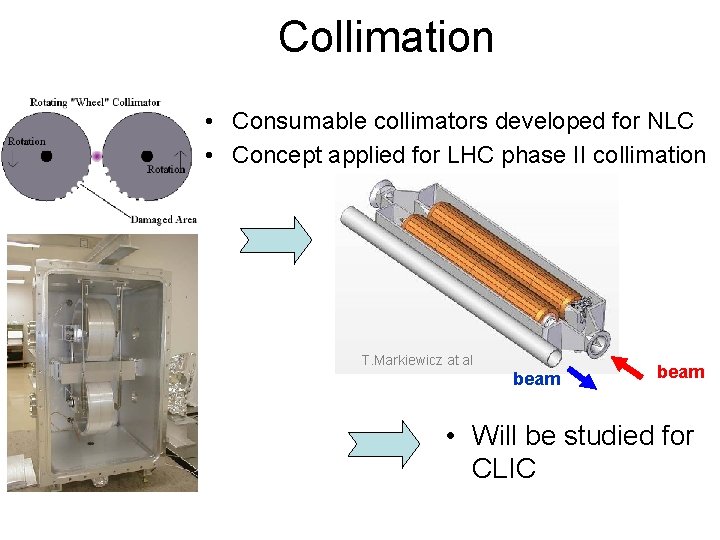
Collimation • Consumable collimators developed for NLC • Concept applied for LHC phase II collimation T. Markiewicz at al beam • Will be studied for CLIC
Crab Cavity • SLAC, FNAL, UK, CERN, INFN, KEK, FP 7 • Design • Phase stability • Collaboration is ongoing to large extent • Synergy with LHC upgrade

Beam Instrumentation • • • Many institutes BPMs Laser wires Extraction line instrumentation Energy spectrometer including magnet Polarimeter Luminometers Orbit feedback design Intra-pulse IP feedback Generic tasks foreseen in FP 7 – BPMs – Laser wires
Potential Other Topics • Beam pipe and vacuum system • Beam dumps – Synergy with other projects • Superconducting final doublet – Could be of interest for CLIC as well
Machine Detector Interface • Many institutions • General layout and integration – Common meeting/review required – Common engineering tools for detector design in preparation (DESY, CERN, IN 2 P 3, FP 7) • Background and luminosity studies – Strengthen support • Masking system – Constraints on vertex detector • Detector field – Need a field for CLIC • Magnet design • Common simulation tools for detector studies – Need to review what is available • Low angle calorimeter • Beam pipe design (LHC) • Vacuum etc. (LHC)
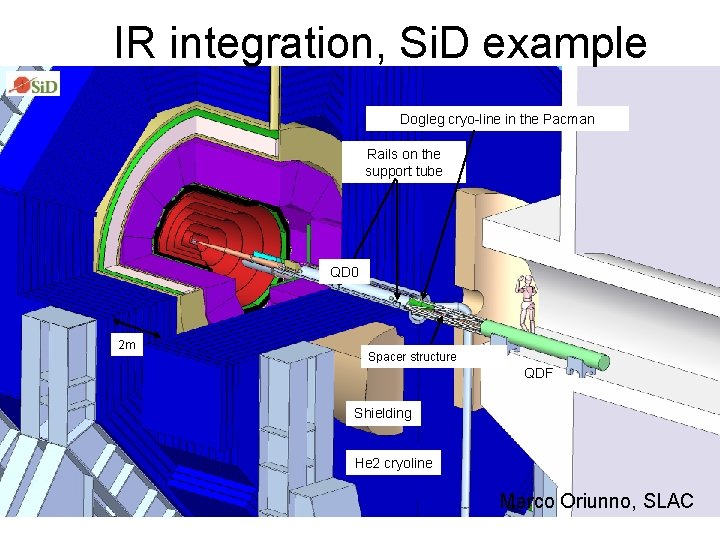
IR integration, Si. D example Dogleg cryo-line in the Pacman Rails on the support tube QD 0 2 m Spacer structure QDF Shielding He 2 cryoline Marco Oriunno, SLAC
Background and Luminosity Studies • Common simulation tools – BDSIM () • Integration into GEANT? – FLUKA (CERN) – Halo and tail generation (CERN) – Common formats etc • Study of machine induced background – In particular, neutrons, muons and synchrotron radiation – Mitigation strategies • e. g. tunnel fillers against muons • Study of beam-beam background and luminosity spectrum
Support, Stabilization and Alignment • LAPP, Oxford, CERN, FP 7, BNL, SLAC, … – Other please join • Low-noise design – Noise level measurements (DESY, CERN) • Among others, measurements at LHC – Component design • Mechanical design of quadrupole support • Final quadrupole design • Stabilization feedback design – Sensors – Actuators – Interferometers

CERN, now Annecy Stability • Long history & potential for future joint developments Small stabilized object SLAC MONALISA at ATF 2 interferometer to monitor FD stability D. Urner et al Nonmagnetic inertial sensor Extended stabilized object SLAC
Experimental Area Integration • Common definitions • Infra-structure – Work is quite generic • No large differences expected for CLIC detector to some ILC detector – Collaboration has started – LHC expertise • Push-pull – Is an option for both projects – A collaboration has started – Brings ILC/CLIC/LHC expertise • Crossing angle – Investigate requirements – Then study benefits to find a common crossing angle
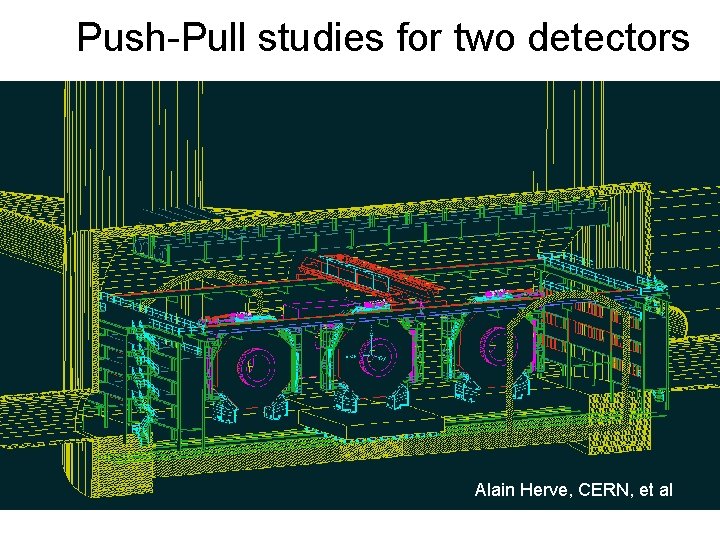
Push-Pull studies for two detectors Alain Herve, CERN, et al
First Milestones • Identify contact persons for different tasks • Investigate what level of efforts and when could be available • Have identified solutions for LHC that can be applied to ILC and CLIC • Have identified solutions for ILC that can be applied to CLIC
- Slides: 19