
CLIC Compact Linear Collider 05 08 2010 M
- Slides: 8
CLIC (Compact Linear Collider) 05. 08. 2010 M. Pasche Aim: Explore physics at the Te. V scale (higgs boson, supersymmetry. . . Mitra Pasche MEW group meeting, Cockcroft Institute
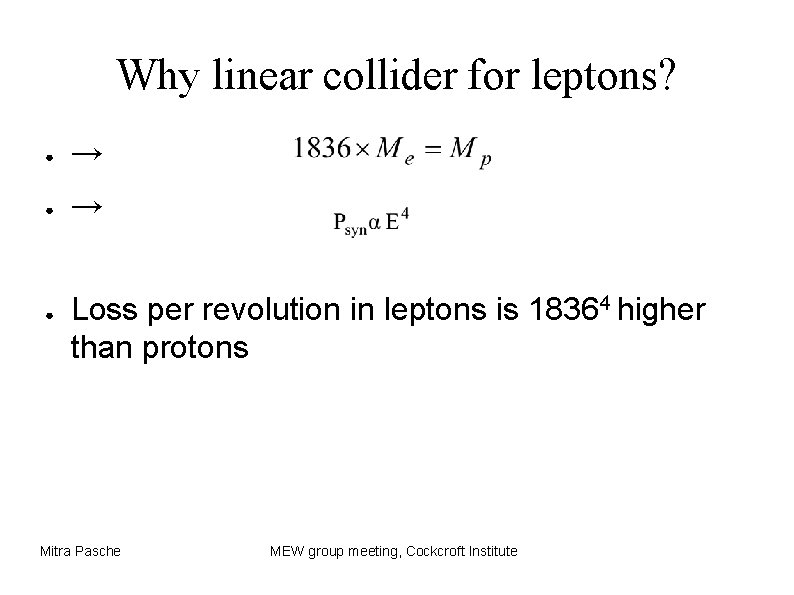
Why linear collider for leptons? ● → ● Loss per revolution in leptons is 18364 higher than protons Mitra Pasche MEW group meeting, Cockcroft Institute
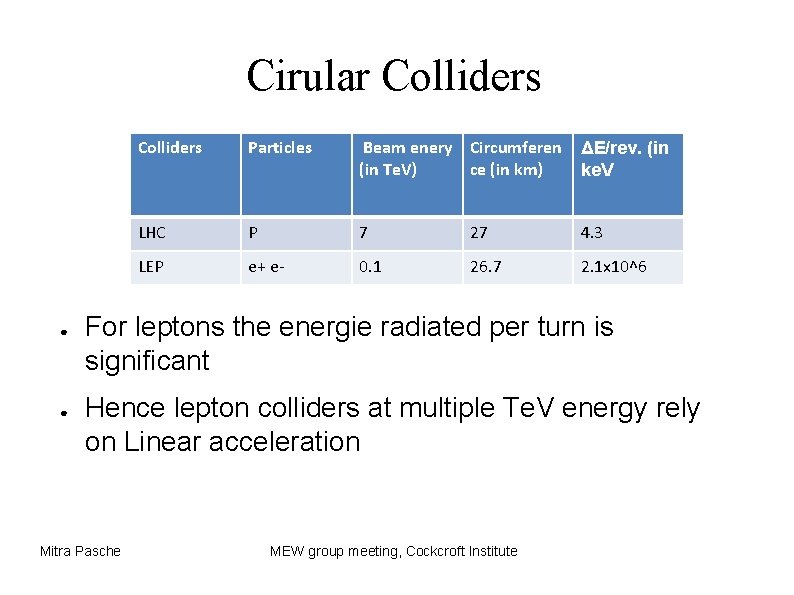
Cirular Colliders ● ● Colliders Particles Beam enery Circumferen (in Te. V) ce (in km) ΔE/rev. (in ke. V LHC P 7 27 4. 3 LEP e+ e- 0. 1 26. 7 2. 1 x 10^6 For leptons the energie radiated per turn is significant Hence lepton colliders at multiple Te. V energy rely on Linear acceleration Mitra Pasche MEW group meeting, Cockcroft Institute
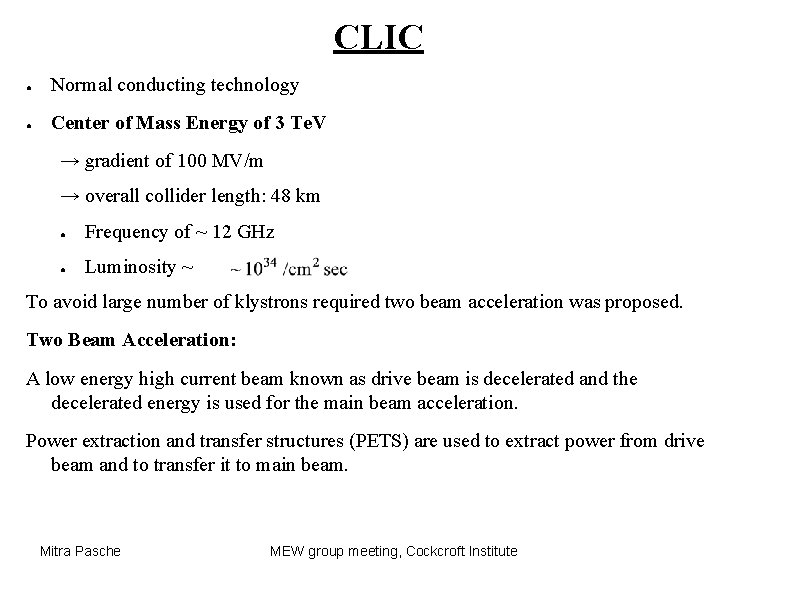
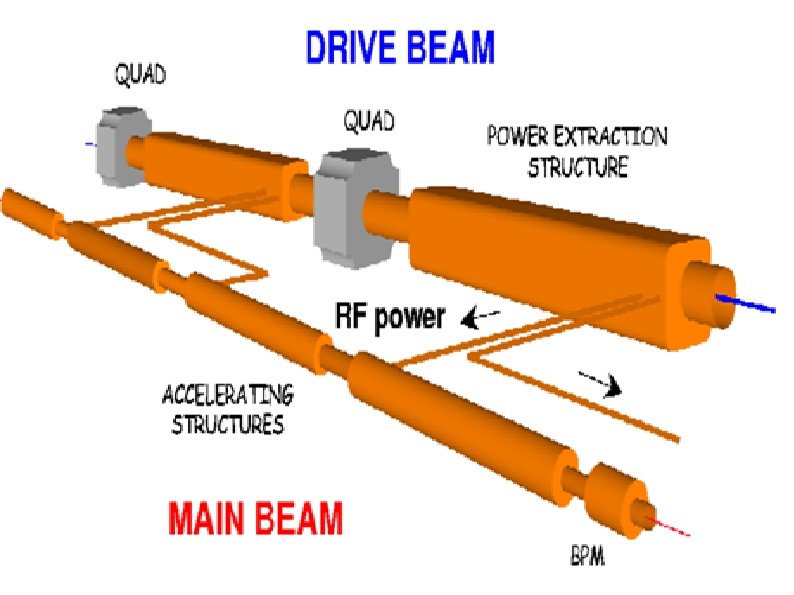
CLIC ● Normal conducting technology ● Center of Mass Energy of 3 Te. V → gradient of 100 MV/m → overall collider length: 48 km ● Frequency of ~ 12 GHz ● Luminosity ~ To avoid large number of klystrons required two beam acceleration was proposed. Two Beam Acceleration: A low energy high current beam known as drive beam is decelerated and the decelerated energy is used for the main beam acceleration. Power extraction and transfer structures (PETS) are used to extract power from drive beam and to transfer it to main beam. Mitra Pasche MEW group meeting, Cockcroft Institute
Mitra Pasche MEW group meeting, Cockcroft Institute
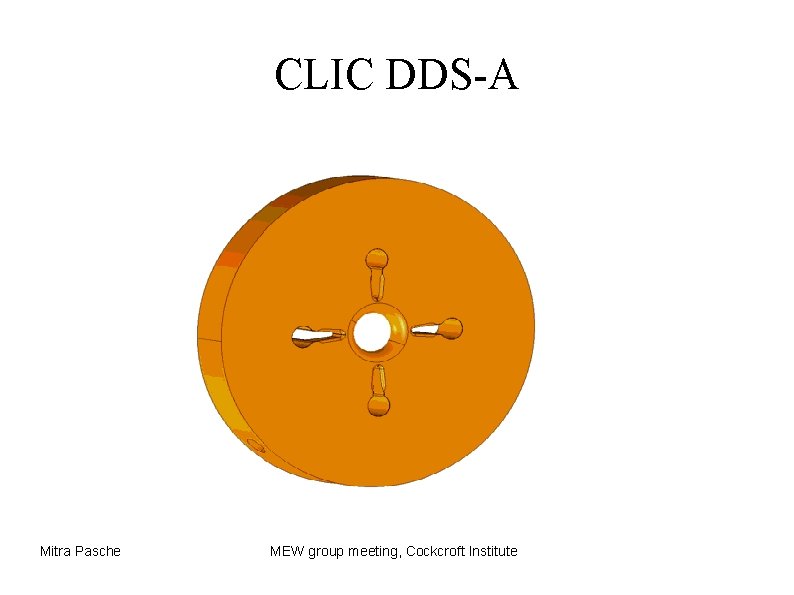
CLIC DDS-A Mitra Pasche MEW group meeting, Cockcroft Institute
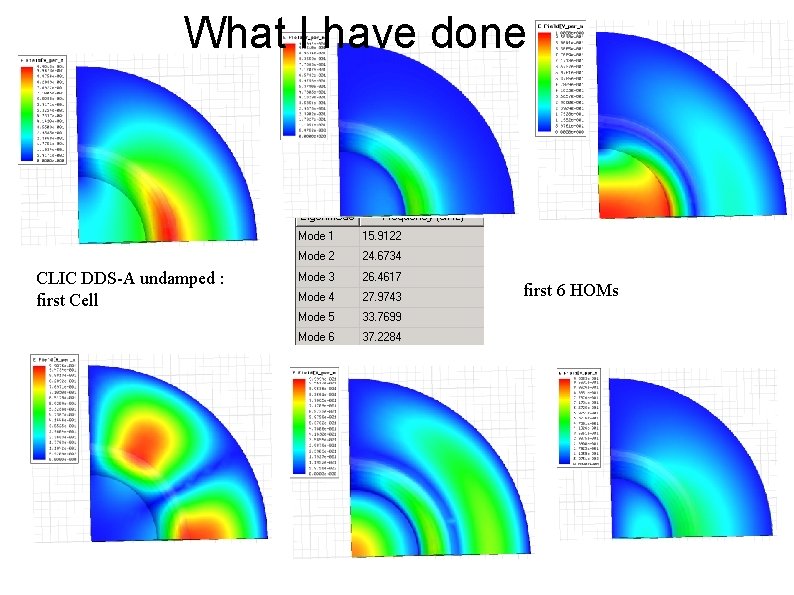
What I have done CLIC DDS-A undamped : first Cell first 6 HOMs
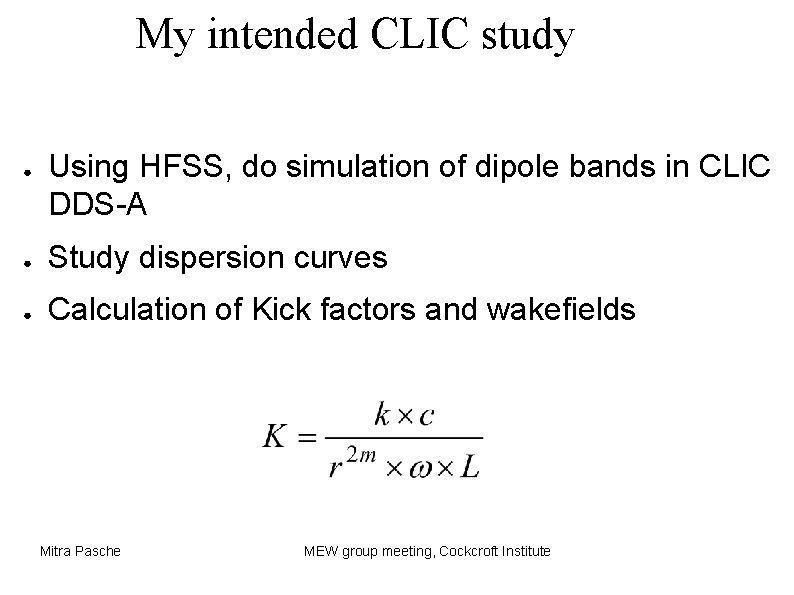
My intended CLIC study ● Using HFSS, do simulation of dipole bands in CLIC DDS-A ● Study dispersion curves ● Calculation of Kick factors and wakefields Mitra Pasche MEW group meeting, Cockcroft Institute