
CLEARING THE ERROR A 2 year research initiative

- Slides: 23
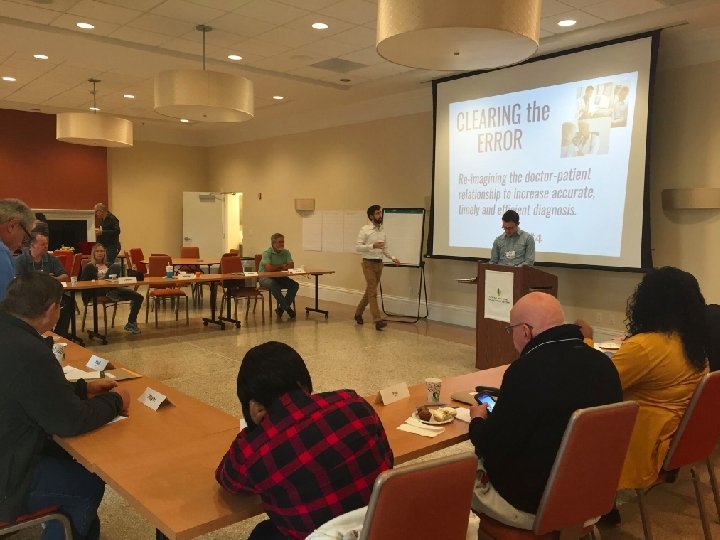
CLEARING THE ERROR A 2 -year research initiative to assess the value of public deliberation in developing healthcare policy and to identify roles patients are willing and able to perform to improve diagnostic quality.
ACTIVATING PATIENTS IN POLICY Patients are the future of healthcare. Educating patients about their condition(s) and involving patients in determining the nature and course of their treatment can improve health and reduce spending. With a little assistance and education, patients can make effective decisions about their own care and about the system that shapes their healthcare experience. We’re exploring the value of incorporating patient knowledge and diversity into the development of health policy, regulations, and institutional practices.
WHY DIAGNOSTIC ERROR? Accurate diagnoses are a fundamental, though often less visible, component of quality healthcare. The relationship between the patient and their provider is a critical determinant in effective diagnosis. Many patients feel unable to fully assert themselves as mutual partners in the patient-provider relationship, leading to poor communication and error. The failure to establish an accurate and timely explanation of the patient’s health problem(s) or communicate that explanation to the patient.
OUR APPROACH To generate new, patient-centered insight into the problem, we convened diverse groups in public deliberation to recommend and evaluate actions that patients and/or their advocates would be willing and able to perform to improve diagnostic quality. Participants also identified obstacles to action that healthcare systems and providers should address to improve diagnosis. Jefferson-center. org/patient-dx
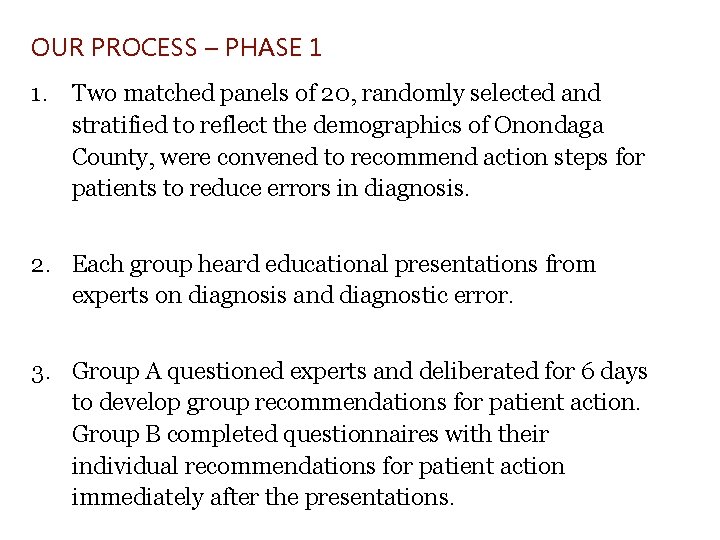
OUR PROCESS – PHASE 1 1. Two matched panels of 20, randomly selected and stratified to reflect the demographics of Onondaga County, were convened to recommend action steps for patients to reduce errors in diagnosis. 2. Each group heard educational presentations from experts on diagnosis and diagnostic error. 3. Group A questioned experts and deliberated for 6 days to develop group recommendations for patient action. Group B completed questionnaires with their individual recommendations for patient action immediately after the presentations.
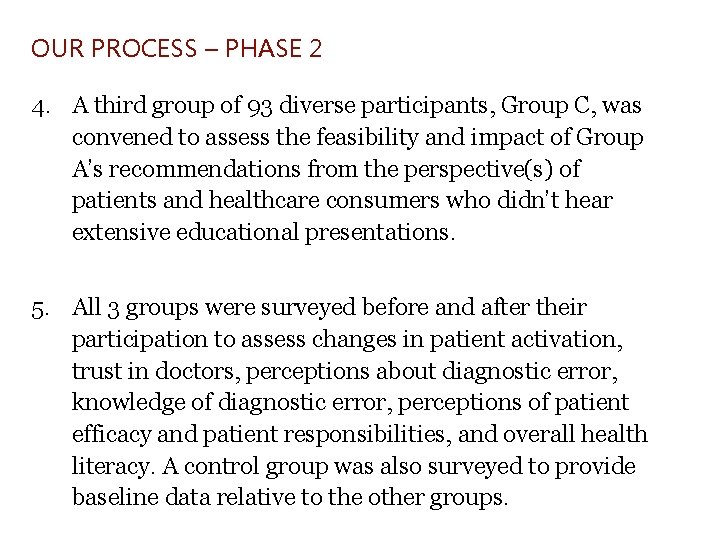
OUR PROCESS – PHASE 2 4. A third group of 93 diverse participants, Group C, was convened to assess the feasibility and impact of Group A’s recommendations from the perspective(s) of patients and healthcare consumers who didn’t hear extensive educational presentations. 5. All 3 groups were surveyed before and after their participation to assess changes in patient activation, trust in doctors, perceptions about diagnostic error, knowledge of diagnostic error, perceptions of patient efficacy and patient responsibilities, and overall health literacy. A control group was also surveyed to provide baseline data relative to the other groups.
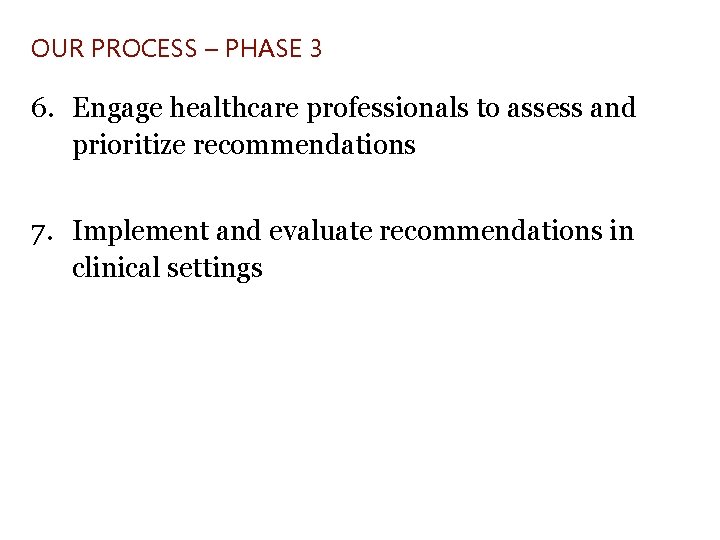
OUR PROCESS – PHASE 3 6. Engage healthcare professionals to assess and prioritize recommendations 7. Implement and evaluate recommendations in clinical settings
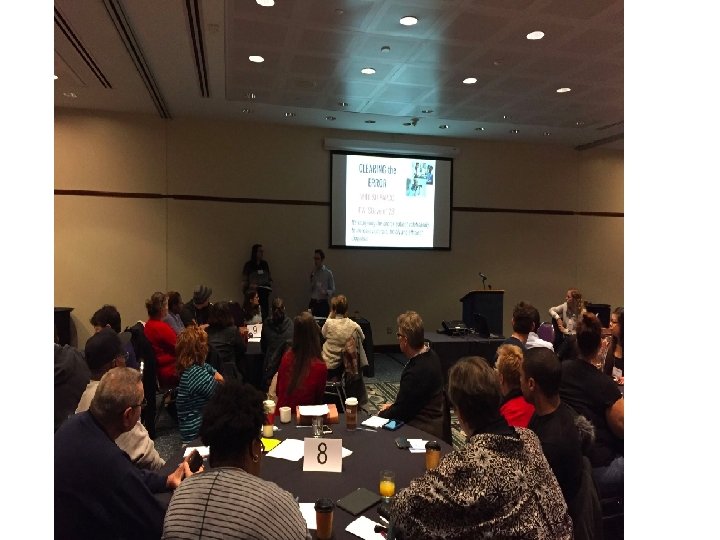
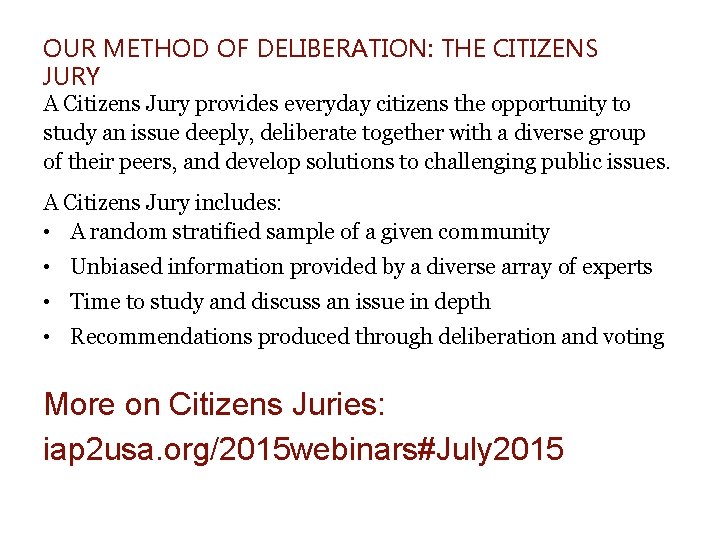
OUR METHOD OF DELIBERATION: THE CITIZENS JURY A Citizens Jury provides everyday citizens the opportunity to study an issue deeply, deliberate together with a diverse group of their peers, and develop solutions to challenging public issues. A Citizens Jury includes: • A random stratified sample of a given community • Unbiased information provided by a diverse array of experts • Time to study and discuss an issue in depth • Recommendations produced through deliberation and voting More on Citizens Juries: iap 2 usa. org/2015 webinars#July 2015
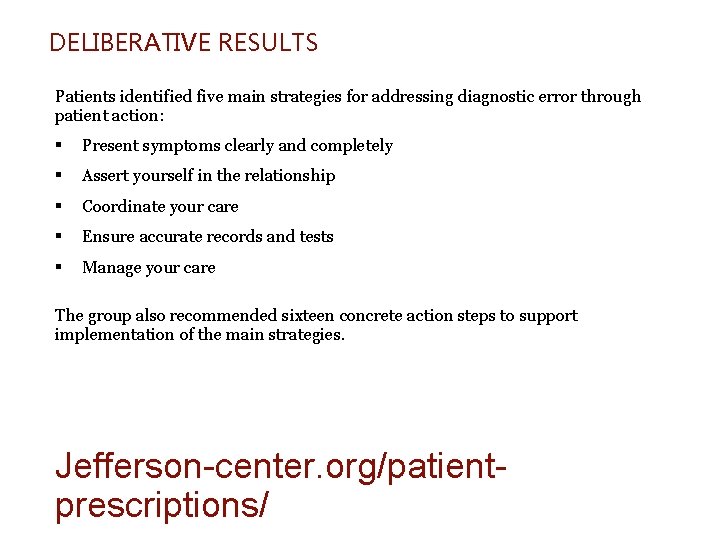
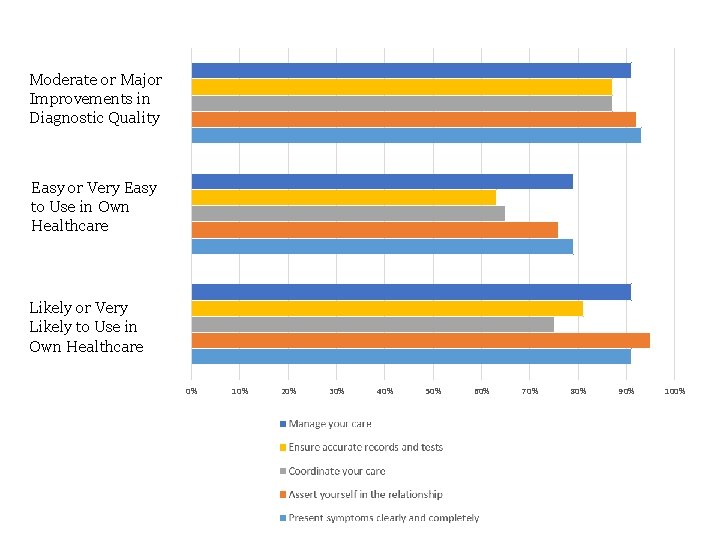
DELIBERATIVE RESULTS Patients identified five main strategies for addressing diagnostic error through patient action: § Present symptoms clearly and completely § Assert yourself in the relationship § Coordinate your care § Ensure accurate records and tests § Manage your care The group also recommended sixteen concrete action steps to support implementation of the main strategies. Jefferson-center. org/patientprescriptions/
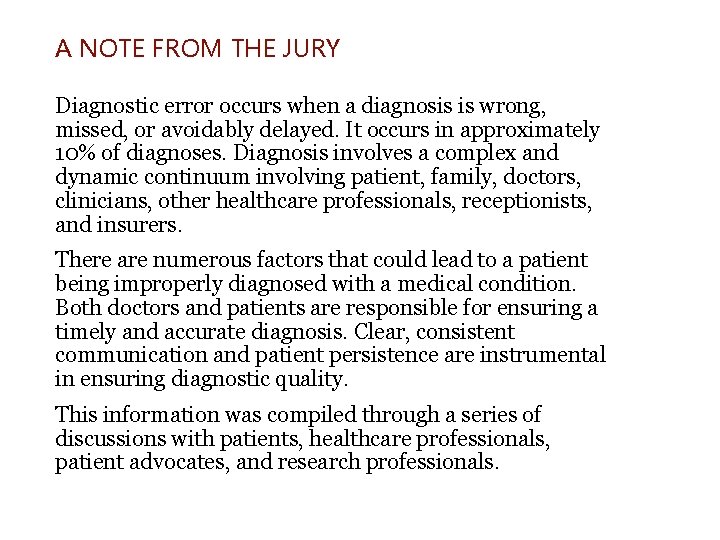
A NOTE FROM THE JURY Diagnostic error occurs when a diagnosis is wrong, missed, or avoidably delayed. It occurs in approximately 10% of diagnoses. Diagnosis involves a complex and dynamic continuum involving patient, family, doctors, clinicians, other healthcare professionals, receptionists, and insurers. There are numerous factors that could lead to a patient being improperly diagnosed with a medical condition. Both doctors and patients are responsible for ensuring a timely and accurate diagnosis. Clear, consistent communication and patient persistence are instrumental in ensuring diagnostic quality. This information was compiled through a series of discussions with patients, healthcare professionals, patient advocates, and research professionals.
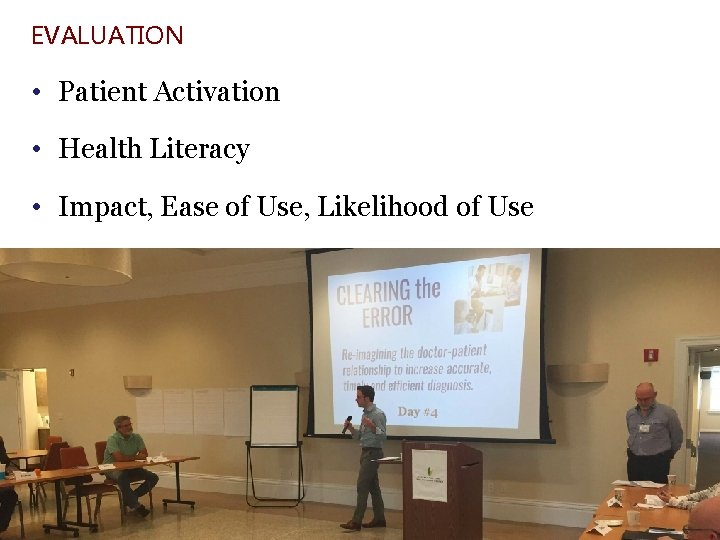
EVALUATION • Patient Activation • Health Literacy • Impact, Ease of Use, Likelihood of Use
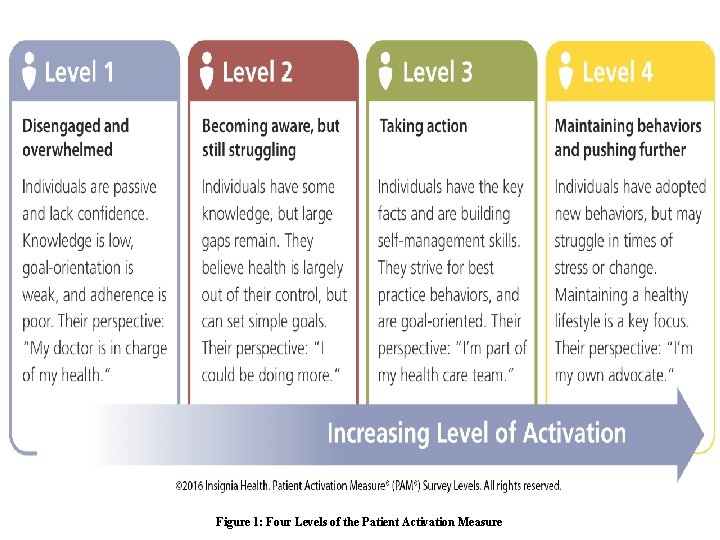
Figure 1: Four Levels of the Patient Activation Measure
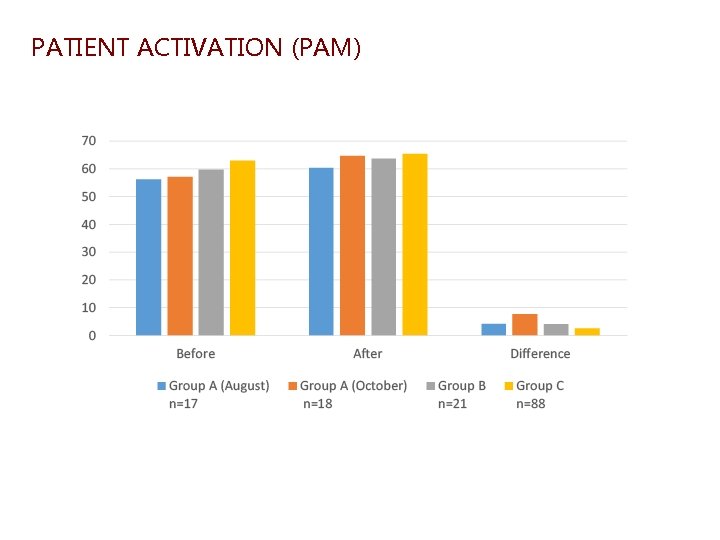
PATIENT ACTIVATION (PAM)
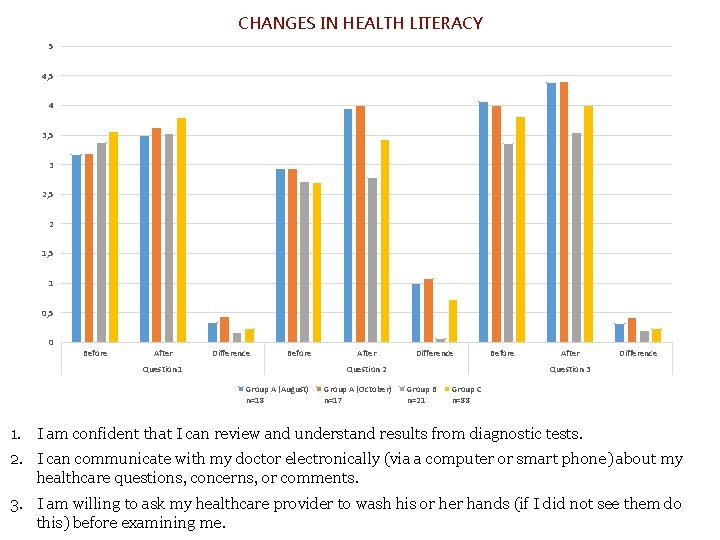
CHANGES IN HEALTH LITERACY 5 4, 5 4 3, 5 3 2, 5 2 1, 5 1 0, 5 0 Before After Difference Before Question 1 After Difference Question 2 Group A (August) n=18 Group A (October) n=17 Before After Difference Question 3 Group B n=21 Group C n=88 1. I am confident that I can review and understand results from diagnostic tests. 2. I can communicate with my doctor electronically (via a computer or smart phone) about my healthcare questions, concerns, or comments. 3. I am willing to ask my healthcare provider to wash his or her hands (if I did not see them do this) before examining me.
Moderate or Major Improvements in Diagnostic Quality Easy or Very Easy to Use in Own Healthcare Likely or Very Likely to Use in Own Healthcare 0% 10% 20% 30% 40% 50% 60% 70% 80% 90% 100%
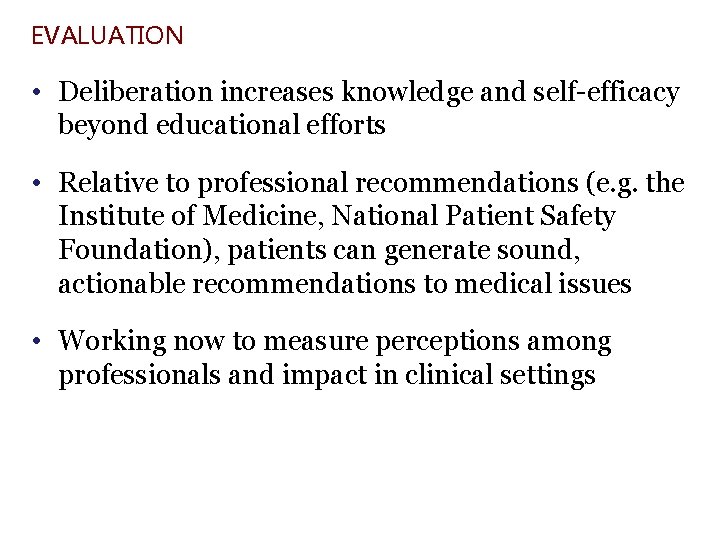
EVALUATION • Deliberation increases knowledge and self-efficacy beyond educational efforts • Relative to professional recommendations (e. g. the Institute of Medicine, National Patient Safety Foundation), patients can generate sound, actionable recommendations to medical issues • Working now to measure perceptions among professionals and impact in clinical settings
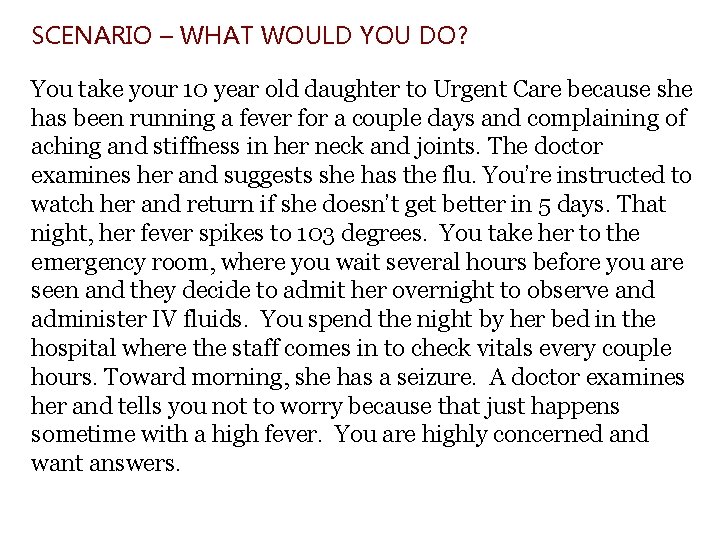
SCENARIO – WHAT WOULD YOU DO? You take your 10 year old daughter to Urgent Care because she has been running a fever for a couple days and complaining of aching and stiffness in her neck and joints. The doctor examines her and suggests she has the flu. You’re instructed to watch her and return if she doesn’t get better in 5 days. That night, her fever spikes to 103 degrees. You take her to the emergency room, where you wait several hours before you are seen and they decide to admit her overnight to observe and administer IV fluids. You spend the night by her bed in the hospital where the staff comes in to check vitals every couple hours. Toward morning, she has a seizure. A doctor examines her and tells you not to worry because that just happens sometime with a high fever. You are highly concerned and want answers.
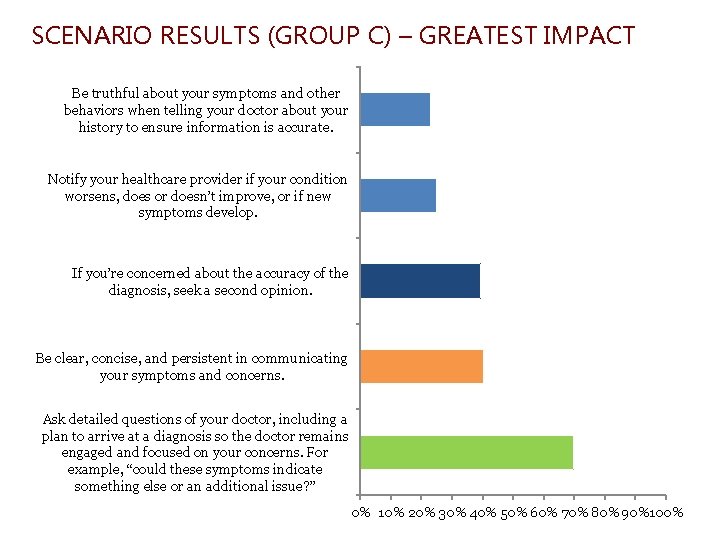
SCENARIO RESULTS (GROUP C) – GREATEST IMPACT Be truthful about your symptoms and other behaviors when telling your doctor about your history to ensure information is accurate. Notify your healthcare provider if your condition worsens, does or doesn’t improve, or if new symptoms develop. If you’re concerned about the accuracy of the diagnosis, seek a second opinion. Be clear, concise, and persistent in communicating your symptoms and concerns. Ask detailed questions of your doctor, including a plan to arrive at a diagnosis so the doctor remains engaged and focused on your concerns. For example, “could these symptoms indicate something else or an additional issue? ” 0% 10% 20% 30% 40% 50% 60% 70% 80% 90%100%
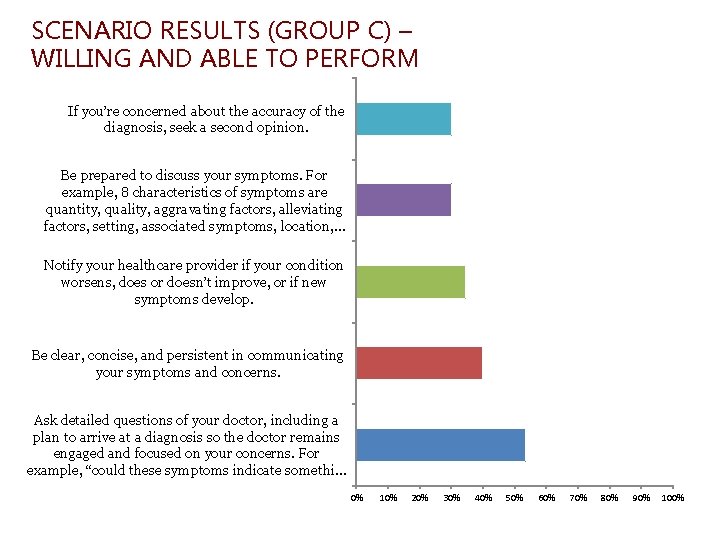
SCENARIO RESULTS (GROUP C) – WILLING AND ABLE TO PERFORM If you’re concerned about the accuracy of the diagnosis, seek a second opinion. Be prepared to discuss your symptoms. For example, 8 characteristics of symptoms are quantity, quality, aggravating factors, alleviating factors, setting, associated symptoms, location, . . . Notify your healthcare provider if your condition worsens, does or doesn’t improve, or if new symptoms develop. Be clear, concise, and persistent in communicating your symptoms and concerns. Ask detailed questions of your doctor, including a plan to arrive at a diagnosis so the doctor remains engaged and focused on your concerns. For example, “could these symptoms indicate somethi. . . 0% 10% 20% 30% 40% 50% 60% 70% 80% 90% 100%
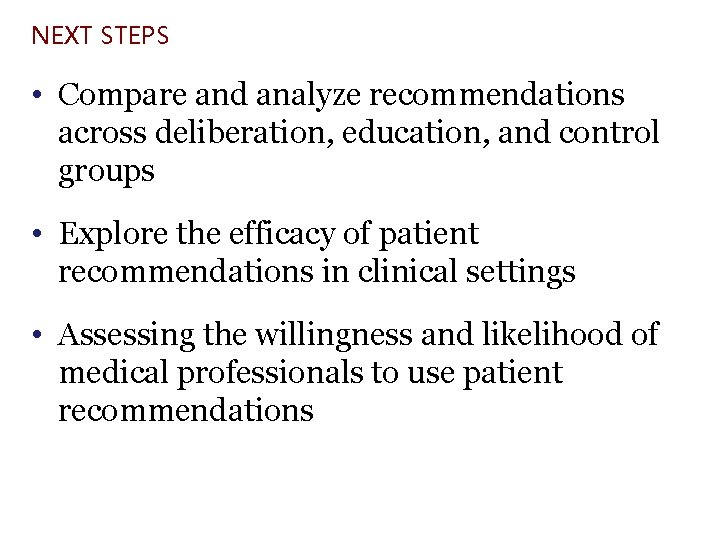
NEXT STEPS • Compare and analyze recommendations across deliberation, education, and control groups • Explore the efficacy of patient recommendations in clinical settings • Assessing the willingness and likelihood of medical professionals to use patient recommendations
If you are interested in pursuing similar patient-led deliberative initiatives an/or want to learn more about our efforts, let us know! Andrew Rockway arockway@jefferson-center. org 651 -209 -7672 Dr. Tina Nabatchi, Syracuse University tnabatch@maxwell. syr. edu Jefferson-center. org/patient-dx