
Clearance Processing Back To The Basics Presented By

Clearance Processing Back To The Basics Presented By Mallory Howard December 12, 2013
Agenda • • • Clearance Processing SF-86 Review Clearance Tracking and Record Keeping Interim Determinations Loss of Jurisdiction Periodic Reinvestigation Processing JPAS Notifications SWFT RRU Admin Downgrades and Terminations DMDC vs. DSS Call Center
Clearance Processing • NISPOM 2 -200 c • NISPOM 2 -200 a • NISPOM 2 -200 d o Within a Multiple-Facility Organization (MFO), the home office can centrally manage o Employee can be processed for a PCL when contractor determines that access is essential in the performance of tasks or services related to the fulfillment of a classified contract o Contractor will limit requests for PCLs to minimal number of employees necessary for operational necessity o Don’t establish pools of cleared employees o At Via. Sat, we meet this by: • Employee is briefed to notify Security when they no longer require a clearance • Revalidating the need for a clearance at the time of their Periodic Reinvestigation • Revalidating when notified that an employee changes programs
Clearance Processing • NISPOM 2 -201 o Investigative Requirements § Single Scope Background Investigation (SSBI) Ø Top Secret Ø Q (Dept. of Energy TS Equivalent) Ø SCI (Special Compartment Information) § National Agency Check with Local Agency Check and Credit Check (NACLC) Ø Secret Ø L (Dept. of Energy Secret Equivalent) Ø Confidential § Periodic Reinvestigation Ø Top Secret – 5 years Ø Secret and Confidential – 10 years Ø SAPS – Defined by customer
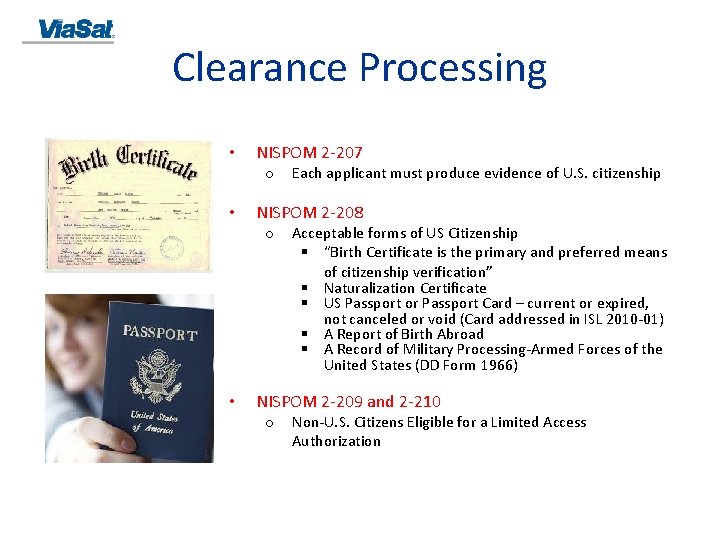
Clearance Processing • NISPOM 2 -207 o • NISPOM 2 -208 o • Each applicant must produce evidence of U. S. citizenship Acceptable forms of US Citizenship § “Birth Certificate is the primary and preferred means of citizenship verification” § Naturalization Certificate § US Passport or Passport Card – current or expired, not canceled or void (Card addressed in ISL 2010 -01) § A Report of Birth Abroad § A Record of Military Processing-Armed Forces of the United States (DD Form 1966) NISPOM 2 -209 and 2 -210 o Non-U. S. Citizens Eligible for a Limited Access Authorization
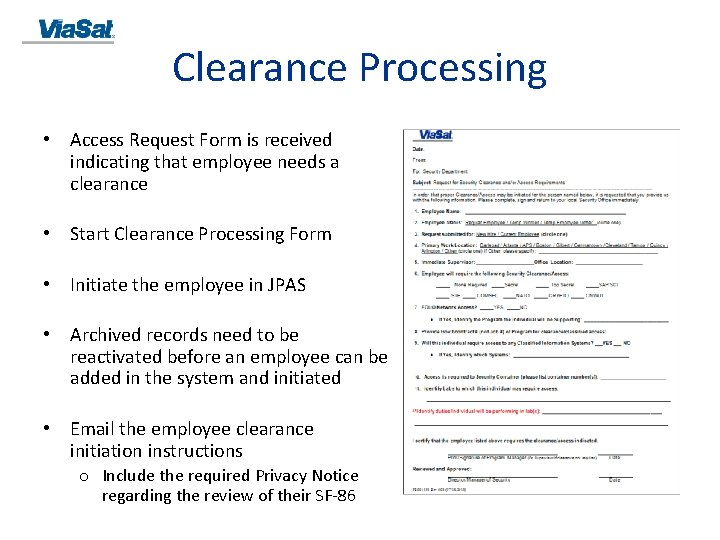
Clearance Processing • Access Request Form is received indicating that employee needs a clearance • Start Clearance Processing Form • Initiate the employee in JPAS • Archived records need to be reactivated before an employee can be added in the system and initiated • Email the employee clearance initiation instructions o Include the required Privacy Notice regarding the review of their SF-86
Clearance Processing • Deadlines o JPAS: 30 days to start, 90 days to complete o Via. Sat: 30 days to start, 15 days to complete • FSO or designee reviews e-QIP for adequacy and completeness • Obtain fingerprints via Electronic Fingerprint Capture or Fingerprint Card (FD-258) and transmit to OPM via SWFT
Clearance Processing What if someone has current eligibility? • An individual should maintain clearance eligibility for 24 months • If you are able to pick up their clearance in JPAS, then you can move forward in doing so as long as their record shows eligibility What is best practice? • Check that most recent debriefing date is within 24 months • Verify that the most recent investigation is in scope • Confirm record separation from the previous employer
Clearance Processing How do I pick up an Interim or Final clearance? • Brief the employee and execute the Classified Information Nondisclosure Agreement, SF-312 o Agreement between United States and an individual who is cleared for access to classified information o Must be executed prior to picking up clearance in JPAS and obtaining access to classified information • Indoctrinate Interim or Final clearance in JPAS
Clearance Processing • A date in the Nd. A field in JPAS means no SF-312 is necessary • The date entered in JPAS must be the date the employee signed their original Nd. A • No Nd. A date shown in the JPAS record means it is your responsibility to add the information SF-312 should be faxed to the PSMO-I: (443) 661 -1140 ATTN: SF-312
Clearance Processing • Common omissions/mistakes on the SF-312: o o Employee SSN is incomplete or omitted Signature of employee is typed or omitted Witness signature is typed or omitted Employee and witness signature dates are not the same • Debriefing signatures no longer required on SF-312 • Notification will be sent via CAF message if a new SF-312 is needed
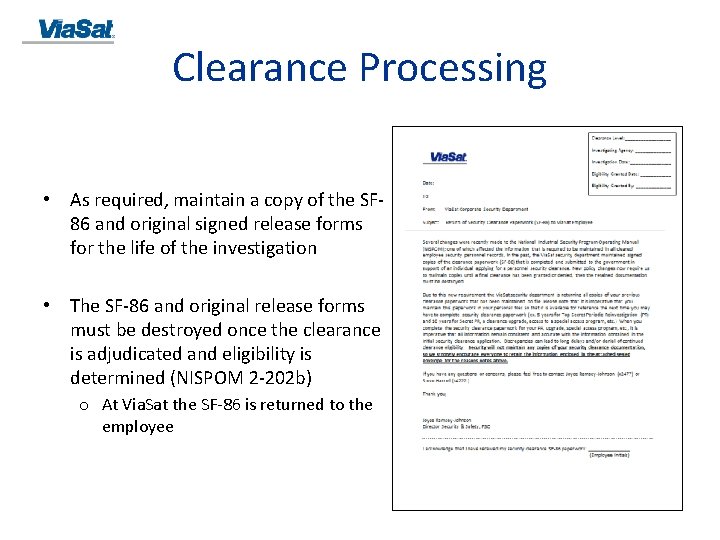
Clearance Processing • As required, maintain a copy of the SF 86 and original signed release forms for the life of the investigation • The SF-86 and original release forms must be destroyed once the clearance is adjudicated and eligibility is determined (NISPOM 2 -202 b) o At Via. Sat the SF-86 is returned to the employee
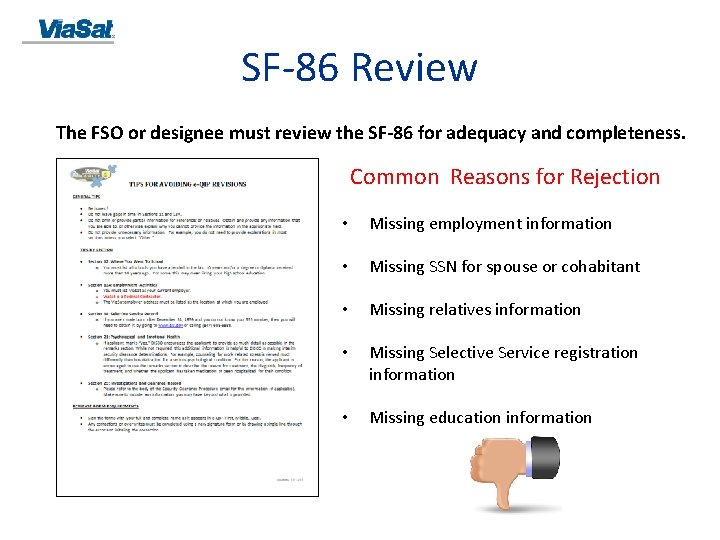
SF-86 Review The FSO or designee must review the SF-86 for adequacy and completeness. Common Reasons for Rejection • Missing employment information • Missing SSN for spouse or cohabitant • Missing relatives information • Missing Selective Service registration information • Missing education information
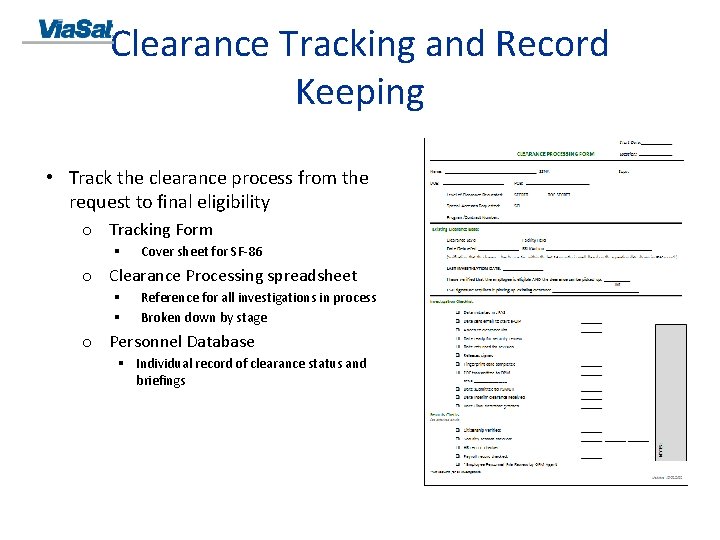
Clearance Tracking and Record Keeping • Track the clearance process from the request to final eligibility o Tracking Form § Cover sheet for SF-86 o Clearance Processing spreadsheet § § Reference for all investigations in process Broken down by stage o Personnel Database § Individual record of clearance status and briefings
Interim Determinations How is an interim clearance granted? • Granted based on the initial review of the SF-86 prior to the investigation opening • An Interim Eligibility Pending notification does not mean final clearance eligibility will not be granted • Interim can be pulled upon further investigation
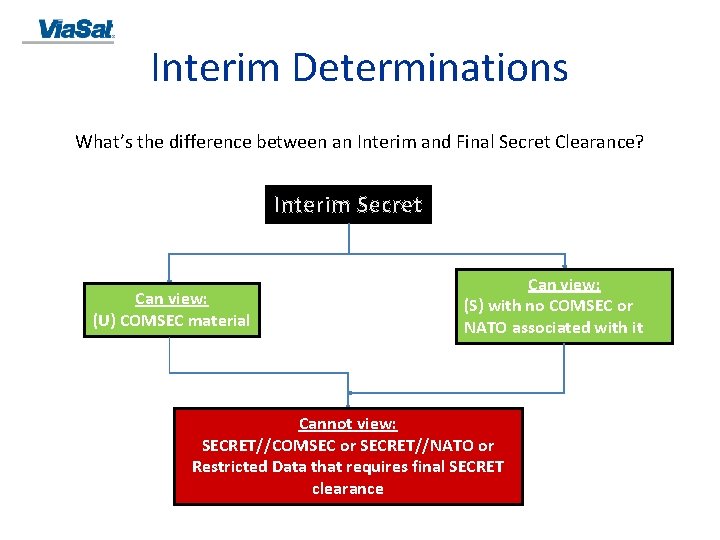
Interim Determinations What’s the difference between an Interim and Final Secret Clearance? Interim Secret Can view: (U) COMSEC material Can view: (S) with no COMSEC or NATO associated with it Cannot view: SECRET//COMSEC or SECRET//NATO or Restricted Data that requires final SECRET clearance
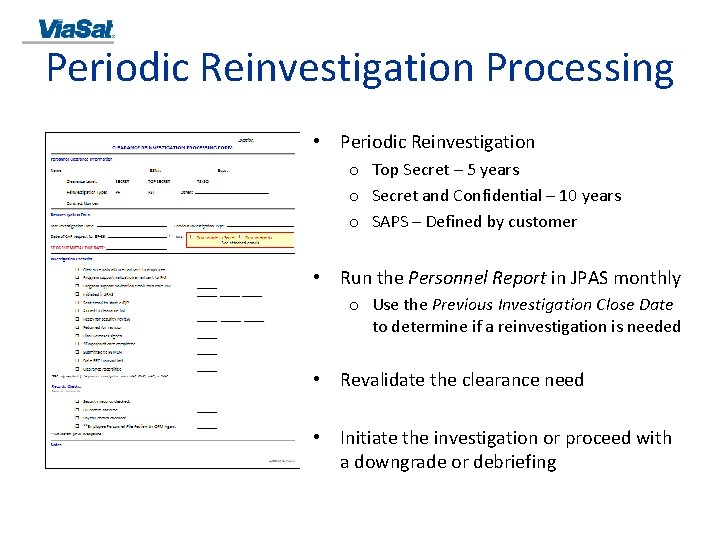
Periodic Reinvestigation Processing • Periodic Reinvestigation o Top Secret – 5 years o Secret and Confidential – 10 years o SAPS – Defined by customer • Run the Personnel Report in JPAS monthly o Use the Previous Investigation Close Date to determine if a reinvestigation is needed • Revalidate the clearance need • Initiate the investigation or proceed with a downgrade or debriefing
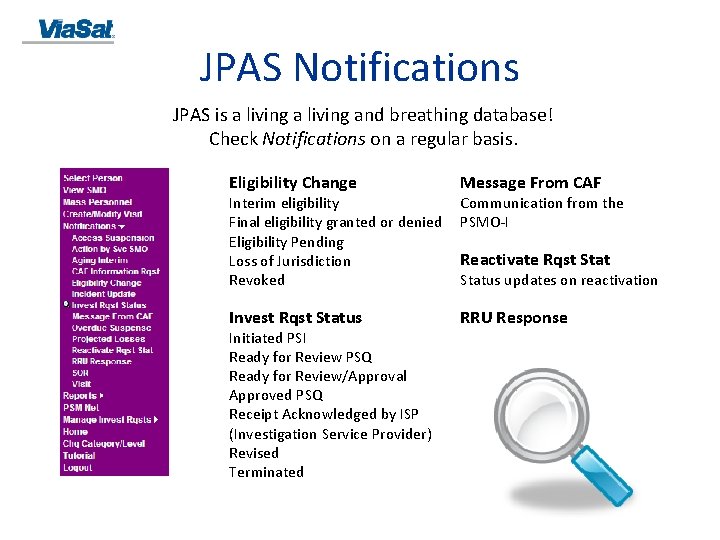
JPAS Notifications JPAS is a living and breathing database! Check Notifications on a regular basis. Eligibility Change Interim eligibility Final eligibility granted or denied Eligibility Pending Loss of Jurisdiction Revoked Invest Rqst Status Initiated PSI Ready for Review PSQ Ready for Review/Approval Approved PSQ Receipt Acknowledged by ISP (Investigation Service Provider) Revised Terminated Message From CAF Communication from the PSMO-I Reactivate Rqst Status updates on reactivation RRU Response
SWFT Secure Web Fingerprint Transmission (SWFT) mandatory as of December 31, 2013 • Options for creating electronic fingerprint files (. eft): o Live Scan o Card Scan • Fingerprinting Service Provider o Via. Sat to provide fingerprinting service to local contractors starting early 2014 • Fingerprints obtained in the following cases: o New Clearance Investigation o New Type of Clearance Investigation
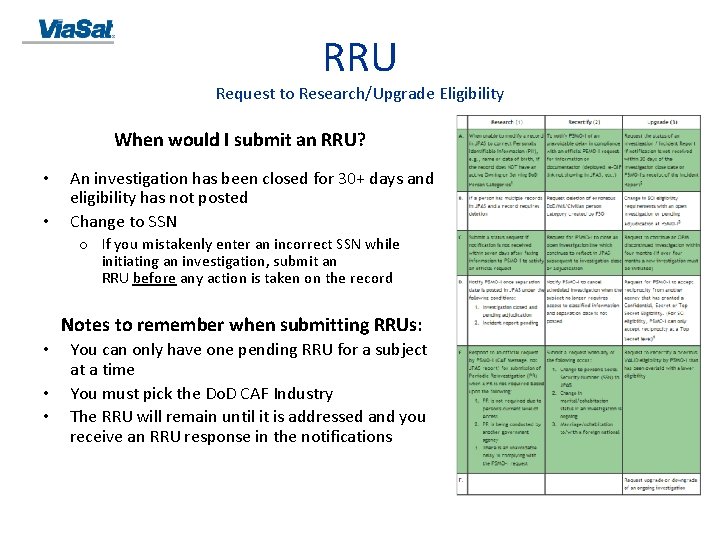
RRU Request to Research/Upgrade Eligibility When would I submit an RRU? • • An investigation has been closed for 30+ days and eligibility has not posted Change to SSN o If you mistakenly enter an incorrect SSN while initiating an investigation, submit an RRU before any action is taken on the record Notes to remember when submitting RRUs: • • • You can only have one pending RRU for a subject at a time You must pick the Do. D CAF Industry The RRU will remain until it is addressed and you receive an RRU response in the notifications
Loss of Jurisdiction • Loss of jurisdiction = no clearance eligibility o The subject must be debriefed and no access should be granted • LOJ usually occurs for one of the following reasons: o The SF-86 was not received following an official CAF request o An incident report was submitted and the contents led to a loss of jurisdiction o A CAF, other than DOHA, determines there is no longer a need for SCI § Debrief and remove from SCI § The FSO must send an RRU to Do. D CAF Industry if Top Secret access is still required
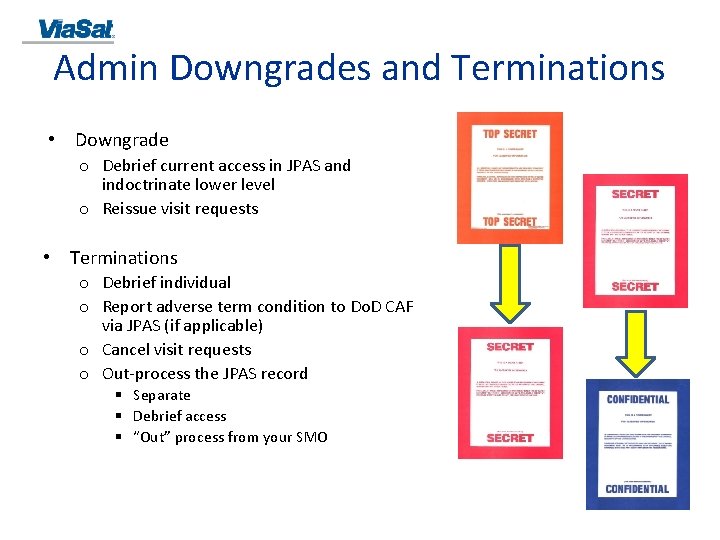
Admin Downgrades and Terminations • Downgrade o Debrief current access in JPAS and indoctrinate lower level o Reissue visit requests • Terminations o Debrief individual o Report adverse term condition to Do. D CAF via JPAS (if applicable) o Cancel visit requests o Out-process the JPAS record § Separate § Debrief access § “Out” process from your SMO
DMDC VS. DSS Call Center Who do you call when you need assistance? DMDC • JPAS • SWFT DSS Call Center • Personnel Security Clearance inquiries • e-QIP • STEPP • ISFD

Contact Information Mallory Howard 6155 El Camino Real Carlsbad, CA 92009 (760) 930 -2925 mallory. howard@viasat. com Interested in attending a more in depth seminar on JPAS and clearance processing? Let us know! Email: sdisac@viasat. com
- Slides: 24