
CLEAR III Monthly Broadcast October 2011 Social Marketing

CLEAR III Monthly Broadcast October 2011
Social Marketing Strategies to Improve Recruitment to CLEAR III Jamie Roberts, MA, CCRP Clinical Trials Specialist NINDS
No Doubt About It CLEAR III is a demanding study with a LOT of moving parts that MUST work together like a well-oiled machine Team dynamics MUST be maximized Tribe and turf factors MUST be minimized Build in redundancy to ensure success Back-up, coordinate, relate, communicate, evaluate ▪ Repeat, repeat
Laws Governing Clinical Trial Recruitment Lasagna’s law: The prevalence of any disease under study drops dramatically immediately upon study initiation, returning to previous levels only once enrollment is complete • Murphy’s law: Everything that can go wrong will go wrong Robert’s number of trial enrollments • Giltinan’s law: The expected quality data obtained from a center where the P. I. is a “thoughtleader” in the field is inversely proportional to the degree of exaltation of the P. I. •
The Funnel Effect (aka Lasagna’s Law) • The pool of available participants when the grant was written shrinks precipitously once the grant is funded but returns to it’s original level once the trial is complete ▫ Tendency to overestimate the pool of available • • participants who meet the I/E criteria and would also be willing to participate Underestimating: ▫ Barriers to participation, competing obligations ▫ Commitment level of investigators/clinicians to trial Overestimating: ▫ Motivation to participate (of subjects and investigators/clinicians)
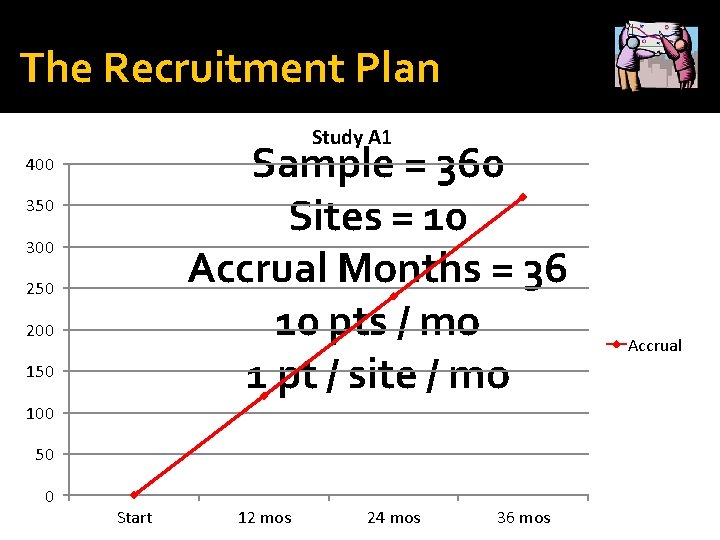
The Recruitment Plan Study A 1 Sample = 360 Sites = 10 Accrual Months = 36 10 pts / mo 1 pt / site / mo 400 350 300 250 200 150 100 50 0 Start 12 mos 24 mos 36 mos Accrual
Don’t Ignore the Elephant
Survey: (true/false) My site has a dedicated 24/7 Stroke Team My site is a certified Stroke Center My study coordinator is an RN My study coordinator is a member of the stroke team 5. We have a structured recruitment strategy for CLEAR III 1. 2. 3. 4.
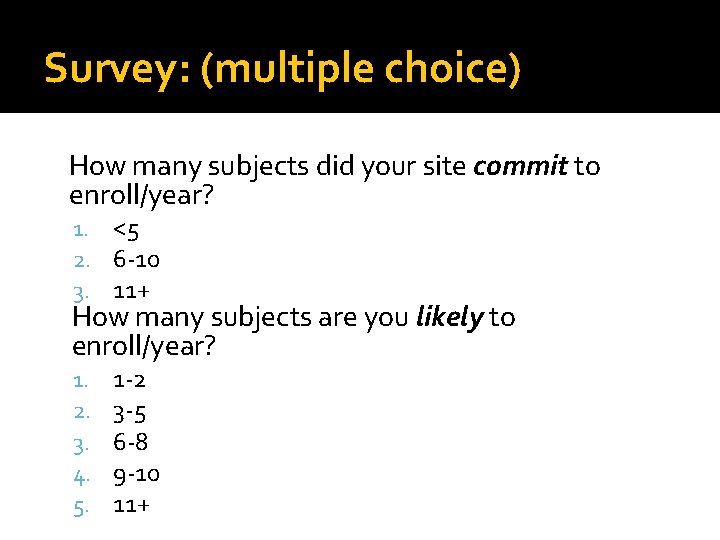
Survey: (multiple choice) • • How many subjects did your site commit to enroll/year? 1. <5 2. 6 -10 3. 11+ How many subjects are you likely to enroll/year? 1. 2. 3. 4. 5. 1 -2 3 -5 6 -8 9 -10 11+
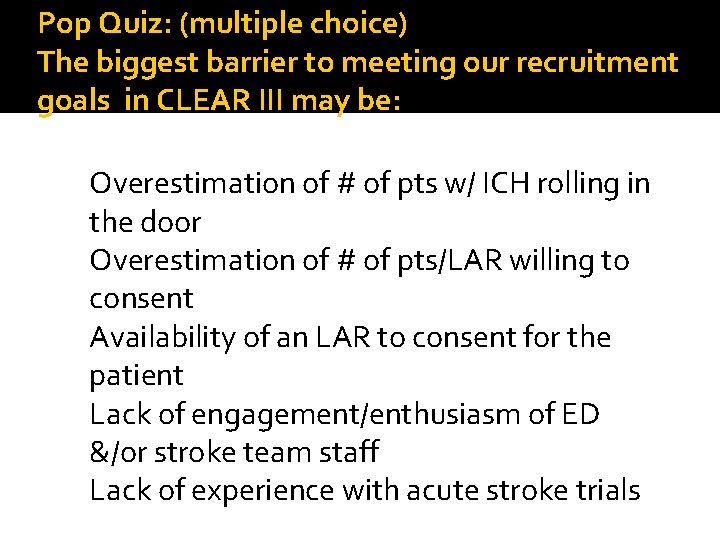
Pop Quiz: (multiple choice) The biggest barrier to meeting our recruitment goals in CLEAR III may be: 1. 2. 3. 4. 5. Overestimation of # of pts w/ ICH rolling in the door Overestimation of # of pts/LAR willing to consent Availability of an LAR to consent for the patient Lack of engagement/enthusiasm of ED &/or stroke team staff Lack of experience with acute stroke trials
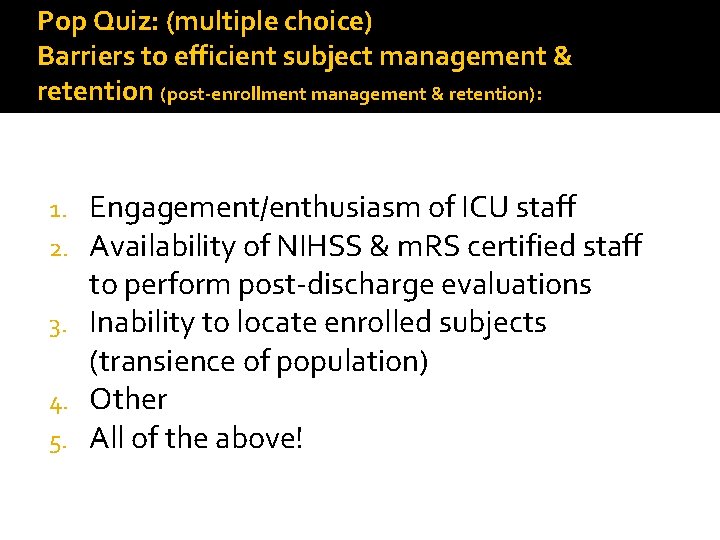
Pop Quiz: (multiple choice) Barriers to efficient subject management & retention (post-enrollment management & retention): Engagement/enthusiasm of ICU staff Availability of NIHSS & m. RS certified staff to perform post-discharge evaluations 3. Inability to locate enrolled subjects (transience of population) 4. Other 5. All of the above! 1. 2.
Why Strategize? You Get What You Pay For �A focused, targeted strategic recruitment and retention plan, adequately funded and resourced, implemented and adjusted to maximize return on investment, will have a significant impact on recruitment and retention, ensuring that your clinical trial can complete on time and within budget.
ALL recruitment is local
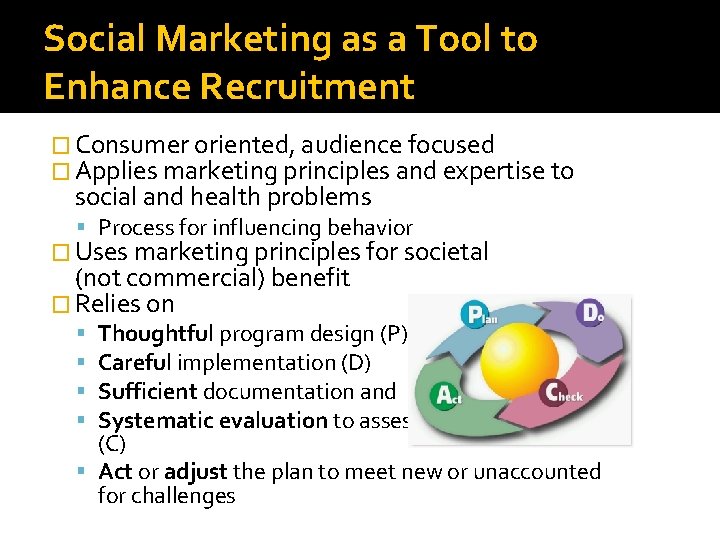
Social Marketing as a Tool to Enhance Recruitment � Consumer oriented, audience focused � Applies marketing principles and expertise to social and health problems Process for influencing behavior � Uses marketing principles for societal (not commercial) benefit � Relies on Thoughtful program design (P) Careful implementation (D) Sufficient documentation and Systematic evaluation to assess success and failure (C) Act or adjust the plan to meet new or unaccounted for challenges
Social Marketing & Stroke Trials Social marketing tools can provide a useful framework for designing, implementing and evaluating a clinical trial recruitment strategy. Using social marketing tactics can help you meet your recruitment and retention goals and thereby ensure the successful completion of the study within it’s timeframe and budget.
Keys to Social Marketing � Know your audience Your recruitment “drivers” ▪ EMS ▪ ED staff ▪ Neurosurgeons ▪ Stroke Center Staff ▪ Stroke Team ▪ Other facilities? Your players ▪ Coordinators ▪ ICU staff ▪ Intensivists, interns, residents, fellows, attendings, neurosurgeons, interventionalists ▪ Patients and their LARs
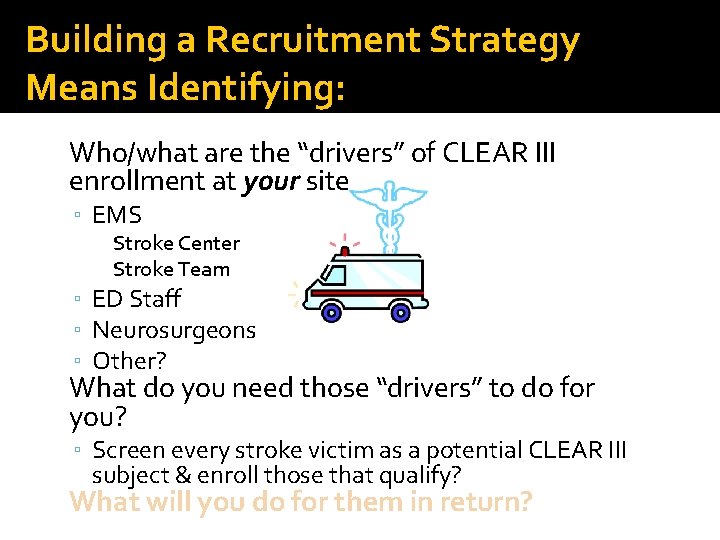
Building a Recruitment Strategy Means Identifying: • Who/what are the “drivers” of CLEAR III enrollment at your site ▫ EMS �Stroke Center �Stroke Team • ▫ ED Staff ▫ Neurosurgeons ▫ Other? What do you need those “drivers” to do for you? ▫ Screen every stroke victim as a potential CLEAR III • subject & enroll those that qualify? What will you do for them in return?
Keys to Social Marketing � Define your message Enroll to CLEAR III Be clear about the behavior you desire from your audience ▪ What is the end-goal or behavior change you need? ▪ Think “CLEAR III” for every patient with ICH that rolls in the door? Behavior change involves: ▪ Awareness ▪ Evaluation and assessment of options ▪ Decision ▪ Post-decision assessment
Influencing Behavior: Change �Awareness Make sure your “drivers” are aware of the trial, reinforce this awareness regularly �Evaluation and Assessment of Options/Alternatives Know what you are competing with/for (other trials, other emergencies, opportunity costs, time, attention) �Decision Make it as easy as possible to select CLEAR III from amongst these alternatives/competing obligations �Post-decision assessment Make sure your “driver” is satisfied with his/her decision
Influencing Behavior: Motivation � Getting someone to do what you want them to do usually requires giving them something in return What benefits are valued by your audience (“drivers”) ▪ ▪ Welfare of the subject, quality of care administered Advancing the science Recognition of effort/contribution Others? Redefine your product (protocol) and messages to align with the values that are important to your audience* ▪ Show participation helps your audience reach who they aspire to be**
Competition �What is CLEAR III competing with? Other studies Other obligations Other patients Busy shift in the ED Opportunity costs Human biases (they’re there, they’re normal, don’t ignore them) �What is CLEAR III competing for? Time Attention, focus Post-decision satisfaction
Marketing Mix �Your strategy should incorporate a range of tactics and approaches that address all of the following variables: Product – the value to subjects/science of the trial itself Price – the opportunity costs of referring/enrolling a patient Place – the quality of the environment/care the patient will receive Promotion – activities to improve/maintain an adequate level of awareness of the study amongst all of the drivers
Specific Strategies to Keep Your Drivers Engaged � In-services, reminders, recognition, rewards � Promotional products Logo or Tagline buttons: Clever, engaging, create/motivate a call to action ▪ “Are we CLEAR? ” or “I’m Getting CLEAR Today” or “Let’s Get CLEAR about ICH” or “Help Us CLEAR Things Up About ICH” Stethoscope “timers”, penlights, useful stuff � Flyers/Posters in visible (& unusual) locations � Easily accessible study coordinator contact info Ensure the study coordinator is notified every time a stroke patient is en route � Web 2. 0 applications Put a 2 D barcode or QR tag on your print media
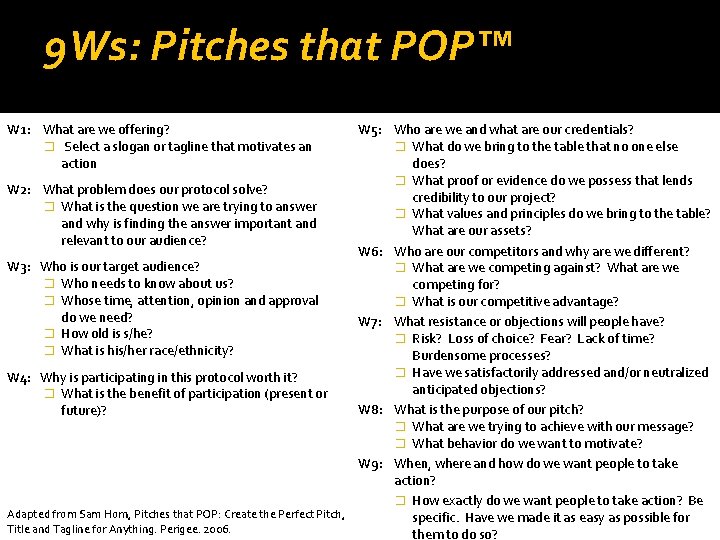
9 Ws: Pitches that POP™ W 1: What are we offering? � Select a slogan or tagline that motivates an action W 5: Who are we and what are our credentials? � What do we bring to the table that no one else does? � What proof or evidence do we possess that lends W 2: What problem does our protocol solve? credibility to our project? � What is the question we are trying to answer � What values and principles do we bring to the table? and why is finding the answer important and What are our assets? relevant to our audience? W 6: Who are our competitors and why are we different? W 3: Who is our target audience? � What are we competing against? What are we � Who needs to know about us? competing for? � Whose time, attention, opinion and approval � What is our competitive advantage? do we need? W 7: What resistance or objections will people have? � How old is s/he? � Risk? Loss of choice? Fear? Lack of time? � What is his/her race/ethnicity? Burdensome processes? � Have we satisfactorily addressed and/or neutralized W 4: Why is participating in this protocol worth it? anticipated objections? � What is the benefit of participation (present or W 8: What is the purpose of our pitch? future)? � What are we trying to achieve with our message? � What behavior do we want to motivate? W 9: When, where and how do we want people to take action? � How exactly do we want people to take action? Be Adapted from Sam Horn, Pitches that POP: Create the Perfect Pitch, specific. Have we made it as easy as possible for Title and Tagline for Anything. Perigee. 2006. them to do so?
Using Social Media to Amplify Your Message Harness instant communication tools to engage your drivers: share study info, updates, new data �Push your message out: Forums, Twitter, Mobile App, You. Tube, email reminders, text messages Everyone has a smart phone The world is no longer a stage, it’s a movie set, so start filming! Pre-educate your audience �Pull your “drivers” in Website, Facebook, Linked. In, My. Space, Friendster, Sermo, Social. MD, Ozmosis, etc.
Cognitive Dissonance Get your audience/influencers to “publicly “ (e. g. online, in a forum, in a Tweet, etc) commit to enrolling Public commitment incentivizes them to re- commit to that “behavior” in order to avoid the stress associated with acting in a manner that conflicts with their stated beliefs/actions
Find the Right Mix �Your campaign will only be successful if you are thoughtful and judicious about how you employ it. Don’t overuse a tactic (e. g. text messages) to the point where you’re ignored Figure out a good “mix” of methods to engage your audience Use your key thought and opinion leaders as “tweeters, ” “bloggers, ” or “forum discussion moderators”
K. I. S. S. Time is a precious commodity for your “drivers” and your “players” Don’t forget what you’re competing with/for Keep your tools easy to use in real-time Keep your messages simple, targeted, focused, strategic, relevant
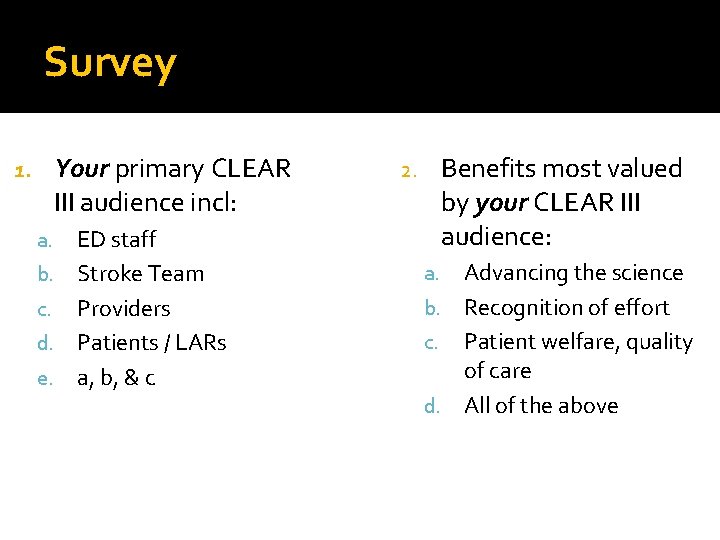
Survey Your primary CLEAR III audience incl: 1. ED staff b. Stroke Team c. Providers d. Patients / LARs e. a, b, & c Benefits most valued by your CLEAR III audience: 2. a. Advancing the science b. Recognition of effort c. Patient welfare, quality of care d. All of the above a.
Thank You!
Resources: Jamie. Roberts@NIH. gov References 1. Andreason, A. (1995). Marketing social change: changing behavior to promote health, social development and the environment. San Francisco: Jossey-Bass 2. Fox, S. , & Jones, S. (2009). The Social Life of Health Information. Washington, DC: Pew Research Center. Accessed May 31, 2011 at http: //www. pewinternet. org/reports/2009/8 -The-Social-Life-of. Health-Information. aspx. 3. French, J. Blair-Stevens, C. , Mc. Vey, D. , & Merritt, R. (2010). Social Marketing and Public Health. New York: Oxford University Press. 4. Goldberg, M. , Fishbein, M. , & Middlestadt, S. , eds. (1997). Social marketing: theoretical and practical perspectives. Mahwah, NJ: Lawrence Erlbaum Associates, Inc. 5. Hughes, A. Using Social Media Platforms to Amplify Public Health Messages: An examination of tenets and best practices for communicating with key audiences. (2010, November). Ogilvy Washington and The Center for Social Impact Communication at Georgetown University. Accessed June 3, 2011 at http: //smexchange. ogilvypr. com/wpcontent/uploads/2010/11/OW_SM_White. Paper. pdf 6. Kaplan, T. (2010, January 20). The Role of Social Media in Clinical Trial Recruitment. Applied Clinical Trials Online. Accessed May 25, 2011 at http: //license. icopyright. net/user. view. Free. Use. act? fuid=MTMw. Mz. Q 0 NTM%3 D 7. Using Marketing Principles to Improve Clinical Trial Recruitment. (2004). Connections: News from the Alzheimer’s Disease Education and Referral (ADEAR) Center of the National Institute on Aging, NIH, DHHS. Volume 12, Number 1. 8. Lenhart, A. (2009). Adults and Social Network Websites. Washington, DC: Pew Research Center. Accessed May 31, 2011 at http: //www. pewinternet. org/reports/2009/Adults-and-Social-Network. Websites. aspx. 9. Jain, S. H. (2009). Practicing Medicine in the Age of Facebook. NEJM, 361, 649 -651. 10. Selzer, J. (2010, March). Engaging HCPs with Social Media. Slides presented at the Public Hearing on Promotion of FDA-Regulated Medical Products Using the Internet and Social Media Tools, Washington DC. Accessed May 31, 2011 at www. fda. gov 11. Siegel, M. & Donner, L. (1998). Marketing public health: strategies to promote social change. Gaithersburg, MD: Aspen Publishers.
References 13. Mc. Donald AM, Treweek S, Haleema S, et al. Using a business model approach and marketing techniques for 14. 15. 16. 17. 18. 19. 20. 21. 22. recruitment to clinical trials. Trials, 2011, 12: 74. Francis D, Roberts I, Elbourne DR, et al. Marketing and clinical trials: a case study. Trials 2007, 8: 37. Project Launch: Creating and Implementing a Communications Plan: A Step-by-Step Approach. http: //projectlaunch. promoteprevent. org/webfm_send/2048, Robert Wood Johnson Foundation: A New Way to Talk About the Social Determinants of Health http: //www. rwjf. org/files/research/vpmessageguide 20101029. pdf, The Health Communicator’s Social Medial Toolkit http: //www. cdc. gov/healthcommunication/Tools. Templates/Social. Media. Toolkit_BM. pdf, The Role of Social Media in Clinical Trial Recruitment http: //appliedclinicaltrialsonline. findpharma. com/appliedclinicaltrials/Online+Extras/The-Role-of-Social-Media-in. Clinical-Trial-Recruit/Article. Standard/Article/detail/652829 Quinn L, Berry A. The Nonprofit Social Media Decision Guide. Idealware. July 2010. http: //www. idealware. org/reports/nonprofit-social-media-decision-guide. Spilker B, Cramer J. (1992). Patient Recruitment in Clinical Trials. Raven Press Ltd Anderson DL. (2004). A Guide To Patient Recruitment and Retention, Jobson Medical Information. Getz K. (2007). The Gift of Participation: A Guide to Making Informed Decisions About Volunteering for a Clinical Trial. Jerian Publishing.
- Slides: 33