
Cleansing creams remove dirt from the skin by
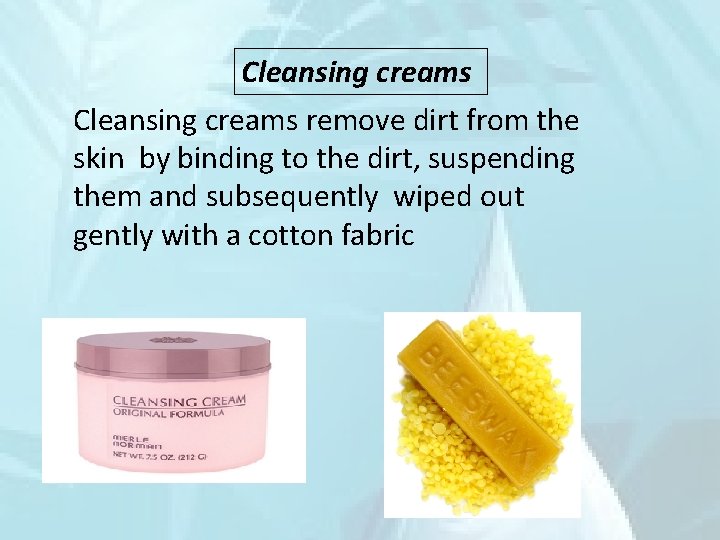
Cleansing creams remove dirt from the skin by binding to the dirt, suspending them and subsequently wiped out gently with a cotton fabric
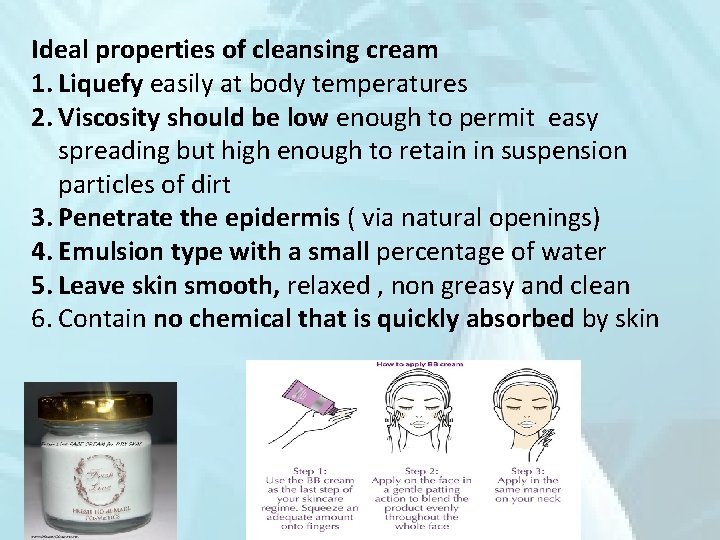
Ideal properties of cleansing cream 1. Liquefy easily at body temperatures 2. Viscosity should be low enough to permit easy spreading but high enough to retain in suspension particles of dirt 3. Penetrate the epidermis ( via natural openings) 4. Emulsion type with a small percentage of water 5. Leave skin smooth, relaxed , non greasy and clean 6. Contain no chemical that is quickly absorbed by skin
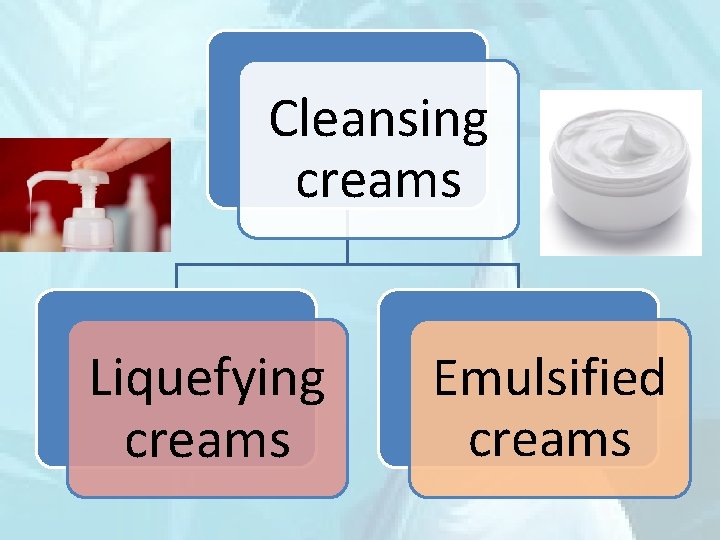
Cleansing creams Liquefying creams Emulsified creams
Liquefied creams Definition: Simple form in which components melted together till homogeneous and poured to set in containers 1. Product must be solid but must liquefy on application 2. Should not be too liquid to flow off the skin RAW MATERIALS REQUIRED: 1. Oily phase: mineral oil, vegetable oil, paraffin wax, stearic acid 2. Purified water: distilled or decomposed 3. Emulsifying agents: a. Non- ionic emulsifiers-spans and tweens( 2%) b. Triethanolamine stearate ( 2%) c. Lanolins ( 2%)
For acidic creams : 1. Glyceryl stearate 2. Cetyl alcohol 3. Sodium cetyl sulphate Thickeners a. waxes: beeswax, paraffin wax, ozokerite, cellulose derivatives like soidium alginate Detergents 1. Sodium cetyl alcohol Perfumes Preservatives Antioxidants
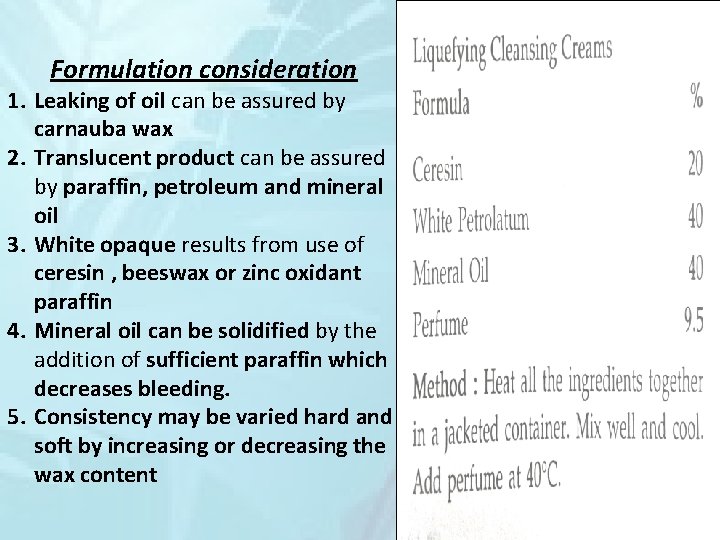
Formulation consideration 1. Leaking of oil can be assured by carnauba wax 2. Translucent product can be assured by paraffin, petroleum and mineral oil 3. White opaque results from use of ceresin , beeswax or zinc oxidant paraffin 4. Mineral oil can be solidified by the addition of sufficient paraffin which decreases bleeding. 5. Consistency may be varied hard and soft by increasing or decreasing the wax content
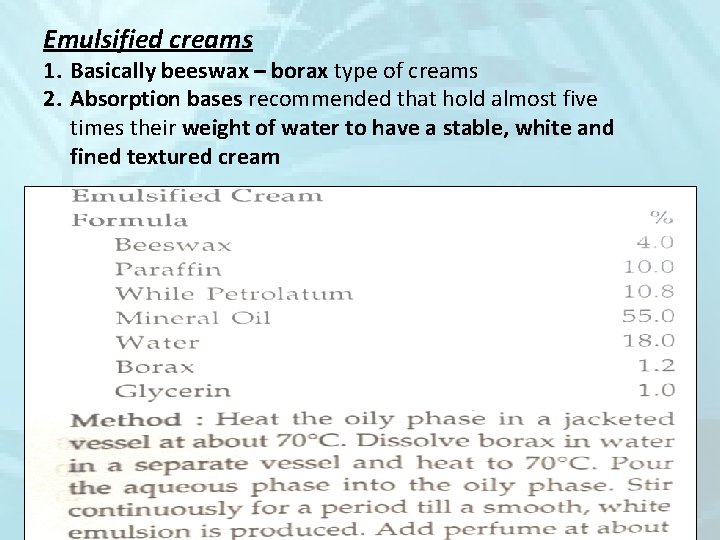
Emulsified creams 1. Basically beeswax – borax type of creams 2. Absorption bases recommended that hold almost five times their weight of water to have a stable, white and fined textured cream

VANISHING CREAM • • Cream that disappear, when rubbed on skin Also know as SNOW Oil in water emulsions Applied as foundation creams to hold face powder and improve adhesion

Ideal properties of vanishing creams 1. High melting point 2. Pure whiteness 3. Very little odor and low iodine number 4. Rubbed easily on the skin without rollon effect
Raw materials a. Stearic acid is the major component of vanishing cream- ( good quality triple pressed must be selected) 1. excess stearic acid, water and soap are basic constituents of stearate based creams 2. Soap formed in-situ by the reaction between a suitable alkali and stearic acid ( determines hardness of the cream) b. Humectants 1. Glycerin most favored followed by sorbitol and propylene glycol 2. Prevents excessive drying out of cream, due to o/w type product 3. Product of water, stearic acid and soap will roll badly when rubbed
c. Alkali 1. Potassium hydroxide , sodium hydroxide , potassium hydroxide, sodium carbonate, triethanolamine and borax 2. Potassium hydroxide is mostly used since makes a cream of fine texture without excessive harshness 3. Sodium or potassium hydroxide when used alone forms hard cream hence always in combination 4. Carbonates not favoured , liberates CO 2 and creams become spongy 5. Borax used in combination with potassium hydroxide or triethanolamine to form white emulsion

Stearic acid provides oil phase and 2030% of free acid neutralized by alkali Emulsifier as soap from KOH ( IN SITU ) VANISHING CREAM in which oil phase melts above body temp and crystallizes as invisible form to give a non greasy and shiny layer on skin

FORMULATION OF VANISHING CREAM • Ideal formula: Ingredients Quantity Category Oil Phase Stearic acid 20. 0 g Cetyl alcohol 0. 50 g Triethanolami. NE 1. 20 g Alkali Na. OH/KOH 0. 36 g Alkali Glycerine 8. 0 g Emollient Water 69. 94 g Vehicle Perfume q. s. Fragrance Preservative q. s. Antimicrobial Aqueous Phase
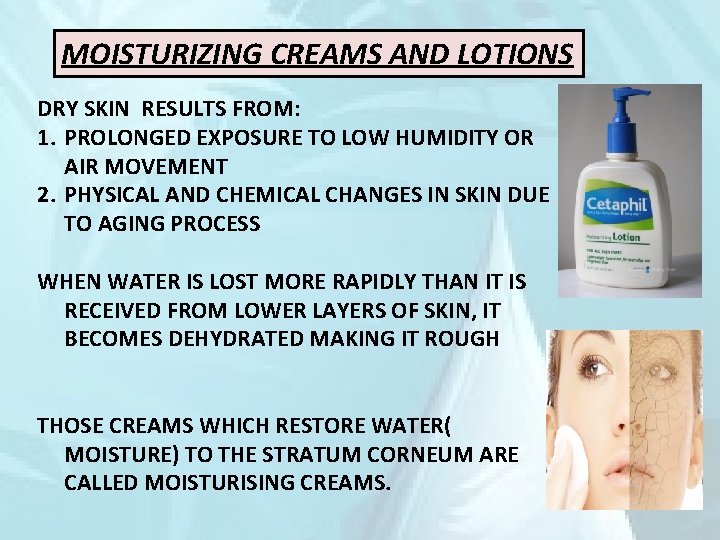
MOISTURIZING CREAMS AND LOTIONS DRY SKIN RESULTS FROM: 1. PROLONGED EXPOSURE TO LOW HUMIDITY OR AIR MOVEMENT 2. PHYSICAL AND CHEMICAL CHANGES IN SKIN DUE TO AGING PROCESS WHEN WATER IS LOST MORE RAPIDLY THAN IT IS RECEIVED FROM LOWER LAYERS OF SKIN, IT BECOMES DEHYDRATED MAKING IT ROUGH THOSE CREAMS WHICH RESTORE WATER( MOISTURE) TO THE STRATUM CORNEUM ARE CALLED MOISTURISING CREAMS.
APPROACH TO RESTORE WATER TO DRY SKIN 1. OCCLUSION 2. HUMECTANCY 3. RESTORATION OF DEFICIENT MATERIAL OCCLUSION RESULTS IN AN IMMEDIATE DECREASE IN THE RATE OF WATER LOSS THROUGH THE EPIDERMIS HUMECTANTS ATTRACTS MOISTURE TO THE SKIN FACILE ADDITION OF WATER TO SKIN DOES NOT SUFFICE TO PLASTICIZE IT AGING LEADS TO CHANGES IN LIPID COMPOSITION OF CELLULAR MEMBRANE. HENCE SUCH PRODUCTS SHOULD BE RICH IN PHOSPHOLIPIDS , AMINO ACIDS AND ESSENTIAL HORMONAL FACTORS
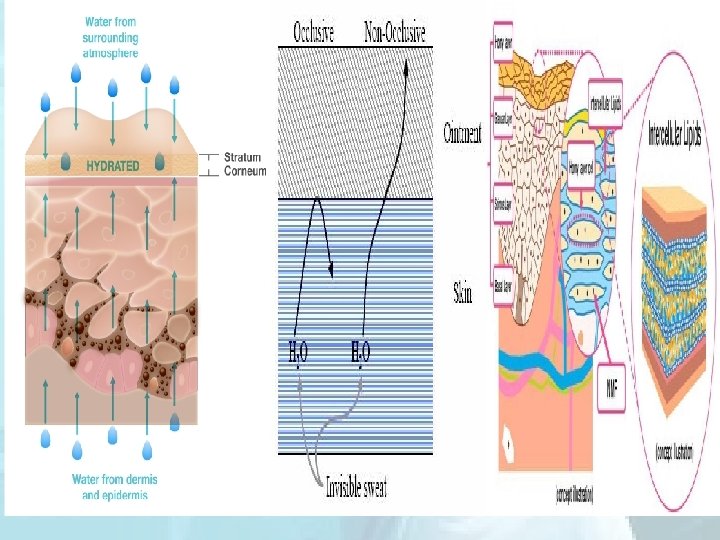
RAW MATERIALS COMPOUNDS PROVIDING OCCLUSION: NON PERMEABLE SUBSTANCES CAN BE USED MINERAL AND VEGETABLE OILS, LANOLINS AND SILICONES FILM FORMING AGENTS: ALBUMIN, GELATIN HUMECTANTS: GLYCEROL, ETHYLENE GLYCOL, PROPYLENE GLYCOL AND SORBITOL EMOLIENTS : IMPARTS SENSE OF WELL BEING TO THE SKIN BY CAUSING FLATTENING OF SURFACE CONTOURS Many humectants also have emollient properties, while not all emollients are humectants. The best moisturizers have a combination of emollients and humectants.

NATURAL MOISTURIZING FACTOR ( NMF ) THERE IS A NATURAL MOISTURIZING FACTOR IN THE SKIN WHICH IS REMOVED BY MEANS OF WATER AND DETERGENTS SOLUTIONS AND APPEARS TO BE AMINO LIPID NATURE E. G. UREA, PYRROLIDONE CARBOXYLIC ACID, AMMONIUM, URATES.
UREA USED IN SKIN CREAMS 1. UREA IS A COMPONENT OF HYDROLIPID EMULSION OF SKIN SURFACE 2. SAFELY USED BETWEEN CONCENTRATION 2 -8% 1. IN W/O EMULSIONS MOISTURIZING EFFECT DEVELOPS MORE SLOWLY BUT LASTS LONGER THAN OIL-IN – WATER EMULSIONS
ADVANTAGES : 1. UREA LACKS ANY SENSITIZING OR PHOTODYNAMIC ACTIVITIES 2. DOES NOT STAIN , COLORLESS AND ODORLESS 3. MOISTURIZING ACTION (GOOD BINDING CAPACITY) BINDS WATER BY INCLUDING IN ITS CRYSTAL STRUCTURE 4. DESQUAMATING ACTION 5. ANTIMICROBIAL ACTION 6. ENHANCE OF THE PENETRATION 7. ANTI-INFLAMMATORY ACTION
DISADVANTAGES: 1. DEGRADATION WITH PROGRESSIVE ALKANIZATION, DEVELOPMENT OF UNPLEASANT ODOUR OR RECRYSTALLIZATION MAKE UREA DIFFICULT TO INCORPORATE INTO STABLE PREPARATION 2. UREA IS TOLERATED DIFFRENTLY BY SLIGHTLY INFLAMMED, DAMAGES SKIN
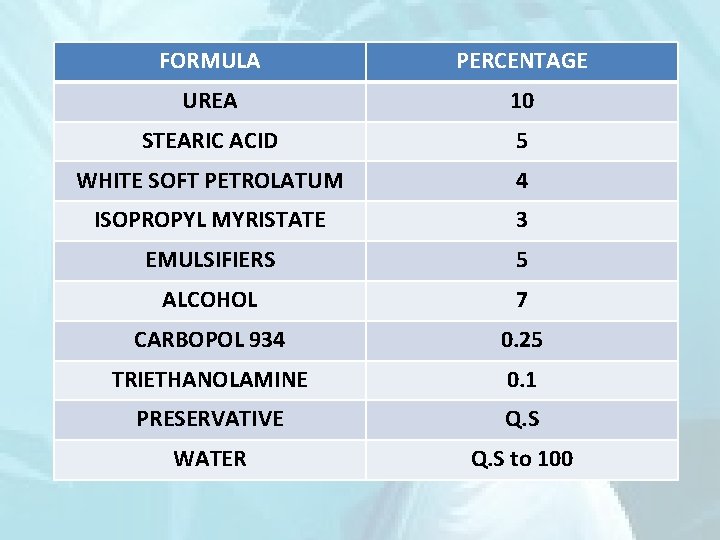
FORMULA PERCENTAGE UREA 10 STEARIC ACID 5 WHITE SOFT PETROLATUM 4 ISOPROPYL MYRISTATE 3 EMULSIFIERS 5 ALCOHOL 7 CARBOPOL 934 0. 25 TRIETHANOLAMINE 0. 1 PRESERVATIVE Q. S WATER Q. S to 100
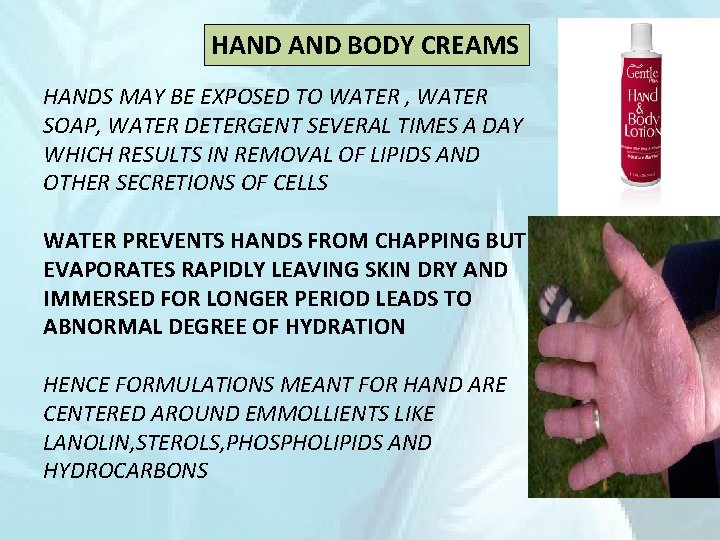
HAND BODY CREAMS HANDS MAY BE EXPOSED TO WATER , WATER SOAP, WATER DETERGENT SEVERAL TIMES A DAY WHICH RESULTS IN REMOVAL OF LIPIDS AND OTHER SECRETIONS OF CELLS WATER PREVENTS HANDS FROM CHAPPING BUT EVAPORATES RAPIDLY LEAVING SKIN DRY AND IMMERSED FOR LONGER PERIOD LEADS TO ABNORMAL DEGREE OF HYDRATION HENCE FORMULATIONS MEANT FOR HAND ARE CENTERED AROUND EMMOLLIENTS LIKE LANOLIN, STEROLS, PHOSPHOLIPIDS AND HYDROCARBONS
IDEAL PROPERTIES 1. SHOULD SOFTEN HANDS EASILY 2. SHOLD APPLY EASILY 3. SHOULD NOT LEAVE A TACKY FILM 4. NON INTERFERENCE WITH NORMAL PERSPIRATION OF SKIN 5. SHOULD HAVE PLEASANT SMELL 6. SHOULD HAVE AN APPEALING COLOUR.
FORMULATION OF HAND LOTIONS OFFER TWO PROBLEMS 1. LOTION EXHIBITS GELLING PROPERTY 2. VISCOSITY OF LOTION MAY BE LOW SO THAT IT RUN OUT OF CONTAINER STEARATE TYPE ARE MORE SUSCEPTIBLE TO GELATION AND SHEAR ACTION FORMULATION CONSIDERATIONS 1. EXCESSIVE POLYOL FATTY ACID ESTERS OR FATTY ALCOHOL SHOULD NOT BE USED IN HAND LOTIONS 2. DISPERSED WAX PHASE BE PLASTICIZED WITH MINERAL OIL 3. SMALL AMOUNTS OF SODIUM LAURYL SULPHATE BE INCORPORATED IN FORMULATION( 0. 1 -0. 5%)
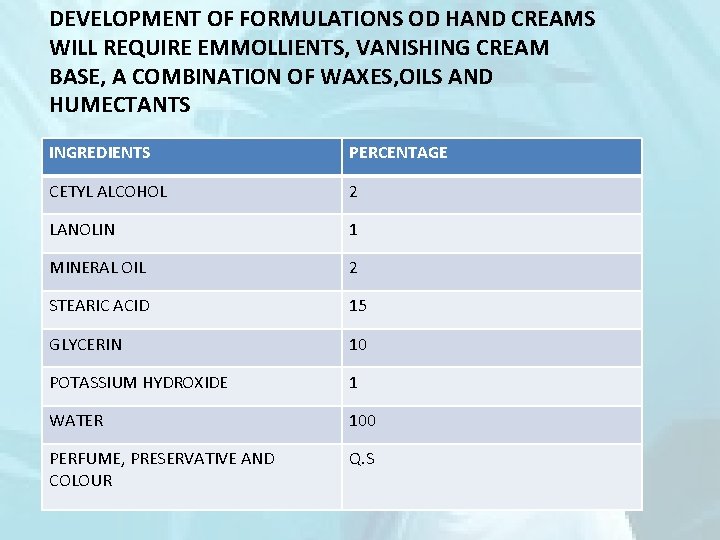
DEVELOPMENT OF FORMULATIONS OD HAND CREAMS WILL REQUIRE EMMOLLIENTS, VANISHING CREAM BASE, A COMBINATION OF WAXES, OILS AND HUMECTANTS INGREDIENTS PERCENTAGE CETYL ALCOHOL 2 LANOLIN 1 MINERAL OIL 2 STEARIC ACID 15 GLYCERIN 10 POTASSIUM HYDROXIDE 1 WATER 100 PERFUME, PRESERVATIVE AND COLOUR Q. S
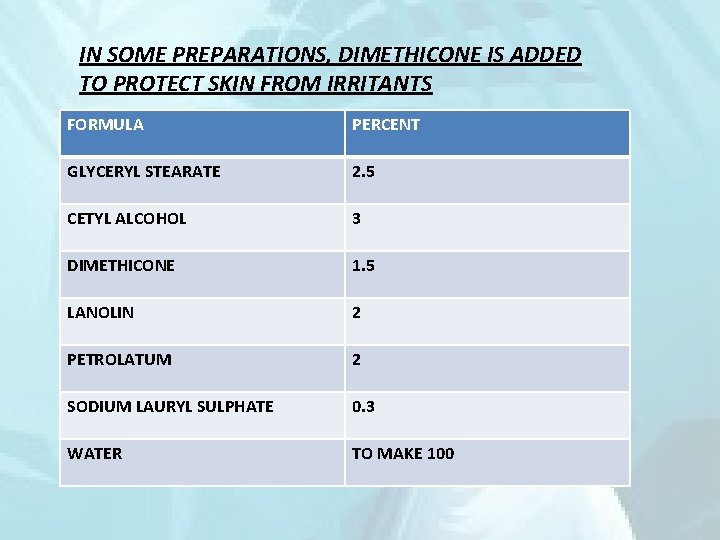
IN SOME PREPARATIONS, DIMETHICONE IS ADDED TO PROTECT SKIN FROM IRRITANTS FORMULA PERCENT GLYCERYL STEARATE 2. 5 CETYL ALCOHOL 3 DIMETHICONE 1. 5 LANOLIN 2 PETROLATUM 2 SODIUM LAURYL SULPHATE 0. 3 WATER TO MAKE 100
- Slides: 27