
Cleanrooms Testing and Monitoring Principles of Cleanroom Testing



- Slides: 59
Cleanrooms: Testing and Monitoring
Principles of Cleanroom Testing (pt. 1) • Quantity: – Turbulently: dilute--air volume (supply and extract) – Unidirectional: air velocity • Direction (flow direction): – from clean area less-clean areas to minimize the movement of contaminated air. • Quality: – the air will not add significantly to the contamination within the room • Distribution inside cleanroom – the air movement has no areas with high concentrations of contamination.
Principles of Cleanroom Testing (pt. 2) • Air supply and extract quantities – turbulently ventilated cleanrooms the air supply and extract volumes – unidirectional airflow air velocity. • Air movement control between areas: direction – The pressure differences between areas are correct. – The air direction through doorways, hatches, etc. is from clean to less-clean.
Principles of Cleanroom Testing (pt. 3) • Filter installation leak test – a damaged filter – between the filter and its housing or – any other part of the filter installation. • Containment leak testing – Contamination is not entering the cleanroom through its construction materials.
Principles of Cleanroom Testing (pt. 4) • Air movement control within the room – turbulently ventilated : check that there are no areas within the room with insufficient air movement. – unidirectional airflow : check that the air velocity and direction throughout the room is that specified in the design. • Airborne particles and microbial concentrations – final measurements of the concentration of particles and micro-organisms
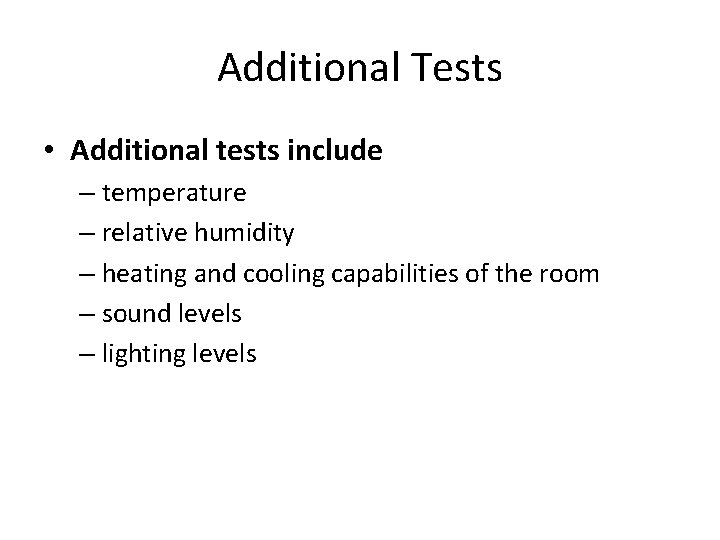
Additional Tests • Additional tests include – temperature – relative humidity – heating and cooling capabilities of the room – sound levels – lighting levels
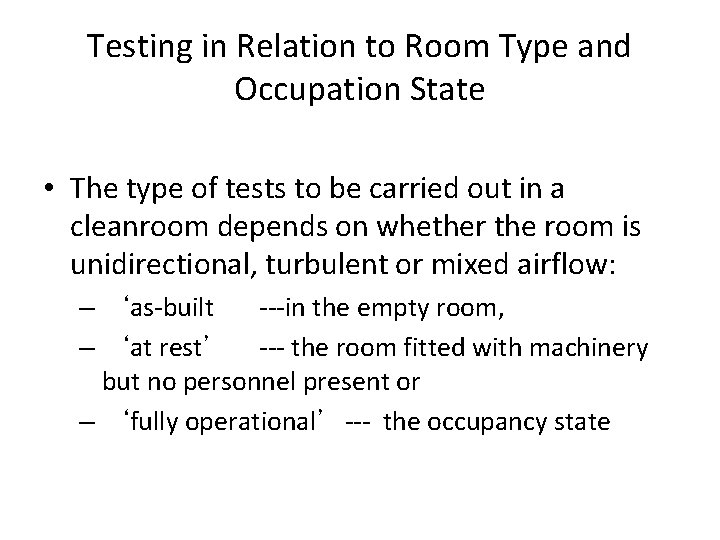
Testing in Relation to Room Type and Occupation State • The type of tests to be carried out in a cleanroom depends on whether the room is unidirectional, turbulent or mixed airflow: – ‘as-built ---in the empty room, – ‘at rest’ --- the room fitted with machinery but no personnel present or – ‘fully operational’--- the occupancy state
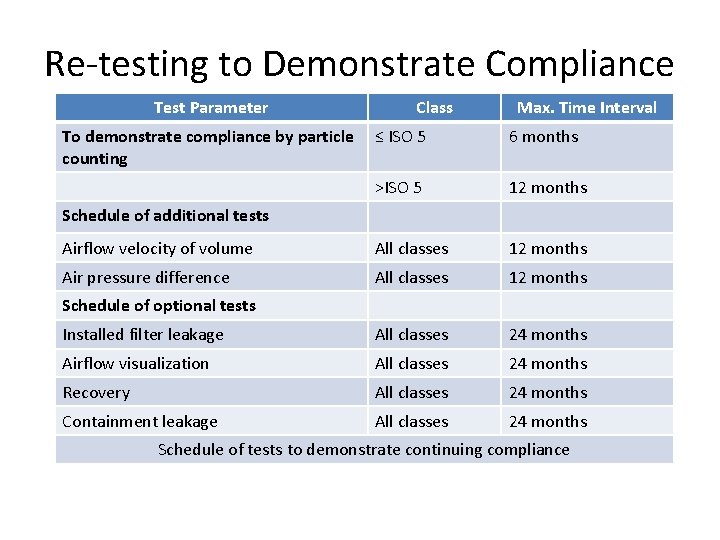
Re-testing to Demonstrate Compliance Test Parameter To demonstrate compliance by particle counting Class Max. Time Interval ≤ ISO 5 6 months >ISO 5 12 months Airflow velocity of volume All classes 12 months Air pressure difference All classes 12 months Installed filter leakage All classes 24 months Airflow visualization All classes 24 months Recovery All classes 24 months Containment leakage All classes 24 months Schedule of additional tests Schedule of optional tests Schedule of tests to demonstrate continuing compliance
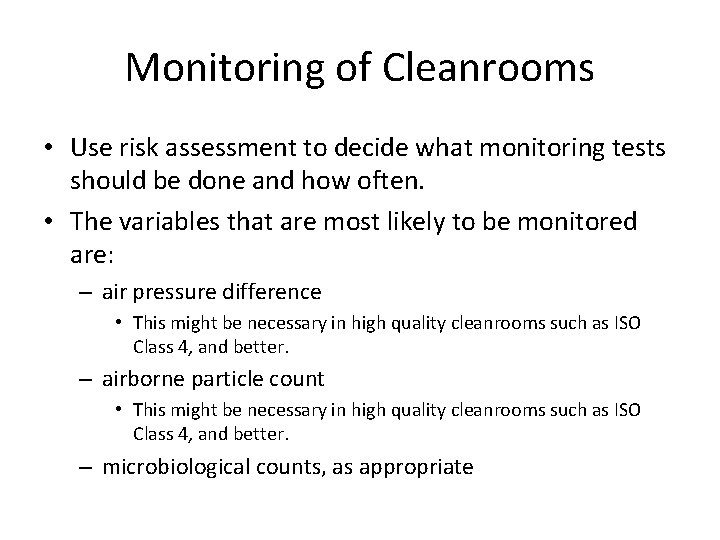
Monitoring of Cleanrooms • Use risk assessment to decide what monitoring tests should be done and how often. • The variables that are most likely to be monitored are: – air pressure difference • This might be necessary in high quality cleanrooms such as ISO Class 4, and better. – airborne particle count • This might be necessary in high quality cleanrooms such as ISO Class 4, and better. – microbiological counts, as appropriate
Measurement of Air Quantities and Pressure Differences
Purpose • A cleanroom must have sufficient clean air supplied to dilute and remove the airborne contamination generated within the room. • Air Cleanliness: – Turbulently ventilated cleanroom • air supply; the more air supplied in a given time, the cleaner the room. – unidirectional cleanroom • air supply velocity • Test: – Initial testing of the design – Regular intervals check
Measuring air quantities from within a cleanroom • Air air filter (no diffuser) anemometer at the filter face average velocity air volume – Difficulty: the non-uniformity of the air velocity inaccurate measurement • Air air diffusers unevenness of air velocities incorrect air volume • Hood: air supply volume average velocity measured at the exit of the hood air volume
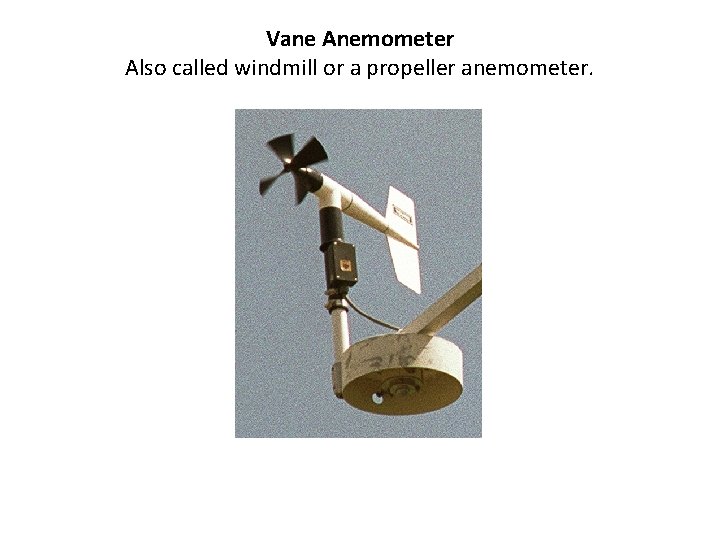
Anemometers • Anemometers: away from the filter of about 30 cm (12 inches) • Vane Anemometer – Principle: Air supply turning a vane frequency velocity – Accuracy: velocity is less than about 0. 2 m/s (40 ft/min), the mechanical friction affects the turning of the vane
Vane Anemometer Also called windmill or a propeller anemometer.
Differential Pressure Tests (pt. 1) • The units: – Pascals are used – 12 Pa = 0. 05 inch water gauge • Inch water column (inch WC) is a unit for pressure. • It is used for measuring small pressure differences across an orifice, or in a pipeline or shaft. Inches of water can be converted to a pressure unit using the formula for pressure head. • An inch of water column (iwc) is synonymous with an inch of water gauge (iwg). • It is defined as the pressure exerted by a column of water of 1 inch in height at defined conditions. • 1 iwg is approximately equal to 249 pascals at 0 °C.
Differential Pressure Tests (pt. 2) • The units: – Pascals are used – 12 Pa = 0. 05 inch water gauge • Pressure difference: 10 or 15 Pa between clean areas – 15 Pa is commonly used between a cleanroom and an unclassified room – 10 Pa between two cleanrooms.
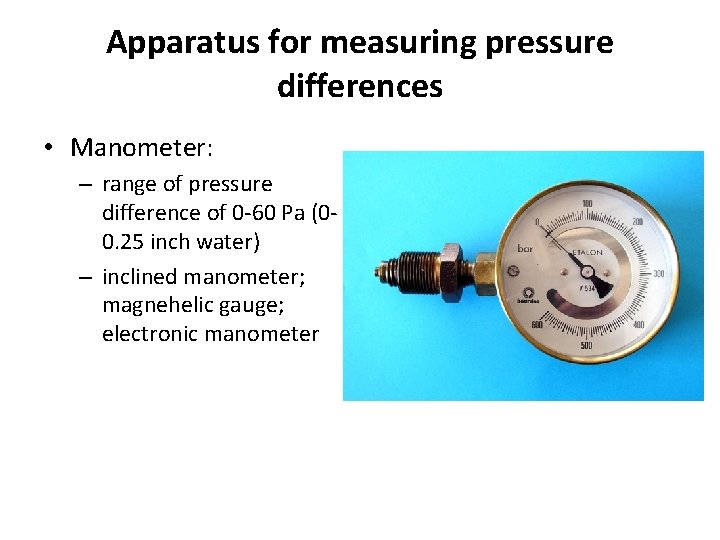
Apparatus for measuring pressure differences • Manometer: – range of pressure difference of 0 -60 Pa (00. 25 inch water) – inclined manometer; magnehelic gauge; electronic manometer
Air Movement Control Between and Within Cleanrooms
Purposes • To show that a cleanroom is working correctly, – it is necessary to demonstrate that no contamination infiltrates into the cleanroom from dirtier adjacent areas. • Cleanroom Containment Leak Testing – Airborne contamination: doors and hatches, holes and cracks in the walls, ceilings and other parts of the cleanroom fabric
Methods of checking infiltration • Smoke test (dust test) – flow direction: open door, or through the cracks around a closed door, cracks at the walls, ceiling, floor and filter housings, service ducts or conduits. • Difficulty – where the containment originates from may be unknown, and it is often difficult to find the places to release test smoke.
Air Movement Control within a Cleanroom • sufficient air movement – dilute, or remove airborne contamination prevent a build-up of contamination • turbulently ventilated cleanroom: – good mixing, critical areas: where the product is exposed to the risk of contamination • unidirectional flow cleanroom – critical areas should be supplied with air coming directly from the high efficiency filters. However, problems may be encountered because of: • heat rising from the machinery and disrupting the airflow • obstructions preventing the supply air getting to the critical area • obstructions, or the machinery shape, turning the unidirectional flow into turbulent flow • contamination being entrained into the clean air.
Air Movement in turbulently ventilated rooms • working well: quickly dispersed • not working well Areas: not disperse quickly contamination build up improved by adjusting the air supply diffuser blades, removing an obstruction, moving a machine.
Filter Installation Leak Testing
HEPA test • Manufacturer's factory and packed OK • Unpacked and fitted into the filter housings maybe damage • Leakage problems – casing – housing • Testing : artificial test aerosol
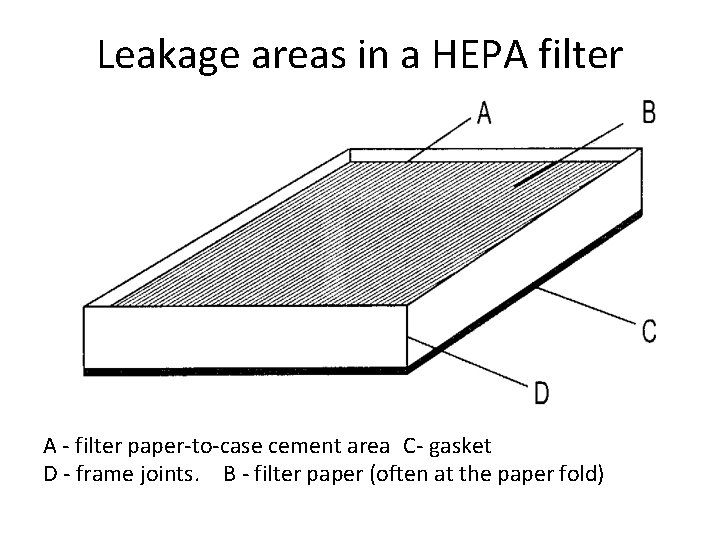
Leakage areas in a HEPA filter A - filter paper-to-case cement area C- gasket D - frame joints. B - filter paper (often at the paper fold)
Single Particle Counters Sample a volume of air and this is collected in a set time
Methods of Testing Filters and Filter Housings • Scanning methods – a probe with a photometer, or single particle counter, – Scan speed : not more than 5 cm/s – The most common leaks: • around the periphery of the filter • the casing-to-housing seal, • the casing joints
Repair of leaks • Filter media leak – at the fold of the paper – repaired on site with silicon • replaced
Cleanroom test • air supply volume, • pressure differences, • air movement within and between cleanrooms, • filter integrity • airborne particle concentration
Particle counter • Particle counter : – Both counts and sizes • Photometer : – Only mass of particles
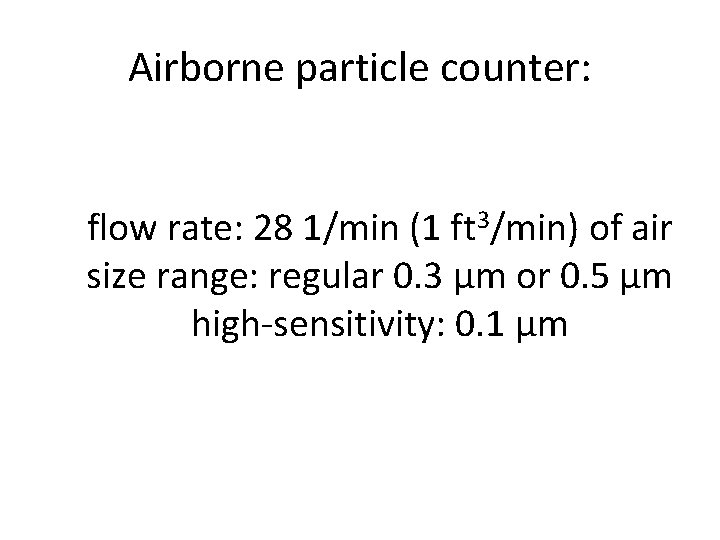
Airborne particle counter: flow rate: 28 1/min (1 ft 3/min) of air size range: regular 0. 3 μm or 0. 5 μm high-sensitivity: 0. 1 μm
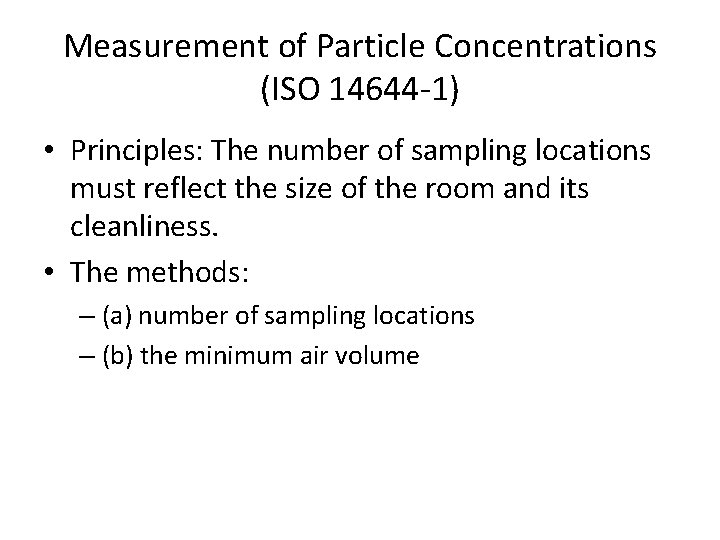
Measurement of Particle Concentrations (ISO 14644 -1) • Principles: The number of sampling locations must reflect the size of the room and its cleanliness. • The methods: – (a) number of sampling locations – (b) the minimum air volume
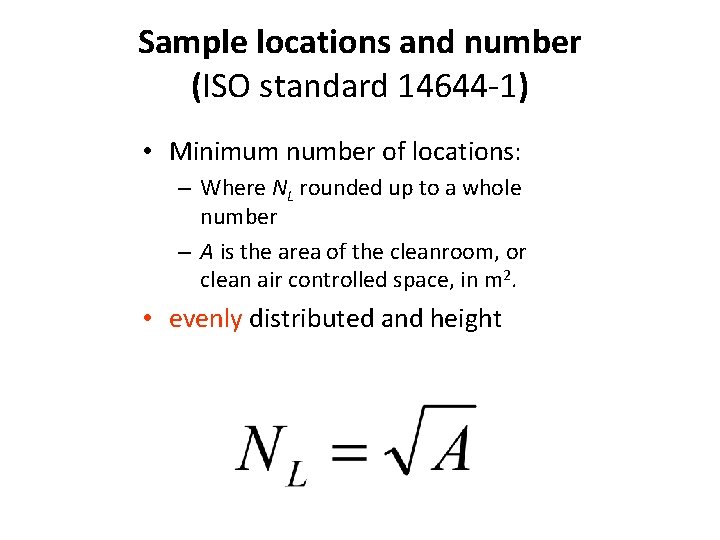
Sample locations and number (ISO standard 14644 -1) • Minimum number of locations: – Where NL rounded up to a whole number – A is the area of the cleanroom, or clean air controlled space, in m 2. • evenly distributed and height
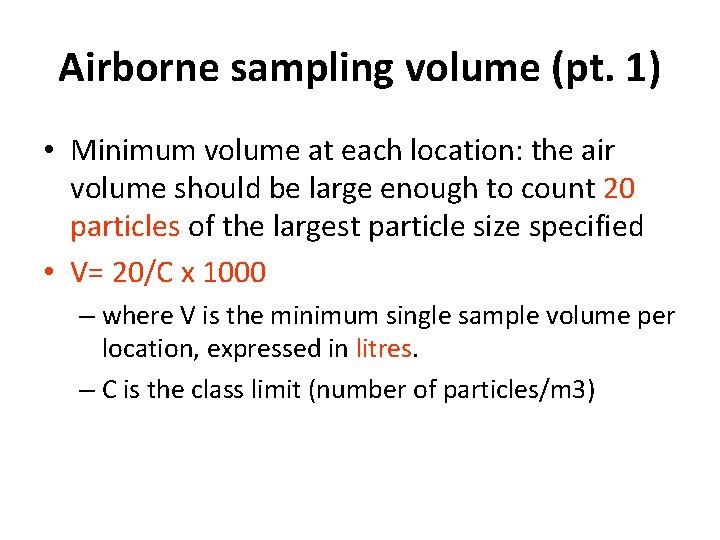
Airborne sampling volume (pt. 1) • Minimum volume at each location: the air volume should be large enough to count 20 particles of the largest particle size specified • V= 20/C x 1000 – where V is the minimum single sample volume per location, expressed in litres. – C is the class limit (number of particles/m 3)
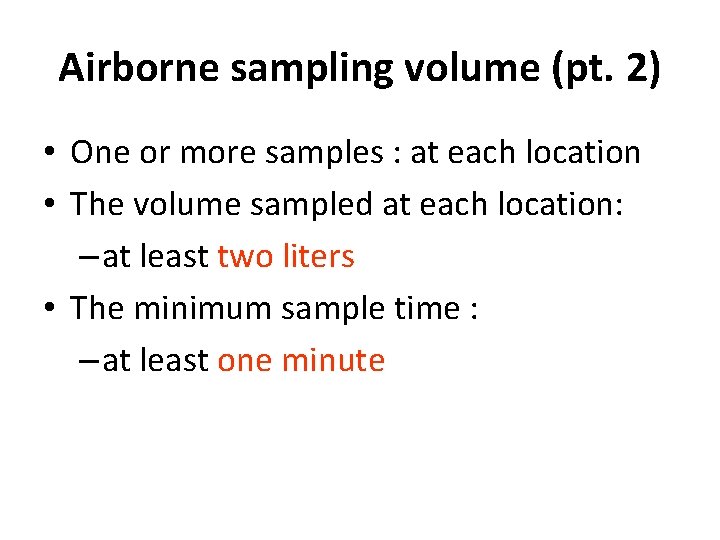
Airborne sampling volume (pt. 2) • One or more samples : at each location • The volume sampled at each location: – at least two liters • The minimum sample time : – at least one minute
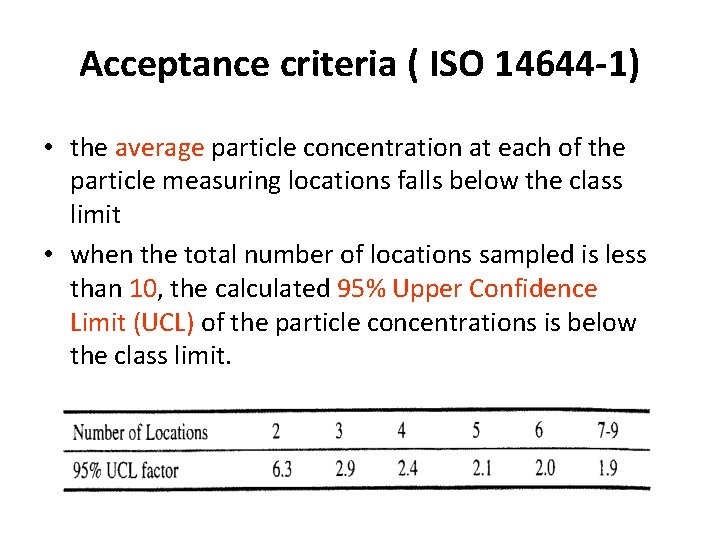
Acceptance criteria ( ISO 14644 -1) • the average particle concentration at each of the particle measuring locations falls below the class limit • when the total number of locations sampled is less than 10, the calculated 95% Upper Confidence Limit (UCL) of the particle concentrations is below the class limit.
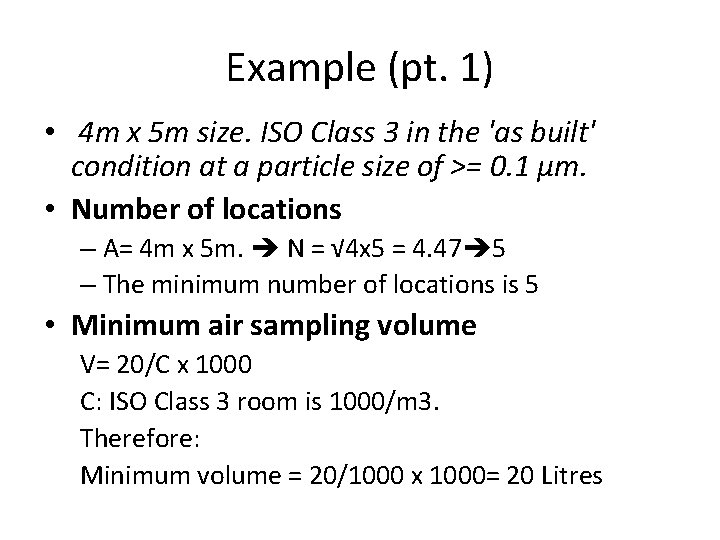
Example (pt. 1) • 4 m x 5 m size. ISO Class 3 in the 'as built' condition at a particle size of >= 0. 1 μm. • Number of locations – A= 4 m x 5 m. N = √ 4 x 5 = 4. 47 5 – The minimum number of locations is 5 • Minimum air sampling volume V= 20/C x 1000 C: ISO Class 3 room is 1000/m 3. Therefore: Minimum volume = 20/1000 x 1000= 20 Litres
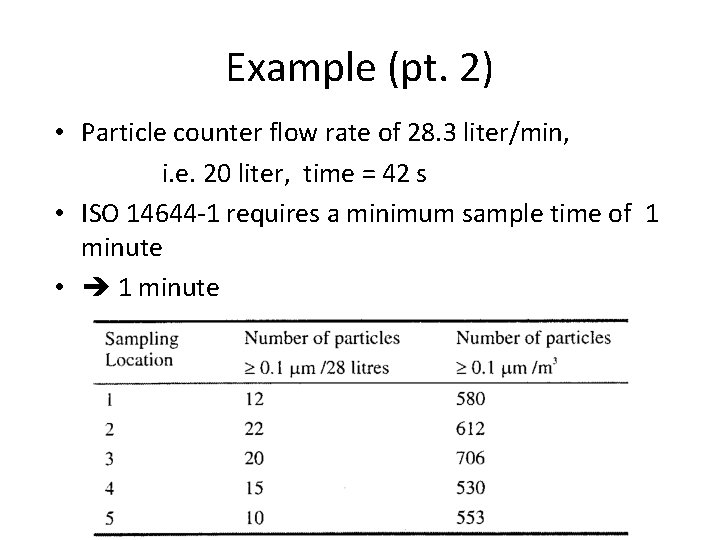
Example (pt. 2) • Particle counter flow rate of 28. 3 liter/min, i. e. 20 liter, time = 42 s • ISO 14644 -1 requires a minimum sample time of 1 minute • 1 minute
Example (pt. 3) • first part of the ISO requirement is therefore satisfied(<1000). OK • As less than nine samples were taken 95% UCL does not exceeded the class limit. ? ? ?
Microbial Counts • People are normally the only source of microorganisms in a cleanroom • as built/ at rest little value • Operational: micro-organisms are continually dispersed from people in the room.
Microbial Sampling of the Air • Volumetric air sampler • Settle plate sampling
Volumetric air samplers • a given volume of air is sampled; also known as 'active' sampling. • impact micro-organisms onto agar media; • remove micro-organisms by membrane filtration.
Agar • Agar: jelly-type material with nutrients added to support microbial growth. • Micro-organisms landing temperature, time colony (millimetres diameter)
Settle plate sampling • where micro-organisms are deposited, mainly by gravity, onto an agar plate. • Impaction onto agar: – inertial impaction – centrifugal forces. • Time and Temperature to grow • Bacteria : 48 hours at 30° C to 35° C; • Fungi: 72 hours at 20° C to 25° C
Centrifugal air samplers • Air rotating vane centrifugal force agar surface
Membrane filtration • A membrane filter is mounted in a holder vacuum draw air microbe-carrying will be filtered out by membrane The membrane placed an agar plate • A membrane filter with a grid printed on the surface will assist in counting the microorganisms.
Settle plate sampling • micro-organisms skin particles 10 to 30μm by gravity onto surfaces at an average rate of about 1 cm/s • Settle plate sampling: Petri dishes (diameter: 90 mm) containing agar medium opened and exposed time (4~5 hours) particles to deposit Petri dishes
Microbial Surface Sampling • contact sampling • swabbing
Contact Surface sampling • Surface (flat) • RODAC (Replicate Organisms Detection and Counting) dishes are used • The agar is rolled over the cleanroom surface Micro-organisms stick to the agar • incubated time and temperature • micro-organisms grow & counted.
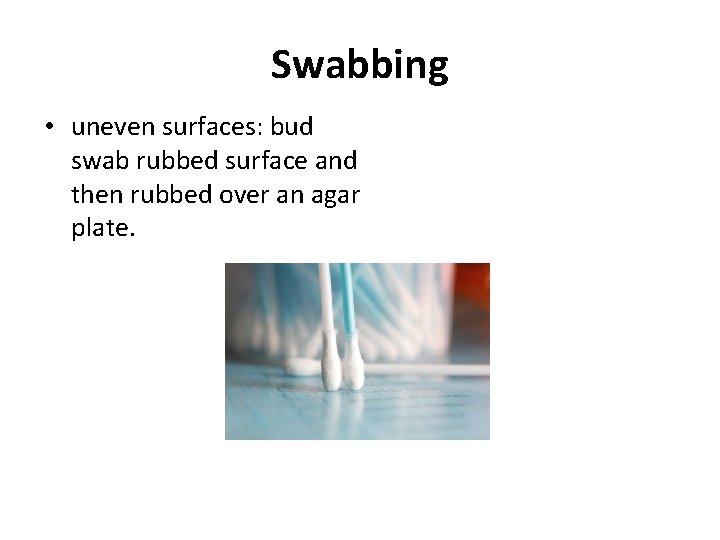
Swabbing • uneven surfaces: bud swab rubbed surface and then rubbed over an agar plate.
Operating a Cleanroom: Contamination Control Purpose • Considering the sources and routes of contamination within a cleanroom and how to control these.
Hazard Analysis and Critical Control Point (HACCP) System (pt. 1) • HACCP has a seven-step approach: – Identify the sources of contamination in the cleanroom. – Assess the importance of these sources – Identify methods that can be used to control these hazards. – Determine valid sampling methods to monitor either the hazards, or their control methods, or both.
Hazard Analysis and Critical Control Point (HACCP) System (pt. 2) – Establish a monitoring schedule with 'alert' and 'action' levels • Establish a monitoring schedule with 'alert' and 'action' levels – Verify that the contamination control system is working effectively by reviewing the product rejection rate, sampling results and control methods and, where appropriate, modifying them. – Establish and maintain appropriate documentation.
Identification of Sources and Routes of Contamination • Sources of contamination – – – – – dirty areas adjacent to the cleanroom; unfiltered air supply; room air; surfaces; people; machines, as they work; raw materials; containers; packaging.
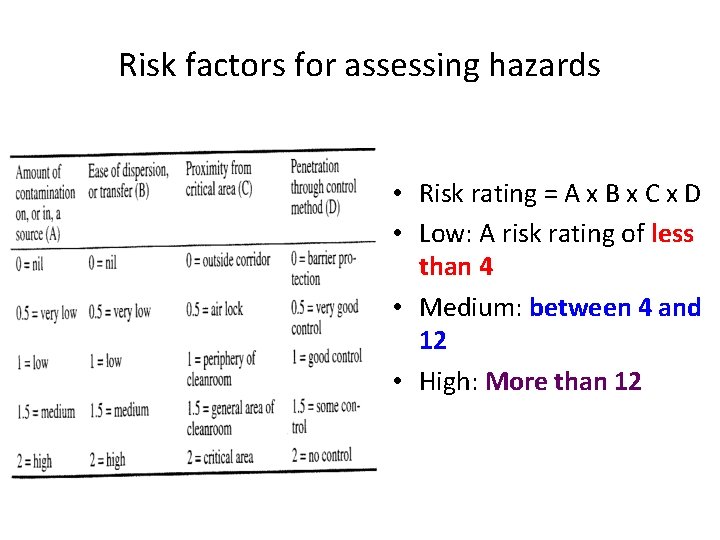
Assessment of the Importance of Hazards • Possible sources of contamination routes of transmission risk assessment • Risk factors: – risk factor A: the amount of contamination on, or in, the source that is available for transfer – risk factor B: the ease by which the contamination is dispersed or transferred – risk factor C: the proximity of the source to the critical point where the product is exposed – risk factor D: how easily the contamination can pass through the control method
Risk factors for assessing hazards • Risk rating = A x B x C x D • Low: A risk rating of less than 4 • Medium: between 4 and 12 • High: More than 12
Documentation • An effective contamination control system will document • (1) the methods described in the preceding steps of this chapter, • (2) the monitoring procedures, and • (3) results from the monitoring. • Regular reports should be issued of an analysis of the monitoring results and any deviations from the expected results. •
Entry and Exit of Personnel Besides Cleanroom Discipline • Skin and clothing: millions of particles and thousands of microbe-carrying particles • Features of cleanroom clothing: – not break up and lint: disperse the minimum of fibres and particles – filter: against particles dispersed from the person's skin and their clothing.
Prior to Arriving at the Cleanroom • Frequency of bathe or shower: • remove the natural skin oils; • dispersion of skin and skin bacteria; • dry skin may wish to use a skin lotion • What clothing is best worn below cleanroom garments? • Artificial fibres: polyester are better than those made from wool and cotton • Close-woven fabrics: more effective in filtering and controlling the particles and microbe-carrying particles • Cosmetics, hair spray, nail varnish removed rings, watches and valuables removed and stored