
Cleanroom Best Practice Disinfectant Rotation and Residue Removal
Cleanroom Best Practice: Disinfectant Rotation and Residue Removal ISPE Ca. SA 2018 Case Study: Introduction of Detergents in Disinfectant Program 1/
Introduction Aaron Mertens • Technical Service Specialist • STERIS Corporation | Life Sciences • Mobile: 440 -530 -0060 • E-Mail: Aaron_Mertens@steris. com • Web: www. sterislifesciences. com STERIS Technical Services Copyright © 2017 STERIS Corporations. All Rights Reserved. 2/
Introduction Angela Swain • QA Manager • Patheon Manufacturing Services, LLC • Phone: 252 -707 -2219 • E-Mail: Angela. Swain@patheon. com 3 | CONFIDENTIAL © 2015 PATHEON®
Cleanroom Best Practice: Disinfectant Rotation and Residue Removal in the Cleanroom To provide an overview of recommended practices for disinfectant use and residue removal in the cleanroom environment. Copyright © 2017 STERIS Corporations. All Rights Reserved. 4/
Case Study: Introduction of Detergents in Disinfection Program To demonstrate the advantages of routinely using detergents to enhance the cleaning and disinfection program. 5 | CONFIDENTIAL © 2015 PATHEON®
“Disinfectants” - Background 6/

EPA Classification Three antimicrobial groups: Sanitizer Disinfectant Sterilant Copyright © 2017 STERIS Corporations. All Rights Reserved. 7/
Sanitizer • Reduces but does not necessarily eliminate all microorganisms on a surface. • Minimum 99. 9% reduction of each test organism. • Used on pre-cleaned surfaces Copyright © 2017 STERIS Corporations. All Rights Reserved. 8/
Disinfectant • Kill or inactivate disease producing microorganisms on inanimate objects • Proper use results in 100% kill of vegetative bacteria, target viruses and target fungi • 4 Log reduction of bacteria • 3 Log reduction of viruses • 6 Log reduction of fungi • May or may not require pre-cleaning Copyright © 2017 STERIS Corporations. All Rights Reserved. 9/
Sterilant • Proper use results in 100% kill of all microorganisms, including bacterial spores (B. subtilis, C. sporogenes) • 6 -7 Log reduction • Always requires precleaning Copyright © 2017 STERIS Corporations. All Rights Reserved. 10/
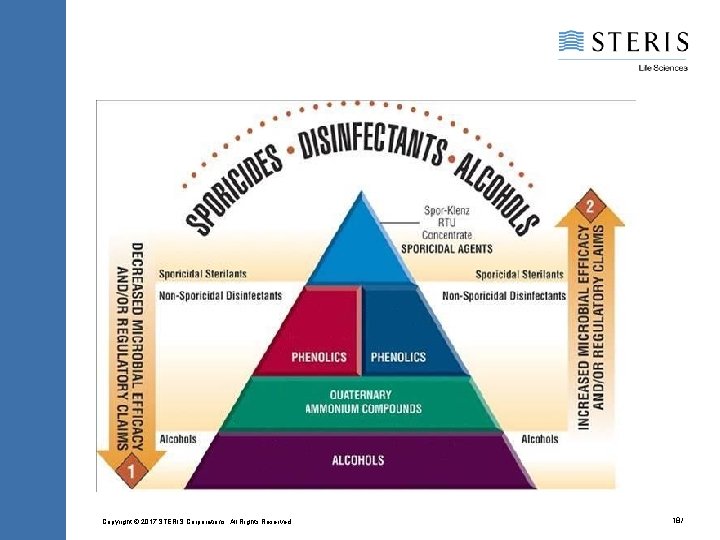
Chemical Types Alcohols Phenolics Quaternary Ammonium Chloride Compounds Peracetic acid / Hydrogen peroxide blends Sodium hypochlorite Chlorine dioxide Hydrogen peroxide Peracetic acid Ozone Biguanides Iodine Products Glutaraldehyde / Formaldehyde Sodium Hydroxide Alcohols Phenolics Quaternary Ammonium Chloride Compounds Peracetic Acid / Hydrogen Peroxide Blends Copyright © 2017 STERIS Corporations. All Rights Reserved. 11/
Disinfectant Rotation 12/
Why do we rotate? Rotation of a disinfectant and a sporicide helps ensure bacterial spores do not take hold in manufacturing and aseptic areas. Regulatory expectations (FDA, MHRA, EU) USP 38 <1072>, PDA Technical Report Copyright © 2017 STERIS Corporations. All Rights Reserved. 13/
PDA Technical Report No. 70 “All rotation systems should be evaluated via the use of area classification, environmental monitoring data, and/or risk assessment. ” Section 10, 11 Pages 36 and 38 Copyright © 2017 STERIS Corporations. All Rights Reserved. 14/
Rotation Guidance • PDA TR 70 – “Given this knowledge, the pharmaceutical and biotechnology industries have moved away from the rotation of two disinfecting agents. This formerly common practice led to high residue levels and subordinate efficacy performance. Today most firms use a system whereby a disinfectant is rotated with a sporicide to more effectively reduce the bioburden levels. The rotation of a disinfectant with a sporicide is superior to the use of rotations of multiple disinfectants. ” Copyright © 2017 STERIS Corporations. All Rights Reserved. 15/

What is rotation? • Alternation of antimicrobial actives • Two disinfectants in sequence, regular rotation, with sterilant as needed • One disinfectant daily, with sterilant weekly, monthly, or quarterly or as needed Copyright © 2017 STERIS Corporations. All Rights Reserved. 16/
Sterilant Application Frequency Rationale • Spore control vs. chemical exposure • Corrosivity and Irritation Sporicidal agent • Rationale (environmental monitoring) • Weekly, monthly, quarterly • Should be specified in SOP’s Copyright © 2017 STERIS Corporations. All Rights Reserved. 17/
Copyright © 2017 STERIS Corporations. All Rights Reserved. 18/

Residue Removal 19/
Residue Removal Maintain surfaces in the cleanroom by periodically removing residue from the surfaces. The presence of residue may: • impact disinfectant effectiveness • hide microbial contamination • contaminate environment and/or product • be an aesthetic issue • create a particulate issue Copyright © 2017 STERIS Corporations. All Rights Reserved. 20/
Residue Removal Strategy Where does the residue come from? • Product, process residue • Sanitizers, disinfectants, sporicides Existing cleanrooms that may have never had a rinsing program Implementing a rinsing program in a new cleanroom environment Addition of a detergent to enhance the disinfection program Copyright © 2017 STERIS Corporations. All Rights Reserved. 21/
PDA TR No. 70 “Irregular or porous surfaces trap residues and other contaminants and make the surface more difficult to clean and disinfect. Development of appropriate cleaning systems is critical to successfully preparing a surface for disinfection. Cleaning operations should routinely occur and frequencies should be based on area classification, usage, risk and visible cleanliness. A good cleaning agent is formulated to contain an effective surfactant system that will support the water in its efforts to release particles, residues and other foreign materials. Procedurally, strict cleaning (without the use of a sanitizer, disinfectant or sporicide) should be conducted on a routine basis as defined by written procedures. ” Copyright © 2017 STERIS Corporations. All Rights Reserved. 22/
Rinsing Frequency Guidance USP 39 <1072> • 70% IPA or Water for Injection • Detergents (Acidic, Neutral, Basic) • As needed to control residue – Aesthetic – Safety Risk (Sticky, Tacky, Slippery) – Particulate Issues – Functional – Microbial Issue (Hiding Microbes & Food Sources) – Product risk (Flaking of residues into filled products) Copyright © 2017 STERIS Corporations. All Rights Reserved. 23/
Recommendations Routine Residue Removal – Water For Injection – 70% Isopropanol, 70% Ethanol – 3% H 2 O 2 – Detergents Copyright © 2017 STERIS Corporations. All Rights Reserved. 24/
Contamination Control Program Recommendation Rotation: Disinfectant and Sterilant Program • Disinfectant - Phenol or Quat • Sporicide • Frequency established using risk based approach and adjusted based on environmental trending data Residue Removal Program: • WFI or 70% Alcohol on a routine basis • Detergent to enhance disinfectant program • Frequency based on surface aesthetics Copyright © 2017 STERIS Corporations. All Rights Reserved. 25/
Best Practice Conclusion 26/
Resources Disinfectant Rotation: • Technical Tip 420 -200 -4002, “A Rational Approach to Alternating (Rotating) Disinfectants in Pharmaceutical, Biotech and Medical Device Cleanrooms” Residue Removal: • Technical Tip 420 -200 -4038, “Residue Removal Recommendations for Hard. Surface Germicidal Agents used in Critical Environments” • Case History 420 -500 -4001, “Cleaning Floors in Cleanrooms with Pro. Klenz Np. H Neutral Detergent” General Disinfection: • Technical Tip 420 -200 -4001, “Product Property Charts for STERIS Sanitizers/Disinfectants and Sterilants” • Technical Tip 420 -200 -4014, “Disinfectant Application Guidelines for Cleanrooms and Controlled Environments” • Technical Tip 420 -200 -4021, “Survey of Disinfectant Usage in Parenteral Facilities” Copyright © 2017 STERIS Corporations. All Rights Reserved. 27/
References • USP 39 <1072> Disinfectants and Antiseptics • PDA Cleaning and Disinfection TR No. 70 (2015) • Annex 1 (2008) and MHRA Orange Guide (2016) • FDA Aseptic Processing Guide (2004) • FDA, MHRA, HPRA, CFDA, ANSM, ANVISA, & EMA Expectations • Industry Articles (Ex. Scott Sutton, Jose Martinez, Richard Prince, Rebecca Smith, Tim Sandle) • The CDC Handbook - A Guide to Cleaning & Disinfecting Cleanrooms (Tim Sandle 2016) • A Guide to Disinfectants and their use in the Pharmaceutical Industry (Pharmig 2006) • USP 39 <1116> Microbiological Control and Monitoring of Aseptic Processing Environments • PIC/S Guide to Good Practices for the Preparation of Medicinal Products in Healthcare Establishments (2014) • WHO Annex 6 • PHSS Technical Monograph #20 “Bio-contamination characterization, control, monitoring and deviation management in controlled/GMP classified areas • USP 39 <797> Pharmaceutical Compounding-Sterile Preparations Copyright © 2017 STERIS Corporations. All Rights Reserved. 28/
Thank you! • Audience • ISPE Ca. SA Chapter • Angela Swain - Patheon 29/
PATHEON CASE STUDY Introduction of Detergents in Disinfectant Program A HEALTHIER WORLD. DELIVERED © 2015 PATHEON®
Why Use Detergents in an Environmental Cleaning Program? • Clean surfaces to remove: - product - protein - residue - etc. • Increases efficacy of disinfectant solutions 31 | CONFIDENTIAL © 2015 PATHEON®
How Detergents increase the efficacy of Disinfectants? Contains a surfactant and may have oxidizing agents or other performance-enhancing ingredients • Surfactants (Surface Active Agents) are chemicals, when dissolved, orient themselves at the interface between the liquid and a solid (residue) and modify the properties of the interface; thereby reducing the surface tension to allow removal 32 | CONFIDENTIAL © 2015 PATHEON®
Change Control initiated to introduce cleaning agents and cleaning materials to the Greenville Sterile facility • Assess new tools, methods, and cleaning agents for safety/ergonomics • Assess effectiveness tools, methods, and cleaning agents • Update procedures • Perform Disinfectant Efficacy Study • Obtain MSDS for new cleaning agents • Create new material numbers for receipt of new cleaning agents • Evaluate new tools related to steam sterilization 33 | CONFIDENTIAL © 2015 PATHEON®
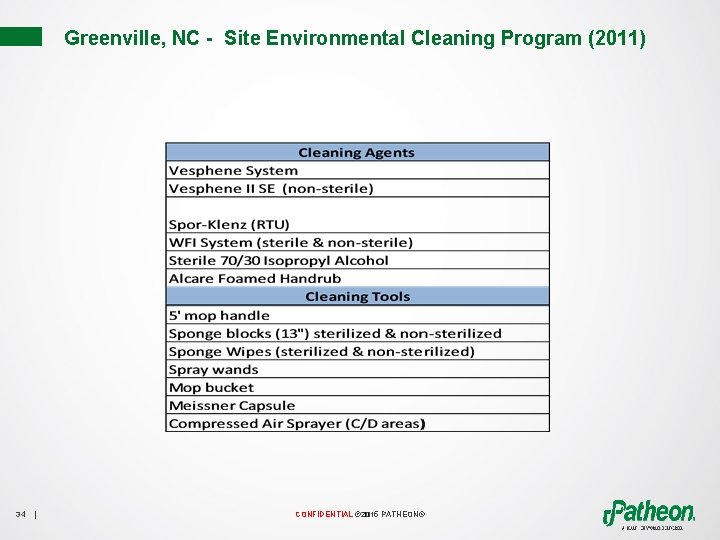
Greenville, NC - Site Environmental Cleaning Program (2011) 34 | CONFIDENTIAL © 2015 PATHEON®
Environmental Cleaning Program Enhancements (CTM) • Techniques • Tools • Disinfecting Solutions • Cleaning Solutions 35 | CONFIDENTIAL © 2015 PATHEON®
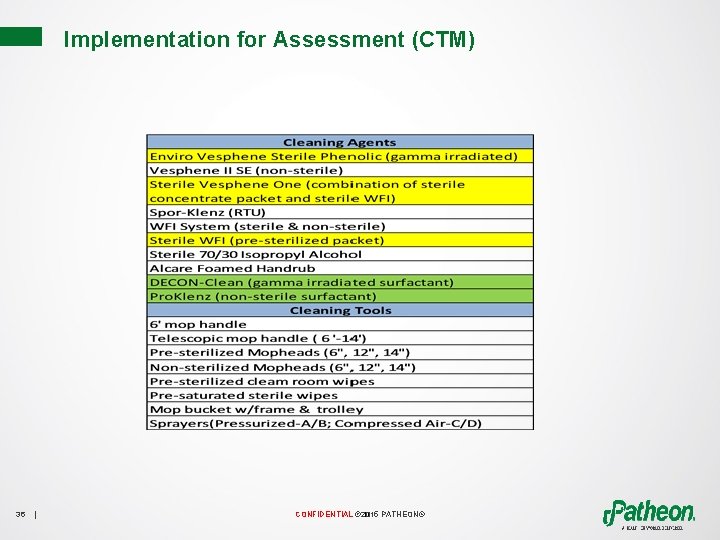
Implementation for Assessment (CTM) 36 | CONFIDENTIAL © 2015 PATHEON®
Quality Assessment (CTM) • Technique • Tools • Visual Residue • EM Data 37 | CONFIDENTIAL © 2015 PATHEON®
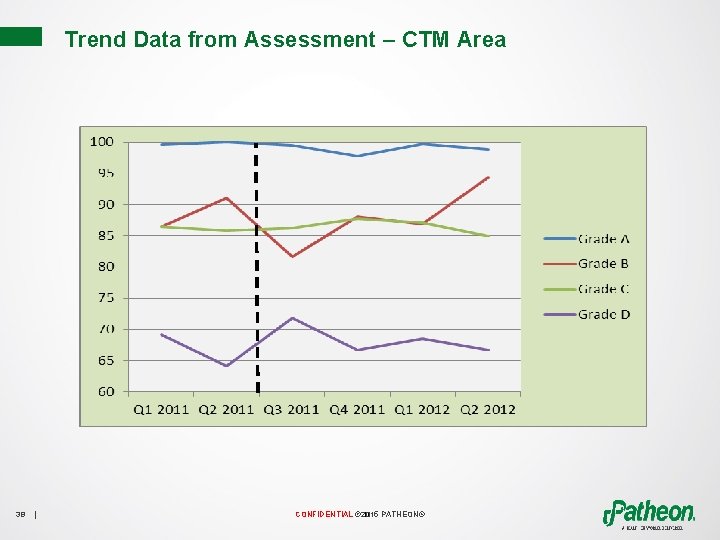
Trend Data from Assessment – CTM Area 38 | CONFIDENTIAL © 2015 PATHEON®
July 2012 Enhanced Cleaning Program Implemented for Facility • Production areas assessed for additional cleaning/disinfection tools • Cleaning procedures updated • Operators trained 39 | CONFIDENTIAL © 2015 PATHEON®
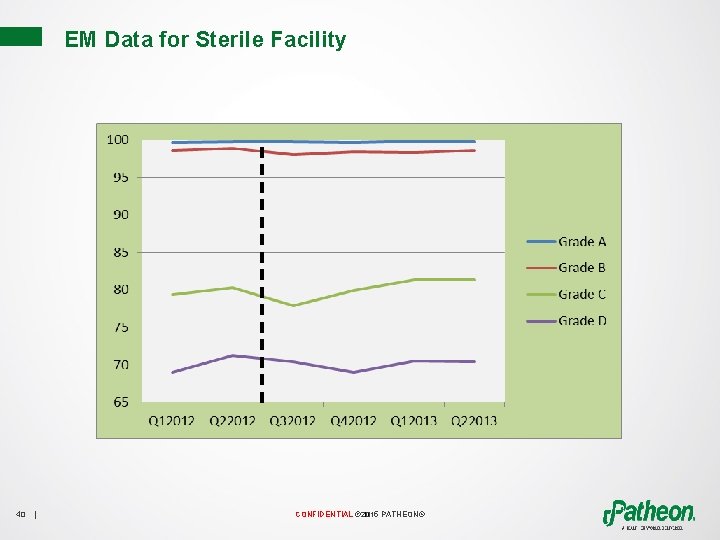
EM Data for Sterile Facility 40 | CONFIDENTIAL © 2015 PATHEON®
Effectiveness of Implementation and Continued Improvement • Reduction of visual residue • Right Tools • Increase operator knowledge • Improved procedures • Development of On-The-Job Training Documents • Quality on the Floor 41 | CONFIDENTIAL © 2015 PATHEON®
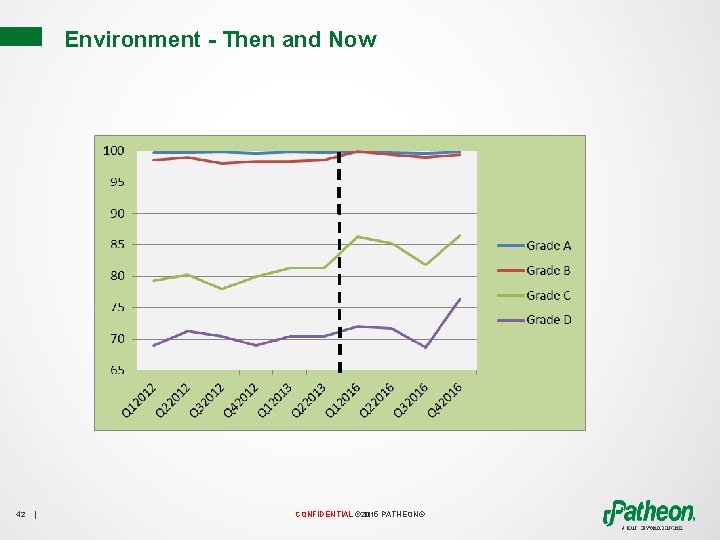
Environment - Then and Now 42 | CONFIDENTIAL © 2015 PATHEON®
Thank You 43 | CONFIDENTIAL © 2015 PATHEON®
- Slides: 43