
Cleaning vs Disinfecting What is the difference between
Cleaning vs Disinfecting
What is the difference between cleaning and disinfecting • From the CDC, “Cleaning and Disinfection for Households” (https: //www. cdc. gov/coronavirus/2019 -ncov/prevent-gettingsick/cleaning-disinfection. html), the difference between cleaning and disinfecting: • Cleaning refers to the removal of germs, dirt, and impurities from surfaces. It does not kill germs, but by removing them, it lowers their numbers and the risk of spreading infection. • Disinfecting refers to using chemicals, for example, EPA-registered disinfectants, to kill germs on surfaces. This process does not necessarily clean dirty surfaces or remove germs, but by killing germs on a surface after cleaning, it can further lower the risk of spreading infection MIT ENVIRONMENT • HEALTH • SAFETY 2
What are the approved disinfectants for COVID 19 • Appropriate COVID-19 Disinfectants include • • • 10% bleach Lysol. R Brand All Purpose Cleaner Alcohol solutions with at least 70% alcohol (i. e. 70% ethanol, 70% isopropyl) Pre. Empt RTU Quatricide Lysol disinfecting wipes • More information can be found at EHS COVID-19 FAQ https: //ehs. mit. edu/about/ehs-covid-19 -faq/ or • A full list of disinfectants that meet the EPA’s criteria for use against SARS-Co. V-2 can be found here: https: //www. epa. gov/pesticideregistration/list-n-disinfectants-use-against-sars-cov-2 MIT ENVIRONMENT • HEALTH • SAFETY 3
Is there a policy about gloves, face coverings, personal protective equipment (PPE) • Yes, you can find the PPE policy and information on face masks and cloth coverings at https: //ehs. mit. edu/about/ehs-covid-19 faq/ • Face coverings/masks are available from MIT if needed. Face coverings and face masks are available in the Lobby of Building 7, at certain research building access checkpoints, and DLCs. It is acceptable to provide or purchase your own. If you purchase/ use your own face covering/mask, please ensure that it meets the minimum criteria for cloth face coverings by reviewing the “Considerations and Minimum Criteria for Cloth Face Coverings” guidance. MIT ENVIRONMENT • HEALTH • SAFETY 4
Guidance to DLCs • For more details on ramping up go to https: //research. mit. edu/sites/research/files/uploads/guidancemit-dlcs-pis-related-common-space-usage-2020 -06 -05. pdf MIT ENVIRONMENT • HEALTH • SAFETY 5
How can you protect yourself • Wear a mask or face covering while on campus • Practice physical distancing and do not gather in groups • Wash your hands frequently with soap and water, scrubbing for at leats 20 sections or using alcohol-based hand sanitizer if handwashing facilites aren’t available • Avoid touching your face • Cover coughs/sneezes with the inside of your elbow • Stay home if you are feeling sick, and seek appropriate medical guidance See the Guidance to MIT DLCs and Pis related to Common Space Usage at https: //covid 19. mit. edu/ MIT ENVIRONMENT • HEALTH • SAFETY 6
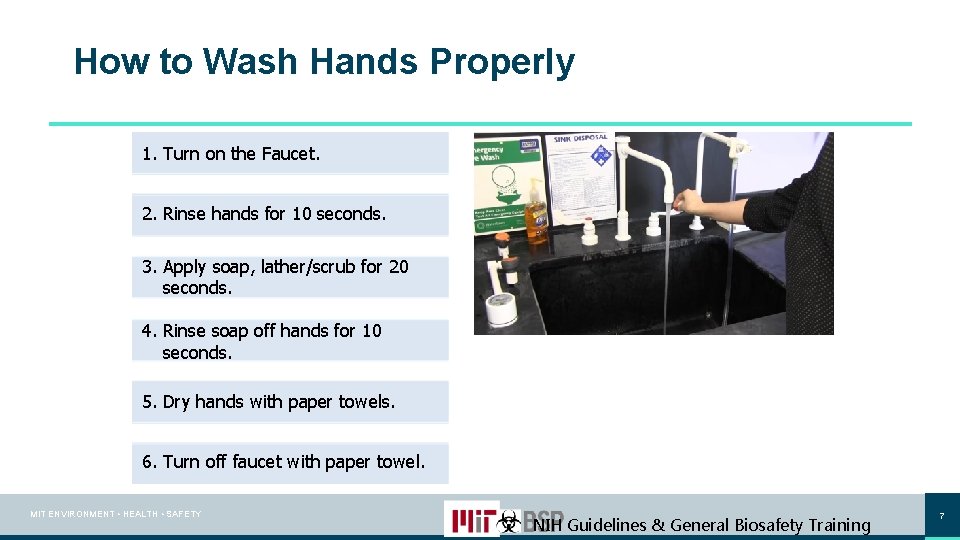
How to Wash Hands Properly 1. Turn on the Faucet. 2. Rinse hands for 10 seconds. 3. Apply soap, lather/scrub for 20 seconds. 4. Rinse soap off hands for 10 seconds. 5. Dry hands with paper towels. 6. Turn off faucet with paper towel. MIT ENVIRONMENT • HEALTH • SAFETY NIH Guidelines & General Biosafety Training 7
Where To Go With Questions • Contact your Faculty • Contact Dan Herrick, Mech. E EHS Coordinator (herrickd@mit. edu) • MIT’s COVID-19 Info Center at https: //covid 19. mit. edu/ • MIT Medical at https: //medical. mit. edu/news/2020/01/2019 -novel-coronavirus-updates-1 • Contact EHS 617 -452 -3477 environment@mit. edu
- Slides: 8