
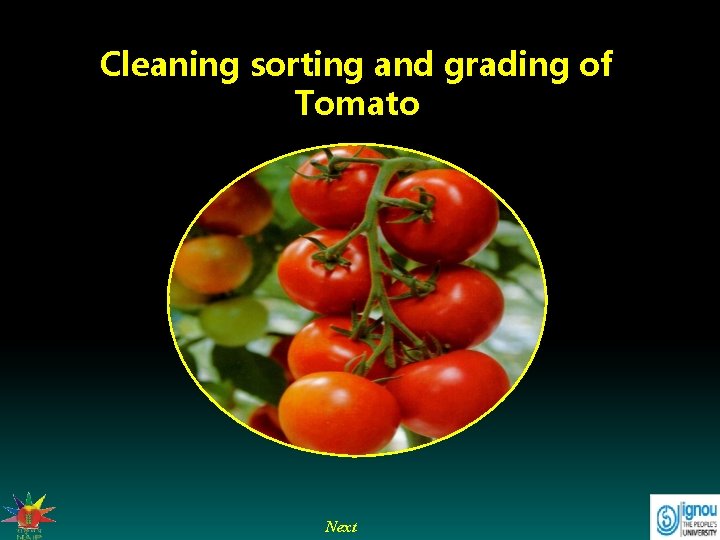
Cleaning sorting and grading of Tomato Next Cleaning




- Slides: 17
Cleaning sorting and grading of Tomato Next
Cleaning sorting and grading of Tomato Introduction Cleaning of tomato is refers to removal of soil particles and any undesirable material adhering to tomato fruits surface by swapping with clothes etc. In tomato cleaning may also refer to washing with water. Sorting Removal of rotten, damaged and cracked tomato fruits from the healthy, bright and clean fruits. This operation will limit the spread of infection to other healthy fruits during handling Click following link to see mechanical sorting of tomato fruits. http: //www. youtube. com/watch? v=so. Kwvvw. Rm. X 8&NR=1 Grading in tomato is referred as categorization of the fruits on the basis of color, size & stage of maturity/degree of ripening etc. Grading can be done manually or by machines. c End Previous Next
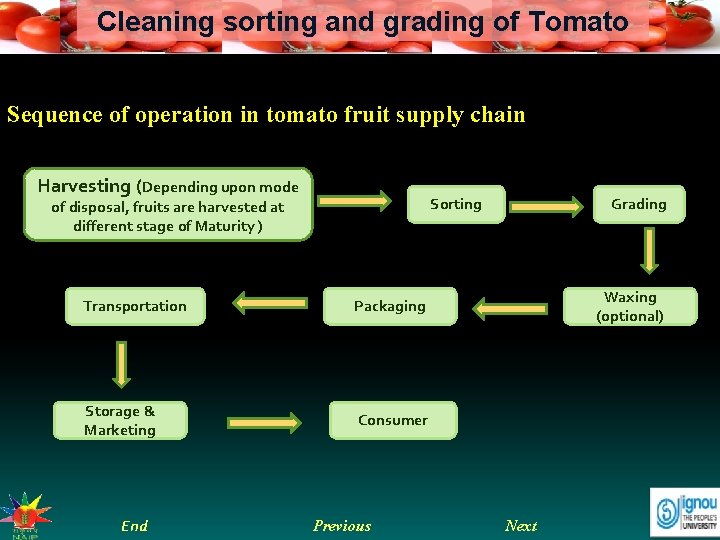
Cleaning sorting and grading of Tomato Sequence of operation in tomato fruit supply chain Harvesting (Depending upon mode Sorting of disposal, fruits are harvested at different stage of Maturity ) Transportation Packaging Storage & Marketing Consumer End Previous Grading Waxing (optional) Next
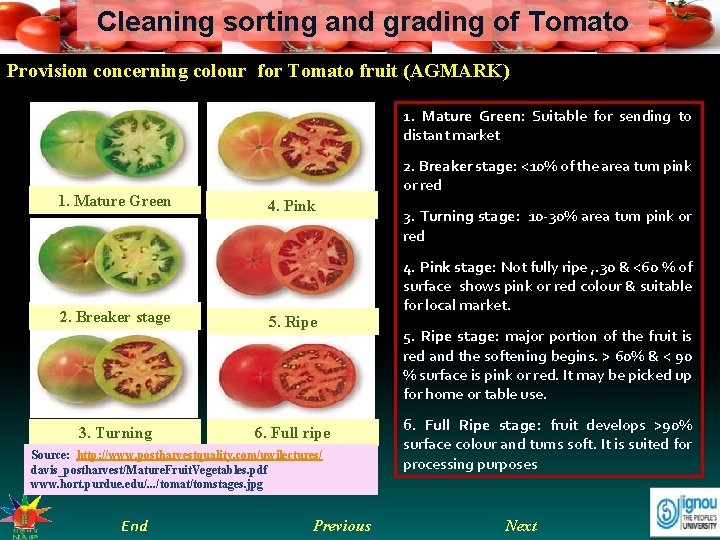
Cleaning sorting and grading of Tomato Provision concerning colour for Tomato fruit (AGMARK) 1. Mature Green: Suitable for sending to distant market 1. Mature Green 2. Breaker stage 3. Turning 2. Breaker stage: <10% of the area turn pink or red 4. Pink 5. Ripe 6. Full ripe Source: http: //www. postharvestquality. com/uwilectures/ davis_postharvest/Mature. Fruit. Vegetables. pdf www. hort. purdue. edu/. . . /tomat/tomstages. jpg End Previous 3. Turning stage: 10 -30% area turn pink or red 4. Pink stage: Not fully ripe , . 30 & <60 % of surface shows pink or red colour & suitable for local market. 5. Ripe stage: major portion of the fruit is red and the softening begins. > 60% & < 90 % surface is pink or red. It may be picked up for home or table use. 6. Full Ripe stage: fruit develops >90% surface colour and turns soft. It is suited for processing purposes Next
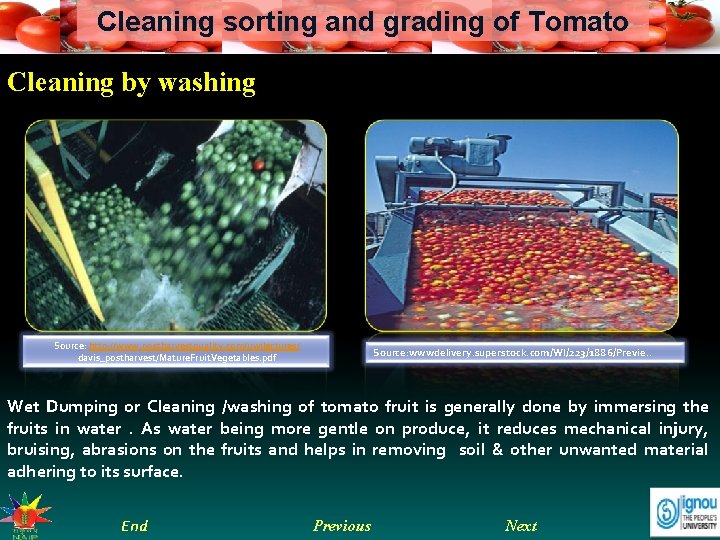
Cleaning sorting and grading of Tomato Cleaning by washing Source: http: //www. postharvestquality. com/uwilectures/ davis_postharvest/Mature. Fruit. Vegetables. pdf Source: wwwdelivery. superstock. com/WI/223/1886/Previe. . Wet Dumping or Cleaning /washing of tomato fruit is generally done by immersing the fruits in water. As water being more gentle on produce, it reduces mechanical injury, bruising, abrasions on the fruits and helps in removing soil & other unwanted material adhering to its surface. End Previous Next
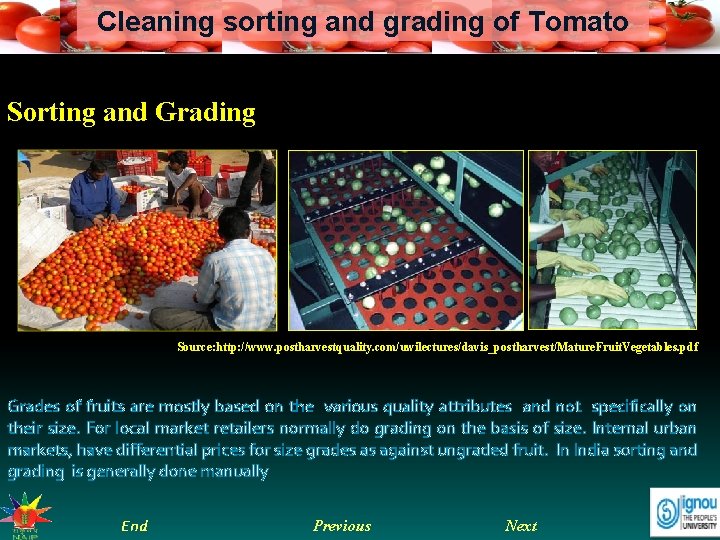
Cleaning sorting and grading of Tomato Sorting and Grading Source: http: //www. postharvestquality. com/uwilectures/davis_postharvest/Mature. Fruit. Vegetables. pdf Grades of fruits are mostly based on the various quality attributes and not specifically on their size. For local market retailers normally do grading on the basis of size. Internal urban markets, have differential prices for size grades as against ungraded fruit. In India sorting and grading is generally done manually End Previous Next
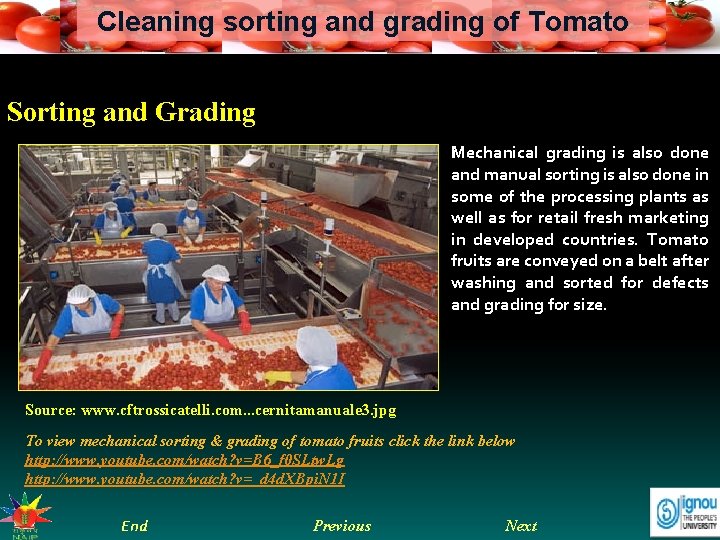
Cleaning sorting and grading of Tomato Sorting and Grading Mechanical grading is also done and manual sorting is also done in some of the processing plants as well as for retail fresh marketing in developed countries. Tomato fruits are conveyed on a belt after washing and sorted for defects and grading for size. Source: www. cftrossicatelli. com. . . cernitamanuale 3. jpg To view mechanical sorting & grading of tomato fruits click the link below http: //www. youtube. com/watch? v=B 6_f 0 SLtw. Lg http: //www. youtube. com/watch? v=_d 4 d. XBpi. N 1 I End Previous Next
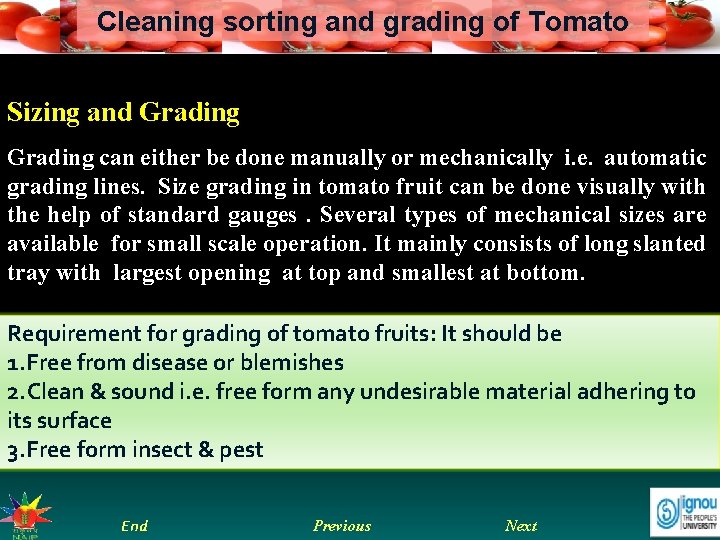
Cleaning sorting and grading of Tomato Sizing and Grading can either be done manually or mechanically i. e. automatic grading lines. Size grading in tomato fruit can be done visually with the help of standard gauges. Several types of mechanical sizes are available for small scale operation. It mainly consists of long slanted tray with largest opening at top and smallest at bottom. Requirement for grading of tomato fruits: It should be 1. Free from disease or blemishes 2. Clean & sound i. e. free form any undesirable material adhering to its surface 3. Free form insect & pest End Previous Next
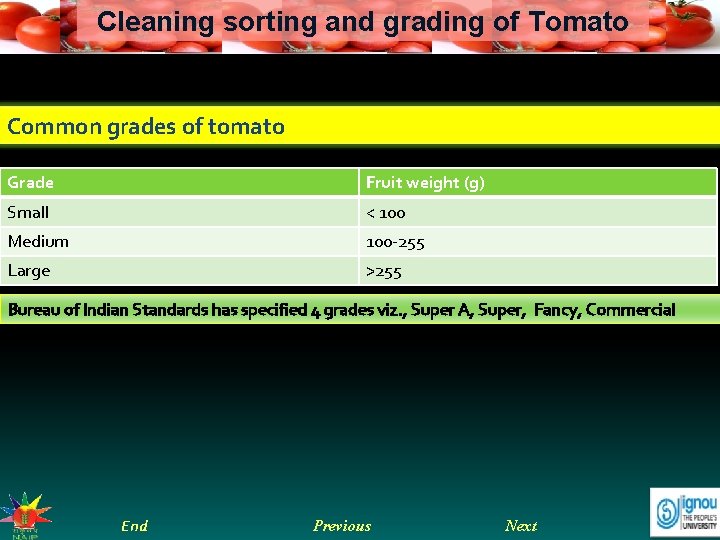
Cleaning sorting and grading of Tomato Common grades of tomato Grade Fruit weight (g) Small < 100 Medium 100 -255 Large >255 Bureau of Indian Standards has specified 4 grades viz. , Super A, Super, Fancy, Commercial End Previous Next
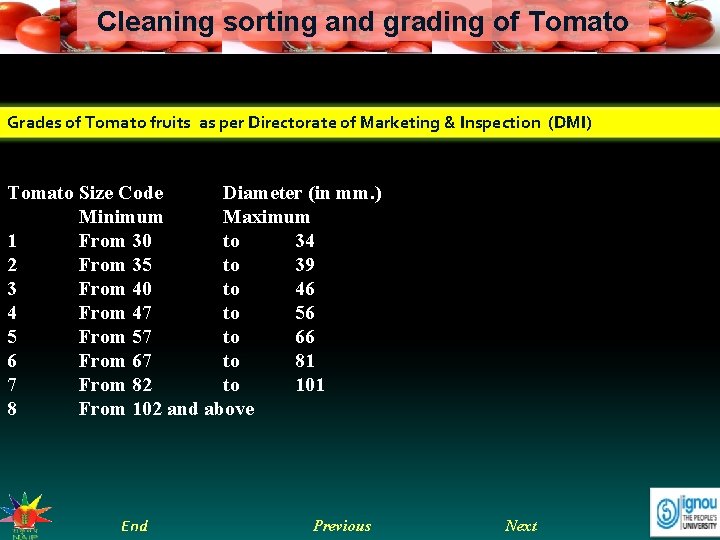
Cleaning sorting and grading of Tomato Grades of Tomato fruits as per Directorate of Marketing & Inspection (DMI) Tomato Size Code Diameter (in mm. ) Minimum Maximum 1 From 30 to 34 2 From 35 to 39 3 From 40 to 46 4 From 47 to 56 5 From 57 to 66 6 From 67 to 81 7 From 82 to 101 8 From 102 and above End Previous Next
Cleaning sorting and grading of Tomato Grade Designation & Quality of Tomato (AGMARK) 1. (i) Tomatoes shall be fruits obtained from varieties of Lycopersicum esculentum Mill of the Solanaceae family. (ii) Tomatoes may be classified into four commercial types : Round, Ribbed, Oblong or elongated, Cherry tomatoes (including cocktail tomatoes) 2. Minimum Requirements Tomatoes shall be (i) (a) whole, sound and fresh in appearance; (b) clean, free of any visible foreign matter; (c) free of pests affecting the general appearance of the produce; (d) free of damage caused by pests; (e) free of abnormal moisture excluding condensation following removal from cold storage; (f) free of any foreign smell and/or taste; (ii) In the case of trusses of tomatoes, the stalk must be fresh, healthy, clean and free from all leaves and any visible foreign matter. (iii) Tomatoes shall comply with the residue levels of heavy metals, Pesticides and other food safety parameters as laid down by the Codex Alimentarius Commission for exports. End Previous Next
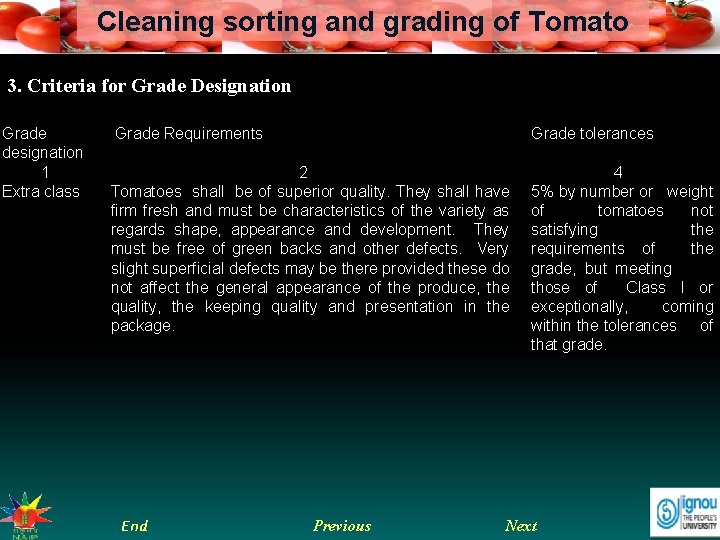
Cleaning sorting and grading of Tomato 3. Criteria for Grade Designation Grade designation 1 Extra class Grade Requirements Grade tolerances 2 Tomatoes shall be of superior quality. They shall have firm fresh and must be characteristics of the variety as regards shape, appearance and development. They must be free of green backs and other defects. Very slight superficial defects may be there provided these do not affect the general appearance of the produce, the quality, the keeping quality and presentation in the package. 4 5% by number or weight of tomatoes not satisfying the requirements of the grade, but meeting those of Class I or exceptionally, coming within the tolerances of that grade. End Previous Next
Cleaning sorting and grading of Tomato 3. Criteria for Grade Designation (-cont-) Grade designation 1 Class I Grade Requirements Grade tolerances 2 Tomatoes shall be of good quality. They shall have reasonably firm flesh and shall be characteristics of the variety as regards shape, appearance and development. They must be free of cracks and visible green back. The following slight defects may be there provide these do not affect the general appearance of the produce, the quality, the keeping quality and presentation in the package: slight superficial defects may be there provided these do not affect the general appearance of the produce, the quality, the keeping quality and presentation in the package. -a slight defect in shape and development; -a slight defect in colouring; -slight skin defects; -very slight bruises; ”Ribbed” tomatoes may show : -healed cracks not more than 1 cm. long; -no excessive protuberances; -small non lignified unbilical scars; -suberization of the stigma upto 1 sq. cm; -no more than one headed scar; -unbilical lignified scars not greater than 1 sq. cm. or linear scar no longer; than 2/3 rd of the greatest diameter of the fruit. 4 10% by number or weight of tomatoes not satisfying the requirements of the grade, but meeting those of Class II or, exceptionally, coming within the tolerances of that grade. End Previous Next
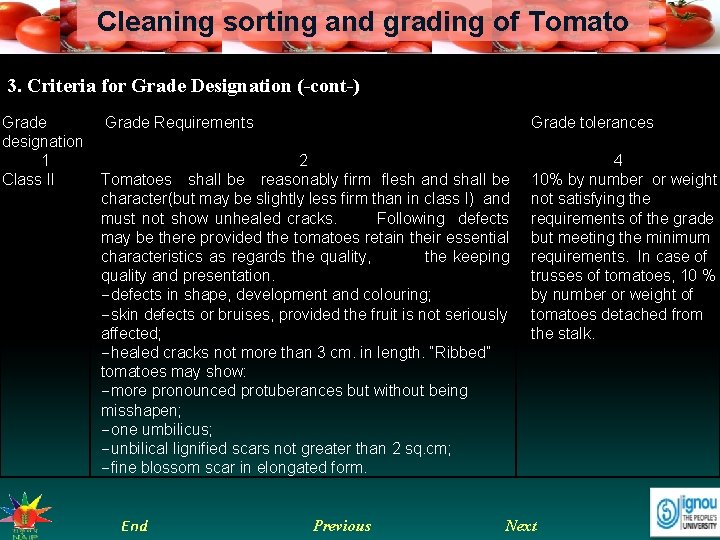
Cleaning sorting and grading of Tomato 3. Criteria for Grade Designation (-cont-) Grade designation 1 Class II Grade Requirements Grade tolerances 2 Tomatoes shall be reasonably firm flesh and shall be character(but may be slightly less firm than in class I) and must not show unhealed cracks. Following defects may be there provided the tomatoes retain their essential characteristics as regards the quality, the keeping quality and presentation. -defects in shape, development and colouring; -skin defects or bruises, provided the fruit is not seriously affected; -healed cracks not more than 3 cm. in length. “Ribbed” tomatoes may show: -more pronounced protuberances but without being misshapen; -one umbilicus; -unbilical lignified scars not greater than 2 sq. cm; -fine blossom scar in elongated form. 4 10% by number or weight not satisfying the requirements of the grade but meeting the minimum requirements. In case of trusses of tomatoes, 10 % by number or weight of tomatoes detached from the stalk. End Previous Next
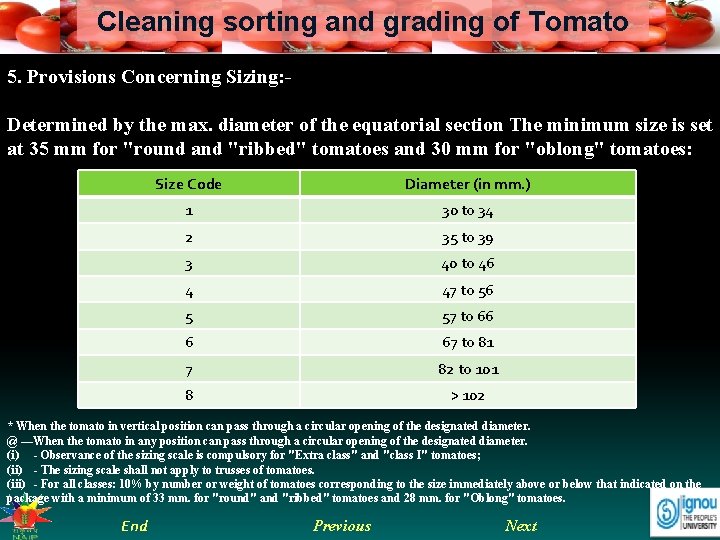
Cleaning sorting and grading of Tomato 5. Provisions Concerning Sizing: Determined by the max. diameter of the equatorial section The minimum size is set at 35 mm for "round and "ribbed" tomatoes and 30 mm for "oblong" tomatoes: Size Code Diameter (in mm. ) 1 30 to 34 2 35 to 39 3 40 to 46 4 47 to 56 5 57 to 66 6 67 to 81 7 82 to 101 8 > 102 * When the tomato in vertical position can pass through a circular opening of the designated diameter. @ —When the tomato in any position can pass through a circular opening of the designated diameter. (i) - Observance of the sizing scale is compulsory for "Extra class" and "class I" tomatoes; (ii) - The sizing scale shall not apply to trusses of tomatoes. (iii) - For all classes: 10% by number or weight of tomatoes corresponding to the size immediately above or below that indicated on the package with a minimum of 33 mm. for "round" and "ribbed" tomatoes and 28 mm. for "Oblong" tomatoes. End Previous Next
Cleaning sorting and grading of Tomato 6. Provisions Concerning Colour: Following terms may be used in the description of the colour - Mature green : when the tomatoes present a yellow colour; - Green : when the surface of the tomato is completely green varying from light to dark green. - Breakers : when there is a definite break in colour from green to tannish - yellow, pink or red on not more than 10% of the surface. - Mottled : When yellow, rose or red are present in more than 10% but no more than 30% of the fruits. - Rose : when rose or red colour are present in more than 30% but less than 60% of the fruit(yellow is not included. - Red : When more than 60% but no more than 90% of the fruits are rose or red colour. - Mature red : when more than 90% of the surface of the fruit shows red colour. Source: AGMARK (2011) Tomato http: //agmarknet. nic. in/fveggmrules 04. htm#tomatoes End Previous Next
Cleaning sorting and grading of Tomato Let us sum up • Tomato is an important but perishable vegetable grown in India. • Tomato is harvested at six stages depending upon the destination market or consumer i. e. Mature Green, Breaker, Turning, Pink, Ripe and Full Ripe stage • Wet Dumping or Cleaning /washing of tomato fruit is generally done by immersing the fruits in water to reduces mechanical injury, bruising, abrasions on the fruits and to remove soil etc. adhering to the surface. • Sorting & Grading in India is generally done manually while mechanized grading by automatic grading lines based on size and weight is also practiced. • Tomato may be weight graded as small (< 100 g, medium (100 -255 g) and large (> 255 g) or Super A, Super, Fancy and commercial or size graded into 8 grades (i. e. 1 to 8) for fruits with size 30 to 102 mm. End Previous Next