
Cleaning and Sanitizing Objectives 10 2 l Different
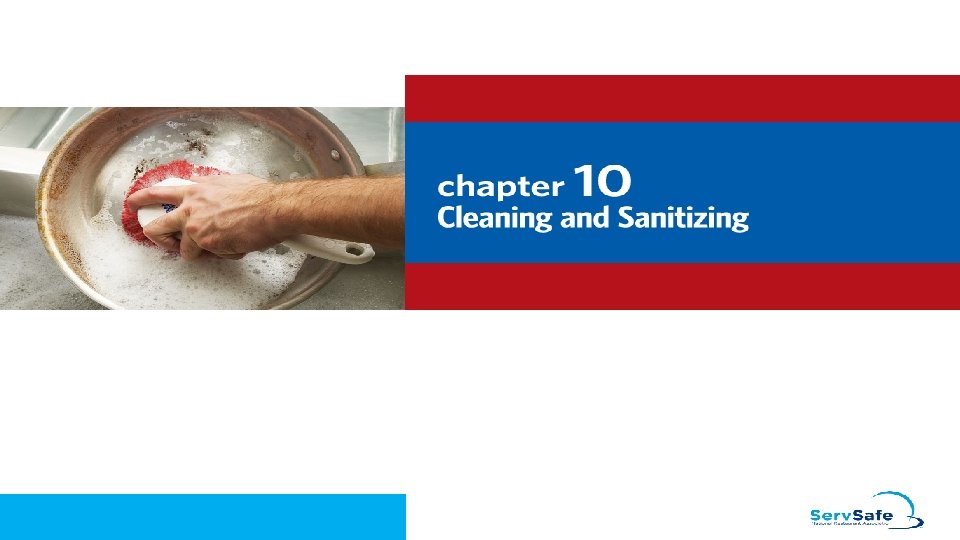

Cleaning and Sanitizing Objectives: 10 -2 l Different methods of sanitizing and how to make sure they are effective l How and when to clean and sanitize surfaces l How to wash items in a dishwasher or a threecompartment sink and then store them l How to use and store cleaning tools and supplies l How to develop a cleaning program
Cleaners must be: l Stable and noncorrosive l Safe to use When using them: 10 -3 l Follow manufacturers’ instructions l Do NOT use one type of detergent in place of another unless the intended use is the same
Sanitizing Surfaces can be sanitized using: l l 10 -4 Heat o The water must be at least 171˚F (77˚C) o Immerse the item for 30 seconds Chemicals o Chlorine o Iodine o Quats
Sanitizing Chemical sanitizing: l l 10 -5 Food-contact surfaces can be sanitized by either o Soaking them in a sanitizing solution o Rinsing, swabbing, or spraying them with a sanitizing solution In some cases a detergentsanitizer blend can be used o Use it once to clean o Use it a second time to sanitize

Sanitizer Effectiveness Concentration: l 10 -6 Sanitizers should be mixed with water to the correct concentration o Not enough sanitizer may make the solution weak and useless o Too much sanitizer may make the solution too strong, unsafe, and corrode metal
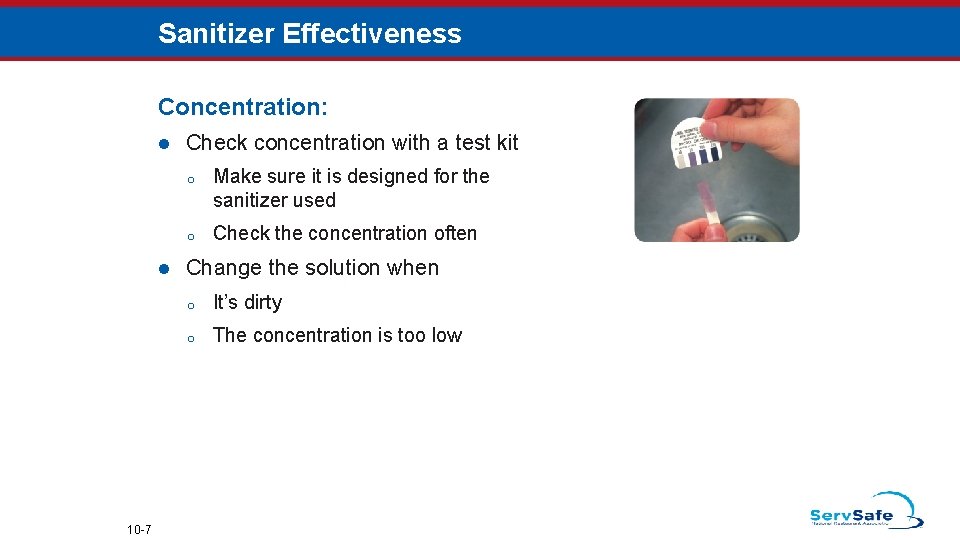
Sanitizer Effectiveness Concentration: l l 10 -7 Check concentration with a test kit o Make sure it is designed for the sanitizer used o Check the concentration often Change the solution when o It’s dirty o The concentration is too low
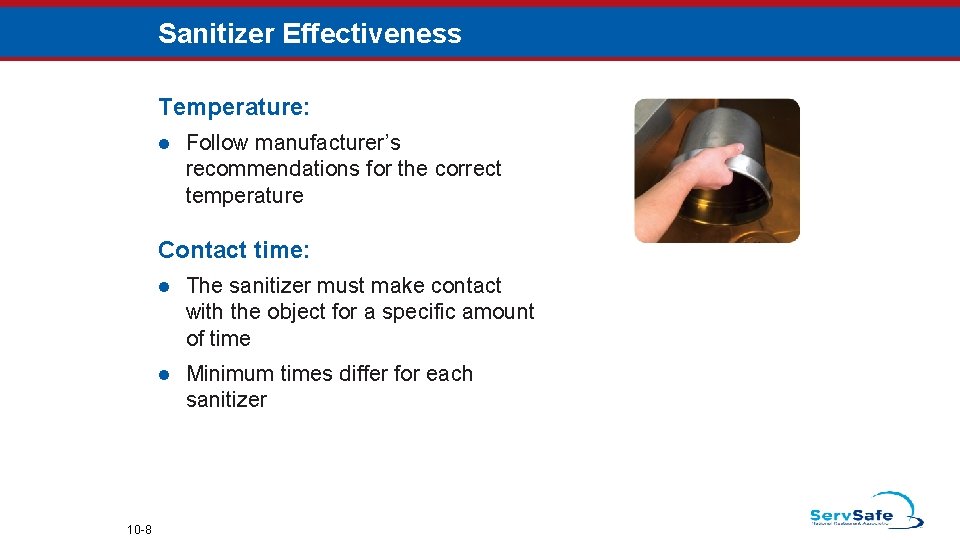
Sanitizer Effectiveness Temperature: l Follow manufacturer’s recommendations for the correct temperature Contact time: 10 -8 l The sanitizer must make contact with the object for a specific amount of time l Minimum times differ for each sanitizer
Sanitizer Effectiveness Water hardness and p. H: 10 -9 l Find out what your water hardness and p. H is from your municipality l Work with your supplier to identify the correct amount of sanitizer to use

Guidelines for the Effective Use of Sanitizers Chlorine Water temperature Water p. H Water hardness Sanitizer concentration range Sanitizer contact time 10 -10 ≥ 100°F (38°C) ≥ 75°F (24°C) ≤ 10 ≤ 8 As per manufacturer’s recommendations 50– 99 ppm ≥ 7 sec
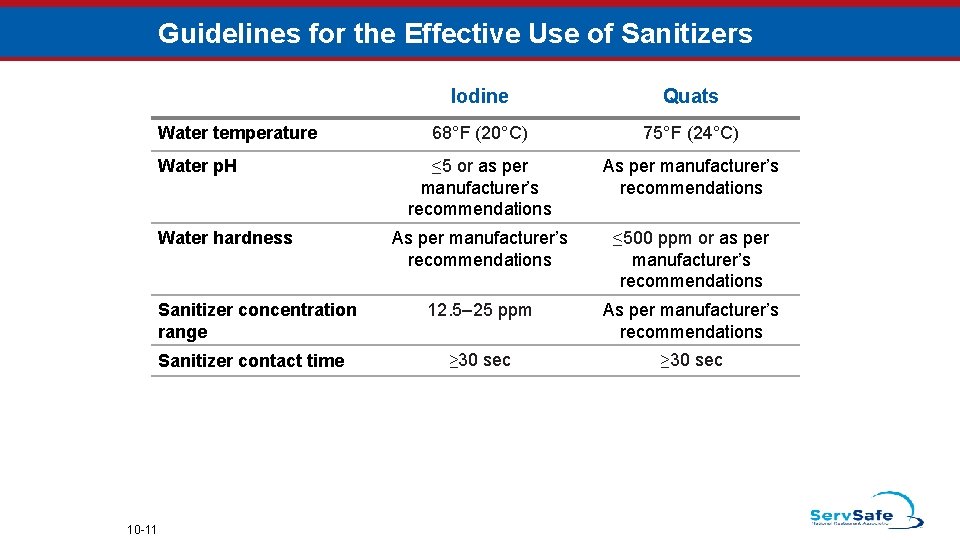
Guidelines for the Effective Use of Sanitizers Water temperature Water p. H Water hardness Sanitizer concentration range Sanitizer contact time 10 -11 Iodine Quats 68°F (20°C) 75°F (24°C) ≤ 5 or as per manufacturer’s recommendations As per manufacturer’s recommendations ≤ 500 ppm or as per manufacturer’s recommendations 12. 5– 25 ppm As per manufacturer’s recommendations ≥ 30 sec
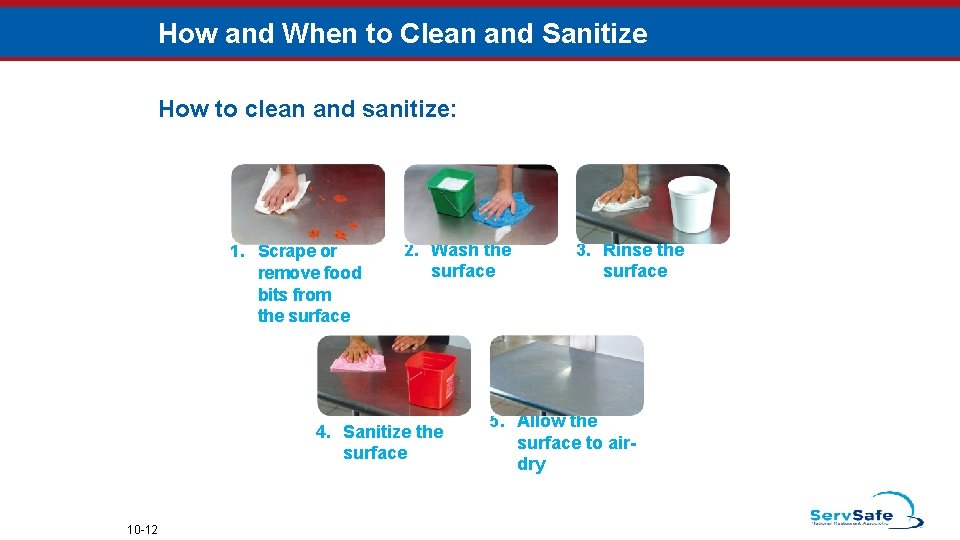
How and When to Clean and Sanitize How to clean and sanitize: 1. Scrape or remove food bits from the surface 2. Wash the surface 4. Sanitize the surface 10 -12 3. Rinse the surface 5. Allow the surface to airdry
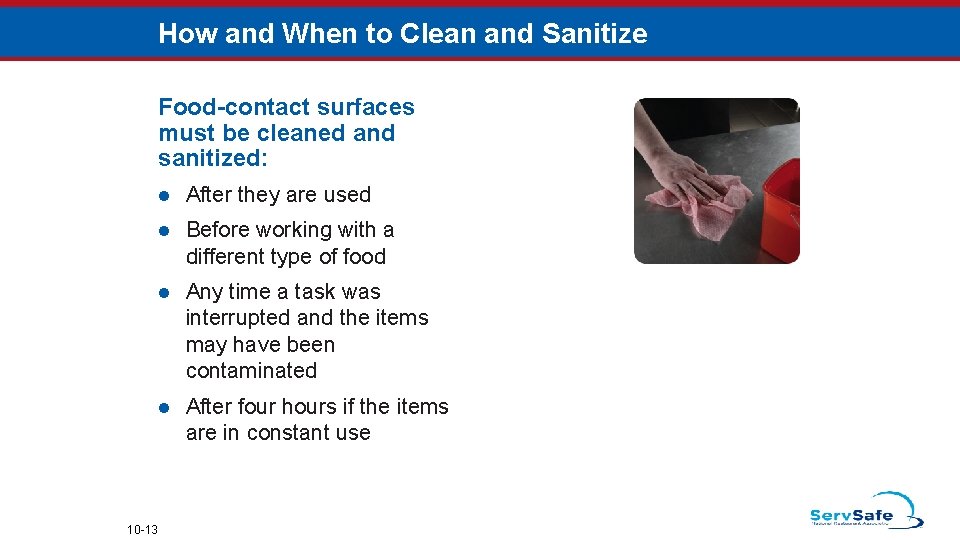
How and When to Clean and Sanitize Food-contact surfaces must be cleaned and sanitized: 10 -13 l After they are used l Before working with a different type of food l Any time a task was interrupted and the items may have been contaminated l After four hours if the items are in constant use
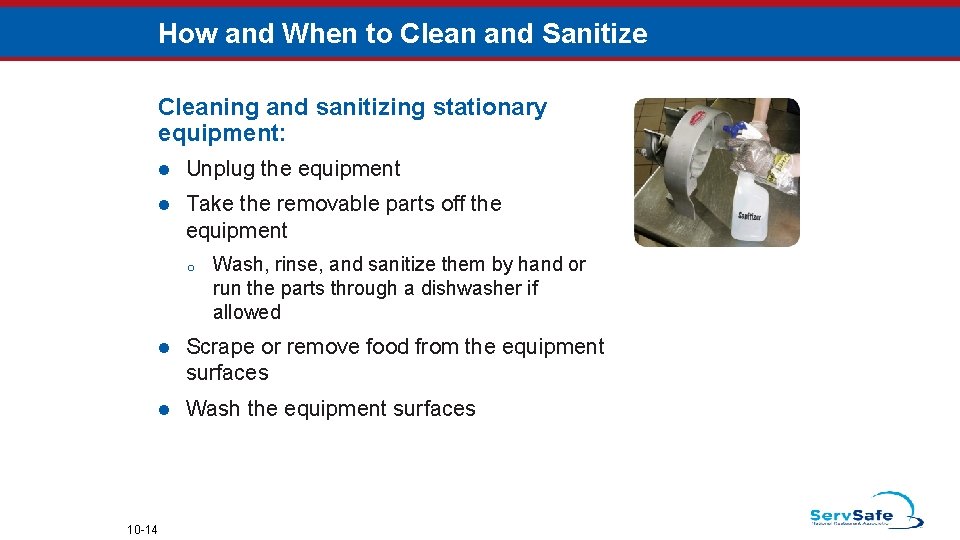
How and When to Clean and Sanitize Cleaning and sanitizing stationary equipment: l Unplug the equipment l Take the removable parts off the equipment o 10 -14 Wash, rinse, and sanitize them by hand or run the parts through a dishwasher if allowed l Scrape or remove food from the equipment surfaces l Wash the equipment surfaces
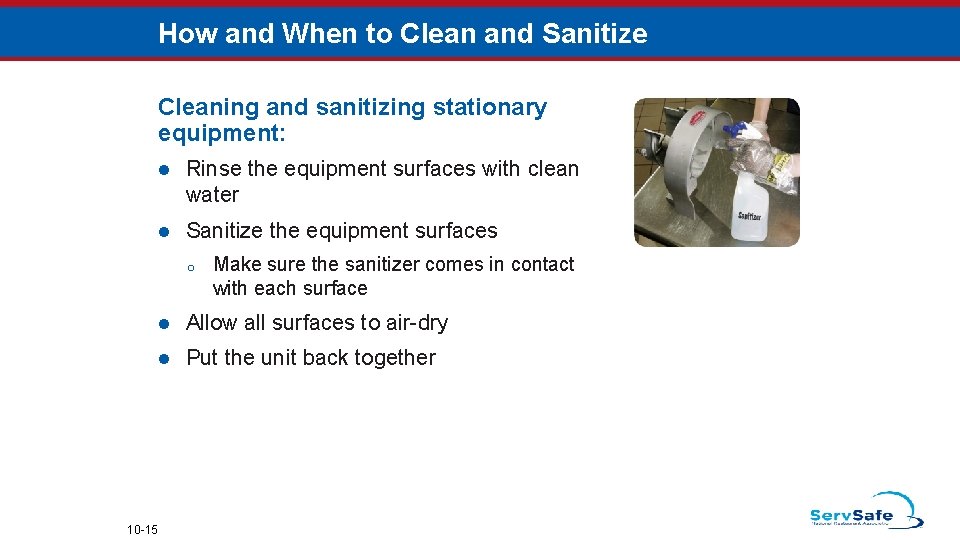
How and When to Clean and Sanitize Cleaning and sanitizing stationary equipment: l Rinse the equipment surfaces with clean water l Sanitize the equipment surfaces o 10 -15 Make sure the sanitizer comes in contact with each surface l Allow all surfaces to air-dry l Put the unit back together
How and When to Clean and Sanitize Clean-in-place equipment: 10 -16 l Equipment holding and dispensing TCS food must be cleaned and sanitized every day unless otherwise indicated by the manufacturer l Check local regulatory requirements
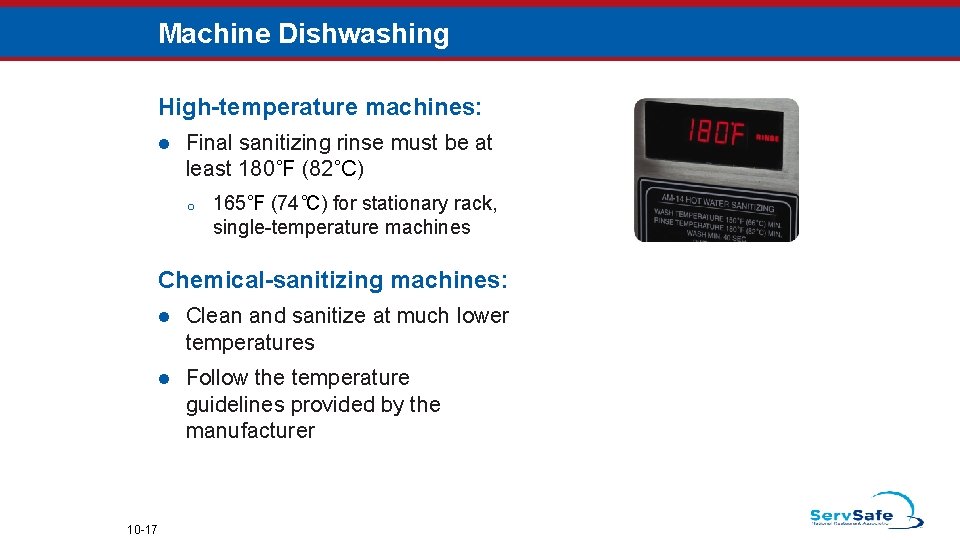
Machine Dishwashing High-temperature machines: l Final sanitizing rinse must be at least 180˚F (82˚C) o 165˚F (74˚C) for stationary rack, single-temperature machines Chemical-sanitizing machines: 10 -17 l Clean and sanitize at much lower temperatures l Follow the temperature guidelines provided by the manufacturer
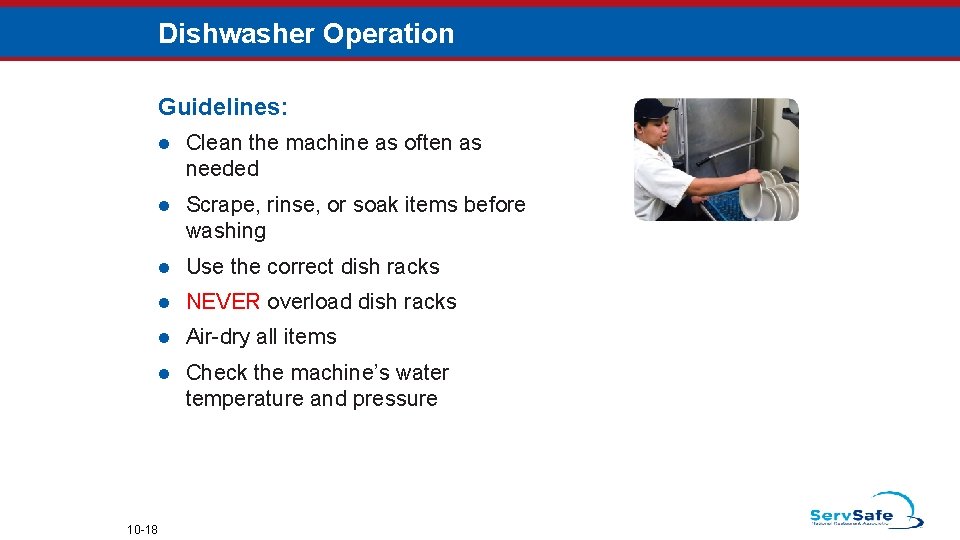
Dishwasher Operation Guidelines: 10 -18 l Clean the machine as often as needed l Scrape, rinse, or soak items before washing l Use the correct dish racks l NEVER overload dish racks l Air-dry all items l Check the machine’s water temperature and pressure
Monitoring High Temperature Dishwashing Machines When using high-temperature dishwashing machines, provide staff with tools to check the temperature of the items being sanitized. Options include: l Maximum registering thermometers l Temperature sensitive tape 10 -19
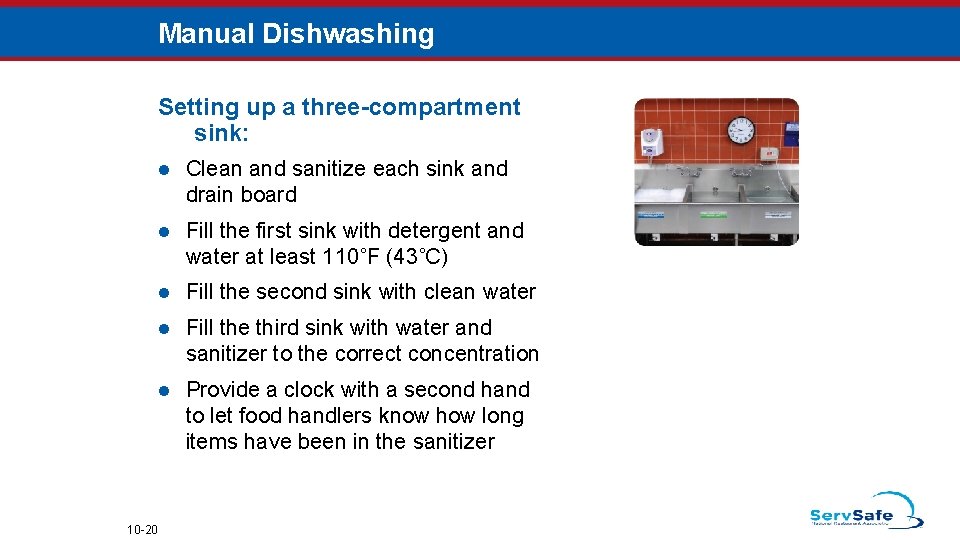
Manual Dishwashing Setting up a three-compartment sink: 10 -20 l Clean and sanitize each sink and drain board l Fill the first sink with detergent and water at least 110˚F (43˚C) l Fill the second sink with clean water l Fill the third sink with water and sanitizer to the correct concentration l Provide a clock with a second hand to let food handlers know how long items have been in the sanitizer
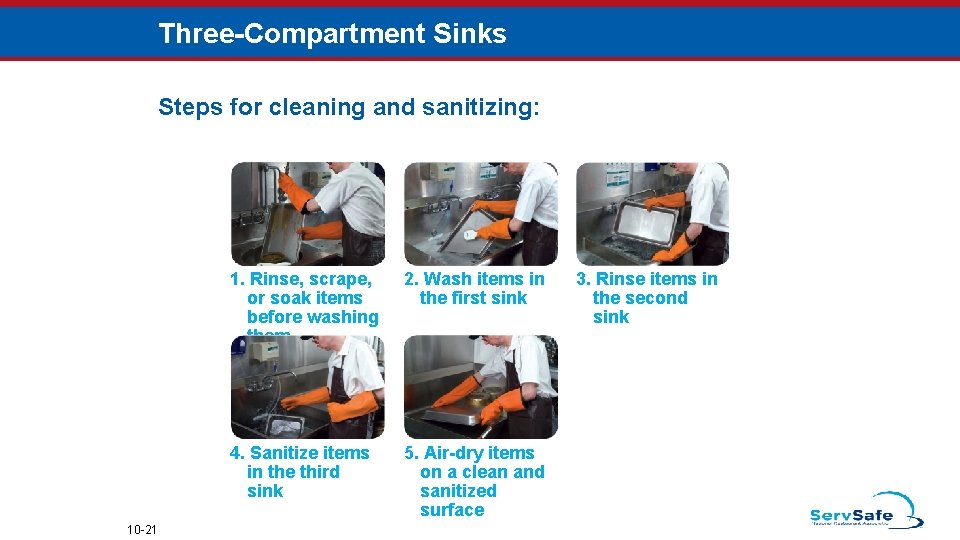
Three-Compartment Sinks Steps for cleaning and sanitizing: 10 -21 1. Rinse, scrape, or soak items before washing them 2. Wash items in the first sink 4. Sanitize items in the third sink 5. Air-dry items on a clean and sanitized surface 3. Rinse items in the second sink
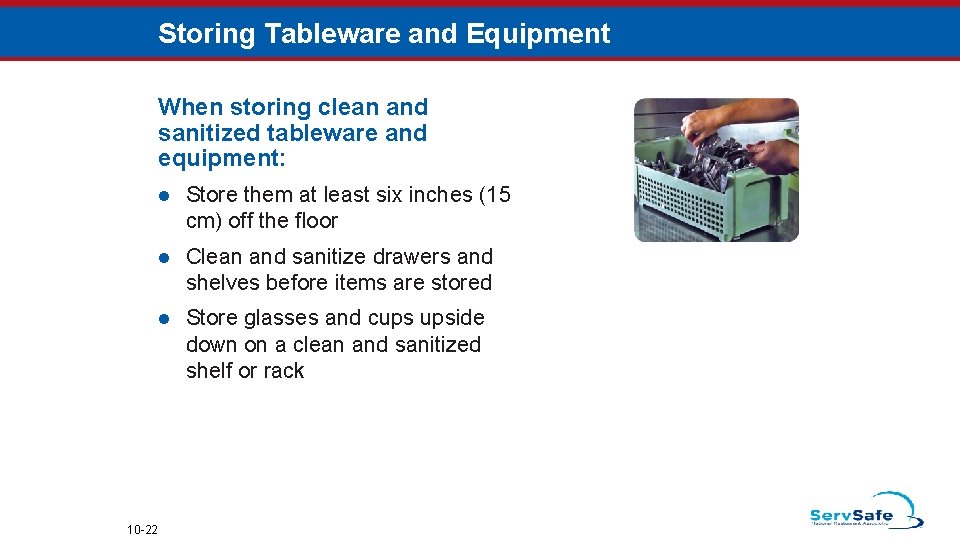
Storing Tableware and Equipment When storing clean and sanitized tableware and equipment: 10 -22 l Store them at least six inches (15 cm) off the floor l Clean and sanitize drawers and shelves before items are stored l Store glasses and cups upside down on a clean and sanitized shelf or rack
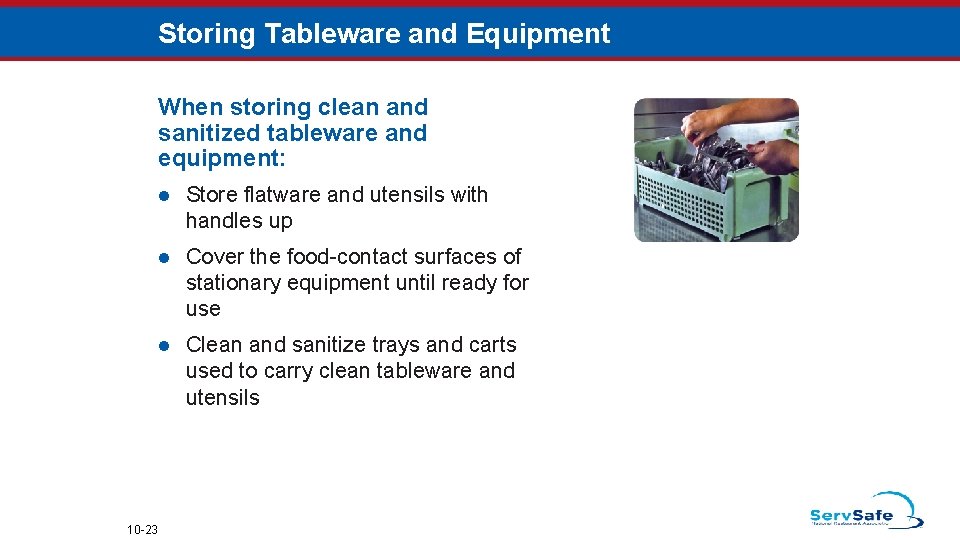
Storing Tableware and Equipment When storing clean and sanitized tableware and equipment: 10 -23 l Store flatware and utensils with handles up l Cover the food-contact surfaces of stationary equipment until ready for use l Clean and sanitize trays and carts used to carry clean tableware and utensils
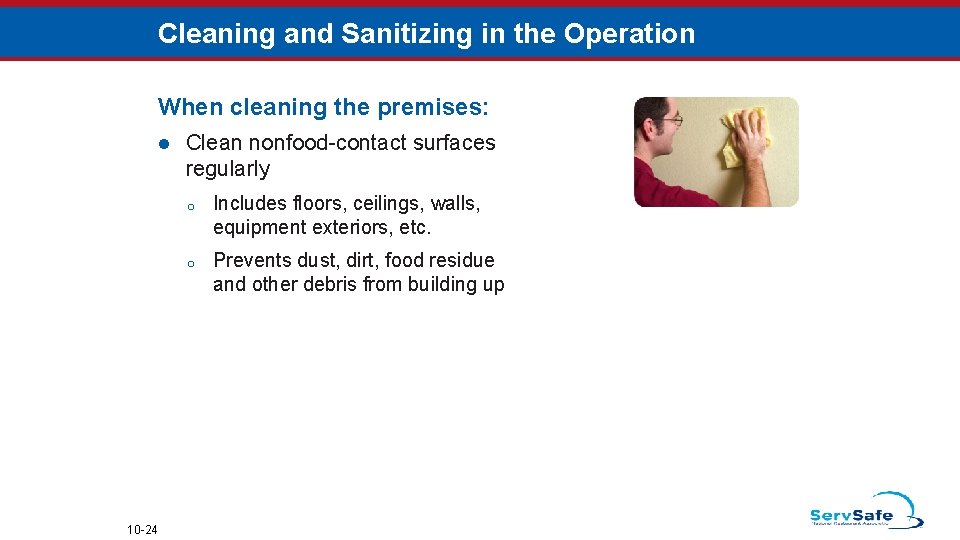
Cleaning and Sanitizing in the Operation When cleaning the premises: l 10 -24 Clean nonfood-contact surfaces regularly o Includes floors, ceilings, walls, equipment exteriors, etc. o Prevents dust, dirt, food residue and other debris from building up
Cleaning and Sanitizing in the Operation Cleaning up after people who get sick: l Diarrhea and vomit in the operation must be cleaned up correctly o 10 -25 It can carry Norovirus, which is highly contagious l Correct cleanup can prevent food from becoming contaminated and keep others from getting sick l Check with your local regulatory authority regarding requirements for cleaning up vomit and diarrhea. A written cleanup plan may be required.
Cleaning and Sanitizing in the Operation Consider the following when developing a plan for cleaning up vomit and diarrhea: 10 -26 l How you will contain liquid and airborne substances, and remove them from the operation l How you will clean, sanitize, and disinfect surfaces l When to throw away food that may have been contaminated l What equipment is needed to clean up these substances, and how it will be cleaned and disinfected after use l When a food handler must wear personal protective equipment
Cleaning and Sanitizing in the Operation Develop a plan for cleaning up vomit and diarrhea: 10 -27 l How staff will be notified of the correct procedures for containing, cleaning, and disinfecting these substances l How to segregate contaminated areas from other areas l When staff must be restricted from working with or around food or excluded from working in the operation l How sick customers will be quickly removed from the operation l How the cleaning plan will be implemented
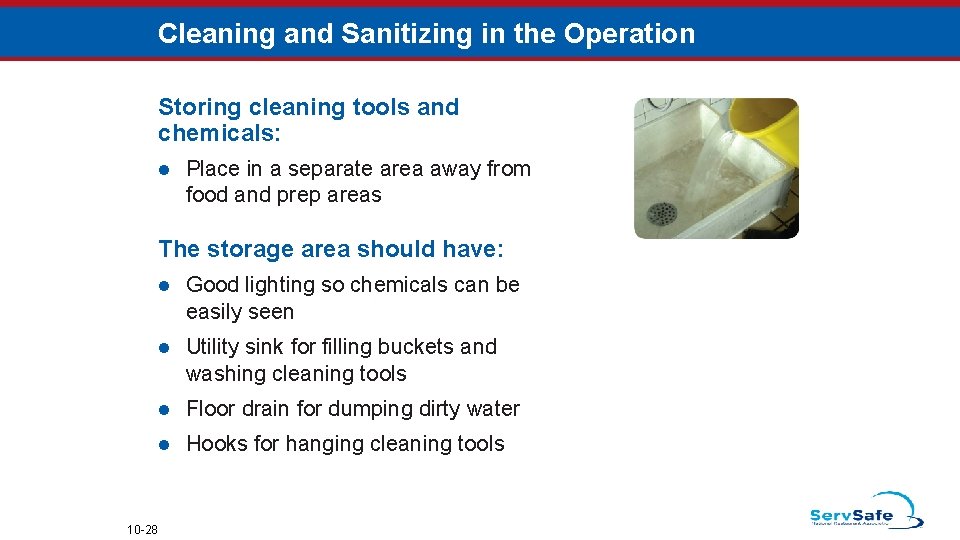
Cleaning and Sanitizing in the Operation Storing cleaning tools and chemicals: l Place in a separate area away from food and prep areas The storage area should have: 10 -28 l Good lighting so chemicals can be easily seen l Utility sink for filling buckets and washing cleaning tools l Floor drain for dumping dirty water l Hooks for hanging cleaning tools
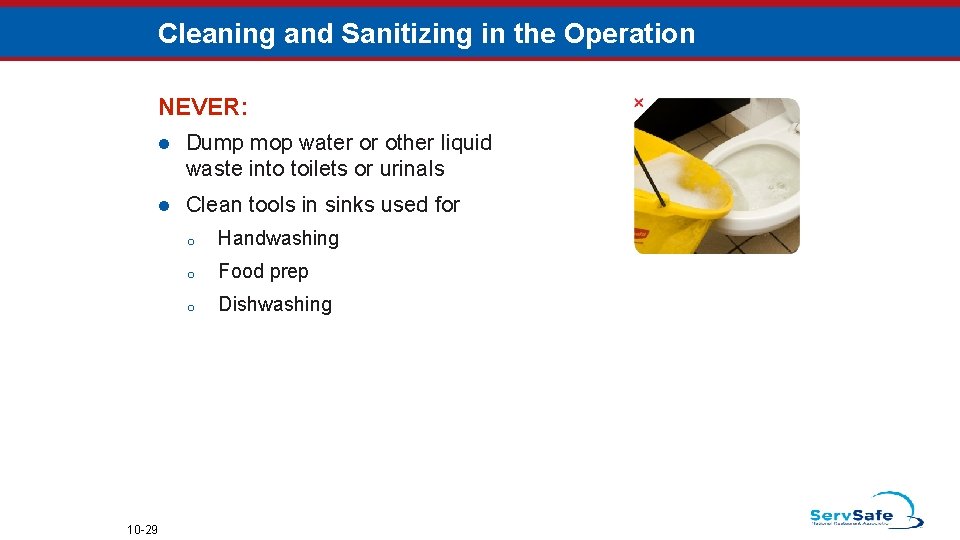
Cleaning and Sanitizing in the Operation NEVER: 10 -29 l Dump mop water or other liquid waste into toilets or urinals l Clean tools in sinks used for o Handwashing o Food prep o Dishwashing
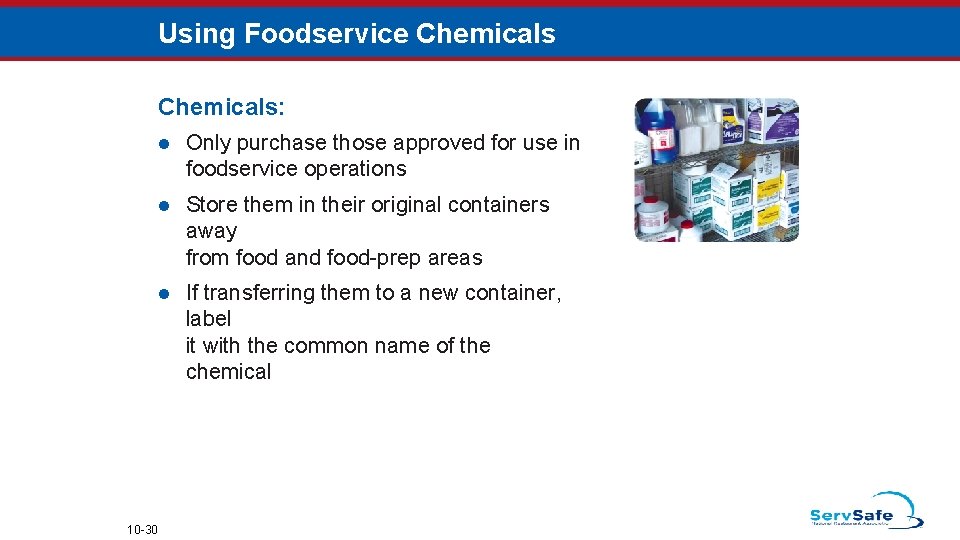
Using Foodservice Chemicals: 10 -30 l Only purchase those approved for use in foodservice operations l Store them in their original containers away from food and food-prep areas l If transferring them to a new container, label it with the common name of the chemical
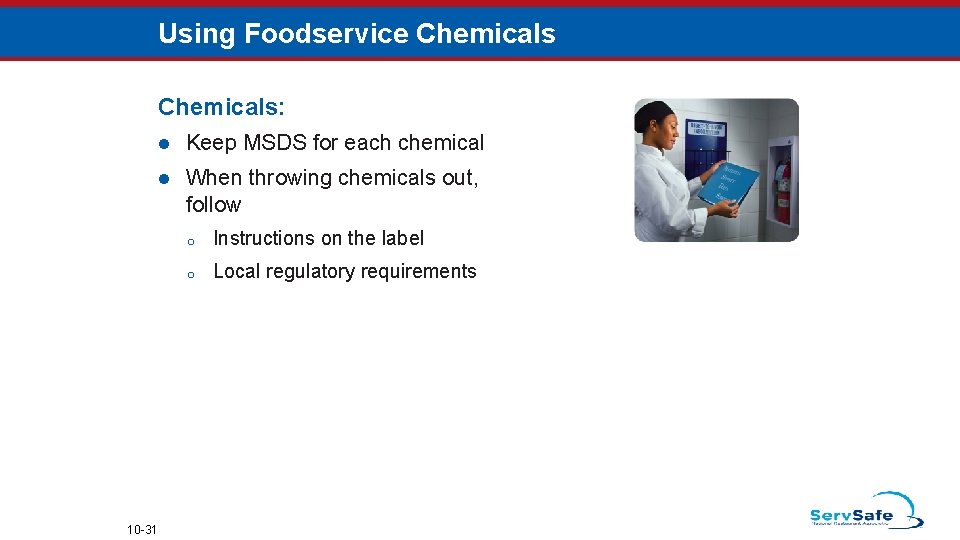
Using Foodservice Chemicals: 10 -31 l Keep MSDS for each chemical l When throwing chemicals out, follow o Instructions on the label o Local regulatory requirements
Developing a Cleaning Program To develop an effective cleaning program: 10 -32 l Create a master cleaning schedule l Train your staff to follow it l Monitor the program to make sure it works
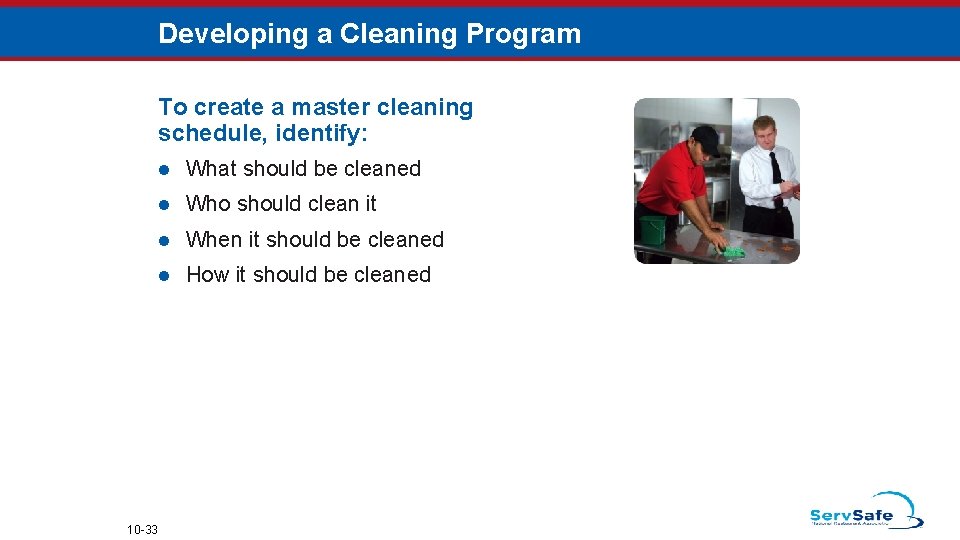
Developing a Cleaning Program To create a master cleaning schedule, identify: 10 -33 l What should be cleaned l Who should clean it l When it should be cleaned l How it should be cleaned
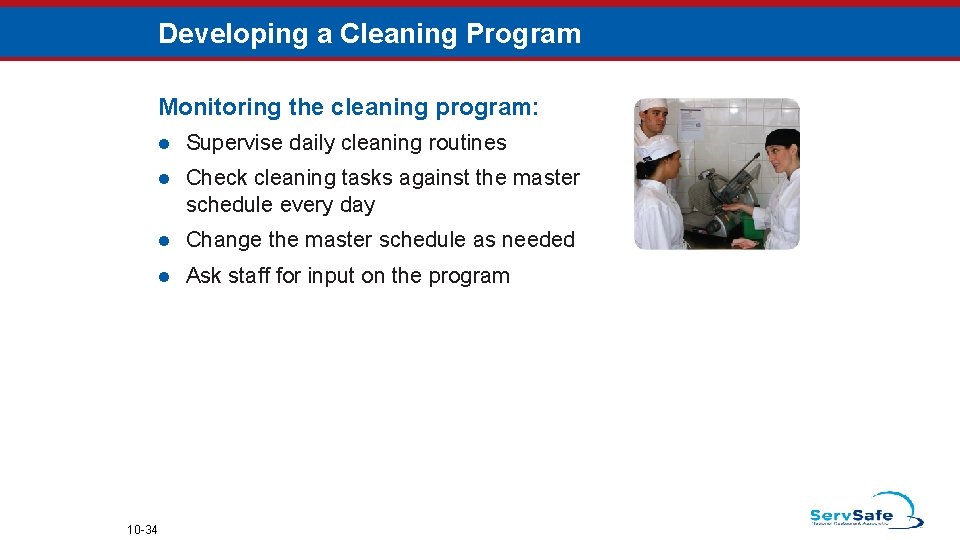
Developing a Cleaning Program Monitoring the cleaning program: 10 -34 l Supervise daily cleaning routines l Check cleaning tasks against the master schedule every day l Change the master schedule as needed l Ask staff for input on the program
- Slides: 34