
Clean Power Plan Overview of Proposed Federal Plan
- Slides: 19
Clean Power Plan: Overview of Proposed Federal Plan and Model Rules Air Quality Committee Special Information Session September 9, 2015 Sushma Masemore, PE Planning Section Chief Division of Air Quality Department of Environment and Natural Resources
Topics Covered What is a Federal Plan? Proposed Federal Plan - Structure Proposed Federal Plan - Trading Programs Proposed Federal Plan - Other Requirements Overview of Proposed Model Rules 2
What is a Federal Plan? Federal plan for attaining compliance with a rule EPA will place a state under a Federal Plan, 12 months after taking action related to the following cases: § Failure to submit State Plan § State Plan is disapproved § Failure to demonstrate compliance Sources become subject to federal administration and enforcement to meet standards specified in the Federal Plan 3
PROPOSED FEDERAL PLAN - STRUCTURE 4
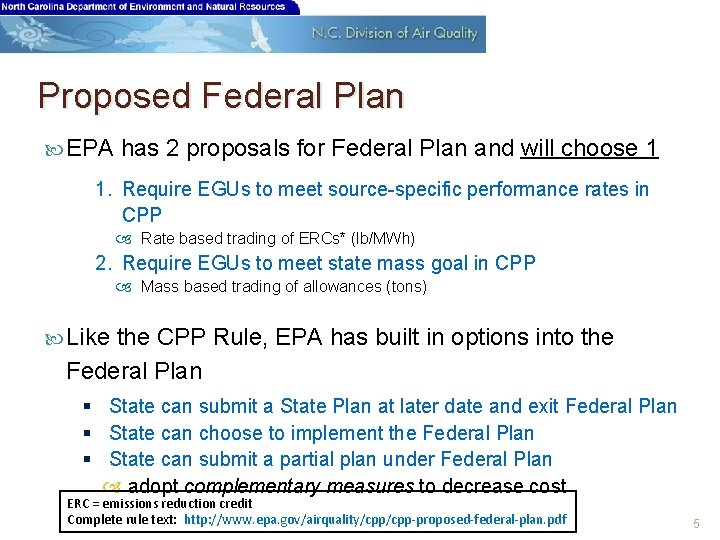
Proposed Federal Plan EPA has 2 proposals for Federal Plan and will choose 1 1. Require EGUs to meet source-specific performance rates in CPP Rate based trading of ERCs* (lb/MWh) 2. Require EGUs to meet state mass goal in CPP Mass based trading of allowances (tons) Like the CPP Rule, EPA has built in options into the Federal Plan § State can submit a State Plan at later date and exit Federal Plan § State can choose to implement the Federal Plan § State can submit a partial plan under Federal Plan adopt complementary measures to decrease cost ERC = emissions reduction credit Complete rule text: http: //www. epa. gov/airquality/cpp-proposed-federal-plan. pdf 5
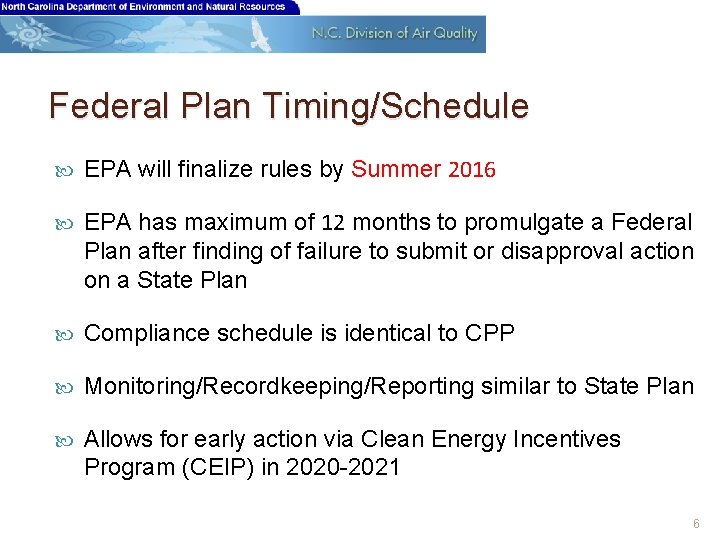
Federal Plan Timing/Schedule EPA will finalize rules by Summer 2016 EPA has maximum of 12 months to promulgate a Federal Plan after finding of failure to submit or disapproval action on a State Plan Compliance schedule is identical to CPP Monitoring/Recordkeeping/Reporting similar to State Plan Allows for early action via Clean Energy Incentives Program (CEIP) in 2020 -2021 6
Questions? Contact Sushma Masemore, PE Division of Air Quality 919 -707 -8700 sushma. masemore@ncdenr. gov 7
ADDITIONAL REFERENCE MATERIALS FROM EPA’S PROPOSED FEDERAL PLAN 8
PROPOSED FEDERAL PLAN – TRADING PROGRAM 9
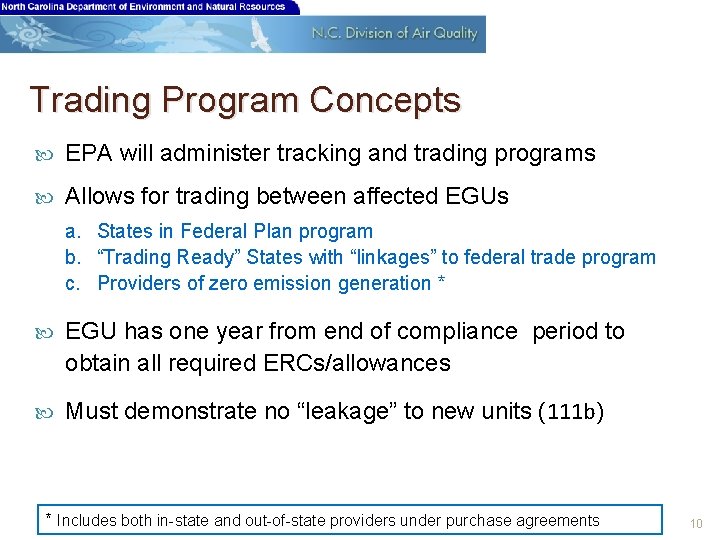
Trading Program Concepts EPA will administer tracking and trading programs Allows for trading between affected EGUs a. States in Federal Plan program b. “Trading Ready” States with “linkages” to federal trade program c. Providers of zero emission generation * EGU has one year from end of compliance period to obtain all required ERCs/allowances Must demonstrate no “leakage” to new units (111 b) * Includes both in-state and out-of-state providers under purchase agreements 10
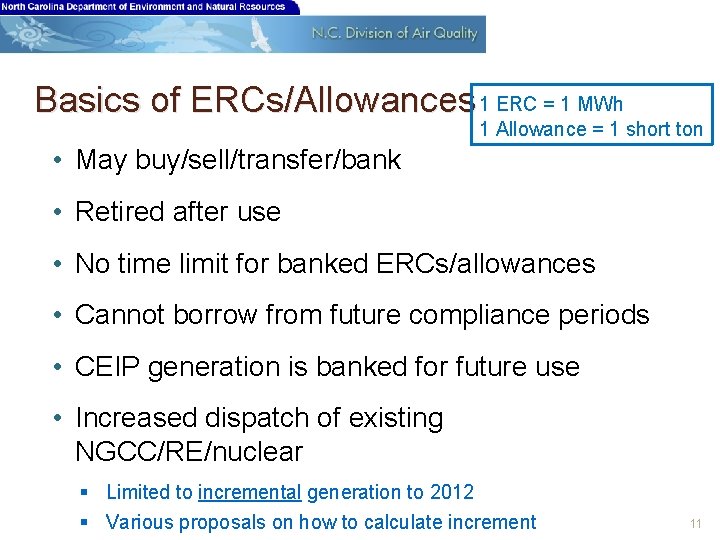
Basics of ERCs/Allowances 1 ERC = 1 MWh 1 Allowance = 1 short ton • May buy/sell/transfer/bank • Retired after use • No time limit for banked ERCs/allowances • Cannot borrow from future compliance periods • CEIP generation is banked for future use • Increased dispatch of existing NGCC/RE/nuclear § Limited to incremental generation to 2012 § Various proposals on how to calculate increment 11
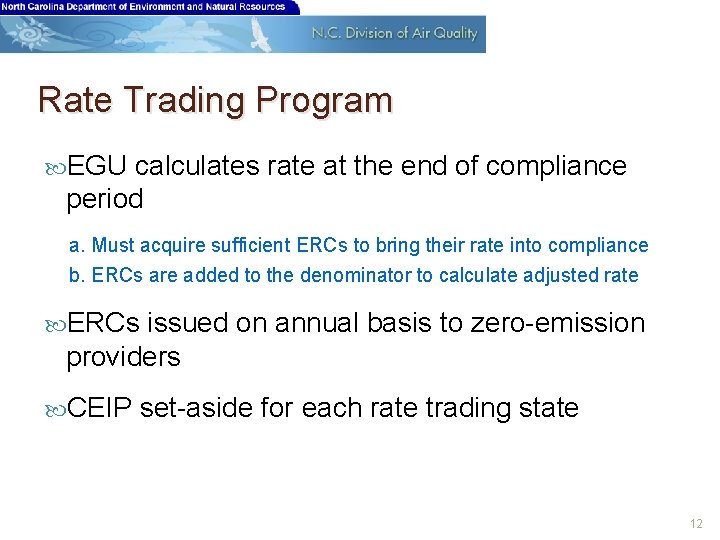
Rate Trading Program EGU calculates rate at the end of compliance period a. Must acquire sufficient ERCs to bring their rate into compliance b. ERCs are added to the denominator to calculate adjusted rate ERCs issued on annual basis to zero-emission providers CEIP set-aside for each rate trading state 12
Mass Trading Program Allowances distributed each period to EGUs based on: § Average 2010 -2012 emissions (EPA method) § Under construction coal/NGCC based on 60%/55% of summer capacity § EGU assumed retired after 2 years of no generation § State can develop its own method EGU emissions must equal allowances for each period EGUs can obtain allowances via trading system as needed Allowance Set-Asides to limit “leakage” 1. CEIP 2. Existing NGCC - limited to generation from 50% to 60% of CF (10%) 13
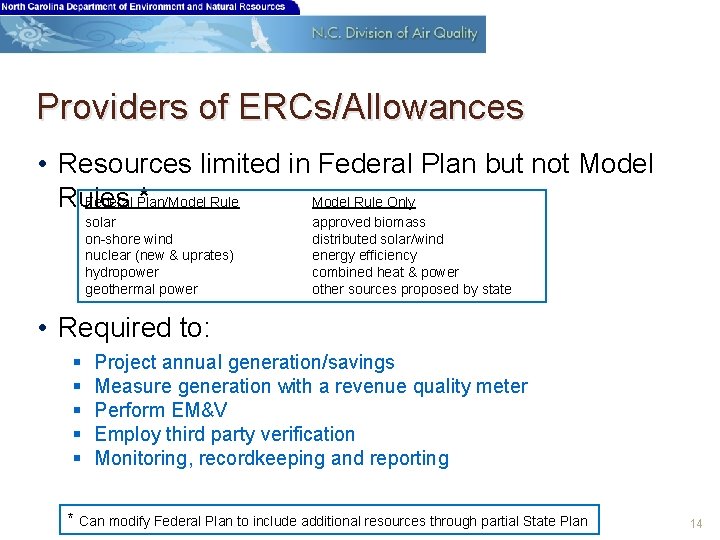
Providers of ERCs/Allowances • Resources limited in Federal Plan but not Model Rules * Federal Plan/Model Rule Only solar on-shore wind nuclear (new & uprates) hydropower geothermal power approved biomass distributed solar/wind energy efficiency combined heat & power other sources proposed by state • Required to: § § § Project annual generation/savings Measure generation with a revenue quality meter Perform EM&V Employ third party verification Monitoring, recordkeeping and reporting * Can modify Federal Plan to include additional resources through partial State Plan 14
PROPOSED FEDERAL PLAN OTHER REQUIREMENTS 15
Other Federal Plan Considerations Electricity System Reliability § EPA will ensure reliability § Rate-based approach does not have safety valve § Mass-based approach has safety valve via allowance set-asides Applicability/Enforceability § Rate or mass limit will apply to EGU Federal Plan is federally enforceable on EGU § EGU subject to violations & corrective measures § Same monitoring/recordkeeping/reporting as State Plan 16
PROPOSED MODEL RULES 17
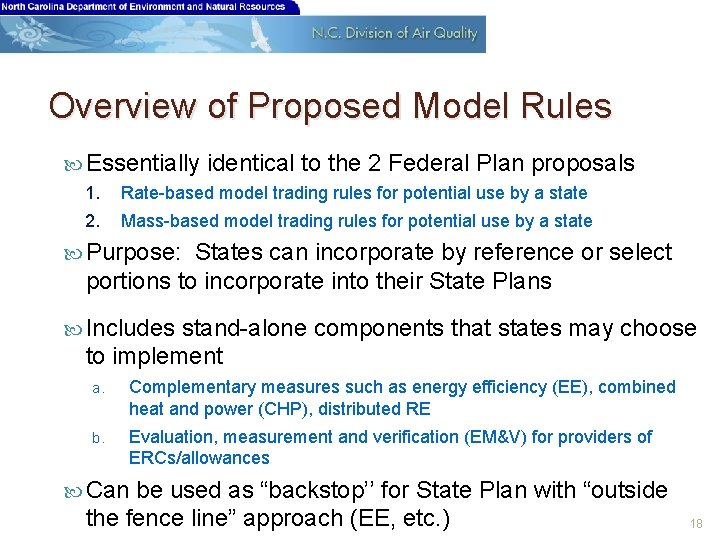
Overview of Proposed Model Rules Essentially 1. 2. identical to the 2 Federal Plan proposals Rate-based model trading rules for potential use by a state Mass-based model trading rules for potential use by a state Purpose: States can incorporate by reference or select portions to incorporate into their State Plans Includes stand-alone components that states may choose to implement a. Complementary measures such as energy efficiency (EE), combined heat and power (CHP), distributed RE b. Evaluation, measurement and verification (EM&V) for providers of ERCs/allowances Can be used as “backstop’’ for State Plan with “outside the fence line” approach (EE, etc. ) 18
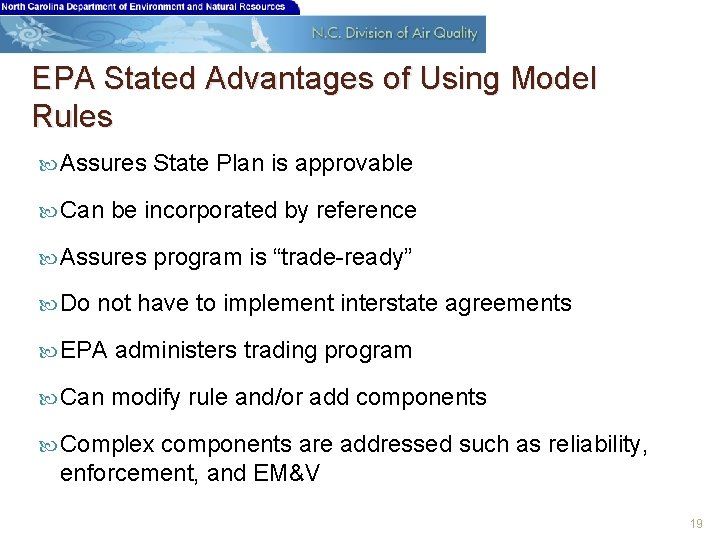
EPA Stated Advantages of Using Model Rules Assures Can be incorporated by reference Assures Do State Plan is approvable program is “trade-ready” not have to implement interstate agreements EPA administers trading program Can modify rule and/or add components Complex components are addressed such as reliability, enforcement, and EM&V 19