
Clean Disinfect Protect Webinar 7222020 MCI NFI Parts
Clean, Disinfect & Protect Webinar 7/22/2020
MCI / NFI Parts Team BRENT MAITLAND Vice President Marketing, Product Planning and Pre-Owned Coach Sales M (630) 235 -9696 BRENT DANIELSON Director of Product Planning & Sales Engineering M (204) 228 -4119
Agenda • Operator Feedback • MCI resources and guidance: • Overview • NFI Parts • Customer toolkit • NFI Parts: Clean & Protect product discussion
Operator Feedback
Operator Feedback Motor coach operators now: • Have been preparing their business for recovery • Some glimmers of hope as states re-open and schools and other activities announced. • Utilizing tools and resources from ABA and UMA to help focus their recovery actions and customer engagement. • Many will need to continued support from Federal programs and key activities such as schools' trips and sports. • Doing anything to help build customer confidence in riding the coach.
FAQ What disinfectant should I use: (See prior webinar for details) • Preferred: L-Lactic Acid, Hypochlorous Acid • Avoid: Bleach or Ammonia Can you provide an overview of the HVAC system and filtration? • Generally the virus spreads person to person through respiratory droplets at close contact (within 6’) or by touching surfaces which have been contaminated by droplets • Respiratory droplets are heavy and will fall to the floor after being expelled due to gravity. NOT Airborne, floating through HVAC systems • Droplets are also quite large in diameter, which means will be captured at a high % by standard MERV 5 or higher HVAC filter media (MCI = min MERV 5) • Change filters every 3 months as a rule of thumb • The fresh air inside an MCI motorcoach is replaced every 10 minutes (6 times each hour) • Is filtered approximately every 2 minutes. (30 x per hour) • The HVAC system automatically optimizes fresh air What are the top ways to prevent the transmission of the virus? • 1. Physical distancing, including the use of masks • 2. Regularly cleaning and disinfecting surfaces
FAQ What products are people adding to their coaches/fleets: • Disinfecting fogger • Driver barriers, especially in scheduled service • Upgraded MERV filters specifically with anti-microbial coating. • We are NOT offering MERV 13 due to reduction in HVAC performance. • UV-C anti-microbial lighting system in HVAC Have you explored other solutions? • Continuous systems: Photo Catalytic Oxidation (PCO) Hydrogen Peroxide – also UV + Catalyst. • FAR-UV (Industry risk if determined airborne vs. droplet) Are we being heard on the Hill? • CERTS act is a direct result of our congressional outreach
Operator Feedback From the survey, the resulting themes emerged: • Operators favored non-distancing themes – passenger masks as opposed greater spacing. • Current lack of clarity on guidance. • Will school bus CDC guidance influence motorcoaches? Why not airplanes too? • Prioritizing of hand cleaning and disinfection strategies. • Fogging drastically reduces labor hours vs hand wiping. • Increased customer communications.
MCI Available Resources 10 © Motor Coach Industries Int’l, Inc. and its subsidiaries. All Rights Reserved.
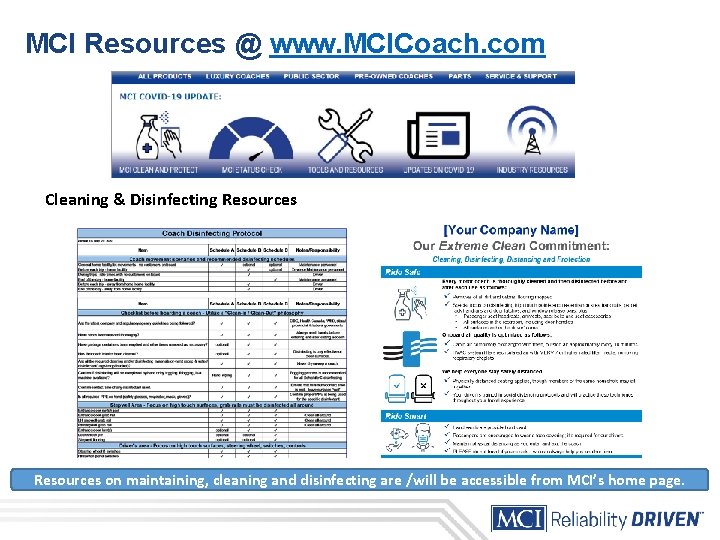
MCI Resources @ www. MCICoach. com Cleaning & Disinfecting Resources on maintaining, cleaning and disinfecting are /will be accessible from MCI’s home page.
Customer Toolkit: Best Practices to Clean, Disinfect and Prevent SARS -Co. V-2 Virus Spread
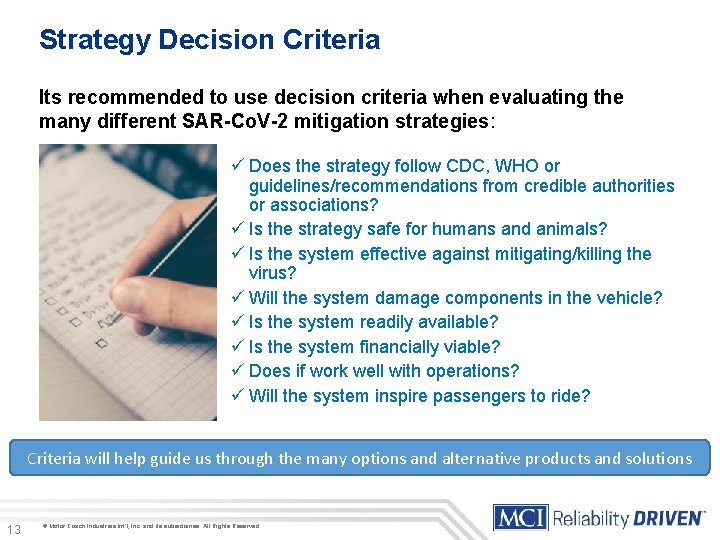
Strategy Decision Criteria Its recommended to use decision criteria when evaluating the many different SAR-Co. V-2 mitigation strategies: ü Does the strategy follow CDC, WHO or guidelines/recommendations from credible authorities or associations? ü Is the strategy safe for humans and animals? ü Is the system effective against mitigating/killing the virus? ü Will the system damage components in the vehicle? ü Is the system readily available? ü Is the system financially viable? ü Does if work well with operations? ü Will the system inspire passengers to ride? Criteria will help guide us through the many options and alternative products and solutions 13 © Motor Coach Industries Int’l, Inc. and its subsidiaries. All Rights Reserved.
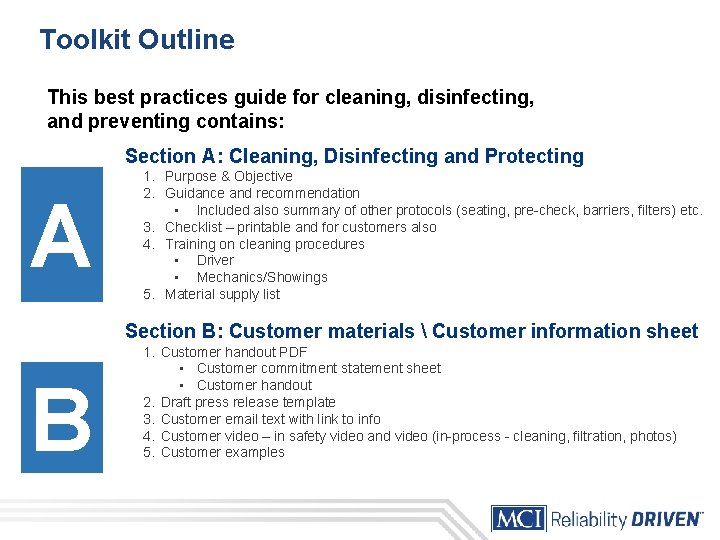
Toolkit Outline This best practices guide for cleaning, disinfecting, and preventing contains: Section A: Cleaning, Disinfecting and Protecting A 1. Purpose & Objective 2. Guidance and recommendation • Included also summary of other protocols (seating, pre-check, barriers, filters) etc. 3. Checklist – printable and for customers also 4. Training on cleaning procedures • Driver • Mechanics/Showings 5. Material supply list Section B: Customer materials Customer information sheet B 1. Customer handout PDF • Customer commitment statement sheet • Customer handout 2. Draft press release template 3. Customer email text with link to info 4. Customer video – in safety video and video (in-process - cleaning, filtration, photos) 5. Customer examples
Toolkit Section A 1: Objective
Toolkit - Section A 1: Objective To provide tools and information that helps our motor coach operators: üImplement Practices for cleaning and disinfecting motor coaches. üCreate customer confidence that motor coaches are a clean and safe mode of transportation.
Section A 2: Guidance And Recommendations
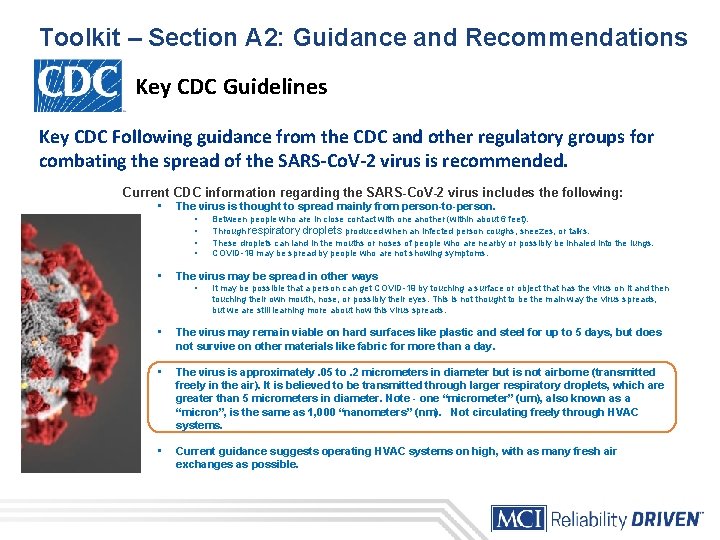
Toolkit – Section A 2: Guidance and Recommendations Key CDC Guidelines Key CDC Following guidance from the CDC and other regulatory groups for combating the spread of the SARS-Co. V-2 virus is recommended. Current CDC information regarding the SARS-Co. V-2 virus includes the following: • The virus is thought to spread mainly from person-to-person. • • • Between people who are in close contact with one another (within about 6 feet). Through respiratory droplets produced when an infected person coughs, sneezes, or talks. These droplets can land in the mouths or noses of people who are nearby or possibly be inhaled into the lungs. COVID-19 may be spread by people who are not showing symptoms. The virus may be spread in other ways • It may be possible that a person can get COVID-19 by touching a surface or object that has the virus on it and then touching their own mouth, nose, or possibly their eyes. This is not thought to be the main way the virus spreads, but we are still learning more about how this virus spreads. • The virus may remain viable on hard surfaces like plastic and steel for up to 5 days, but does not survive on other materials like fabric for more than a day. • The virus is approximately. 05 to. 2 micrometers in diameter but is not airborne (transmitted freely in the air). It is believed to be transmitted through larger respiratory droplets, which are greater than 5 micrometers in diameter. Note - one “micrometer” (um), also known as a “micron”, is the same as 1, 000 “nanometers” (nm). Not circulating freely through HVAC systems. • Current guidance suggests operating HVAC systems on high, with as many fresh air exchanges as possible.
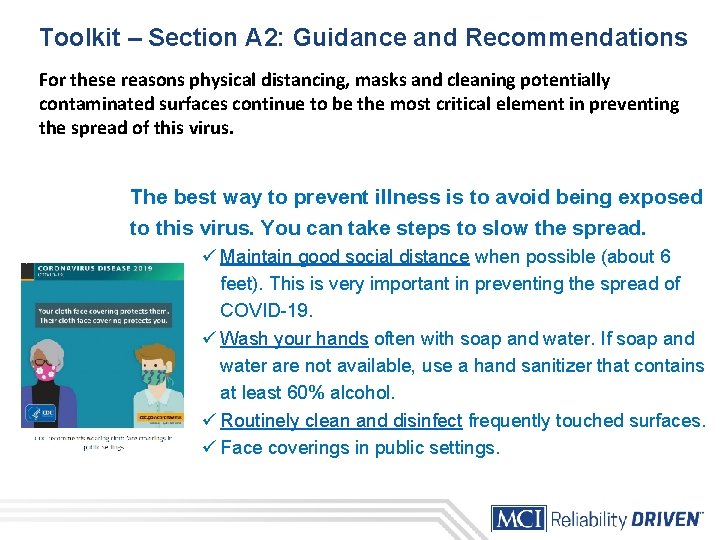
Toolkit – Section A 2: Guidance and Recommendations For these reasons physical distancing, masks and cleaning potentially contaminated surfaces continue to be the most critical element in preventing the spread of this virus. The best way to prevent illness is to avoid being exposed to this virus. You can take steps to slow the spread. ü Maintain good social distance when possible (about 6 feet). This is very important in preventing the spread of COVID-19. ü Wash your hands often with soap and water. If soap and water are not available, use a hand sanitizer that contains at least 60% alcohol. ü Routinely clean and disinfect frequently touched surfaces. ü Face coverings in public settings.
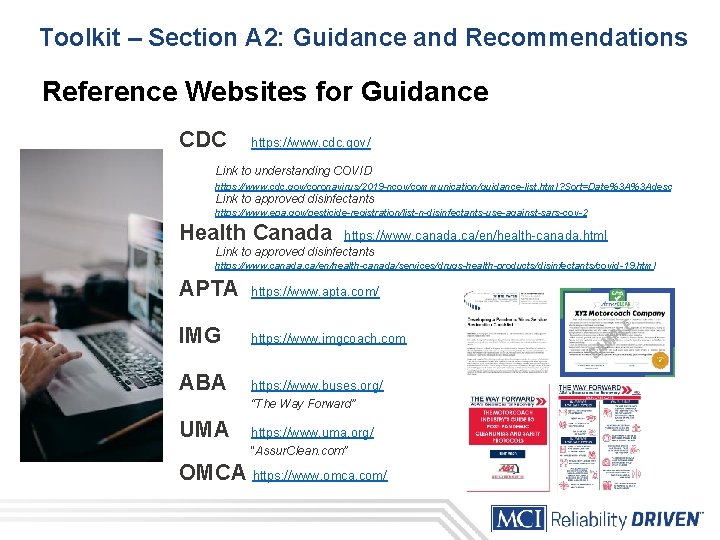
Toolkit – Section A 2: Guidance and Recommendations Reference Websites for Guidance CDC https: //www. cdc. gov/ Link to understanding COVID https: //www. cdc. gov/coronavirus/2019 -ncov/communication/guidance-list. html? Sort=Date%3 A%3 Adesc Link to approved disinfectants https: //www. epa. gov/pesticide-registration/list-n-disinfectants-use-against-sars-cov-2 Health Canada https: //www. canada. ca/en/health-canada. html Link to approved disinfectants https: //www. canada. ca/en/health-canada/services/drugs-health-products/disinfectants/covid-19. html APTA https: //www. apta. com/ IMG https: //www. imgcoach. com ABA https: //www. buses. org/ “The Way Forward” UMA https: //www. uma. org/ “Assur. Clean. com” OMCA https: //www. omca. com/
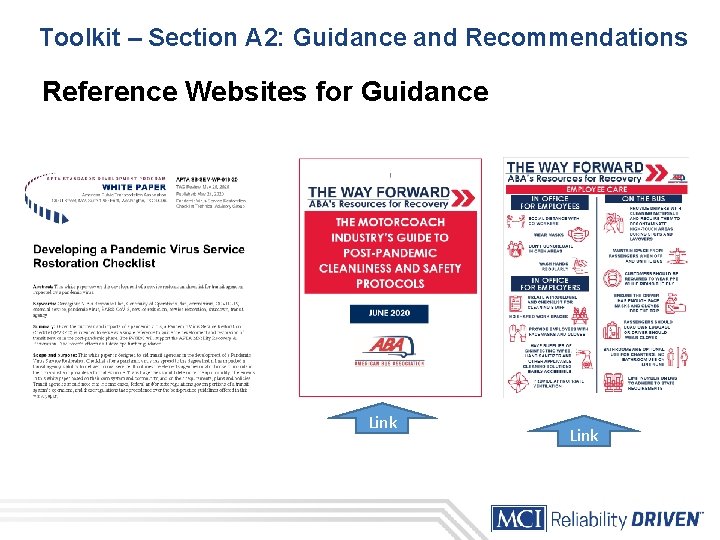
Toolkit – Section A 2: Guidance and Recommendations Reference Websites for Guidance Link
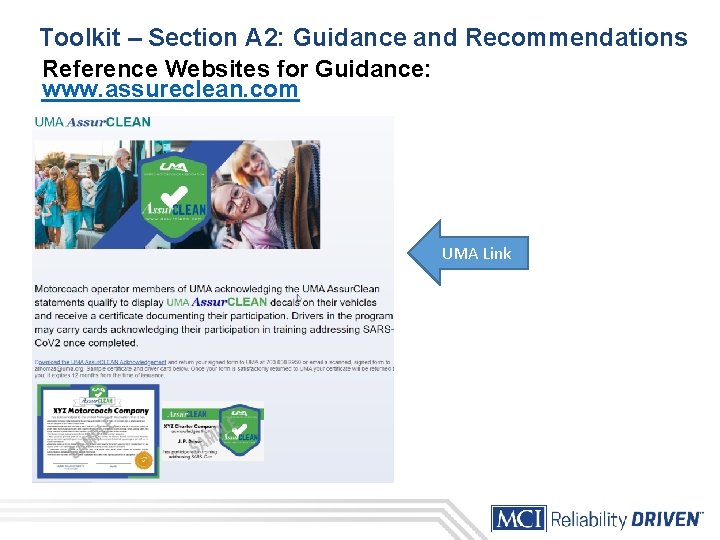
Toolkit – Section A 2: Guidance and Recommendations Reference Websites for Guidance: www. assureclean. com UMA Link
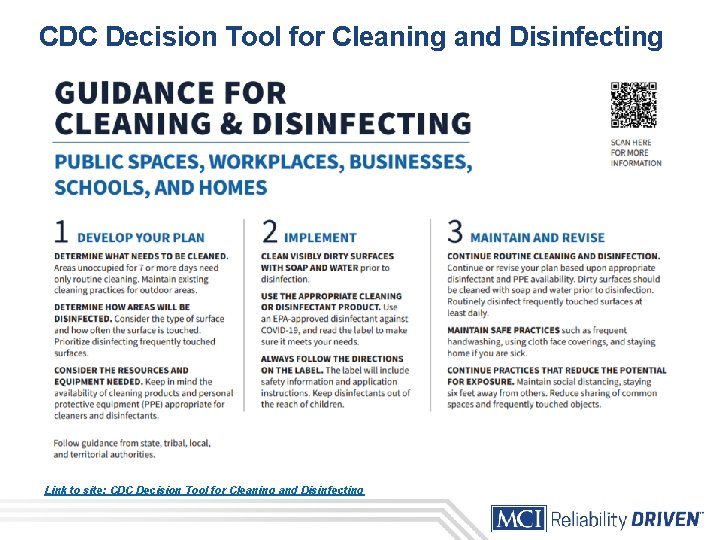
CDC Decision Tool for Cleaning and Disinfecting Link to site: CDC Decision Tool for Cleaning and Disinfecting
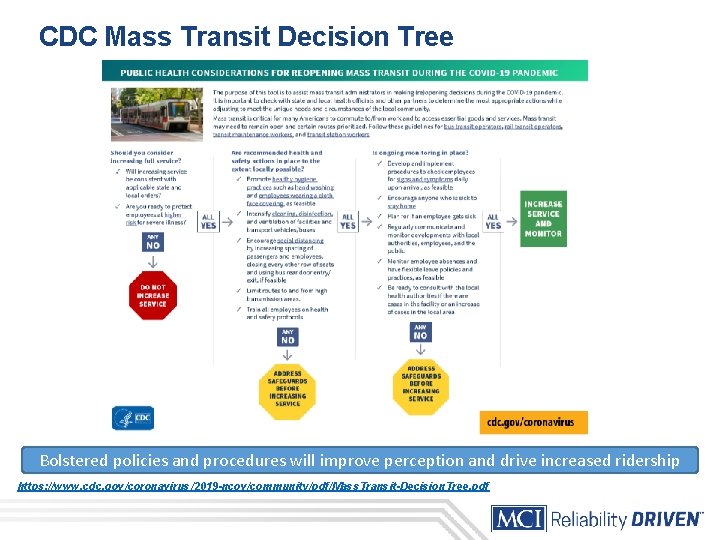
CDC Mass Transit Decision Tree Bolstered policies and procedures will improve perception and drive increased ridership https: //www. cdc. gov/coronavirus/2019 -ncov/community/pdf/Mass. Transit-Decision. Tree. pdf
Terminology Per the CDC, it is important to know the difference between cleaning, disinfecting, and sanitizing. • Cleaning removes germs, dirt, and impurities from surfaces or objects. Cleaning works by using soap (or detergent) and water to physically remove germs from surfaces. This process does not necessarily kill germs, but by removing them, it lowers their numbers and the risk of spreading infection. • Disinfecting kills germs on surfaces or objects. Disinfecting works by using chemicals to kill germs on surfaces or objects. This process does not necessarily clean dirty surfaces or remove germs, but by killing germs on a surface after cleaning, it can further lower the risk of spreading infection. • Sanitizing lowers the number of germs on surfaces or objects to a safe level, as judged by public health standards or requirements. This process works by either cleaning or disinfecting surfaces or objects to lower the risk of spreading infection. https: //www. cdc. gov/flu/school/cleaning. htm
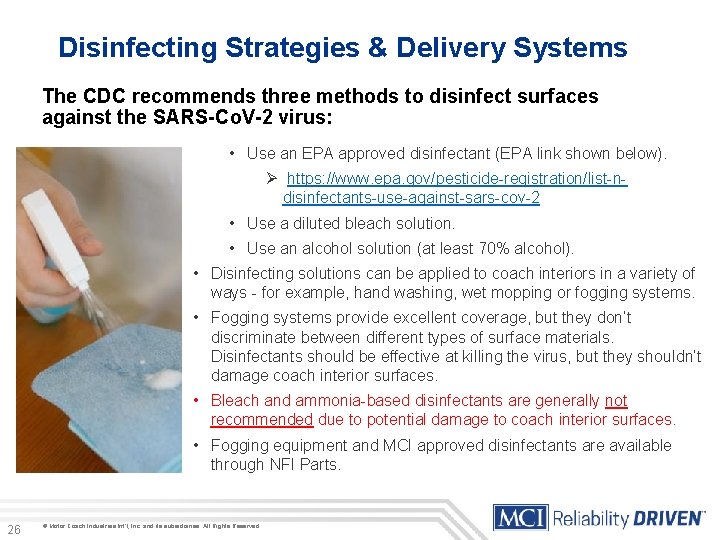
Disinfecting Strategies & Delivery Systems The CDC recommends three methods to disinfect surfaces against the SARS-Co. V-2 virus: • Use an EPA approved disinfectant (EPA link shown below). Ø https: //www. epa. gov/pesticide-registration/list-ndisinfectants-use-against-sars-cov-2 • Use a diluted bleach solution. • Use an alcohol solution (at least 70% alcohol). • Disinfecting solutions can be applied to coach interiors in a variety of ways - for example, hand washing, wet mopping or fogging systems. • Fogging systems provide excellent coverage, but they don’t discriminate between different types of surface materials. Disinfectants should be effective at killing the virus, but they shouldn’t damage coach interior surfaces. • Bleach and ammonia-based disinfectants are generally not recommended due to potential damage to coach interior surfaces. • Fogging equipment and MCI approved disinfectants are available through NFI Parts. 26 © Motor Coach Industries Int’l, Inc. and its subsidiaries. All Rights Reserved.
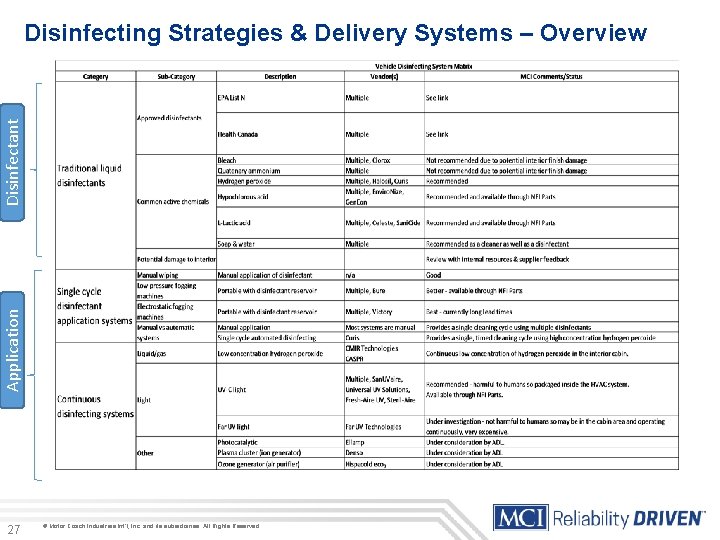
Application Disinfectant Disinfecting Strategies & Delivery Systems – Overview 27 © Motor Coach Industries Int’l, Inc. and its subsidiaries. All Rights Reserved.
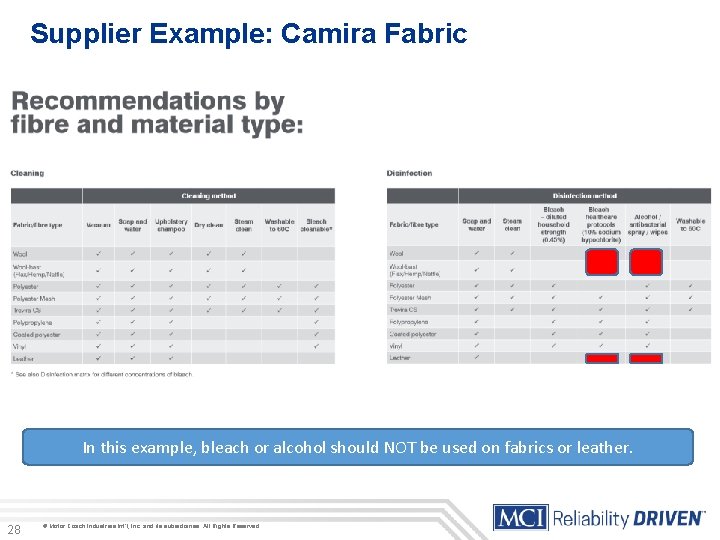
Supplier Example: Camira Fabric In this example, bleach or alcohol should NOT be used on fabrics or leather. 28 © Motor Coach Industries Int’l, Inc. and its subsidiaries. All Rights Reserved.
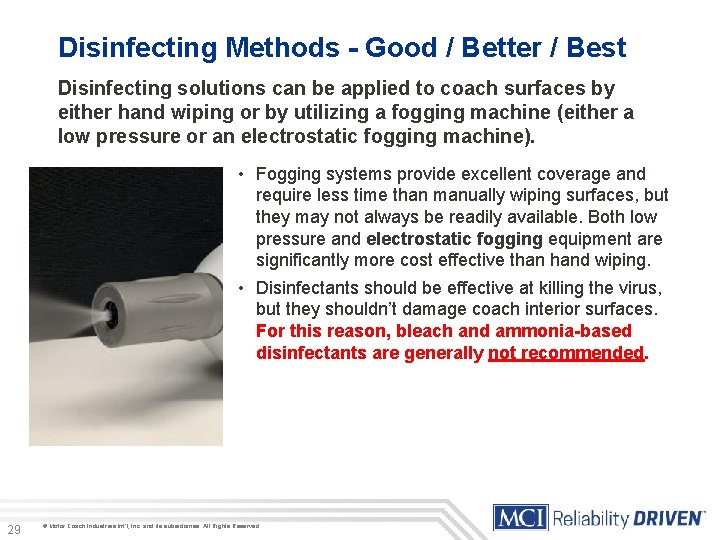
Disinfecting Methods - Good / Better / Best Disinfecting solutions can be applied to coach surfaces by either hand wiping or by utilizing a fogging machine (either a low pressure or an electrostatic fogging machine). • Fogging systems provide excellent coverage and require less time than manually wiping surfaces, but they may not always be readily available. Both low pressure and electrostatic fogging equipment are significantly more cost effective than hand wiping. • Disinfectants should be effective at killing the virus, but they shouldn’t damage coach interior surfaces. For this reason, bleach and ammonia-based disinfectants are generally not recommended. 29 © Motor Coach Industries Int’l, Inc. and its subsidiaries. All Rights Reserved.
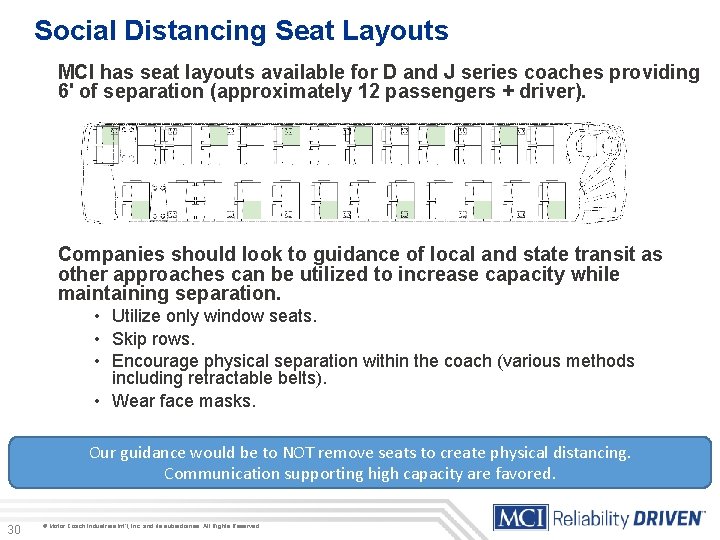
Social Distancing Seat Layouts MCI has seat layouts available for D and J series coaches providing 6' of separation (approximately 12 passengers + driver). Companies should look to guidance of local and state transit as other approaches can be utilized to increase capacity while maintaining separation. • Utilize only window seats. • Skip rows. • Encourage physical separation within the coach (various methods including retractable belts). • Wear face masks. Our guidance would be to NOT remove seats to create physical distancing. Communication supporting high capacity are favored. 30 © Motor Coach Industries Int’l, Inc. and its subsidiaries. All Rights Reserved.
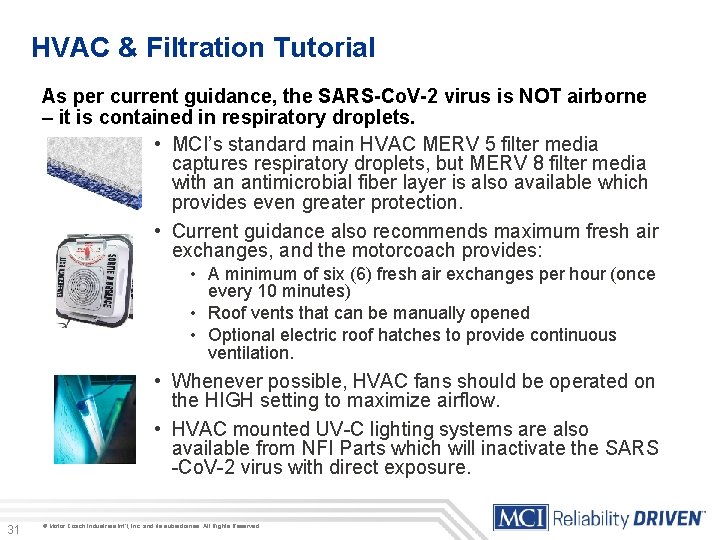
HVAC & Filtration Tutorial As per current guidance, the SARS-Co. V-2 virus is NOT airborne – it is contained in respiratory droplets. • MCI’s standard main HVAC MERV 5 filter media captures respiratory droplets, but MERV 8 filter media with an antimicrobial fiber layer is also available which provides even greater protection. • Current guidance also recommends maximum fresh air exchanges, and the motorcoach provides: • A minimum of six (6) fresh air exchanges per hour (once every 10 minutes) • Roof vents that can be manually opened • Optional electric roof hatches to provide continuous ventilation. • Whenever possible, HVAC fans should be operated on the HIGH setting to maximize airflow. • HVAC mounted UV-C lighting systems are also available from NFI Parts which will inactivate the SARS -Co. V-2 virus with direct exposure. 31 © Motor Coach Industries Int’l, Inc. and its subsidiaries. All Rights Reserved.
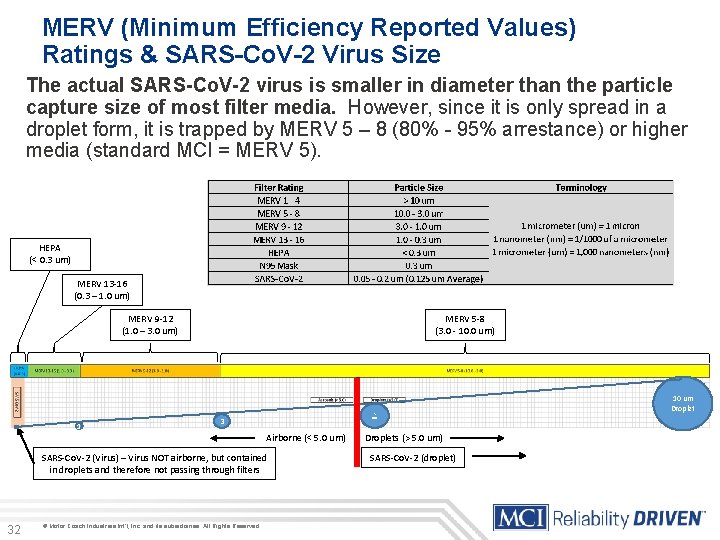
MERV (Minimum Efficiency Reported Values) Ratings & SARS-Co. V-2 Virus Size The actual SARS-Co. V-2 virus is smaller in diameter than the particle capture size of most filter media. However, since it is only spread in a droplet form, it is trapped by MERV 5 – 8 (80% - 95% arrestance) or higher media (standard MCI = MERV 5). HEPA (< 0. 3 um) MERV 13 -16 (0. 3 – 1. 0 um) MERV 9 -12 (1. 0 – 3. 0 um) 1 MERV 5 -8 (3. 0 - 10. 0 um) 5 um 3 Airborne (< 5. 0 um) SARS-Co. V-2 (Virus) – Virus NOT airborne, but contained in droplets and therefore not passing through filters 32 © Motor Coach Industries Int’l, Inc. and its subsidiaries. All Rights Reserved. Droplets (> 5. 0 um) SARS-Co. V-2 (droplet) 10 um Droplet
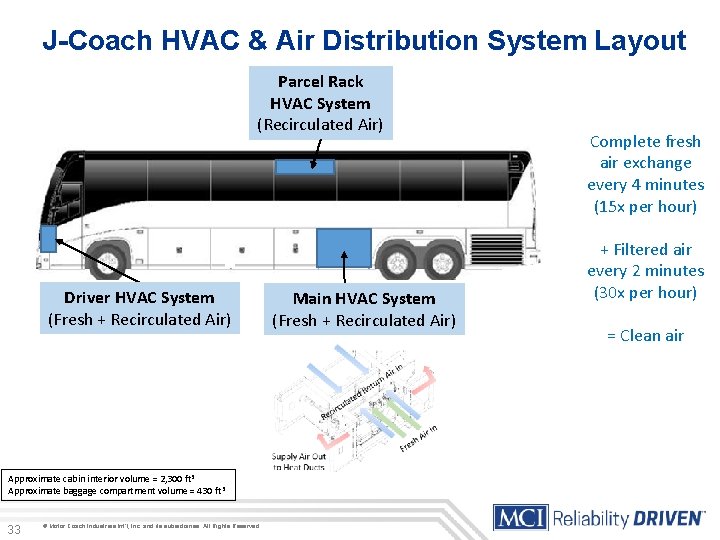
J-Coach HVAC & Air Distribution System Layout Parcel Rack HVAC System (Recirculated Air) Driver HVAC System (Fresh + Recirculated Air) Approximate cabin interior volume = 2, 300 ft 3 Approximate baggage compartment volume = 430 ft 3 33 © Motor Coach Industries Int’l, Inc. and its subsidiaries. All Rights Reserved. Main HVAC System (Fresh + Recirculated Air) Complete fresh air exchange every 4 minutes (15 x per hour) + Filtered air every 2 minutes (30 x per hour) = Clean air
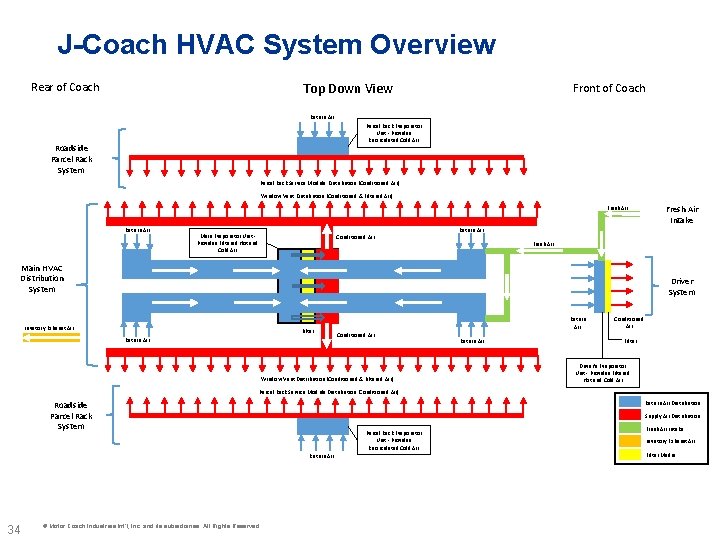
J-Coach HVAC System Overview Top Down View Rear of Coach Front of Coach Return Air Parcel Rack Evaporator Unit - Provides Recirculated Cold Air Roadside Parcel Rack System Parcel Rack Service Module Distribution (Conditioned Air) Window Vent Distribution (Conditioned & Filtered Air) Fresh Air Intake Fresh Air Return Air Main Evaporator Unit - Provides Filtered Hot and Cold Air Conditioned Air Return Air Fresh Air Main HVAC Distribution System Driver System Lavatory Exhaust Air Filter Return Air Conditioned Air Window Vent Distribution (Conditioned & Filtered Air) Return Air Conditioned Air Filter Driver’s Evaporator Unit - Provides Filtered Hot and Cold Air Parcel Rack Service Module Distribution (Conditioned Air) Return Air Distribution Roadside Parcel Rack System Supply Air Distribution Parcel Rack Evaporator Unit - Provides Recirculated Cold Air Return Air 34 © Motor Coach Industries Int’l, Inc. and its subsidiaries. All Rights Reserved. Fresh Air Intake Lavatory Exhaust Air Filter Media
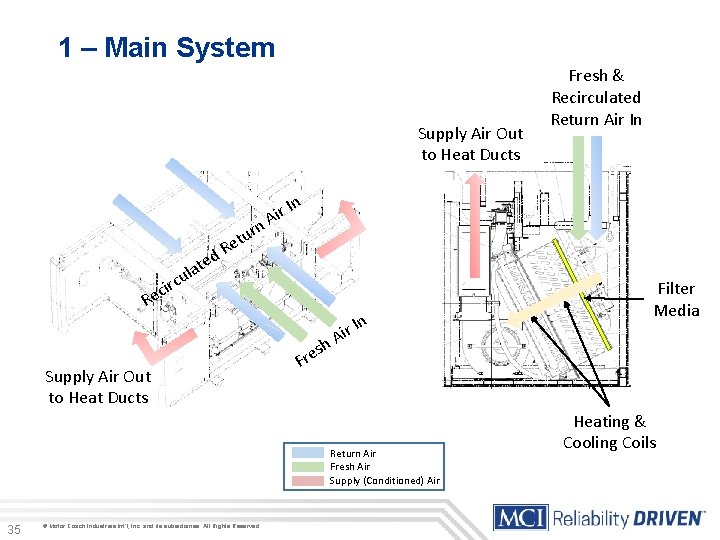
1 – Main System Supply Air Out to Heat Ducts Fresh & Recirculated Return Air In r i A n tur e d R e lat u irc c Re n I r i A Filter Media h Supply Air Out to Heat Ducts s e r F Return Air Fresh Air Supply (Conditioned) Air 35 © Motor Coach Industries Int’l, Inc. and its subsidiaries. All Rights Reserved. Heating & Cooling Coils
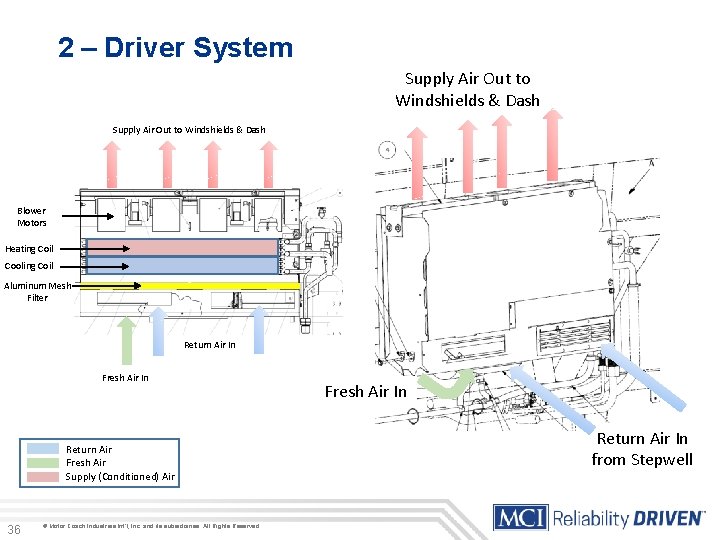
2 – Driver System Supply Air Out to Windshields & Dash Blower Motors Heating Coil Cooling Coil Aluminum Mesh Filter Return Air In Fresh Air In Return Air Fresh Air Supply (Conditioned) Air 36 © Motor Coach Industries Int’l, Inc. and its subsidiaries. All Rights Reserved. Fresh Air In Return Air In from Stepwell
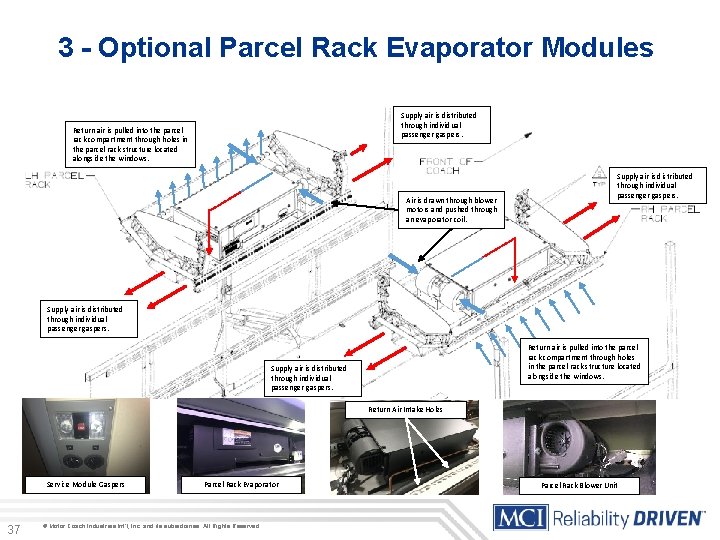
3 - Optional Parcel Rack Evaporator Modules Supply air is distributed through individual passenger gaspers. Return air is pulled into the parcel rack compartment through holes in the parcel rack structure located alongside the windows. Air is drawn through blower motors and pushed through an evaporator coil. Supply air is distributed through individual passenger gaspers. Return air is pulled into the parcel rack compartment through holes in the parcel rack structure located alongside the windows. Supply air is distributed through individual passenger gaspers. Return Air Intake Holes Service Module Gaspers 37 Parcel Rack Evaporator © Motor Coach Industries Int’l, Inc. and its subsidiaries. All Rights Reserved. Parcel Rack Blower Unit
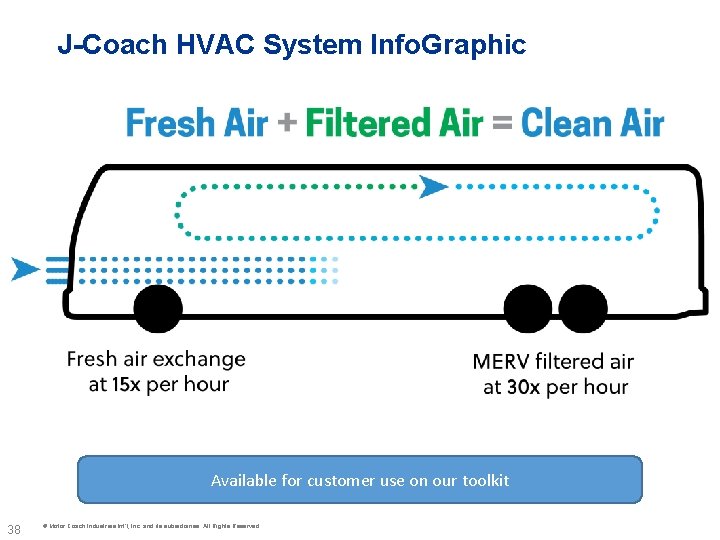
J-Coach HVAC System Info. Graphic Available for customer use on our toolkit 38 © Motor Coach Industries Int’l, Inc. and its subsidiaries. All Rights Reserved.
Section A 3: Overview and Checklist 39 © Motor Coach Industries Int’l, Inc. and its subsidiaries. All Rights Reserved.
Printable Documents and Checklists 40 © Motor Coach Industries Int’l, Inc. and its subsidiaries. All Rights Reserved.
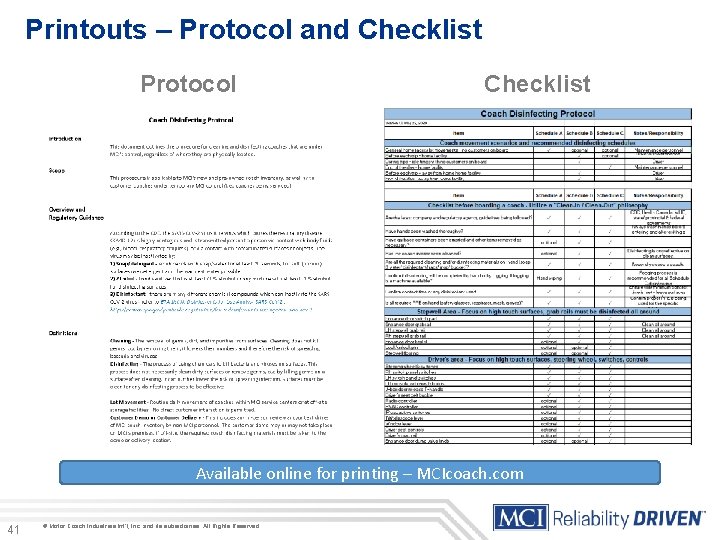
Printouts – Protocol and Checklist Protocol Checklist Available online for printing – MCIcoach. com 41 © Motor Coach Industries Int’l, Inc. and its subsidiaries. All Rights Reserved.
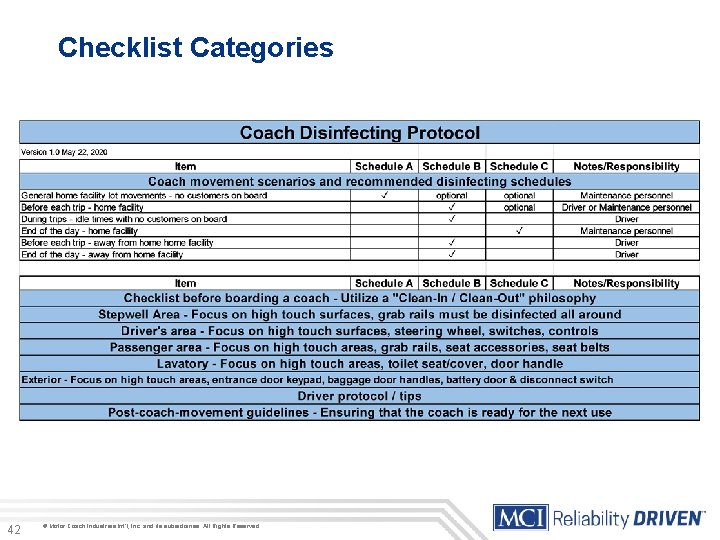
Checklist Categories 42 © Motor Coach Industries Int’l, Inc. and its subsidiaries. All Rights Reserved.
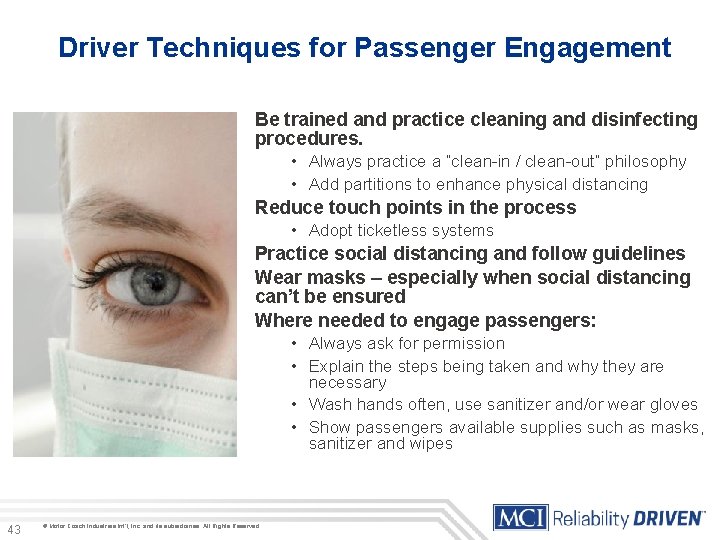
Driver Techniques for Passenger Engagement Be trained and practice cleaning and disinfecting procedures. • Always practice a “clean-in / clean-out” philosophy • Add partitions to enhance physical distancing Reduce touch points in the process • Adopt ticketless systems Practice social distancing and follow guidelines Wear masks – especially when social distancing can’t be ensured Where needed to engage passengers: • Always ask for permission • Explain the steps being taken and why they are necessary • Wash hands often, use sanitizer and/or wear gloves • Show passengers available supplies such as masks, sanitizer and wipes 43 © Motor Coach Industries Int’l, Inc. and its subsidiaries. All Rights Reserved.
Section A 4: Training 44 © Motor Coach Industries Int’l, Inc. and its subsidiaries. All Rights Reserved.
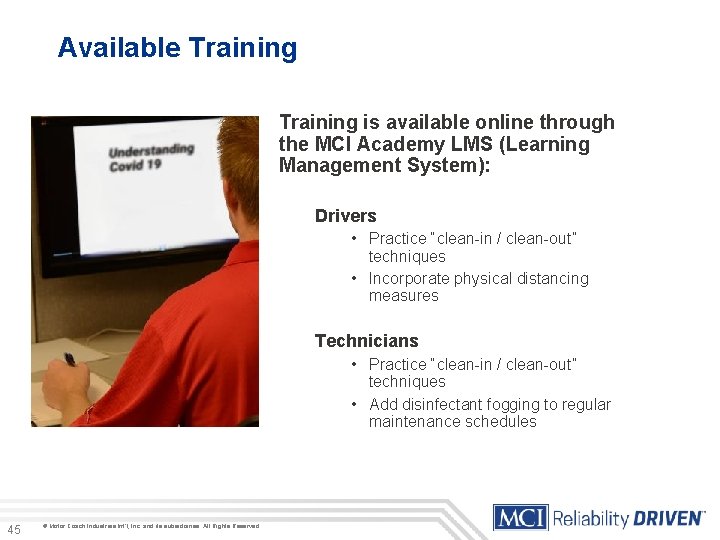
Available Training is available online through the MCI Academy LMS (Learning Management System): Drivers • Practice “clean-in / clean-out” techniques • Incorporate physical distancing measures Technicians • Practice “clean-in / clean-out” techniques • Add disinfectant fogging to regular maintenance schedules 45 © Motor Coach Industries Int’l, Inc. and its subsidiaries. All Rights Reserved.
Section A 5: Supply List 46 © Motor Coach Industries Int’l, Inc. and its subsidiaries. All Rights Reserved.
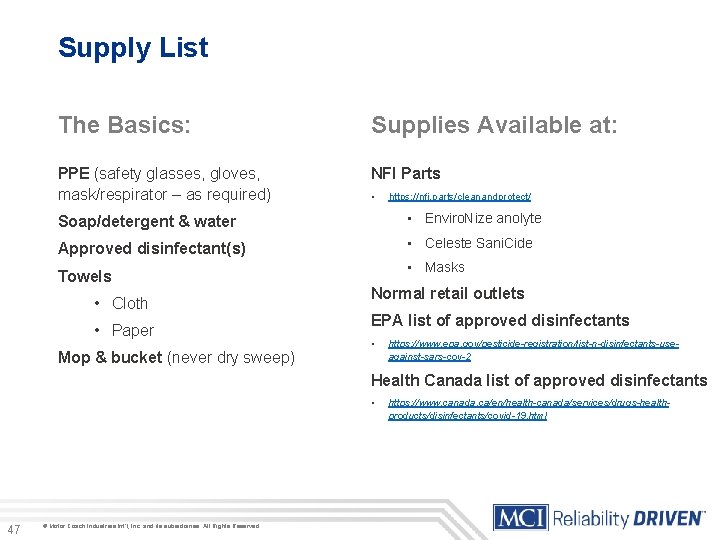
Supply List The Basics: Supplies Available at: PPE (safety glasses, gloves, mask/respirator – as required) NFI Parts • https: //nfi. parts/cleanandprotect/ Soap/detergent & water • Enviro. Nize anolyte Approved disinfectant(s) • Celeste Sani. Cide Towels • Cloth • Paper Mop & bucket (never dry sweep) • Masks Normal retail outlets EPA list of approved disinfectants • https: //www. epa. gov/pesticide-registration/list-n-disinfectants-useagainst-sars-cov-2 Health Canada list of approved disinfectants • 47 © Motor Coach Industries Int’l, Inc. and its subsidiaries. All Rights Reserved. https: //www. canada. ca/en/health-canada/services/drugs-healthproducts/disinfectants/covid-19. html
Section B 1: Customer Handout PDF Customer Commitment Statement Sheet 48 © Motor Coach Industries Int’l, Inc. and its subsidiaries. All Rights Reserved.
Explanation of Tools The following are designed as "general" guidance and should be tailored to the policy and procedures of: • The company • The state and local guidance • Type of customer – Tour, Charter, Line Haul / Scheduled Service
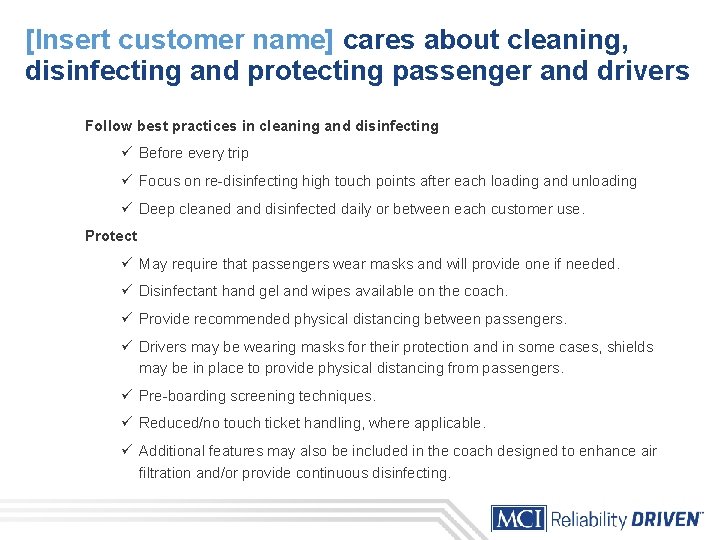
[Insert customer name] cares about cleaning, disinfecting and protecting passenger and drivers Follow best practices in cleaning and disinfecting ü Before every trip ü Focus on re-disinfecting high touch points after each loading and unloading ü Deep cleaned and disinfected daily or between each customer use. Protect ü May require that passengers wear masks and will provide one if needed. ü Disinfectant hand gel and wipes available on the coach. ü Provide recommended physical distancing between passengers. ü Drivers may be wearing masks for their protection and in some cases, shields may be in place to provide physical distancing from passengers. ü Pre-boarding screening techniques. ü Reduced/no touch ticket handling, where applicable. ü Additional features may also be included in the coach designed to enhance air filtration and/or provide continuous disinfecting.
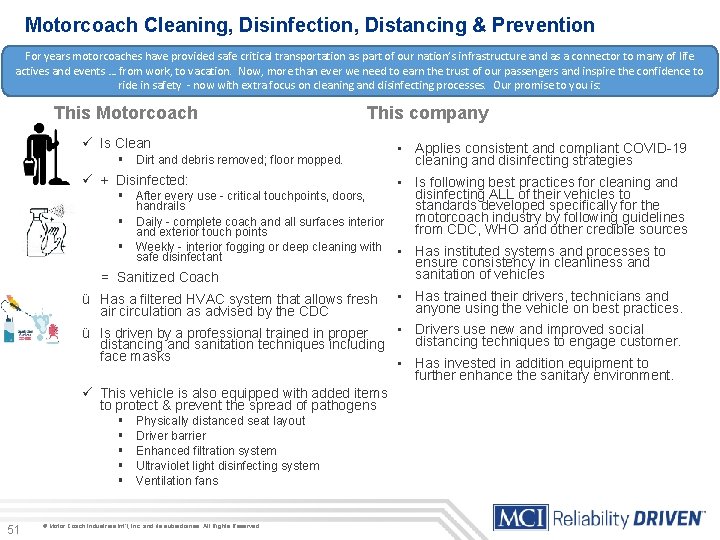
Motorcoach Cleaning, Disinfection, Distancing & Prevention For years motorcoaches have provided safe critical transportation as part of our nation’s infrastructure and as a connector to many of life actives and events … from work, to vacation. Now, more than ever we need to earn the trust of our passengers and inspire the confidence to ride in safety - now with extra focus on cleaning and disinfecting processes. Our promise to you is: This Motorcoach This company ü Is Clean § Dirt and debris removed; floor mopped. • Applies consistent and compliant COVID-19 cleaning and disinfecting strategies ü + Disinfected: • Is following best practices for cleaning and disinfecting ALL of their vehicles to § After every use - critical touchpoints, doors, standards developed specifically for the handrails motorcoach industry by following guidelines § Daily - complete coach and all surfaces interior from CDC, WHO and other credible sources and exterior touch points § Weekly - interior fogging or deep cleaning with • safe disinfectant = Sanitized Coach ü Has a filtered HVAC system that allows fresh air circulation as advised by the CDC Has instituted systems and processes to ensure consistency in cleanliness and sanitation of vehicles • Has trained their drivers, technicians and anyone using the vehicle on best practices. • Drivers use new and improved social ü Is driven by a professional trained in proper distancing techniques to engage customer. distancing and sanitation techniques including face masks • Has invested in addition equipment to further enhance the sanitary environment. ü This vehicle is also equipped with added items to protect & prevent the spread of pathogens § § § 51 Physically distanced seat layout Driver barrier Enhanced filtration system Ultraviolet light disinfecting system Ventilation fans © Motor Coach Industries Int’l, Inc. and its subsidiaries. All Rights Reserved.
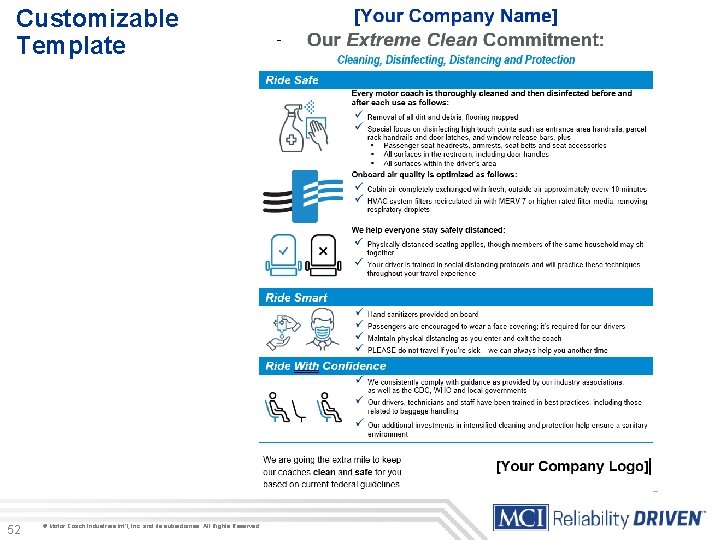
Customizable Template 52 © Motor Coach Industries Int’l, Inc. and its subsidiaries. All Rights Reserved.
Section B 2: Draft Press Release and Template 53 © Motor Coach Industries Int’l, Inc. and its subsidiaries. All Rights Reserved.
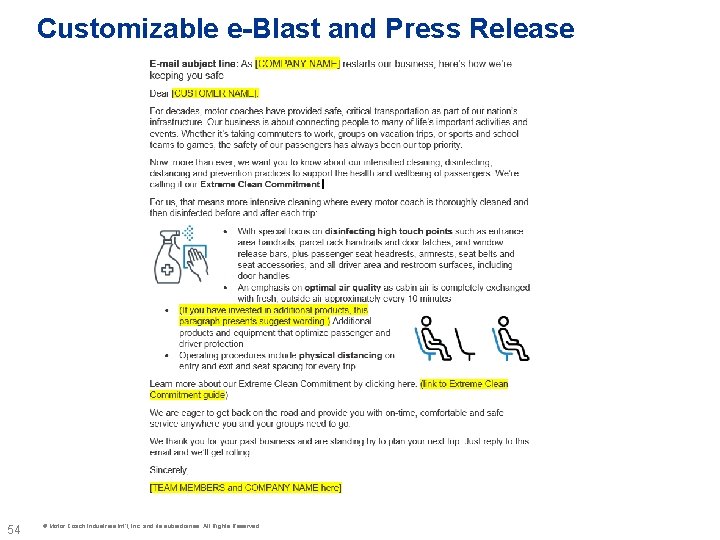
Customizable e-Blast and Press Release 54 © Motor Coach Industries Int’l, Inc. and its subsidiaries. All Rights Reserved.
NFI Parts: Clean & Protect 55 © Motor Coach Industries Int’l, Inc. and its subsidiaries. All Rights Reserved.
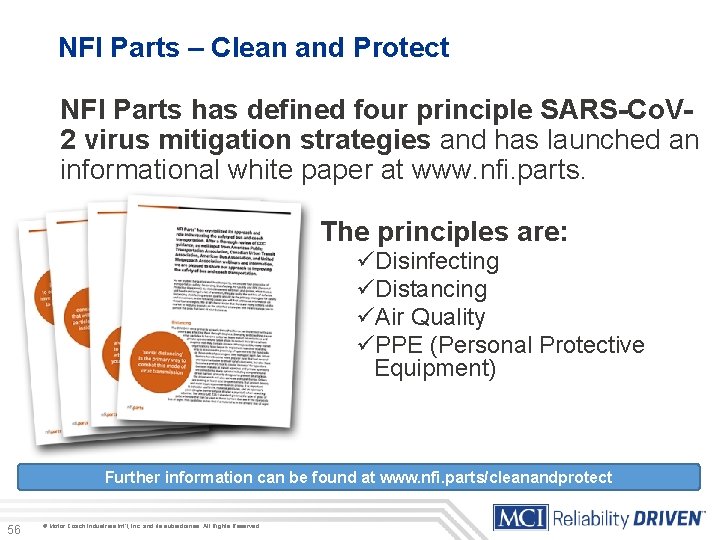
NFI Parts – Clean and Protect NFI Parts has defined four principle SARS-Co. V 2 virus mitigation strategies and has launched an informational white paper at www. nfi. parts. The principles are: üDisinfecting üDistancing üAir Quality üPPE (Personal Protective Equipment) Further information can be found at www. nfi. parts/cleanandprotect 56 © Motor Coach Industries Int’l, Inc. and its subsidiaries. All Rights Reserved.
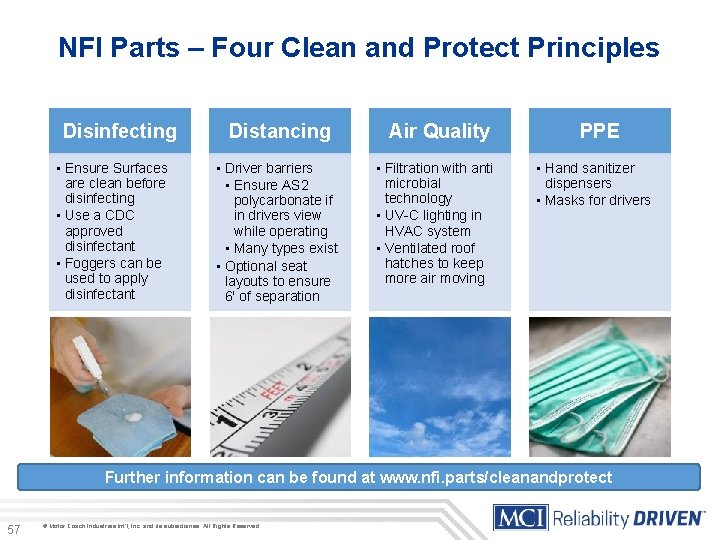
NFI Parts – Four Clean and Protect Principles Disinfecting • Ensure Surfaces are clean before disinfecting • Use a CDC approved disinfectant • Foggers can be used to apply disinfectant Distancing Air Quality • Driver barriers • Ensure AS 2 polycarbonate if in drivers view while operating • Many types exist • Optional seat layouts to ensure 6' of separation • Filtration with anti microbial technology • UV-C lighting in HVAC system • Ventilated roof hatches to keep more air moving PPE • Hand sanitizer dispensers • Masks for drivers Further information can be found at www. nfi. parts/cleanandprotect 57 © Motor Coach Industries Int’l, Inc. and its subsidiaries. All Rights Reserved.
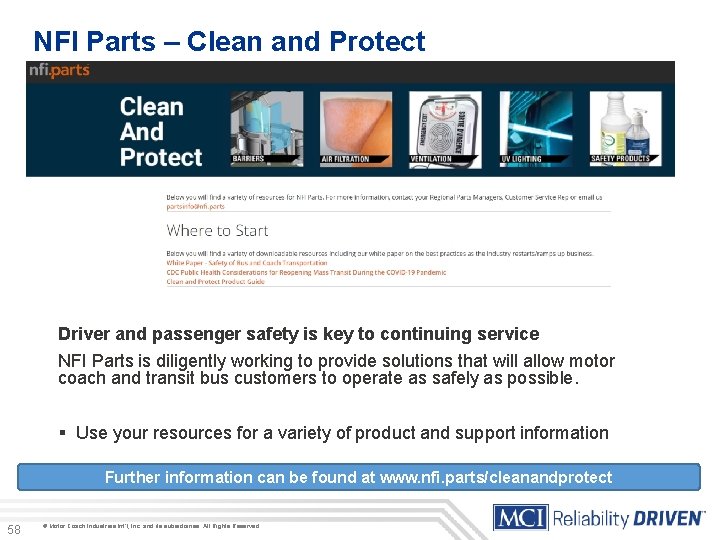
NFI Parts – Clean and Protect Driver and passenger safety is key to continuing service NFI Parts is diligently working to provide solutions that will allow motor coach and transit bus customers to operate as safely as possible. § Use your resources for a variety of product and support information Further information can be found at www. nfi. parts/cleanandprotect 58 © Motor Coach Industries Int’l, Inc. and its subsidiaries. All Rights Reserved.
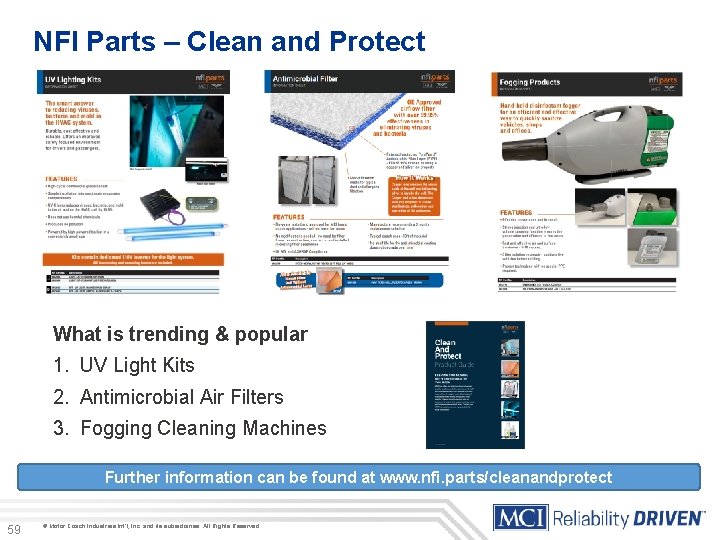
NFI Parts – Clean and Protect What is trending & popular 1. UV Light Kits 2. Antimicrobial Air Filters 3. Fogging Cleaning Machines Further information can be found at www. nfi. parts/cleanandprotect 59 © Motor Coach Industries Int’l, Inc. and its subsidiaries. All Rights Reserved.
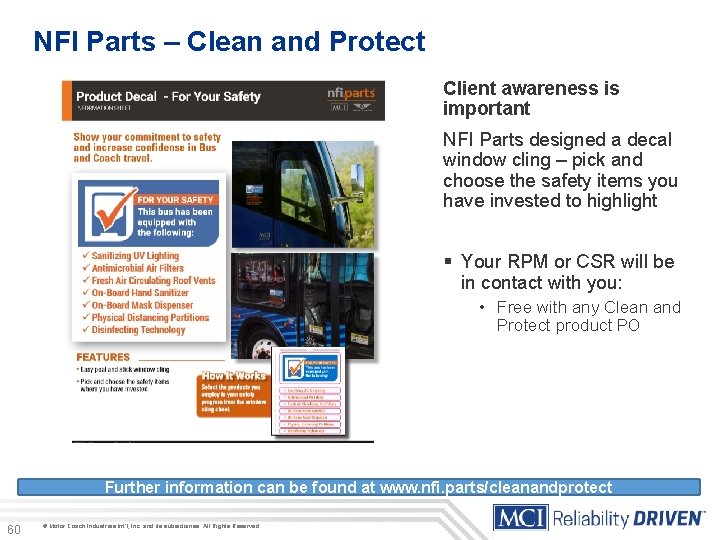
NFI Parts – Clean and Protect Client awareness is important NFI Parts designed a decal window cling – pick and choose the safety items you have invested to highlight § Your RPM or CSR will be in contact with you: • Free with any Clean and Protect product PO Further information can be found at www. nfi. parts/cleanandprotect 60 © Motor Coach Industries Int’l, Inc. and its subsidiaries. All Rights Reserved.
End 61 © Motor Coach Industries Int’l, Inc. and its subsidiaries. All Rights Reserved.
- Slides: 60