
Clean Development Mechanism CDM Current status and future

- Slides: 27
Clean Development Mechanism (CDM) – Current status and future options in the transport sector Holger Dalkmann CURB-AIR Side Event COP 13/MOP 13 Bali, 13 December 2007
Overview • Background: Climate Change, CDM and Transport • Project CDM - Case Studies • Barriers in the existing CDM context • Future applications: Beyond a project approach • Conclusion: Transport is too important to wait for CDM solutions
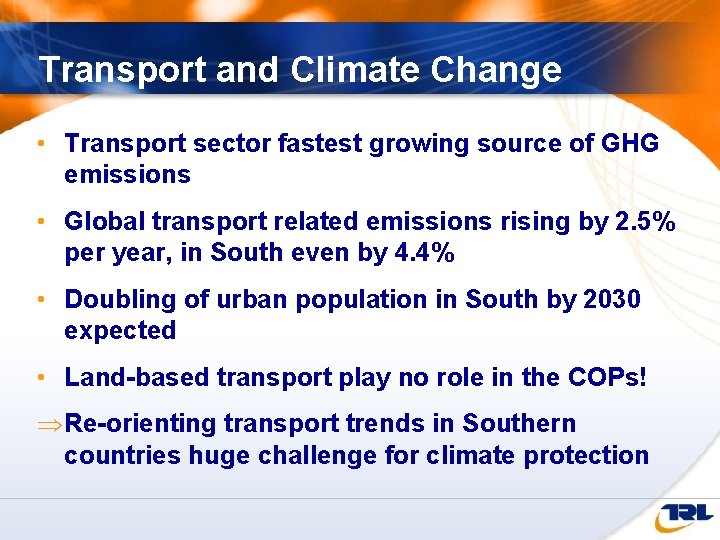
Transport and Climate Change • Transport sector fastest growing source of GHG emissions • Global transport related emissions rising by 2. 5% per year, in South even by 4. 4% • Doubling of urban population in South by 2030 expected • Land-based transport play no role in the COPs! Re-orienting transport trends in Southern countries huge challenge for climate protection
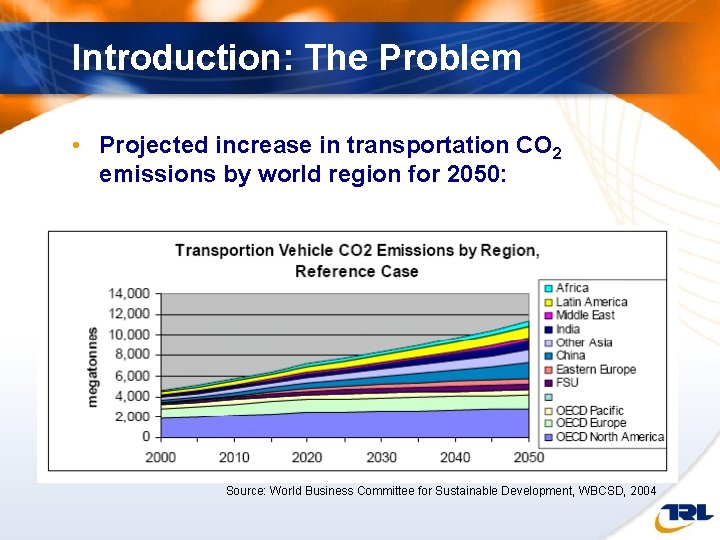
Introduction: The Problem • Projected increase in transportation CO 2 emissions by world region for 2050: Source: World Business Committee for Sustainable Development, WBCSD, 2004
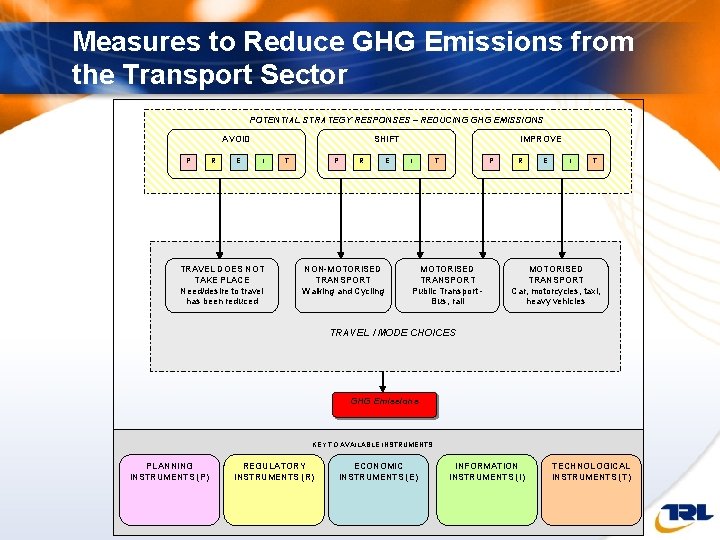
Measures to Reduce GHG Emissions from the Transport Sector POTENTIAL STRATEGY RESPONSES – REDUCING GHG EMISSIONS AVOID P R E SHIFT I TRAVEL DOES NOT TAKE PLACE Need/desire to travel has been reduced T P R NON-MOTORISED TRANSPORT Walking and Cycling E IMPROVE I CHOICE T P MOTORISED TRANSPORT Public Transport Bus, rail R E I T MOTORISED TRANSPORT Car, motorcycles, taxi, heavy vehicles TRAVEL / MODE CHOICES GHG Emissions KEY TO AVAILABLE INSTRUMENTS PLANNING INSTRUMENTS (P) REGULATORY INSTRUMENTS (R) ECONOMIC INSTRUMENTS (E) INFORMATION INSTRUMENTS (I) TECHNOLOGICAL INSTRUMENTS (T)
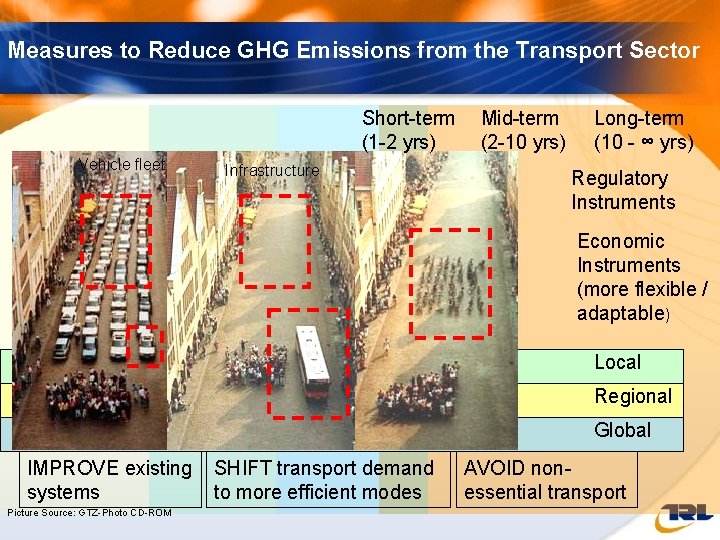
Measures to Reduce GHG Emissions from the Transport Sector Short-term (1 -2 yrs) Vehicle fleet Infrastructure Mid-term (2 -10 yrs) Long-term (10 - ∞ yrs) Regulatory Instruments Economic Instruments (more flexible / adaptable) Local Regional Global IMPROVE existing systems Picture Source: GTZ-Photo CD-ROM SHIFT transport demand to more efficient modes AVOID nonessential transport
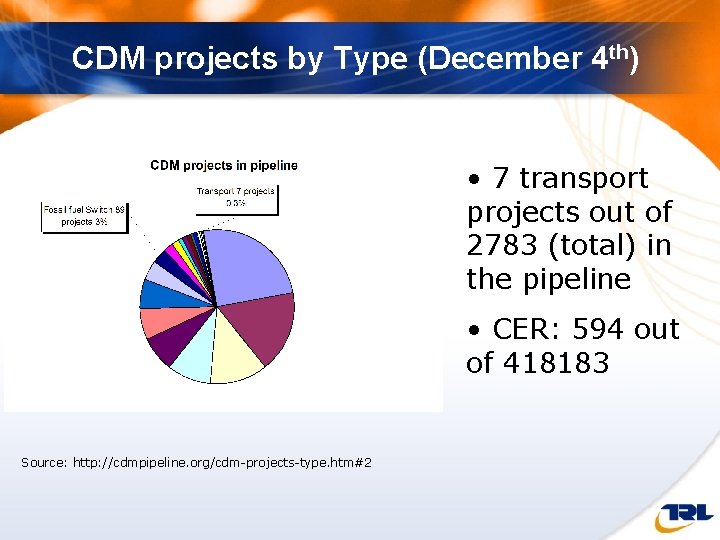
CDM projects by Type (December 4 th) • 7 transport projects out of 2783 (total) in the pipeline • CER: 594 out of 418183 Source: http: //cdmpipeline. org/cdm-projects-type. htm#2
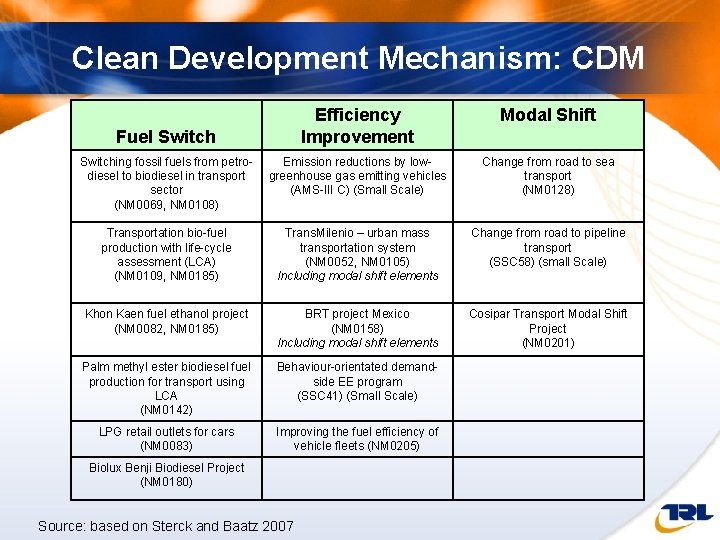
Current Status of Transport in CDM • Currently: almost 2783 projects in the pipeline, including only seven transport projects • Nine further transport projects have submitted proposals for new methodologies • Five of them were rejected • Four are still under consideration • Three different categories of projects: • fuel switch • modal shift • efficiency improvement
Clean Development Mechanism: CDM Efficiency Improvement Modal Shift Switching fossil fuels from petrodiesel to biodiesel in transport sector (NM 0069, NM 0108) Emission reductions by lowgreenhouse gas emitting vehicles (AMS-III C) (Small Scale) Change from road to sea transport (NM 0128) Transportation bio-fuel production with life-cycle assessment (LCA) (NM 0109, NM 0185) Trans. Milenio – urban mass transportation system (NM 0052, NM 0105) Including modal shift elements Change from road to pipeline transport (SSC 58) (small Scale) Khon Kaen fuel ethanol project (NM 0082, NM 0185) BRT project Mexico (NM 0158) Including modal shift elements Cosipar Transport Modal Shift Project (NM 0201) Palm methyl ester biodiesel fuel production for transport using LCA (NM 0142) Behaviour-orientated demandside EE program (SSC 41) (Small Scale) LPG retail outlets for cars (NM 0083) Improving the fuel efficiency of vehicle fleets (NM 0205) Fuel Switch Biolux Benji Biodiesel Project (NM 0180) Source: based on Sterck and Baatz 2007
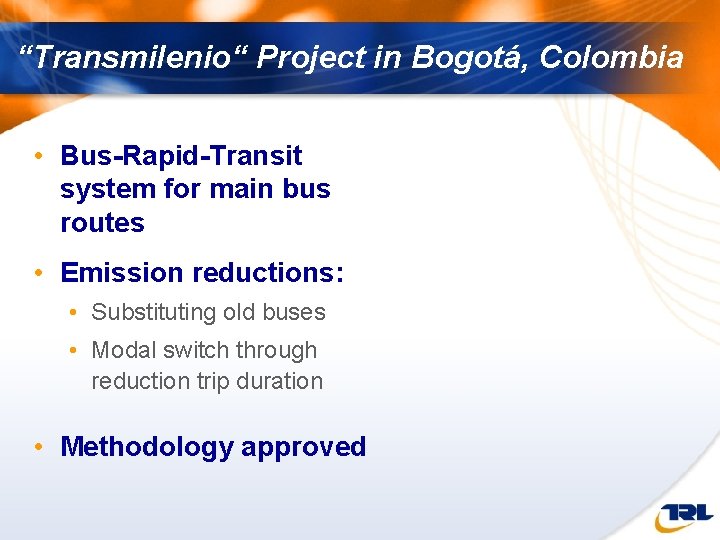
“Transmilenio“ Project in Bogotá, Colombia • Bus-Rapid-Transit system for main bus routes • Emission reductions: • Substituting old buses • Modal switch through reduction trip duration • Methodology approved
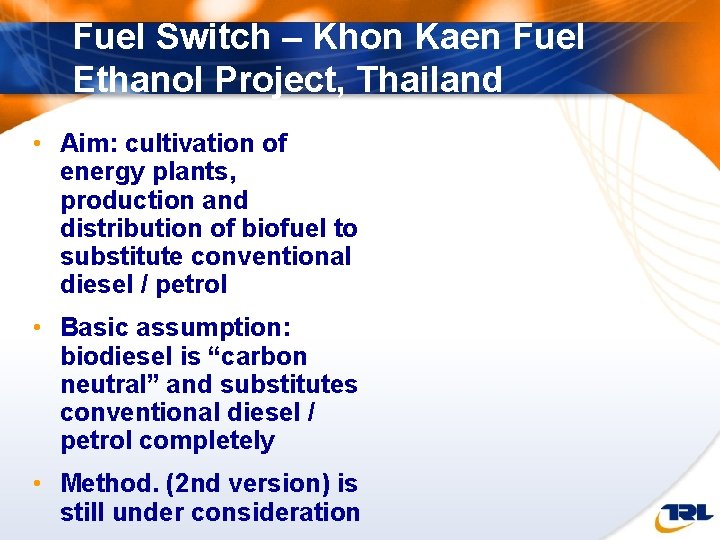
Fuel Switch – Khon Kaen Fuel Ethanol Project, Thailand • Aim: cultivation of energy plants, production and distribution of biofuel to substitute conventional diesel / petrol • Basic assumption: biodiesel is “carbon neutral” and substitutes conventional diesel / petrol completely • Method. (2 nd version) is still under consideration
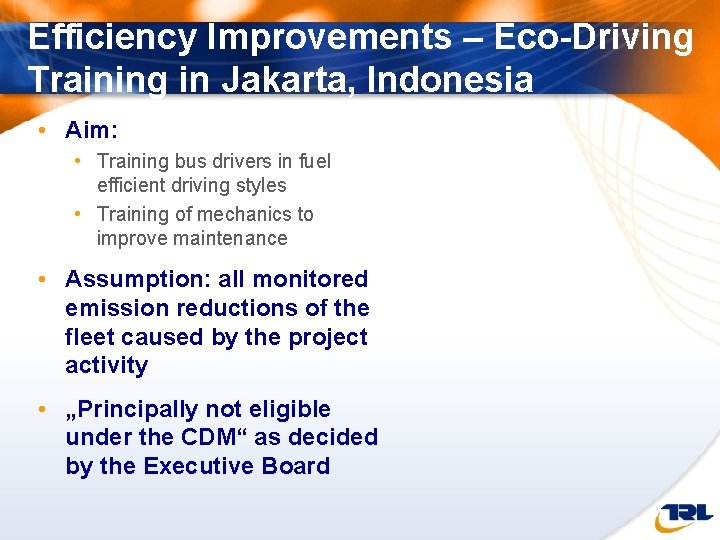
Efficiency Improvements – Eco-Driving Training in Jakarta, Indonesia • Aim: • Training bus drivers in fuel efficient driving styles • Training of mechanics to improve maintenance • Assumption: all monitored emission reductions of the fleet caused by the project activity • „Principally not eligible under the CDM“ as decided by the Executive Board
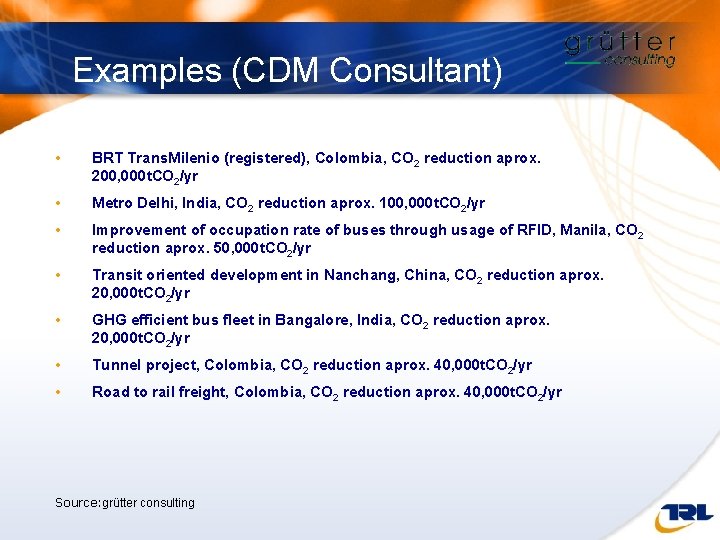
Examples (CDM Consultant) • BRT Trans. Milenio (registered), Colombia, CO 2 reduction aprox. 200, 000 t. CO 2/yr • Metro Delhi, India, CO 2 reduction aprox. 100, 000 t. CO 2/yr • Improvement of occupation rate of buses through usage of RFID, Manila, CO 2 reduction aprox. 50, 000 t. CO 2/yr • Transit oriented development in Nanchang, China, CO 2 reduction aprox. 20, 000 t. CO 2/yr • GHG efficient bus fleet in Bangalore, India, CO 2 reduction aprox. 20, 000 t. CO 2/yr • Tunnel project, Colombia, CO 2 reduction aprox. 40, 000 t. CO 2/yr • Road to rail freight, Colombia, CO 2 reduction aprox. 40, 000 t. CO 2/yr Source: grütter consulting
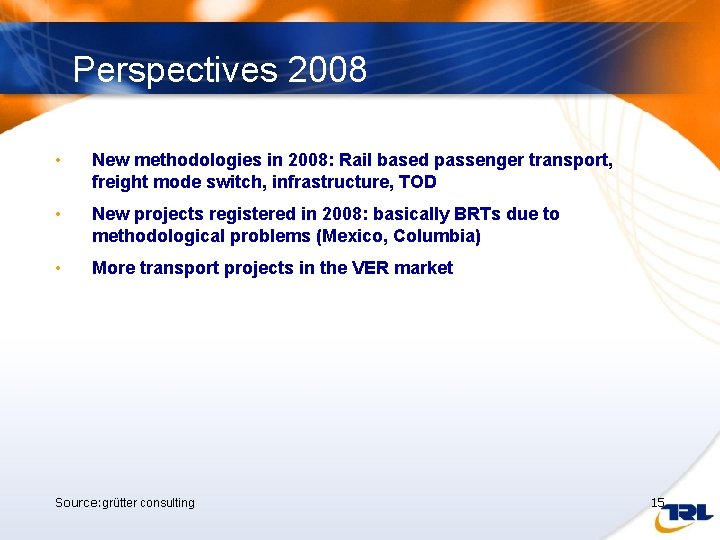
Perspectives 2008 • New methodologies in 2008: Rail based passenger transport, freight mode switch, infrastructure, TOD • New projects registered in 2008: basically BRTs due to methodological problems (Mexico, Columbia) • More transport projects in the VER market Source: grütter consulting 15
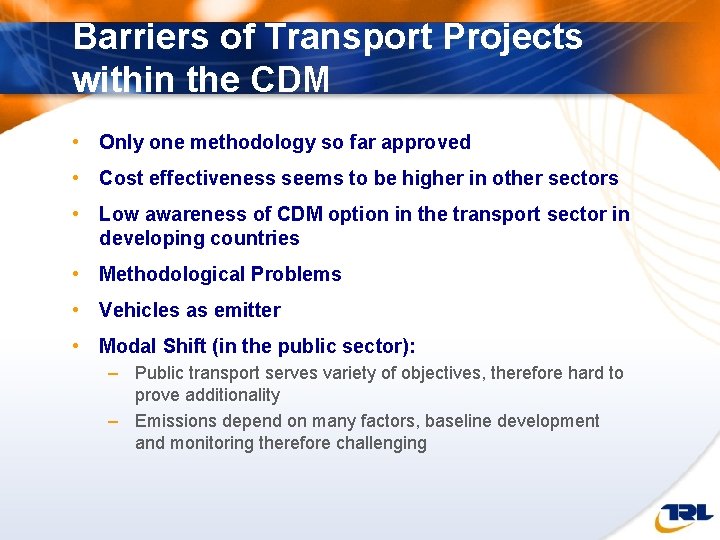
Barriers of Transport Projects within the CDM • Only one methodology so far approved • Cost effectiveness seems to be higher in other sectors • Low awareness of CDM option in the transport sector in developing countries • Methodological Problems • Vehicles as emitter • Modal Shift (in the public sector): – Public transport serves variety of objectives, therefore hard to prove additionality – Emissions depend on many factors, baseline development and monitoring therefore challenging
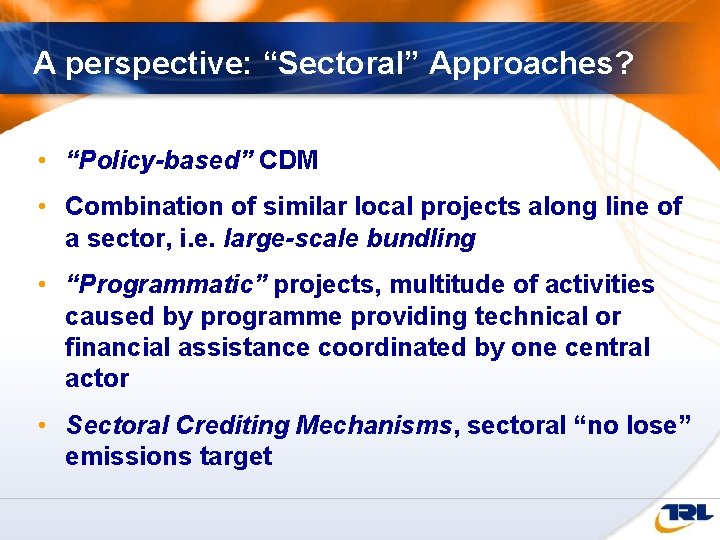
A perspective: “Sectoral” Approaches? • “Policy-based” CDM • Combination of similar local projects along line of a sector, i. e. large-scale bundling • “Programmatic” projects, multitude of activities caused by programme providing technical or financial assistance coordinated by one central actor • Sectoral Crediting Mechanisms, sectoral “no lose” emissions target
Scenarios: Sectoral CDM in Transport A) Policy/Programmatic CDM: CERs to public actor for the application of an instrument towards a sustainable transport system B) Sectoral Targets: CERs for meeting ambitous reduction targets for GHG emission in the transport sector on local level
Scenarios: Sectoral CDM in Transport A) Policy/Programmatic CDM: CERs to public actor for the application of an instrument towards a sustainable transport system Policy CDM will be accepted after 2012. Application options: - Planning Instruments (e. g. Local Transport Plan) - Economic Instruments (e. g. Congestion Charging)
Scenario A: Planning Instruments (1) Example: Strategic Environmental Assessment (SEA) in Local Transport Plans (LTP) § Purpose of SEA is to ensure consideration of environmental effects when developing LTP SEA documented state of the environment § Scope is to consider the impacts of the LTP (medium to long-term) § SEA assessed actual and alternative LTP options to find environmentally best approach
Scenario A: LTP-SEA and CDM Project definition • Project activity: Development of LTP and its implementation Methodology • Baseline: Business-asusual-scenario from SEA assessment • Project participants: Transport Administration; • Additionality: Plan needs to deviate from BAU Environmental Admin. ; consultants • Monitoring: Transport surveys and further SEA • Project boundary: Vehicle indicators/data emissions covered by the plan, which is defined through the administrative boundaries; no leakage • Emission reduction: Difference between baseline and actual emissions
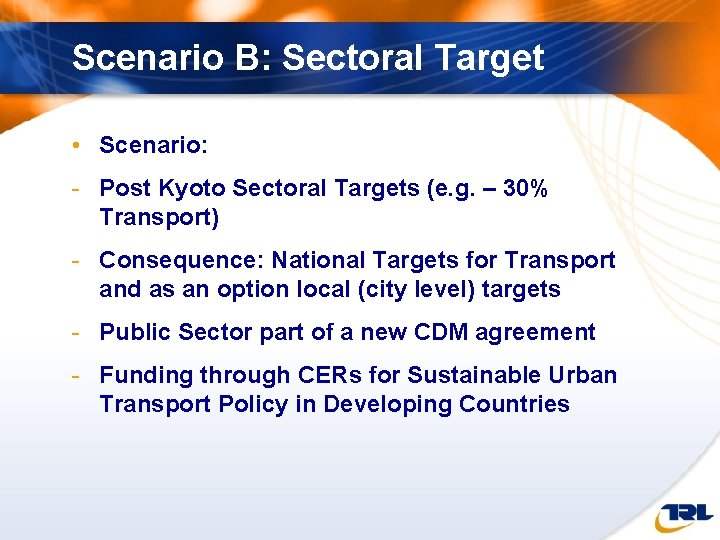
Scenario B: Sectoral Target • Scenario: - Post Kyoto Sectoral Targets (e. g. – 30% Transport) - Consequence: National Targets for Transport and as an option local (city level) targets - Public Sector part of a new CDM agreement - Funding through CERs for Sustainable Urban Transport Policy in Developing Countries
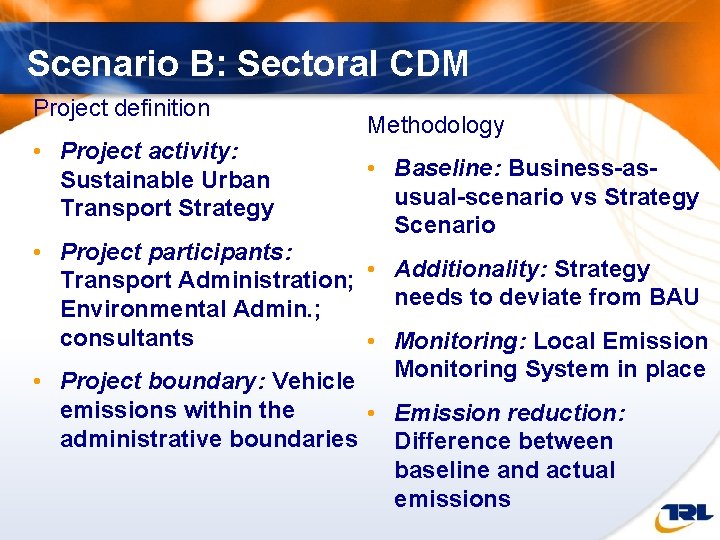
Scenario B: Sectoral CDM Project definition • Project activity: Sustainable Urban Transport Strategy Methodology • Baseline: Business-asusual-scenario vs Strategy Scenario • Project participants: Transport Administration; • Additionality: Strategy needs to deviate from BAU Environmental Admin. ; consultants • Monitoring: Local Emission Monitoring System in place • Project boundary: Vehicle emissions within the • Emission reduction: administrative boundaries Difference between baseline and actual emissions
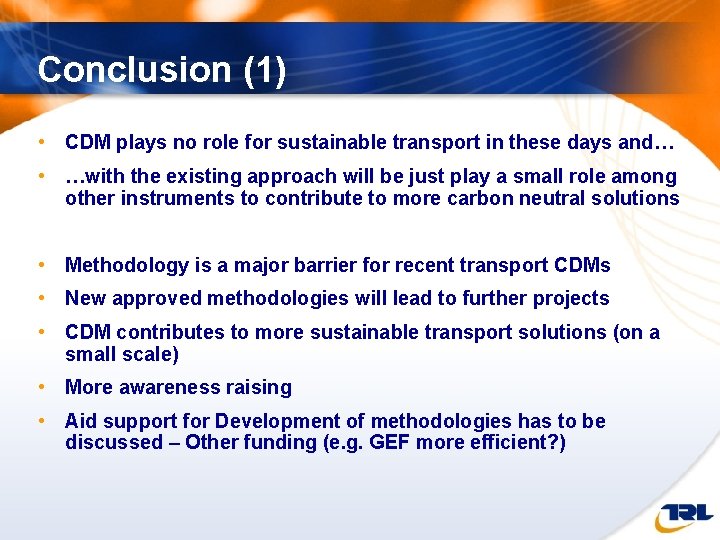
Conclusion (1) • CDM plays no role for sustainable transport in these days and… • …with the existing approach will be just play a small role among other instruments to contribute to more carbon neutral solutions • Methodology is a major barrier for recent transport CDMs • New approved methodologies will lead to further projects • CDM contributes to more sustainable transport solutions (on a small scale) • More awareness raising • Aid support for Development of methodologies has to be discussed – Other funding (e. g. GEF more efficient? )
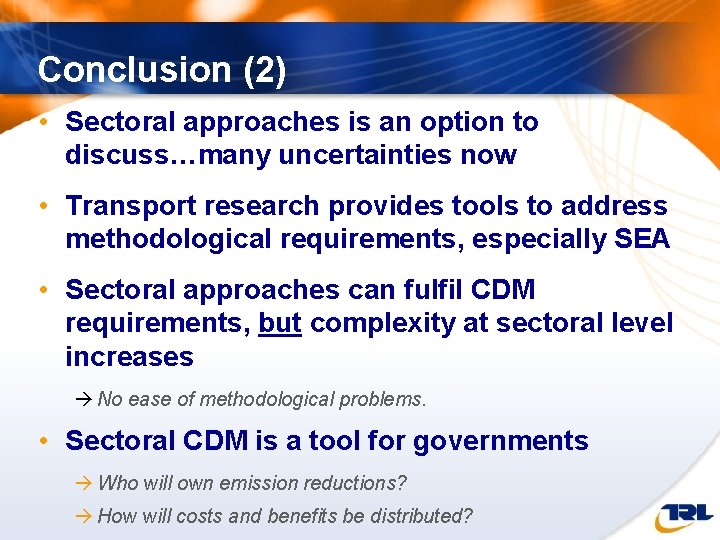
Conclusion (2) • Sectoral approaches is an option to discuss…many uncertainties now • Transport research provides tools to address methodological requirements, especially SEA • Sectoral approaches can fulfil CDM requirements, but complexity at sectoral level increases No ease of methodological problems. • Sectoral CDM is a tool for governments Who will own emission reductions? How will costs and benefits be distributed?
Conclusion (3) • Problem: Certified Emission Reductions (CER)s allow emissions increase in industrialized countries; • Potential means to address challenges: • Quantify uncertainty and discount CERs accordingly; • Apply conservative baseline, below BAU scenario; • Determine part of emission reductions due to project activity. • However: Transport is a too important sector to leave the problem to CDM
Dalkmann et al. (2007): The Sectoral Clean Development Mechanism - A Contribution from a Sustainable Transport Perspective http: //www. wupperinst. org/uploads/tx_wibeitrag/Tr ansport-CDM. pdf Dalkmann, H. and Brannigan, C. : Climate and Transport – A sourcebook for sustainable transportation http: //www. sutp. org/ Holger Dalkmann hdalkmann@trl. co. uk www. c 4 s. info