
CLAUSES ENGLISH IV CLAUSES A group of words
- Slides: 22
CLAUSES ENGLISH IV
CLAUSES A group of words containing a subject and a verb and used as part of a sentence
INDEPENDENT CLAUSE An independent clause is a group of words with a subject and a verb that makes sense by itself. An independent clause is also known as a simple sentence.
DEPENDENT CLAUSE A dependent clause and a subordinate clause are the same thing! Dependent clauses are groups of words with subjects and verbs that do not make sense by themselves. Dependent clauses do not express a complete thought. By themselves, they cannot be a complete sentence.
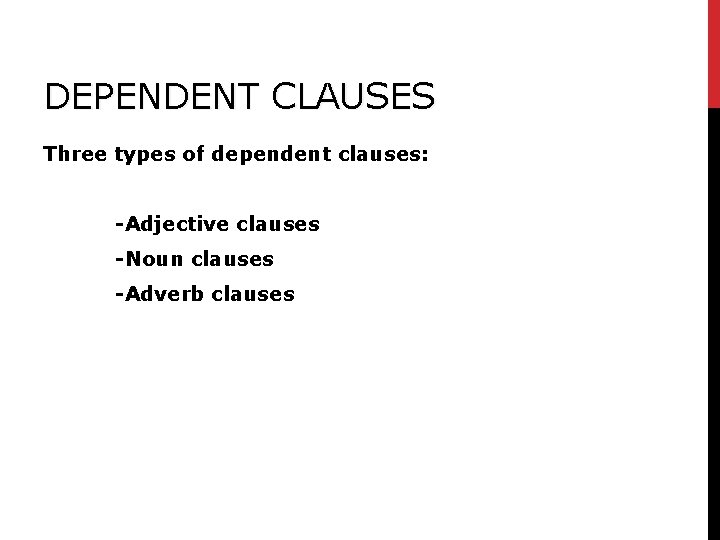
DEPENDENT CLAUSES Three types of dependent clauses: -Adjective clauses -Noun clauses -Adverb clauses
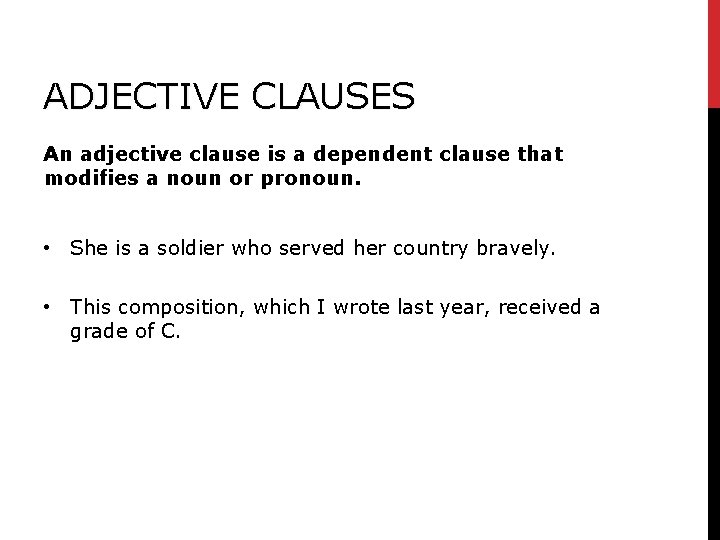
ADJECTIVE CLAUSES An adjective clause is a dependent clause that modifies a noun or pronoun. • She is a soldier who served her country bravely. • This composition, which I wrote last year, received a grade of C.
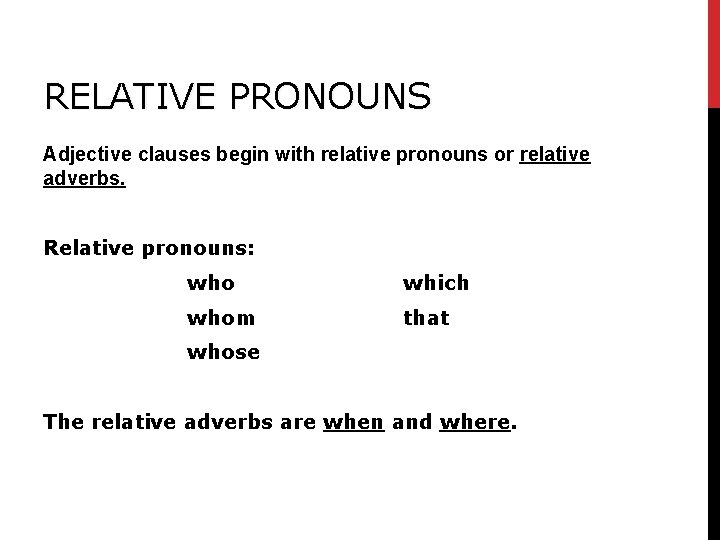
RELATIVE PRONOUNS Adjective clauses begin with relative pronouns or relative adverbs. Relative pronouns: who which whom that whose The relative adverbs are when and where.
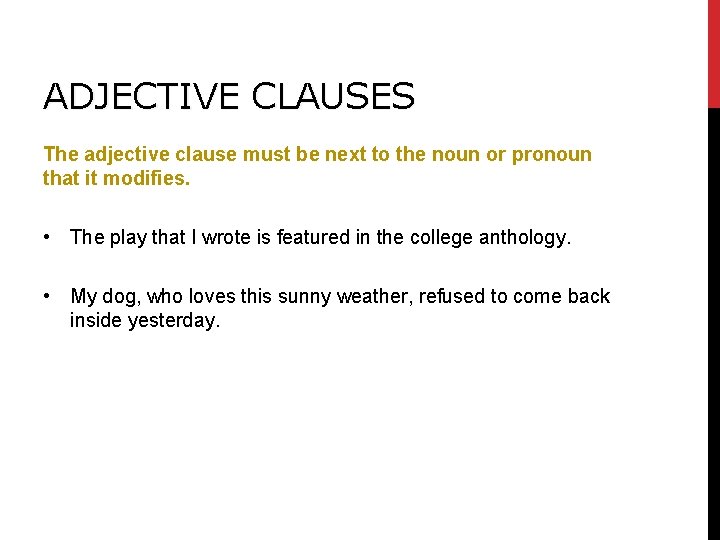
ADJECTIVE CLAUSES The adjective clause must be next to the noun or pronoun that it modifies. • The play that I wrote is featured in the college anthology. • My dog, who loves this sunny weather, refused to come back inside yesterday.
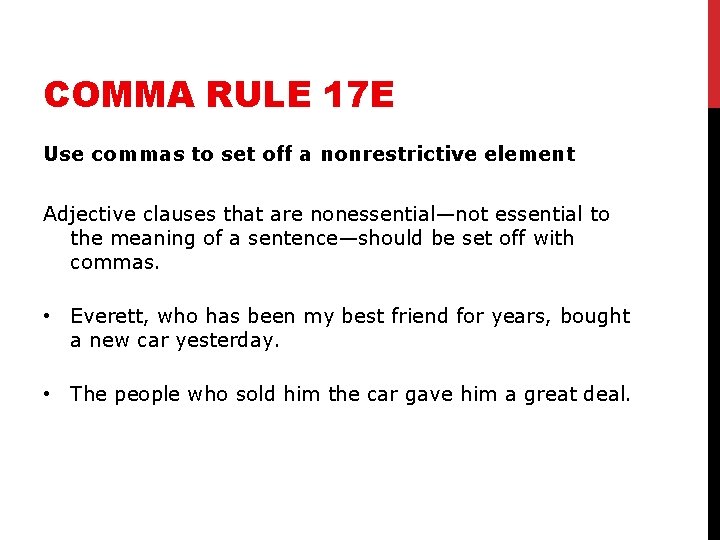
COMMA RULE 17 E Use commas to set off a nonrestrictive element Adjective clauses that are nonessential—not essential to the meaning of a sentence—should be set off with commas. • Everett, who has been my best friend for years, bought a new car yesterday. • The people who sold him the car gave him a great deal.
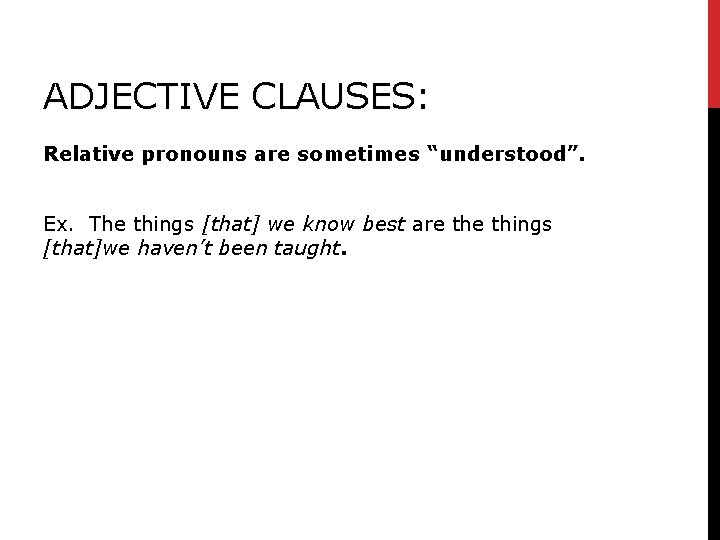
ADJECTIVE CLAUSES: Relative pronouns are sometimes “understood”. Ex. The things [that] we know best are things [that]we haven’t been taught.
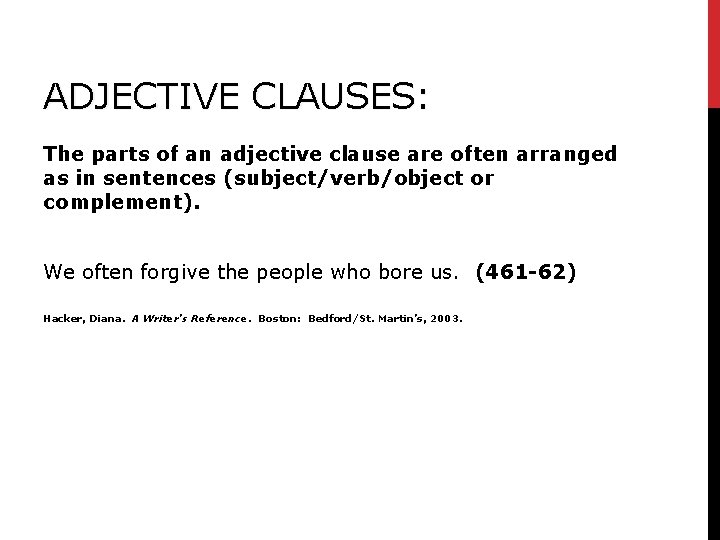
ADJECTIVE CLAUSES: The parts of an adjective clause are often arranged as in sentences (subject/verb/object or complement). We often forgive the people who bore us. (461 -62) Hacker, Diana. A Writer’s Reference. Boston: Bedford/St. Martin’s, 2003.
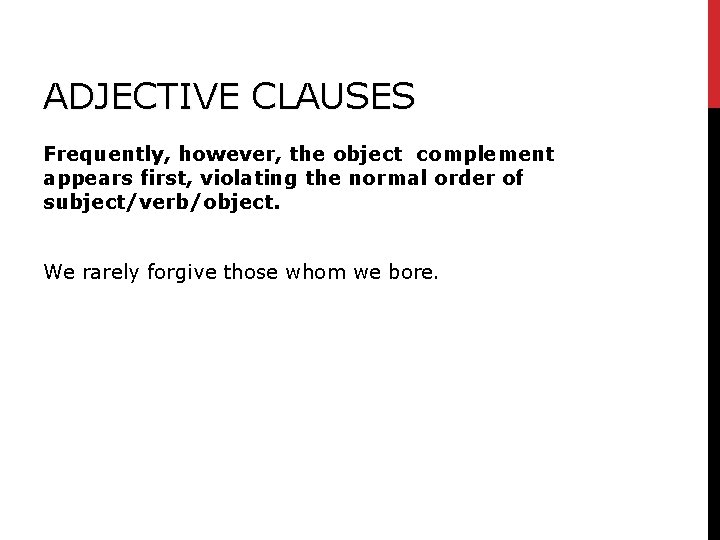
ADJECTIVE CLAUSES Frequently, however, the object complement appears first, violating the normal order of subject/verb/object. We rarely forgive those whom we bore.
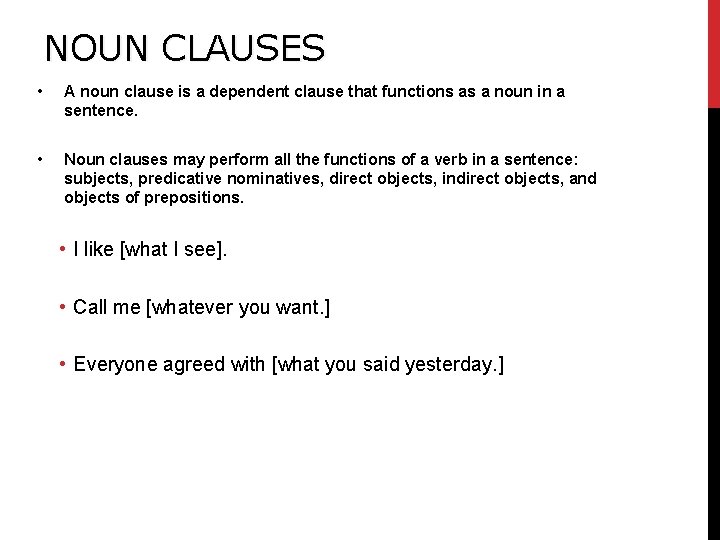
NOUN CLAUSES • A noun clause is a dependent clause that functions as a noun in a sentence. • Noun clauses may perform all the functions of a verb in a sentence: subjects, predicative nominatives, direct objects, indirect objects, and objects of prepositions. • I like [what I see]. • Call me [whatever you want. ] • Everyone agreed with [what you said yesterday. ]
ADVERB CLAUSES An adverb clause is a dependent clause that modifies a verb, an adjective, or an adverb.
SUBORDINATING CONJUNCTIONS A conjunction that begins an adverb clause is called a subordinating conjunction. It joins the clause to the rest of the sentence.
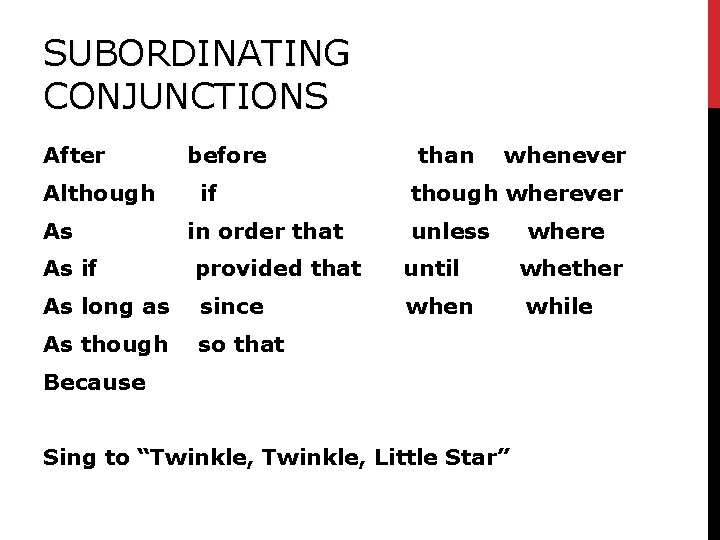
SUBORDINATING CONJUNCTIONS After Although As before if in order that than whenever though wherever unless where As if provided that until whether As long as since when while As though so that Because Sing to “Twinkle, Little Star”
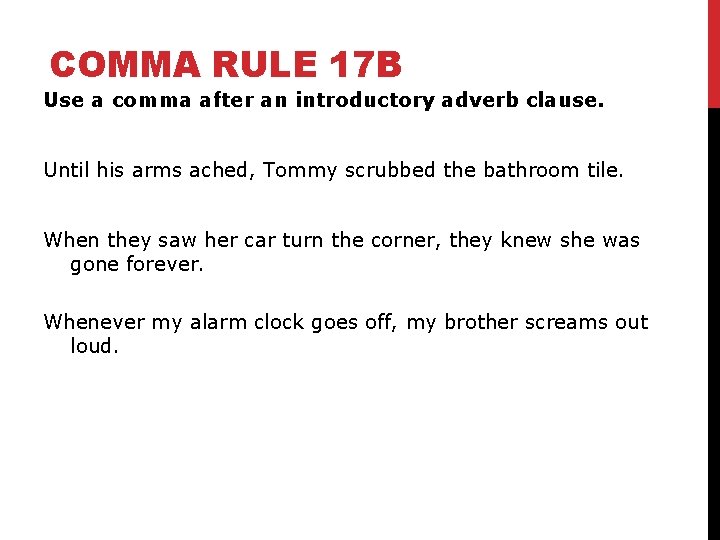
COMMA RULE 17 B Use a comma after an introductory adverb clause. Until his arms ached, Tommy scrubbed the bathroom tile. When they saw her car turn the corner, they knew she was gone forever. Whenever my alarm clock goes off, my brother screams out loud.
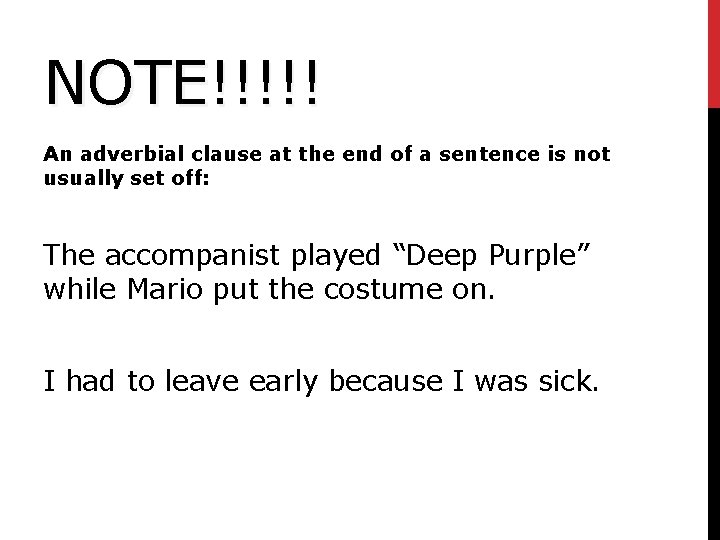
NOTE!!!!! An adverbial clause at the end of a sentence is not usually set off: The accompanist played “Deep Purple” while Mario put the costume on. I had to leave early because I was sick.
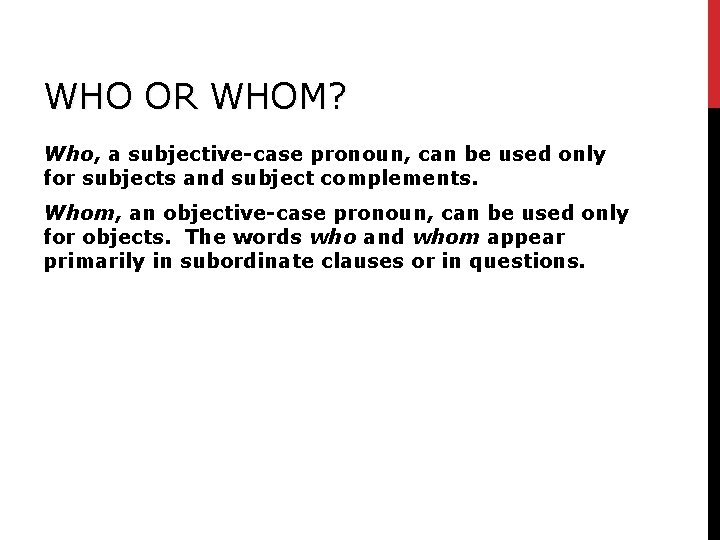
WHO OR WHOM? Who, a subjective-case pronoun, can be used only for subjects and subject complements. Whom, an objective-case pronoun, can be used only for objects. The words who and whom appear primarily in subordinate clauses or in questions.
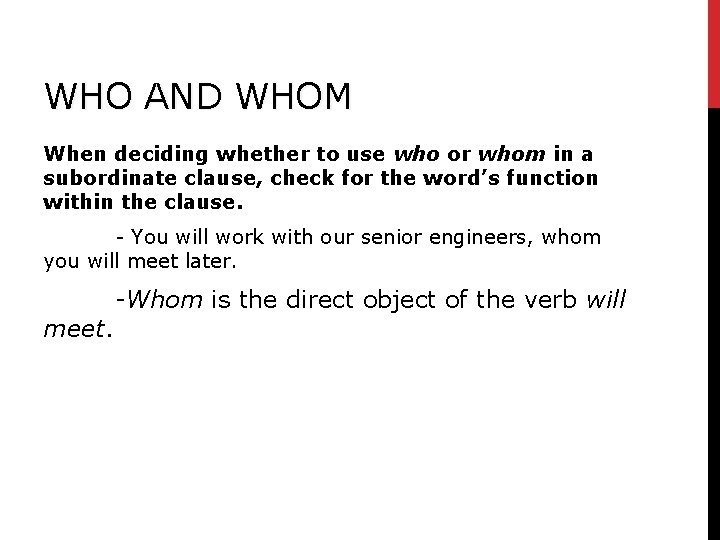
WHO AND WHOM When deciding whether to use who or whom in a subordinate clause, check for the word’s function within the clause. - You will work with our senior engineers, whom you will meet later. meet. -Whom is the direct object of the verb will
WHO, WHICH Do not use which to refer to persons. Use who instead. • Ex. Fans wondered how an old man who walked with a limp could play football.
THAT That, though generally used to refer to things, may be used to refer to a group or class of people. -The team that scores the most points in this game will win the tournament.