
Classroom Slides for A Sound Education Gregory L

- Slides: 18
Classroom Slides for A Sound Education Gregory L. Vogt, Ed. D Center for Educational Outreach Baylor College of Medicine
What Is Energy? n n Energy is hard to define because it changes form. Energy causes a change in the condition of matter, or state changes (such as burning a candle). Or it also can mean movement (such as a vibration or change in physical location). In the case of sound, the sound wave’s energy is manifested as vibrations rolling across bands of molecules.
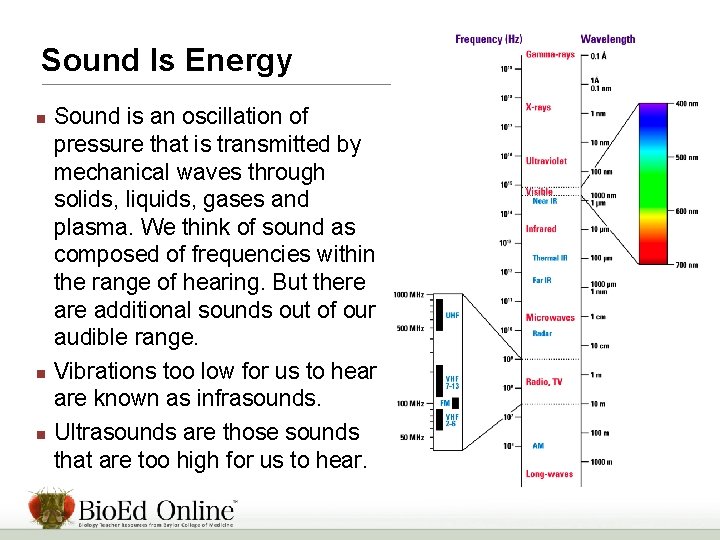
Sound Is Energy n n n Sound is an oscillation of pressure that is transmitted by mechanical waves through solids, liquids, gases and plasma. We think of sound as composed of frequencies within the range of hearing. But there additional sounds out of our audible range. Vibrations too low for us to hear are known as infrasounds. Ultrasounds are those sounds that are too high for us to hear.
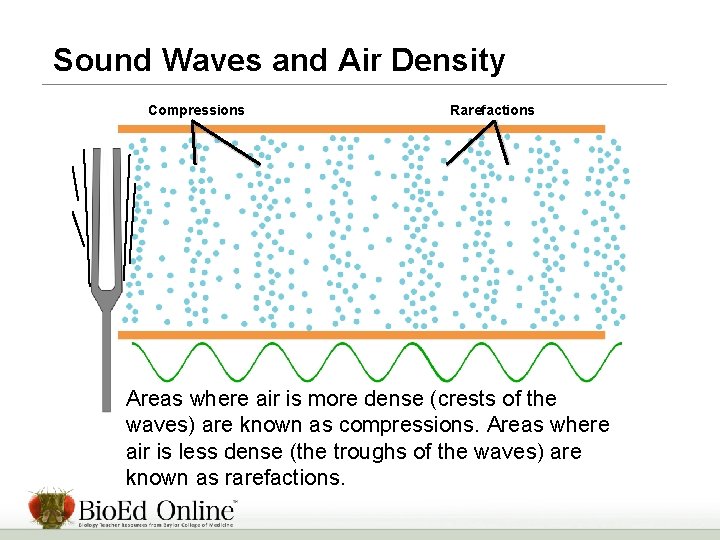
Types of Sound Waves n n Longitudinal sound waves are waves of alternating pressure deviations from the equilibrium pressure, causing local regions of compression (wave crest, more dense), and rarefaction (wave trough, less dense). Transverse waves are waves of alternating shear stress at right angle to the direction of propagation. Sound waves can be transmitted through solids as both longitudinal waves and transverse waves.
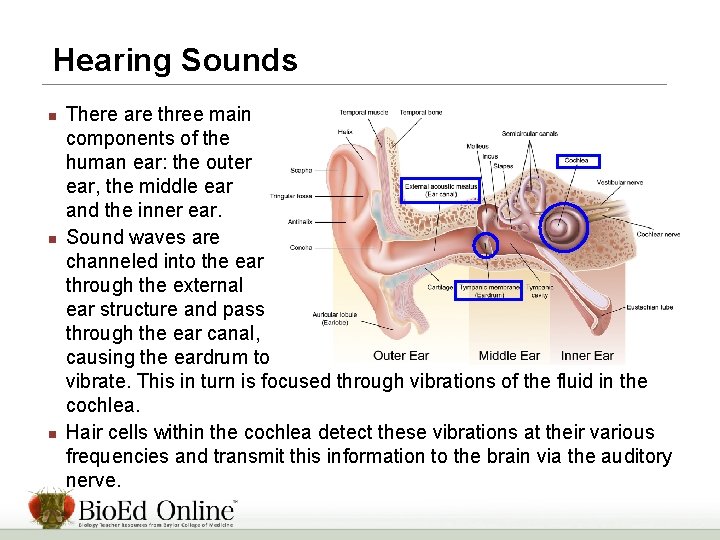
Hearing Sounds n n n There are three main components of the human ear: the outer ear, the middle ear and the inner ear. Sound waves are channeled into the ear through the external ear structure and pass through the ear canal, causing the eardrum to vibrate. This in turn is focused through vibrations of the fluid in the cochlea. Hair cells within the cochlea detect these vibrations at their various frequencies and transmit this information to the brain via the auditory nerve.
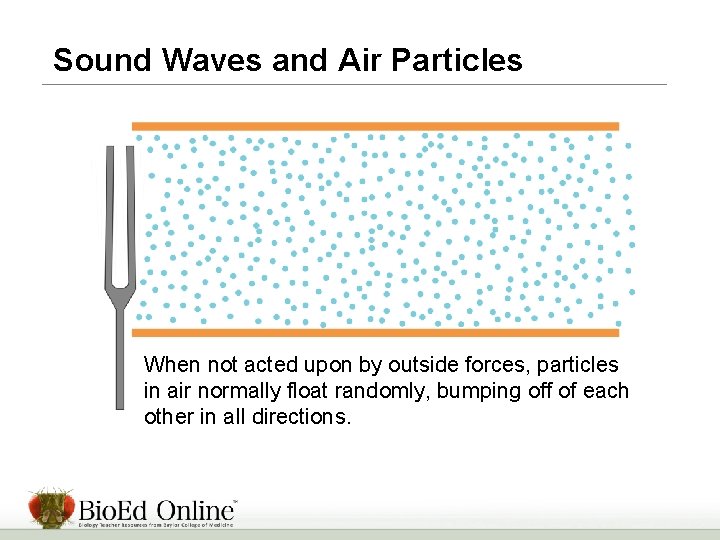
Sound Waves and Air Particles When not acted upon by outside forces, particles in air normally float randomly, bumping off of each other in all directions.
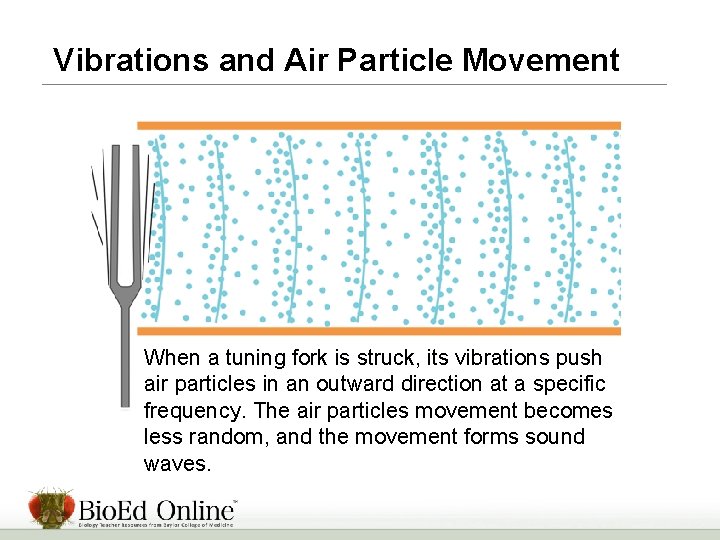
Vibrations and Air Particle Movement When a tuning fork is struck, its vibrations push air particles in an outward direction at a specific frequency. The air particles movement becomes less random, and the movement forms sound waves.
Sound Waves and Air Density Compressions Rarefactions Areas where air is more dense (crests of the waves) are known as compressions. Areas where air is less dense (the troughs of the waves) are known as rarefactions.
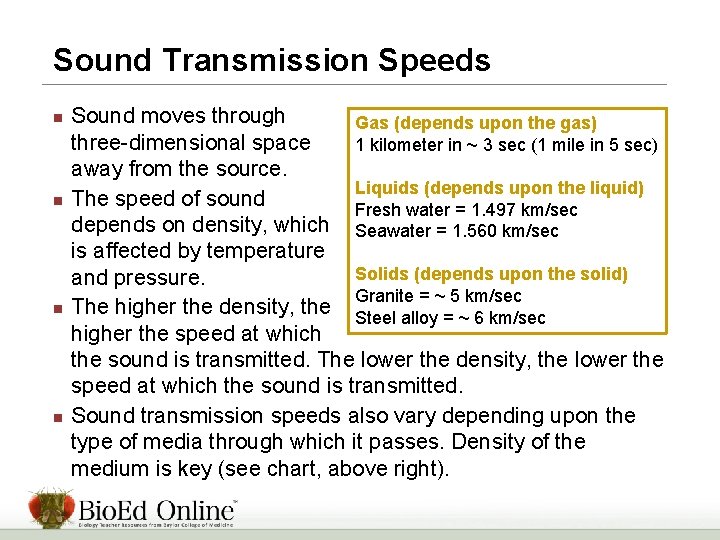
Sound Transmission Speeds n n Sound moves through Gas (depends upon the gas) three-dimensional space 1 kilometer in ~ 3 sec (1 mile in 5 sec) away from the source. Liquids (depends upon the liquid) The speed of sound Fresh water = 1. 497 km/sec depends on density, which Seawater = 1. 560 km/sec is affected by temperature Solids (depends upon the solid) and pressure. Granite = ~ 5 km/sec The higher the density, the Steel alloy = ~ 6 km/sec higher the speed at which the sound is transmitted. The lower the density, the lower the speed at which the sound is transmitted. Sound transmission speeds also vary depending upon the type of media through which it passes. Density of the medium is key (see chart, above right).
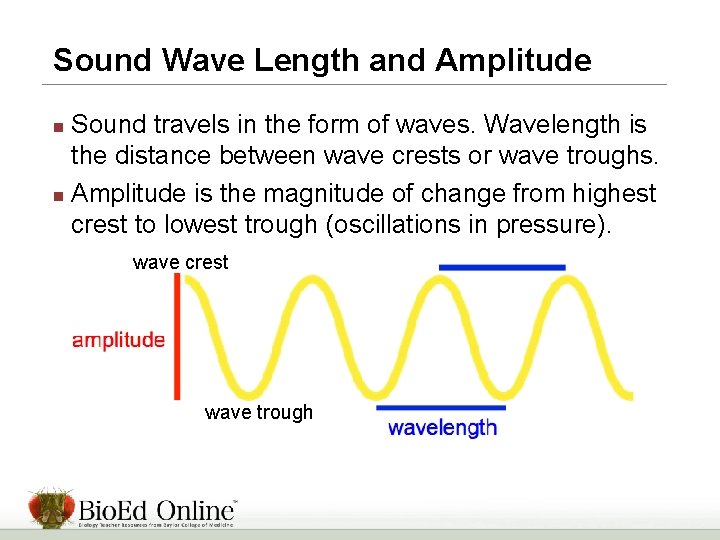
Sound Wave Length and Amplitude Sound travels in the form of waves. Wavelength is the distance between wave crests or wave troughs. n Amplitude is the magnitude of change from highest crest to lowest trough (oscillations in pressure). n wave crest wave trough
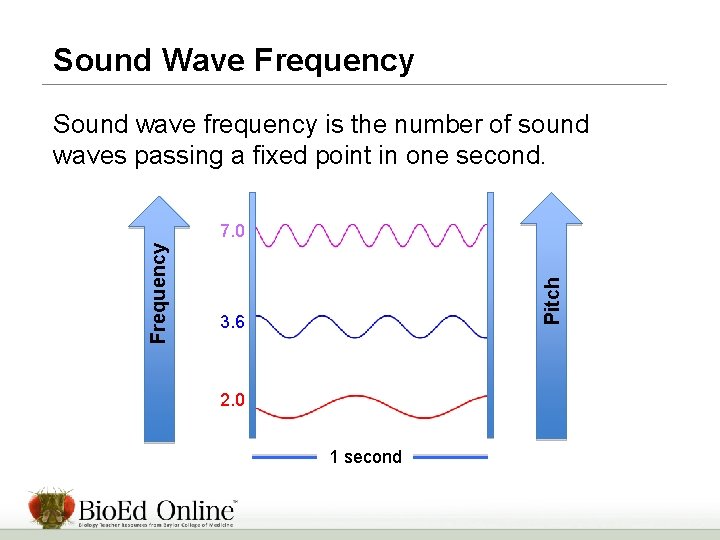
Sound Wave Frequency Sound wave frequency is the number of sound waves passing a fixed point in one second. Pitch Frequency 7. 0 3. 6 2. 0 1 second
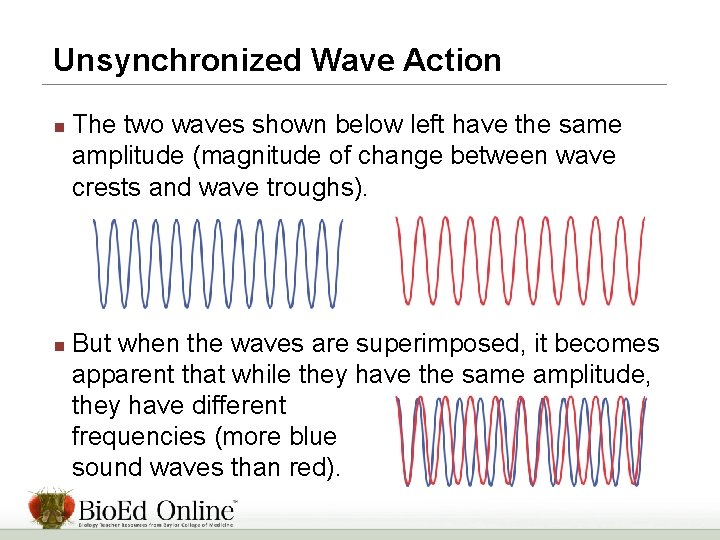
Unsynchronized Wave Action n n The two waves shown below left have the same amplitude (magnitude of change between wave crests and wave troughs). But when the waves are superimposed, it becomes apparent that while they have the same amplitude, they have different frequencies (more blue sound waves than red).
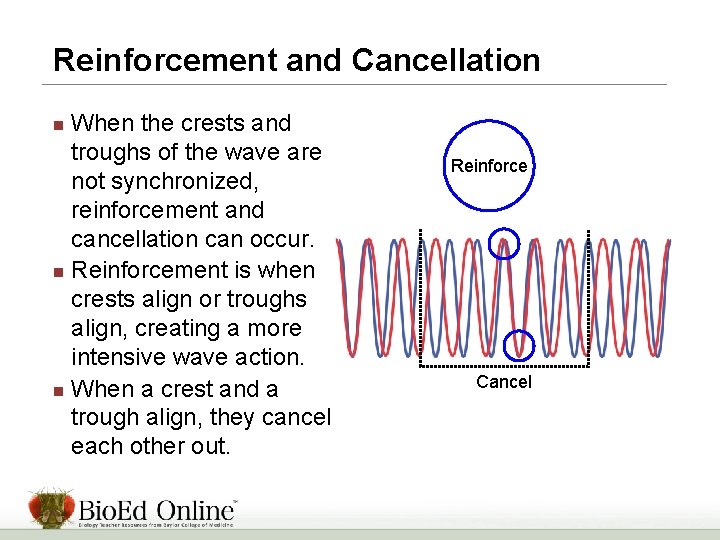
Reinforcement and Cancellation When the crests and troughs of the wave are not synchronized, reinforcement and cancellation can occur. n Reinforcement is when crests align or troughs align, creating a more intensive wave action. n When a crest and a trough align, they cancel each other out. n Reinforce Cancel
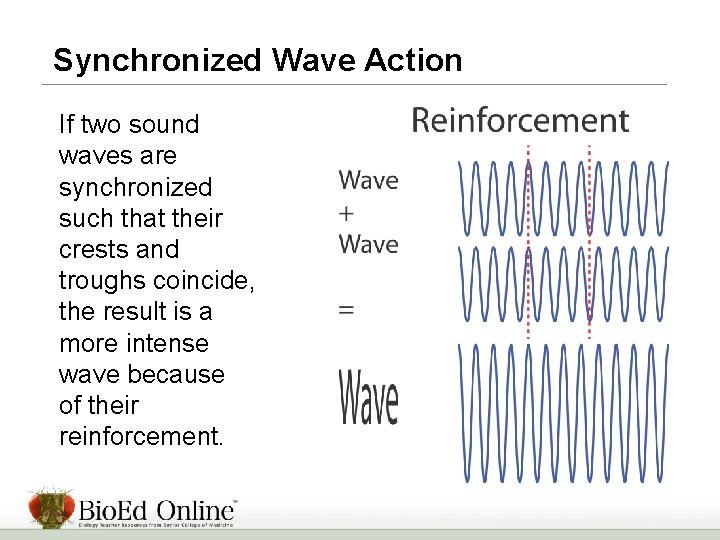
Synchronized Wave Action If two sound waves are synchronized such that their crests and troughs coincide, the result is a more intense wave because of their reinforcement.
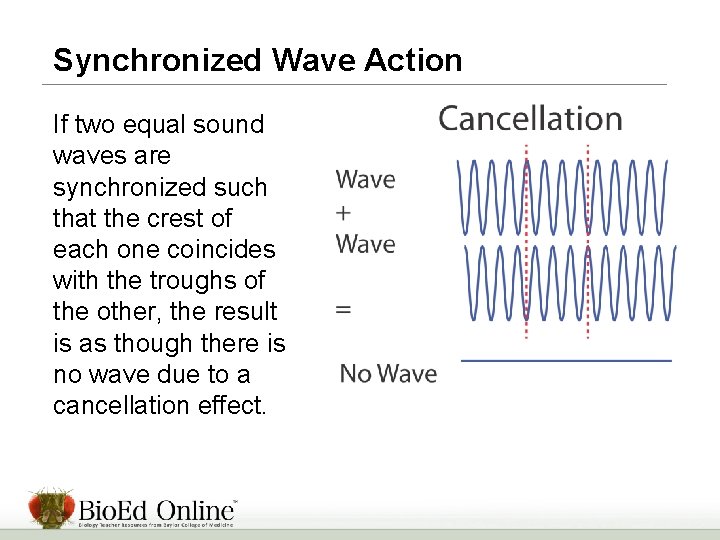
Synchronized Wave Action If two equal sound waves are synchronized such that the crest of each one coincides with the troughs of the other, the result is as though there is no wave due to a cancellation effect.
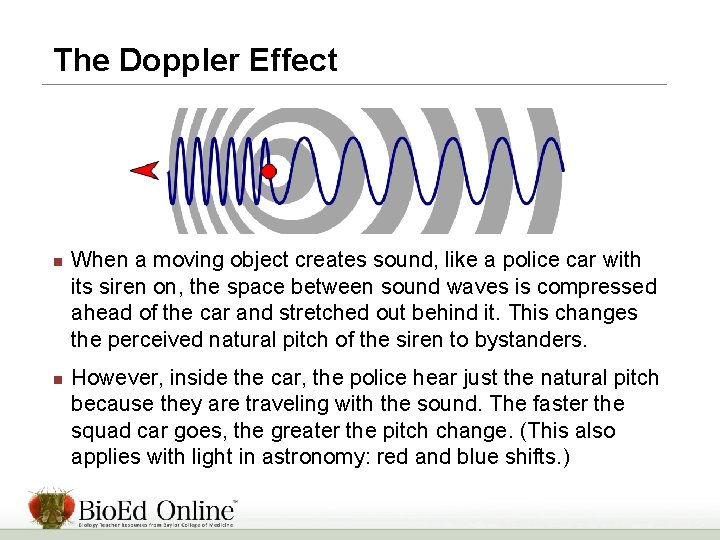
The Doppler Effect n n When a moving object creates sound, like a police car with its siren on, the space between sound waves is compressed ahead of the car and stretched out behind it. This changes the perceived natural pitch of the siren to bystanders. However, inside the car, the police hear just the natural pitch because they are traveling with the sound. The faster the squad car goes, the greater the pitch change. (This also applies with light in astronomy: red and blue shifts. )
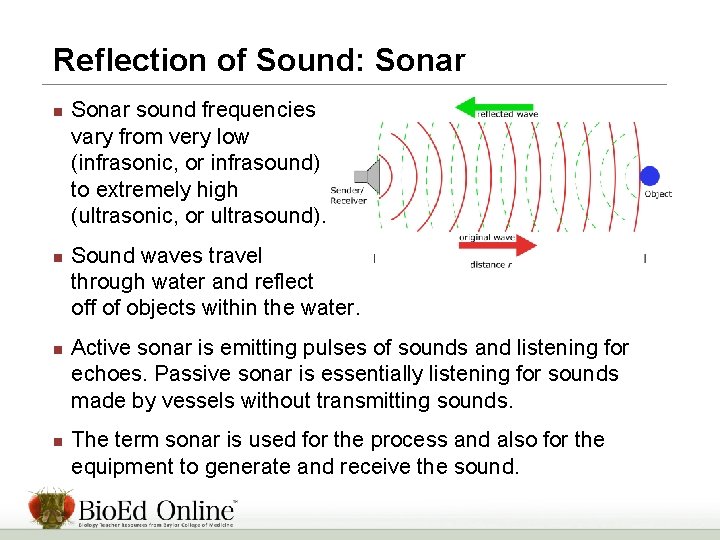
Reflection of Sound: Sonar n n Sonar sound frequencies vary from very low (infrasonic, or infrasound) to extremely high (ultrasonic, or ultrasound). Sound waves travel through water and reflect off of objects within the water. Active sonar is emitting pulses of sounds and listening for echoes. Passive sonar is essentially listening for sounds made by vessels without transmitting sounds. The term sonar is used for the process and also for the equipment to generate and receive the sound.
High Frequency Sound Waves n n Ultrasonic devices are used to detect objects and measure distances. Ultrasonic imaging (sonography) is used in medicine, manufacturing and chemistry. Ultrasound can be used on Earth and in space to assess and heal fractured bones, remove tumors, stop internal bleeding and break apart kidney stones—all without surgery. Organisms such as bats and porpoises use ultrasound for locating prey and obstacles. Earphones transmit sound to a person’s ears. However, the sound is carried to via an electric current (which is inaudible), which activates speakers inside the earphones causing them to vibrate the air so that the sound can be heard.