
Classroom Observation Mapping Description Ulrike StadlerAltmann Free University
Classroom Observation – Mapping & Description Ulrike Stadler-Altmann, Free University of Bozen-Bolzano Italy
Description Why observing classroom’s use? Classroom observation is a main tool to understand teaching and learning processes in school, when the results of the observations are analysed and reflected based on theory of teaching and learning (see Helmke 2012; Meyer 2010). Useful for the classroom observation in connecting space and teaching/learning are the questions: • How teachers use their classrooms for teaching? (see Stadler-Altmann 2015, 2018, 2019) • How students use their classrooms for learning? (see Waldner 2018; Stadler-Altmann 2013) Mapping & Description of classroom’s use The aim of combining mapping and description is to analyze the effects of existing learning space on the practice and activities of teachers and students. Even to understand how teachers and students behave in a classroom and how the leaning space could support or could constrain teaching and learning.

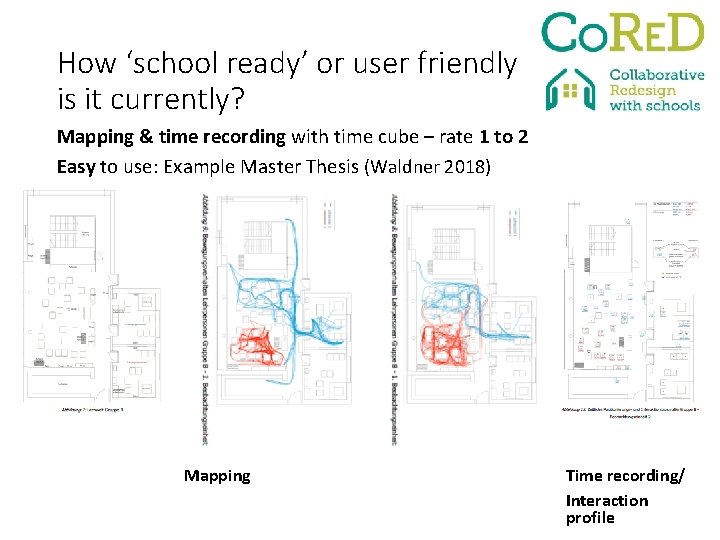
Description Observation method: Mapping Based on the floorplan of a classroom the observing of the classroom’s use will be mapped: teachers’ and students’ movement are drawn and notes of the action/interaction at the different positions are added (see fig. 1).
Description Observation method: description Taking into account research in education (see Horne Martin 2002) a „Cluster of Acitivities“ will be used to describe the activities during a lesson: (1) Introduction. Activities usually present at the beginning of each lesson which include students arriving and registration; (2) Teacher Teaching. The focus of attention is the teacher; usually the whole class is focused on the teacher; (3) Pupils on task. The focus of activity is on students working either individually or in groups. Most teacher-pupil(s) interactions occur in this cluster; (4) Transition. The focus is dispersed, there is usually a lot of movement in the class as pupils are completing tasks and sharing work with peers and teacher; (5) Conclusion. The focus is on cleaning up the tables, tidying up and packing. Pupils leave the room and it is the end of the class. (Horne Martin 2002, p. 142).
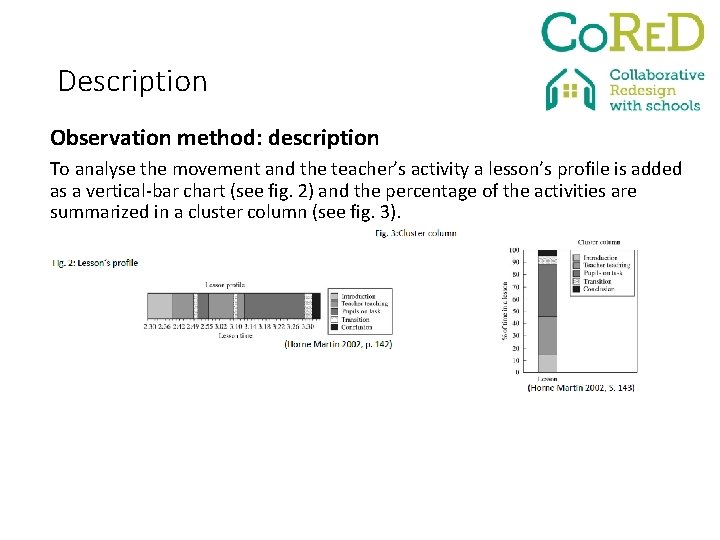
Description Observation method: description To analyse the movement and the teacher’s activity a lesson’s profile is added as a vertical-bar chart (see fig. 2) and the percentage of the activities are summarized in a cluster column (see fig. 3).
Which principle(s) could it support and how? Four principles to facilitating collaborative engagement about school space : 1. Start where people are (mentally and physically); 2. Understand the intertwining of physical, organisational and social aspects of school environment; 3. Facilitate the exploration of ideas and possibilities; 4. Appreciate the complex lengthy process that is change
Who has it been used with so far? • Teachers • Young pupils What impact do open and/or traditional classroom design have on the extent of temporal interaction between teachers and pupils at certain Positions in classroom’s space? (Waldner Behavioural mapping Time recording ZEI (cube for time recording, Timeular) Tracking teachers and students (Joanne Deppeler & Deborah Corrigan) https: //timeular. com/
How ‘school ready’ or user friendly is it currently? Mapping & time recording with time cube – rate 1 to 2 Easy to use: Example Master Thesis (Waldner 2018) Mapping Time recording/ Interaction profile
Analysis What will you want the tool-trialler to do with the data? • Mapping floorplans, classrooms, school space • Time recording What needs to be returned to you? • Plans with and without movement patterns • Profile of time recording
References Helmke, A. (2012), Unterrichtsqualität und Lehrerprofessionalität. Diagnose, Evaluation und Verbesserung des Unterrichts (4. Aufl. ), Seelze: Kallmeyer. Horne Martin, S. C. (2004), Environment-Behaviour Studies in the Classroom, in: The Journal of Design and Technology Education, Vol. 9, Nr. 2, p. 77 -89. Horne Martin, S. C. (2002), The Classroom Environment and its Effects on the Practice of Teachers, in: Journal of Environmental Psychology (22), p. 139 -156. Meyer, H. (2010), Was ist guter Unterricht? , Berlin: Cornelsen. Stadler-Altmann, U. (2019), Pedagogical Research in regards to School Design Processes. A fragmentary overview developing pedagogical inspired principles for both planning and designing school buildings, in: Weyland, B. ; Stadler -Altmann, U. ; Galletti, A. ; Prey, K. , SCUOLE IN MOVIMENTO. Progettare insieme tra pedagogia, architettura e design, Franco Angeli Open Access, pp. 14 -23. Stadler-Altmann, U. (2018), Ambienti di apprendimento formali: gli edifici scolastici e le aule influenzano i processi di insegnamento e apprendimento? Contributo teorico, in: formazione & insegnamento. European journal of research on education and teaching. Rivista internazionale di Scienze dell’educazione e della formazione Anno XVI (2): p. 209224. Stadler-Altmann, U. (2015), The Influence of School and Classroom Space on Education, in: Rubie-Davis, Chr. ; Stephens, J. (Ed. ), The Social Psychology of the Classroom International Handbook (in press – May 2015). Stadler-Altmann, U. (2013), Lehren und Lernen in der gebauten Umgebung. Anmerkungen zur medialen Nutzung des Klassenraums im Unterricht, in: Westphal, K. ; Jörissen, B. (Hrsg. ), Mediale Erfahrungen: Vom Straßenkind zum Medienkind. Pädagogische Raum- und Medienforschung im 21. Jahrhundert, Weinheim, München: Juventa, S. 176196. Waldner, A. (2018), Lehren und Lernen im Spannungsverhältnis von Klassenraumgestaltung, Lehrpersonen, Schülerinnen und Schülern, Master Thesis, Bressanone. Woolner, P. (2018) Collaborative Re-design: Working with School Communities to Understand Improve their Learning Environments. In: Ellis, RA; Goodyear, P, ed. Spaces of teaching and learning: Integrating perspectives on research and practice. Singapore: Springer.
- Slides: 10