
Classroom Management Introduction n n n Classroom management

- Slides: 15
Classroom Management
Introduction n n n Classroom management is challenging; traditionally, it was a matter of exerting control over learners; recently, it is perceived as an art of establishing good climate & management of learning; more related to the issue of how a teacher establishes his/her authority by offering interesting/stimulating lessons; teachers need to gain students’ respect & confidence by showing their concerns about students; the use of skills and techniques in lesson planning, encouragement and preventive measures, etc.
Discussion Please identify the following items and see if they are serious misbehaviors or not: 1. Come into the classroom noisily 2. Come in consistently late 3. Play with other students when teachers teach 4. Fail to produce a textbook when requested 5. Call out in class 6. Make insulting remarks to the teacher or to other classmates 7. Physically threaten other classmates
Activity: Managing Robert’s behavior Robert always went out to the blackboard to do class work without the teacher’s permission. The teacher asked him: “Robert, do you know that your action has disrupted the class routine and prevented others from participating in doing class work? ” However, Robert didn’t understand the teacher’s point and answered: “I don’t go out when I don’t know how to solve the problem!” What could you do?
Activity: Intervention strategies n n A student is copying answers from his/her classmate’s test paper; A student takes another student’s textbook; A student sharpens his/her pencil during your presentation; A student refuses to participate in class activities in your lesson. As a teacher, what can you do?
The worst encounter in Chan Shu Kui n n We have seen several examples of misbehaviour in classrooms. Spend about ten minutes talking to your group members, exchanging and understanding the problems they have encountered. Put down the worst experience in your group and share it with us. Share with the group a happy experience.
Interactions in classrooms n n Classroom is a social setting where students engage in learning. It provides a context for students to interact with their peers and teachers. These interactions include negotiating, competing, saving face, asking for help, working in teams, etc. Peer relationship is a crucial part to constitute classroom climate Peer interaction has a direct impact on students’ personal development and the quality of teaching and learning
Classroom scenario Mr. Lam entered into the classroom and greeted the pupils. It was a dull room with only a few worn-out posters on the walls. He turned on the computer in order to run a DVD for his lesson. It took him more than five minutes to get the computer to produce the right images, and during that time Mr. Lam said nothing as he was focusing on what had happened to his computer. As a few students started talking and the noise began to get louder, Mr. Lam shouted, “Please keep quiet!”, but none of the students paid any attention to him. All of a sudden, Mr. Lam banged his table and shouted to the students in an intimidating tone, “If you keep on making a noise, all of you will be punished. ” At that point, Mary whispered to her neighbour May, “I have not made any noise at all, so why does Mr. Lam have to punish me? ” The Q: What’s wrong with the class? Who should be responsible? If you were the teacher, what could you do in order to avoid this?
Major Works of Classroom Management 1. 2. 3. 4. Management of the physical environment Management of learning Management of daily routines: procedures and rules Management of discipline
Managing Physical Environment of the Classroom n n n It is about designing or furnishing classrooms to motivate students to learn; Physical settings create a set of expectations about socially acceptable behavioral repertoires; The setting should enable children to meet their basic needs e. g. self actualization through learning; Classroom seating arrangements reflect teachers’ preferred teaching style; Competent teachers determine the most appropriate social arrangements for the students and lessons; There is no best way to arrange seating; but it is an attempt to maximize student engagement and learning
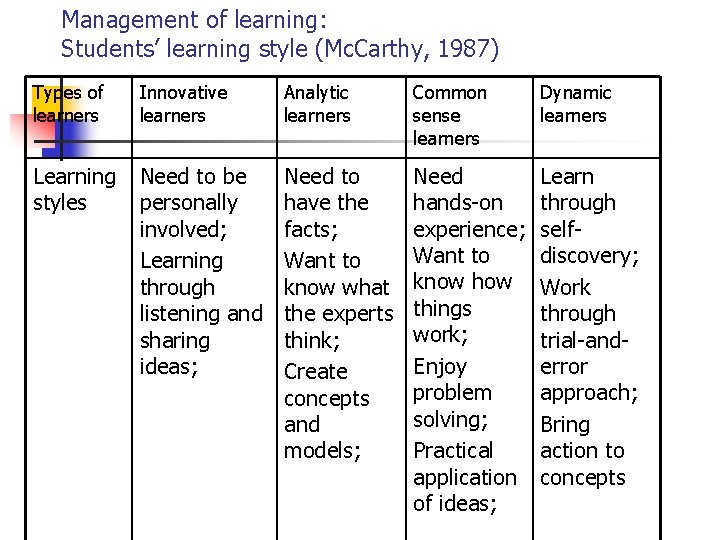
Management of learning: Students’ learning style (Mc. Carthy, 1987) Types of learners Innovative learners Analytic learners Common sense learners Dynamic learners Learning styles Need to be personally involved; Learning through listening and sharing ideas; Need to have the facts; Want to know what the experts think; Create concepts and models; Need hands-on experience; Want to know how things work; Enjoy problem solving; Practical application of ideas; Learn through selfdiscovery; Work through trial-anderror approach; Bring action to concepts
Establishing Classroom Management Procedures & Rules n n n Two major goals of Classroom management: (a) create a conducive learning environment for students (b) help students to develop their sense of responsibility & self-regulation (Eggen & Kauchak, 1997) To achieve the goal for self discipline, teacher needs to establish routines and procedures in the classroom; Some measures applied for handling misbehavior.
The need for classroom guidelines n n Classroom guidelines are necessary for the efficient and effective running of a classroom. Guidelines can minimize confusion & ensure orderly interactions among students. It can minimize the loss of valuable teaching time and provide a conducive learning environment for students. It also provides clear expectations & welldefined norms to students.
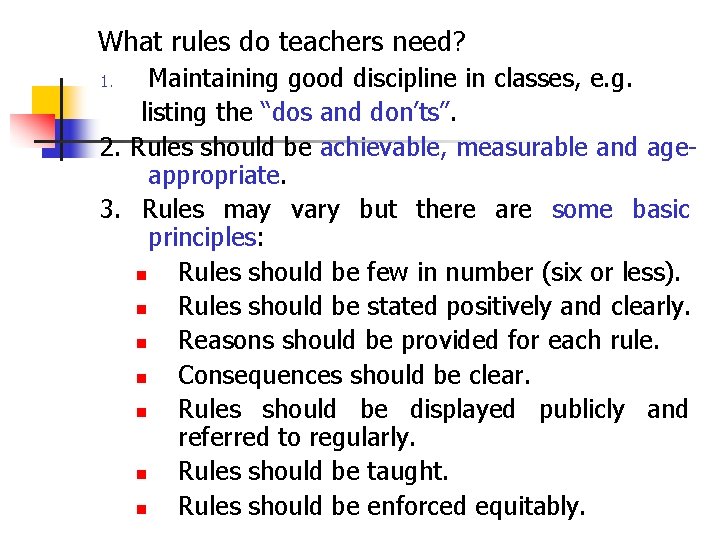
What rules do teachers need? Maintaining good discipline in classes, e. g. listing the “dos and don’ts”. 2. Rules should be achievable, measurable and ageappropriate. 3. Rules may vary but there are some basic principles: n Rules should be few in number (six or less). n Rules should be stated positively and clearly. n Reasons should be provided for each rule. n Consequences should be clear. n Rules should be displayed publicly and referred to regularly. n Rules should be taught. n Rules should be enforced equitably. 1.
Thank you