
Classroom Management and Behavior Interventions Similarities and Differences
Classroom Management and Behavior Interventions Similarities and Differences in General and Special Education
What Is the Goal of Behavior Management? ¡ To facilitate student learning. l Ensure learning is successful. For each individual. ¡ For all students involved. ¡ Maximizing academic engaged ¡
Two Forms of Management ¡ Classroom management l l l ¡ Prevention of the need for crisis management Institution in classes of support for positive learning behaviors Establishment and fluent use of key management strategies Crisis management l When classroom management fails
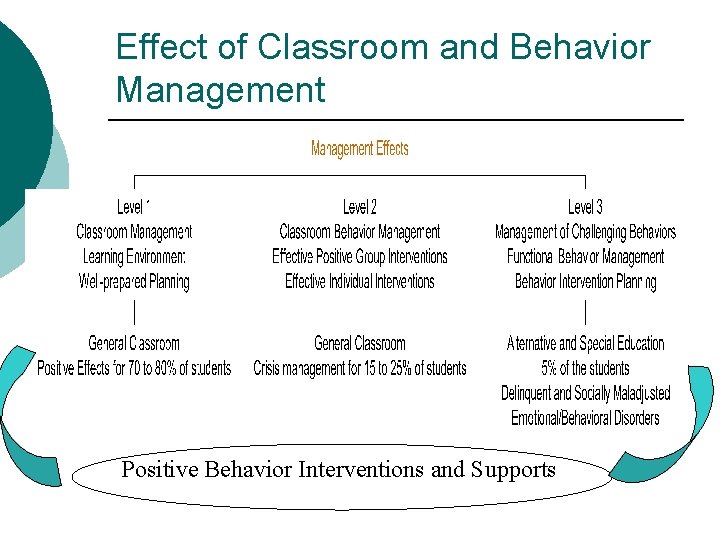
Effect of Classroom and Behavior Management Positive Behavior Interventions and Supports
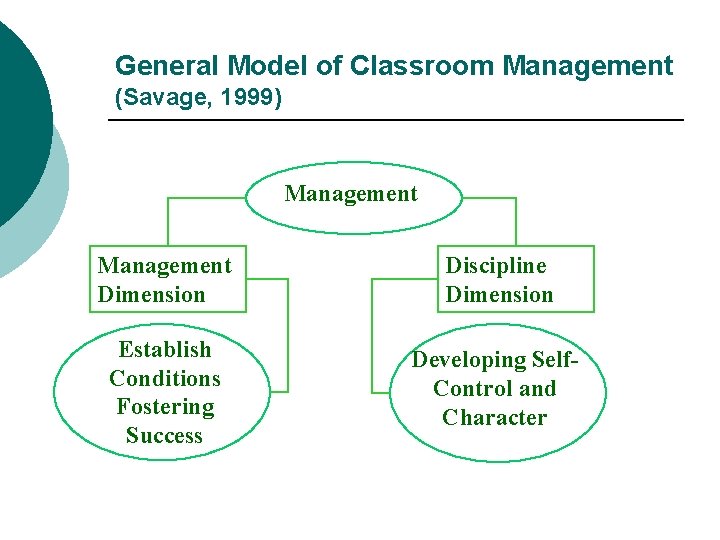
General Model of Classroom Management (Savage, 1999) Management Dimension Discipline Dimension Establish Conditions Fostering Success Developing Self. Control and Character
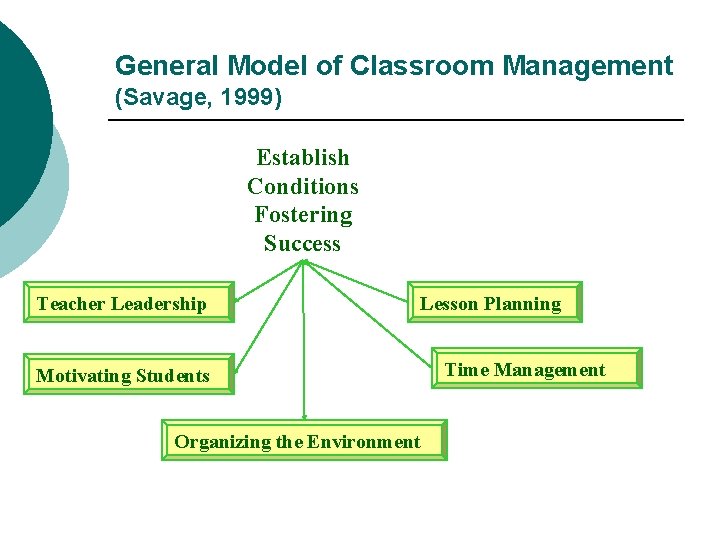
General Model of Classroom Management (Savage, 1999) Establish Conditions Fostering Success Teacher Leadership Lesson Planning Motivating Students Organizing the Environment Time Management
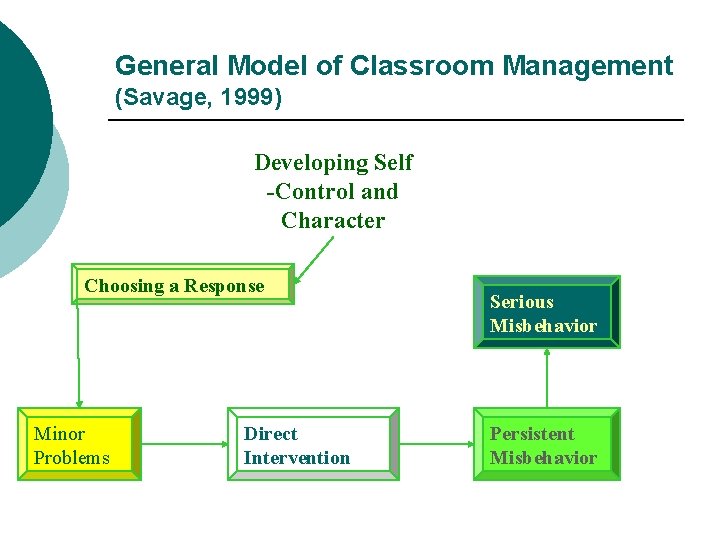
General Model of Classroom Management (Savage, 1999) Developing Self -Control and Character Choosing a Response Minor Problems Direct Intervention Serious Misbehavior Persistent Misbehavior
Responding to Inappropriate Behavior ¡ ¡ Focus on the purpose of management l foster student learning Identify your response motives Develop and choose from a range of alternatives Maintain a “least intrusive” response schedule
Least Intrusive Response schedule Low-Profile Responses supporting stimulus control ¡ Direct Intervention ¡ Behavior Interventions for Persistent and Serious Misbehavior ¡
Low Profile Responses ¡ Modeling Appropriate Behaviors ¡ Understanding Group Dynamics ¡ Addressing Minor Problems with Low Profile Responses

Modeling ¡ Don’t ask students to do what you will not ¡ Approach your behaviors from the students’ view ¡ Admit that you can sometimes fail ¡ Always demonstrate that you are trying
Group Dynamics ¡ Groups reinforce individual behavior ¡ Group reinforcement competes with teacher reinforcement ¡ Students play different roles in groups
Student roles in Groups ¡ Leaders l Supporters ¡ Instigators ¡ Class clowns ¡ Scapegoats ¡ Isolates
Teacher roles in a classroom ¡ Facilitator l l l Group maintenance: promote group welfare Confidant Expert in content ¡ Leader l l l Decision maker Arbitrator Expert: Modeling
Roadblocks to Communication (Gordon, 1974) ¡ ¡ ¡ ¡ ¡ Orders/commands Threats Preaching Judgments Name-calling/stereotyping/labeling Interpreting/analyzing Undue praise (look for something “positive”) Sympathizing Interrogating Withdrawing/diverting
Communication Facilitators ¡ Student-Owned Problems First ¡ Active Listening ¡ “I” Messages ¡ Sample Activities
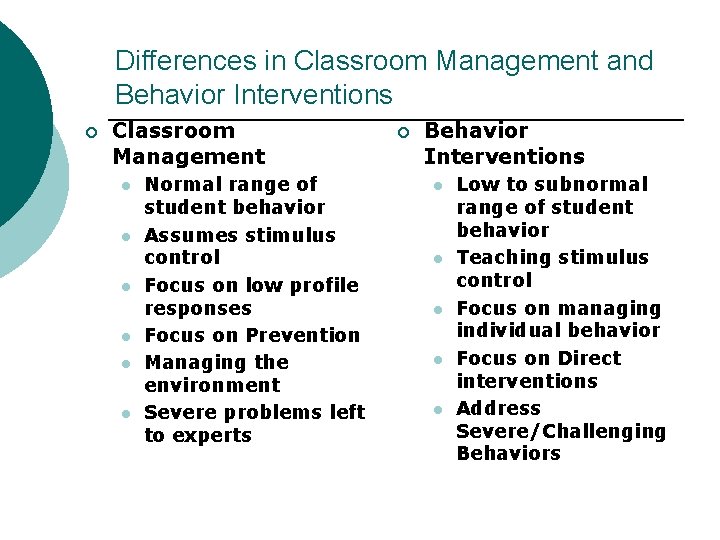
Differences in Classroom Management and Behavior Interventions ¡ Classroom Management l l l Normal range of student behavior Assumes stimulus control Focus on low profile responses Focus on Prevention Managing the environment Severe problems left to experts ¡ Behavior Interventions l l l Low to subnormal range of student behavior Teaching stimulus control Focus on managing individual behavior Focus on Direct interventions Address Severe/Challenging Behaviors
Problem 1 (from Savage, 1999) ¡ Address this problem from a classroom management perspective l l Keith is not really a problem student. He wants to please and is a likable student who does acceptable work. The problem is that he is constantly talking. When students are working independently, he talks incessantly to himself and to those around him. It is not loud talking, but is noticeable. The behavior disturbs you, and you think it bothers those who are seated near him. What might be causing Keith to talk? Is this a problem requiring your intervention? What would you do [using classroom management techniques] to help Keith control his talking?
Problem 2 (Savage, 1999) ¡ Address this problem from a classroom management perspective l l You are teaching a very capable tenth-grade science class. The students are generally well behaved and produce outstanding work. A number of the students, however, tend to be late; arriving in class a few minutes after the bell rings. They are not disruptive, but just wait until the last minute. The principal observes this behavior and reminds you of attendance policies stating that this problem must rectified. He plans to monitor this problem and assist you if you cannot correct it. You are embarrassed and upset. You decide to use an “I” message and active listening to get student cooperation and solve the problem. What I-message would you convey to the class? What will you do if students become angry or defensive? What are some possible actions to suggest to the class.
Functional Behavior Management Observing behavior ¡ Defining behavior ¡ Measuring behavior ¡ Collecting data on observed behavior displaying observed behavior ¡ Making data-based decisions ¡
Observing Behavior ¡ Determining priority behaviors l l l Deciding on a target behavior Making a determination of the behavior’s level of priority Determining whether to remediate, accommodate, postpone, or ignore
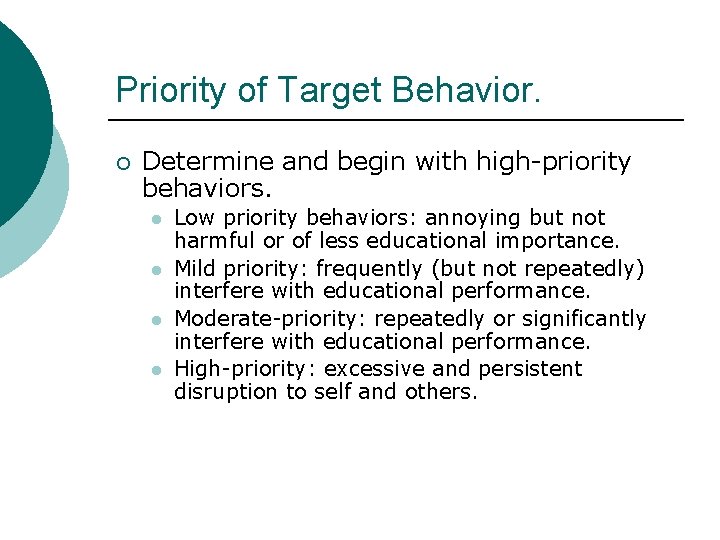
Priority of Target Behavior. ¡ Determine and begin with high-priority behaviors. l l Low priority behaviors: annoying but not harmful or of less educational importance. Mild priority: frequently (but not repeatedly) interfere with educational performance. Moderate-priority: repeatedly or significantly interfere with educational performance. High-priority: excessive and persistent disruption to self and others.
- Slides: 22