
Classroom Management 1 Chapter 9 The Classroom management
- Slides: 49
Classroom Management 1 Chapter 9
The Classroom management Problem • Describe the characteristics of an ineffective classroom management. • What types of behaviors take away from classroom instruction? • Inappropriate classroom management is one of the reasons that teachers leave the profession early.
Reasons for ineffective classroom management • Why do teachers struggle with classroom management? • Do you feel prepared?
What works best for me. • New teachers often gain advice from seasoned teachers about what works for them. • The problem is that what often works has not been tested through research. • There is not a “how to” manual for management. • It is something that has to be developed over time.
Research Based Instruction • Explicit instruction is something that needs to be incorporated into our classroom instruction on a daily basis. • Why are teachers forgetting how to use and incorporate these methods? • In order for you to be success in the area of classroom management, you must have organized, efficient, and an orderly classroom.
Characteristics of successful management • Preventing • Responding – Positive people respond, negative people react. • Intervening
Prevention • What is prevention? • Teachers who have effective classroom management can prevent problems from happening rather than responding to inappropriate behaviors. • Preventing refers to behaviors and actions that prevent student behaviors and result in a higher rate of student engagement. – When you are preventing, there is more time for learning
Responding • Teachers can do all the right things and still encounter inappropriate behavior. • Teachers need to know how to respond to student behavior. • Avoid the power struggle. • Responding to problem behaviors must be efficient, effective, and appropriate for the level of misbehavior.
Intervening • This method involves using research based interventions. • Manipulating consequences
Prevention and Classroom Management • The old rule was to punish the misbehavior. • Jacob Kounin Research page 219 • What teachers do effect what students do.
Curriculum of Control • The system of control, the problem with points. • Points are used to control a variety of social and classroom behaviors. • Classroom atmospheres are rigid and controlling.
Curriculum of Control • Characteristics of classrooms that focus on control: – Boring and ineffective classroom activities – Too much down time – Negative teacher-student interactions
Results • If teachers pay attention to what they are teaching, creating engaging and meaningful lessons, and work at student relationships the result will be a more effective classroom structure.
Proactive versus Reactive • • What does the word proactive mean? What does the word reactive mean? How do they apply to classroom behavior? Before an action or problem occurs, the teacher teaches carefully and strategically all that is required so that students have the information necessary to perform or behave appropriately.
Primary Components of a Proactive classroom • • • Teacher behaviors and attitudes Building positive relationships Communicating positive expectations Praising students Enriching the classroom with incentives and reinforcers
Activity • Do and don’s activity
Teacher authority and Credibility • Look at the figure on page 225 • Fill out the table and go over responses
Modeling • An effective teacher must be able to model appropriate self-discipline and self-control • What does this look like? • What should you not do?
Classroom structure • • • The physical space Seating arrangements Effective teaching Managing classroom time Determining correct level of instruction Providing clear directions Monitoring student attention Holding students accountable Managing classroom lessons Lesson momentum Provid variety
Implementing a Proactive Classroom Management System • Step 1: Develop classroom procedures • Establishing classroom routines – Figure 9. 6 • beginning the school day • Keeping early finishers busy • Planning transition time
Implementing a Proactive Classroom Management System • Step 2: Develop student rules and teach them to the students – Figure 9. 7 • Step 3: Monitor and acknowledge correct performance of expected behavior – Figure 9. 8 • Step 4: develop clear and consistent procedures • Step 5: collect data on what is working
Classroom management 2 • Responding to behavior problems • The Nature of Problem behaviors: students with EBD display a wide variety of behavior problems – List overt and covert behavior problems
Categories of problem behaviors • 1. ) nonproblems: problems that are brief • 2. ) minor problems: behaviors that are violations of classroom rules • 3. ) major problems: behaviors that effect classroom order and interfere with classroom learning • 4. ) escalating or spreading problems
Ineffective response to problem behavior • • • Ignoring Nattering Yelling and threatening Talking to an upset child Engaging in escalating interactions with students • Page 246 figure 10. 1
Principles for responding to problem behavior • Emphasize preventive measures – Develop classroom rules – Minimize student downtime – Plan lessons at the appropriate level – Monitor student behavior
Principles for responding to problem behavior • Principle 2: modify the learning environment page 248 • Principle 3: Use pre-correction strategies • Principle 4: respond privately • Principle 5: respond consistently and fairly • Principle 6: Use alpha commands • Principle 7: Maintain dignity • Principle 8: stay calm • Principle 9: develop a game plan • Principle 10: provide contingent reinforcement
Alpha versus Beta commands • Alpha commands are short and direct statements – I need you to… – Please take out… – The chair needs to stay on the floor
Practice making Alpha commands • Practice writing alpha commands for the following situations: – Student is talking to his neighbor during instruction – Student is refusing to get his started on her work – Student is tipping desk – Student is refusing to do his work
Practice • Role play with another student • Revisit principle 8 on page 251
Responding to noncompliance • One of the biggest issues for teachers to deal with in their classrooms are minor behaviors. Minor behaviors are behaviors that disrupt learning and violate classroom rules. • Why do students use noncompliance?
Types of Noncompliance • • • Passive Simple refusal Direct defiance Negotiation Pg 254
Variables that affect compliance • Issuing specific, direct, and unambiguous commands • Using statements rather than commands (take out your math book, not would you please take out your math book) • Issuing one command repeating it only once • Give the student enough time to comply (5 to 10 minutes) • Make eye contact with the students • Reinforce student compliance
Responding to commands • Comply with directions • Fail to comply with demands by delaying, ignoring or actively refusing • Change the nature of the command through negotiation • Describe student behavior through each of the three situations
Variables that affect compliance • Issuing specific direct commands • Using a statement rather than a question • Issuing one command repeating it once if necessary • Giving the students adequate wait time • Stand close to the student and make eye contact • Reinforce student compliance
Precision requests • Precision request hand out
Think Time • • • Catch the problem behavior early Moving to the designated think time area Serving Think Time Debriefing with the student Debriefing forms Rejoining the classroom
Responding to Severe Misbehavior • • • Ensure the safety of others Call or send for assistance Attempt to defuse the situation Use physical restraint as a last resort Documentation Notify the students parents/guardians
Developing Crisis Management • Make sure that you are prepared for a crisis because chances are pretty good that a crisis will occur. • Use low-profile nonverbal procedures • Move in • Deliver precision request • Administer the consequence • Debrief the student
Management 3
Types of Reinforcers • • • Social reinforcers Activity reinforcers Token reinforcement Tangible reinforcement Edible reinforcers
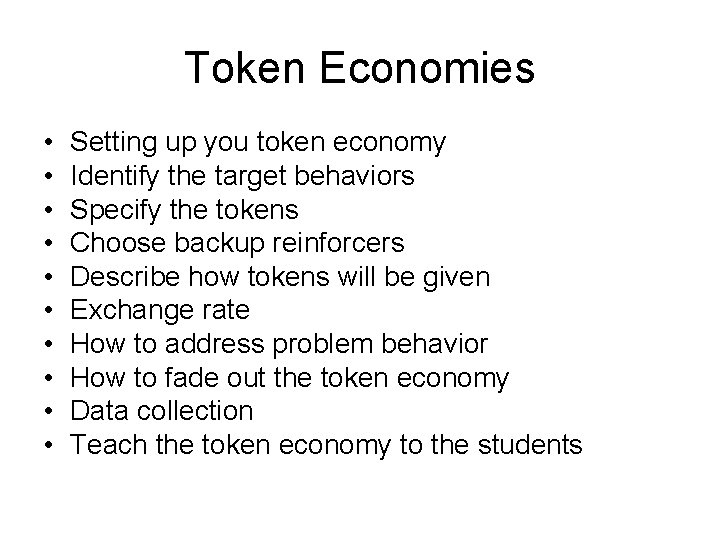
Token Economies • • • Setting up you token economy Identify the target behaviors Specify the tokens Choose backup reinforcers Describe how tokens will be given Exchange rate How to address problem behavior How to fade out the token economy Data collection Teach the token economy to the students
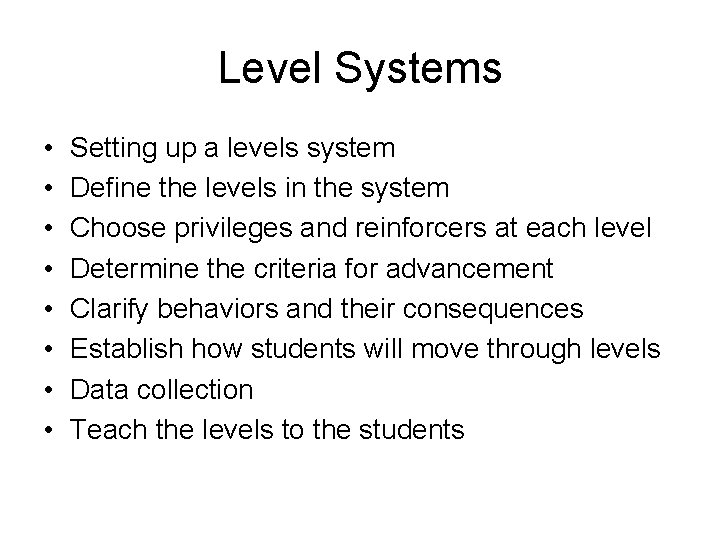
Level Systems • • Setting up a levels system Define the levels in the system Choose privileges and reinforcers at each level Determine the criteria for advancement Clarify behaviors and their consequences Establish how students will move through levels Data collection Teach the levels to the students
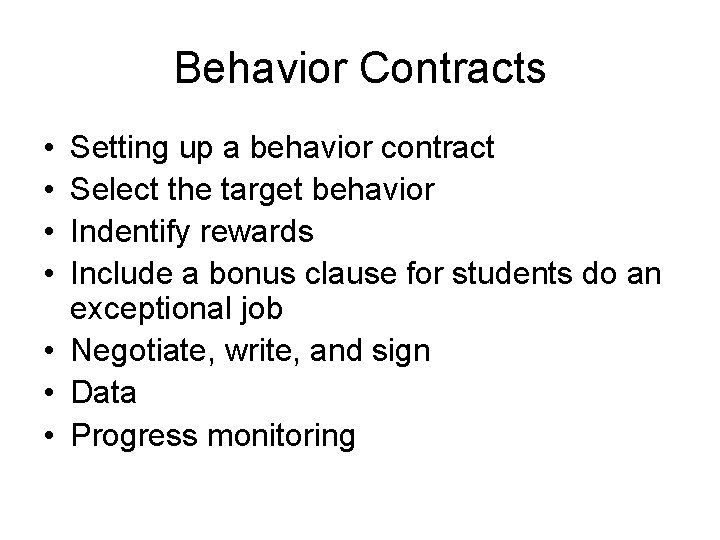
Behavior Contracts • • Setting up a behavior contract Select the target behavior Indentify rewards Include a bonus clause for students do an exceptional job • Negotiate, write, and sign • Data • Progress monitoring
Group Oriented Contingencies • Dependent group oriented contingencies • Independent group oriented contingencies • Interpersonal group oriented contingencies
Group Oriented Contingencies • Determine the type of contingency system that will be used • Identify the target behavior • Choose the group rewards • Define the criteria • Develop data collection • Teach the system to the students
Response Cost • Identify the target behaviors • Ensure that students have a reserve of reinforcers prior to implementing response cost • Determine the size of the fines • Determine how fines will be collected • Data collection • Teach the system to the students
Time-Out • • • Enrich the time-out environment Identify the target behavior Select types of time-outs Determine implementation guidelines Data collection Teach the system
Overcorrection System • • • Think restitution Chose the type of overcorrection Identify the target behaviors Determine implementation guidelines Data collection Teach the system
Guidelines and Principles of Behavior Reduction Interventions • Page 297