
Classroom Chemistry Grade 5 Science Student Learner Expectations



- Slides: 35
Classroom Chemistry Grade 5 Science
Student Learner Expectations
Safety Rules Do not let chemicals come in contact with your skin l Rinse well, if you do get chemicals on yourself. l Wipe up spills immediately. l Wash your hands with soap l Never taste chemicals. l Waft, when smelling. l
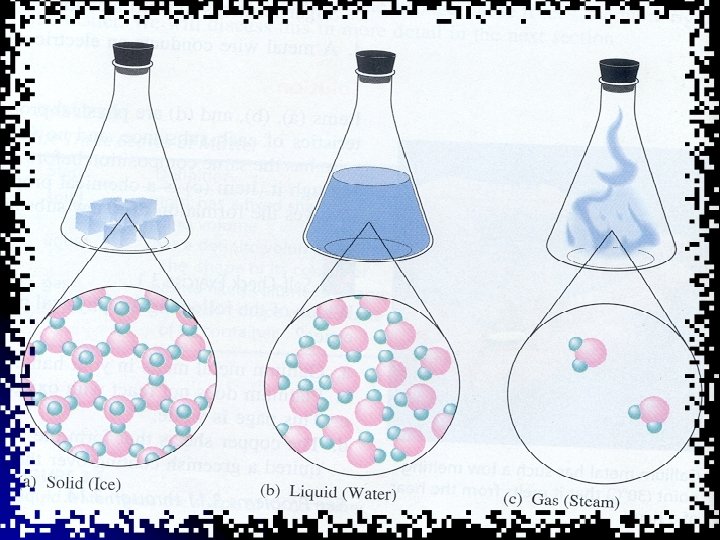
Matter l Matter is the substance of which physical objects are composed. l It can be solid, liquid or gas.
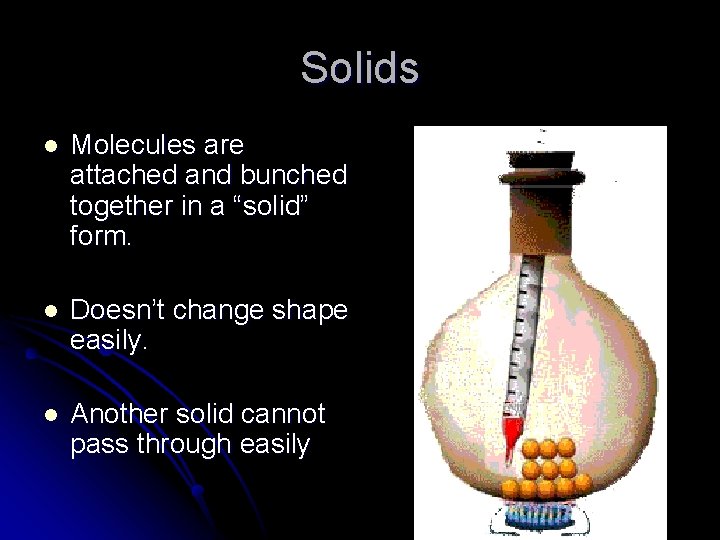
Solids l Molecules are attached and bunched together in a “solid” form. l Doesn’t change shape easily. l Another solid cannot pass through easily
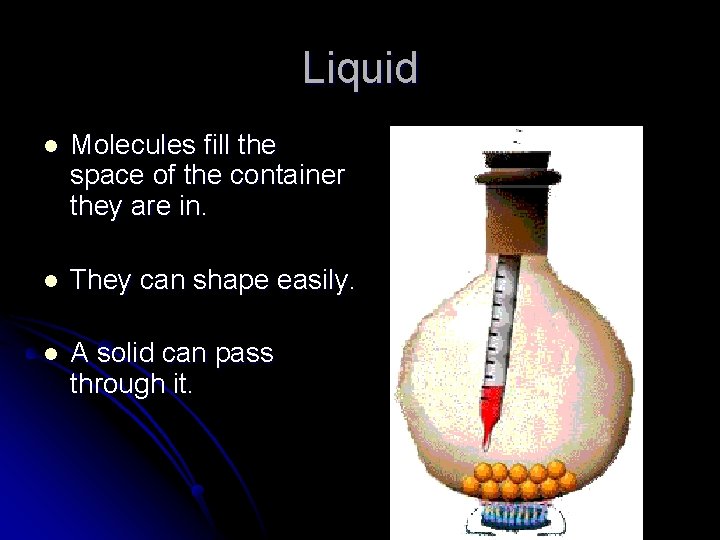
Liquid l Molecules fill the space of the container they are in. l They can shape easily. l A solid can pass through it.
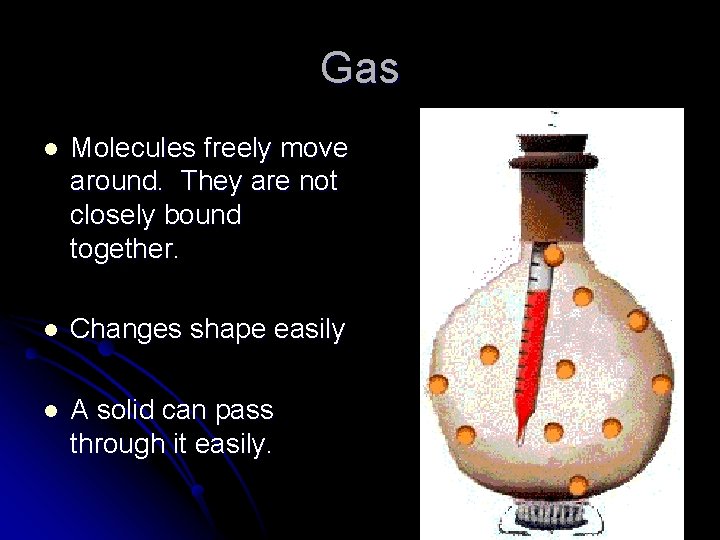
Gas l Molecules freely move around. They are not closely bound together. l Changes shape easily l A solid can pass through it easily.
Changes of State l Solid to Liquid- Melting l Liquid to Solid- Freezing l Liquid to Gas- Evaporation l Gas to Liquid- Condensation
Mixtures l Matter can generally be mixed with other types of matter. l A mixture is when particles of one substance mixes with particles of another substance. They are generally pure substances.
Where do we see mixtures? l Brainstorm as a small group. l Examples: recipes, construction-concrete, water, lemonade, salad dressings. l BLM #1
Separating Mixtures l How can you separate substances from a mixture? BLM #2 l Methods of Separating: sieves, magnets, air, water, evaporation, distilling, filtering l
Separating Mixtures l In groups, complete BLM #2 l See if you can separate the mixture you are given.
Methods of Separating l Sieves: can be used to separate solids. l Magnets: can pick magnetic objects, from non-magnetic.
Methods of Separating l Air: you can blow away lighter substances, to leave heavier ones. l Water: some substances will float or sink based on their buoyancy.
Methods of Separating l Evaporation: evaporate the liquid and leave the solid. l Distilling: the processing of vaporizing into gas and then condensing back into a liquid
Methods of Separating l Filtration: using a filter and pouring the liquid through to separate the solid. l http: //www. bbc. co. uk/schools/scienceclips/ ages/10_11/rev_irrev_changes. shtml
Mixing Liquids l BLM #3 and #4 Some liquids mix completely and are unable to be separated. eg: Milk and Tea l Some liquids do not dissolve in others and are more buoyant. eg: oil and water l Some liquids are heavier, less buoyant and settle on the bottom. eg: syrup l
Mixing Liquids l Some liquids react to each other. Eg: vinegar and milk. l Some liquids are able to dissolve solids, while some are not. l Lemonade is an example of a liquid mixture.
Activity: Layering Liquids l Why were the liquids able to be layered and not mixed? l Try mixing two different liquids, record your observations.
Lifesaver Experiment l BLM #6 and 7 l Observe how long the lifesaver takes to dissolve l The lifesaver dissolved into the water l Dissolve is when a solid crumbles into a liquid. l Can you make it dissolve faster?
Lifesaver Experiment: Inferences Manipulated Variablel Responding Variable- amount of time it will take to dissolve a lifesaver. l
Solutions l A homogeneous mixture in which the solute is uniformly distributed throughout the solvent. l Solute- The substance that is being dissolved in a solution. l Solvent- the substance that does the dissolving in a solution
Suspension l A mixture in which very small particles of a solid remain suspended without dissolving. l Heterogeneous Mixture- when one substance is unevenly mixed with another.
Separating Solutions Filtering l Pouring off the liquid l Evaporation l l Solution to Recovery Activity
Crystals l We can recover a dissolved substance by evaporation. l We can create crystals when the liquid evaporates.
Surface Tension l Water droplets are round and shaped like balloons l The film that forms on the surface of the water is called surface tension. l Surface tension is due to cohesion. An attraction of the molecules in water.
Surface Tension l Water is very cohesive. The water molecules act like glue. l Penny Challenge Paper Clip l Why was the water able to bulge up? Surface tension-cohesion of water molecules.
Carbon Dioxide Air is composed of 78% Nitrogen, 21% oxygen and 1% other gases like carbon dioxide, water vapour, helium, etc. l We breath oxygen. l Carbon Dioxide is the gas we breath out. That is formed from burning fuel. l Carbon dioxide is heavier than oxygen l Gas in a Bag activity. BLM #12 l
Reversible and Irreversible Changes l Reversible changes can go back to their original state. l Irreversible changes cannot go back to their original state.
Chemical Reaction l These are changes where two substances react chemically and they make a new substance. Testing Powders Activity l BLM 13 and 15 l
Acids and Bases An acid is substance that has ph less than 7 l A base is a substance that has a ph greater than 7. l Neutral has a ph of 7 l Both acids and bases are potentially harmful and they eat away at other substances. l
Litmus Paper l Litmus paper is used to determine if a liquid is acidic or basic Red Paper- acid stays red, base turns it blue l Blue Paper- acid turns it red, base stays blue. l Neutral- blue paper stays blue, red paper stays red. l