
Classifying Stars Classifying stars by their spectra was
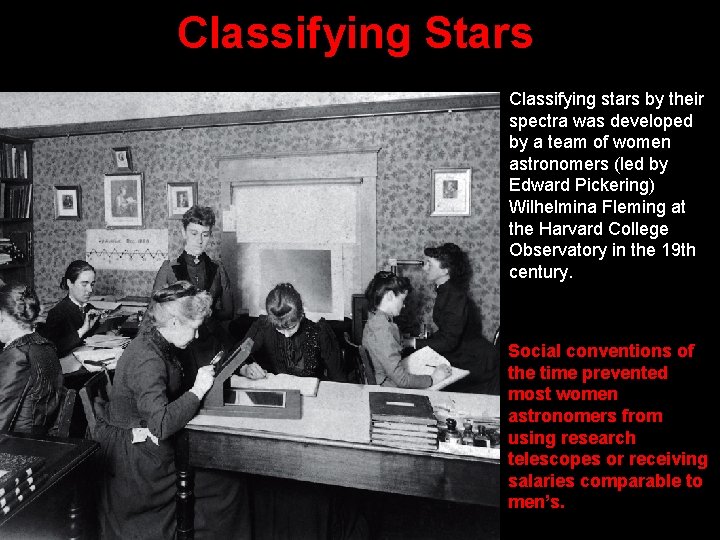
Classifying Stars Classifying stars by their spectra was developed by a team of women astronomers (led by Edward Pickering) Wilhelmina Fleming at the Harvard College Observatory in the 19 th century. Social conventions of the time prevented most women astronomers from using research telescopes or receiving salaries comparable to men’s.
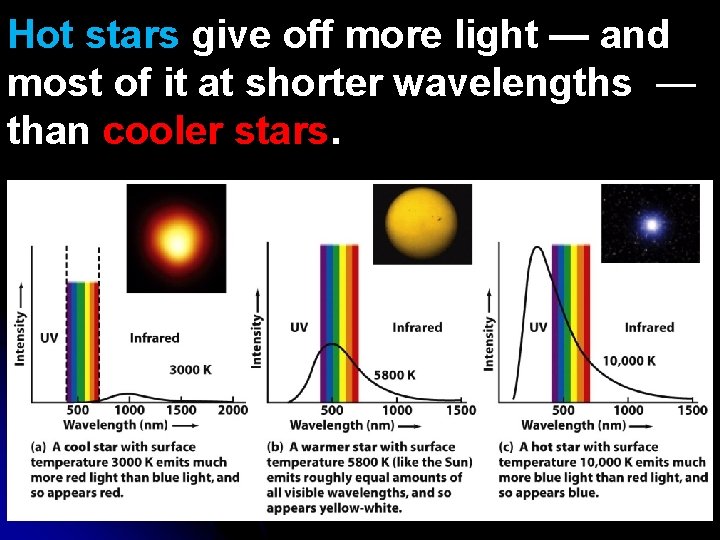
Hot stars give off more light — and most of it at shorter wavelengths — than cooler stars.
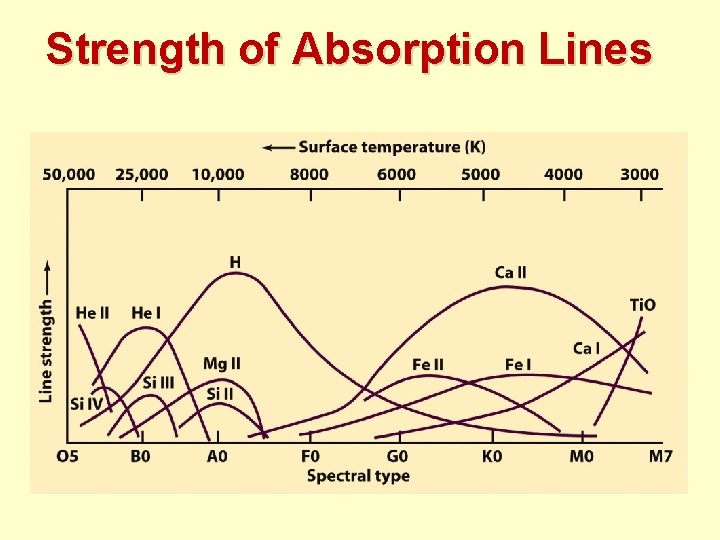
Strength of Absorption Lines
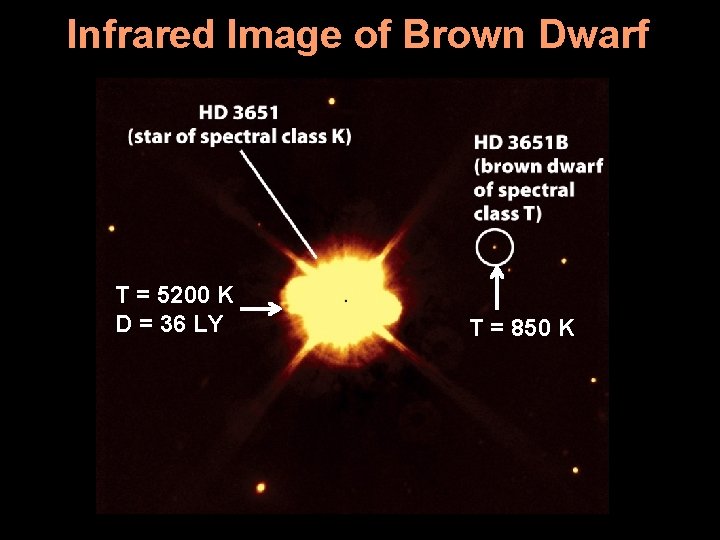
Infrared Image of Brown Dwarf T = 5200 K D = 36 LY T = 850 K
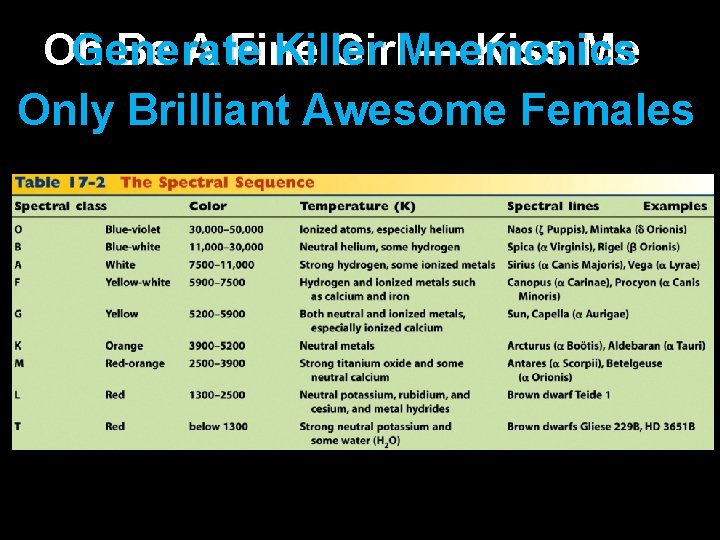
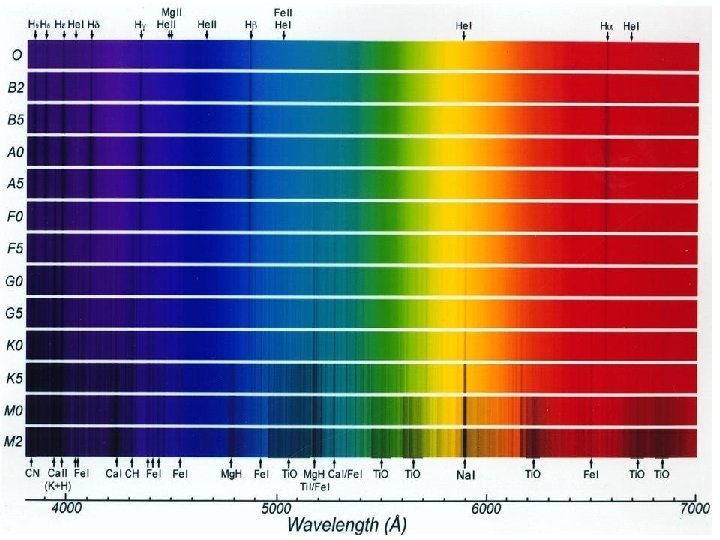
Generate Killer Oh Be A Fine Girl. Mnemonics — Kiss Me Only Brilliant Awesome Females
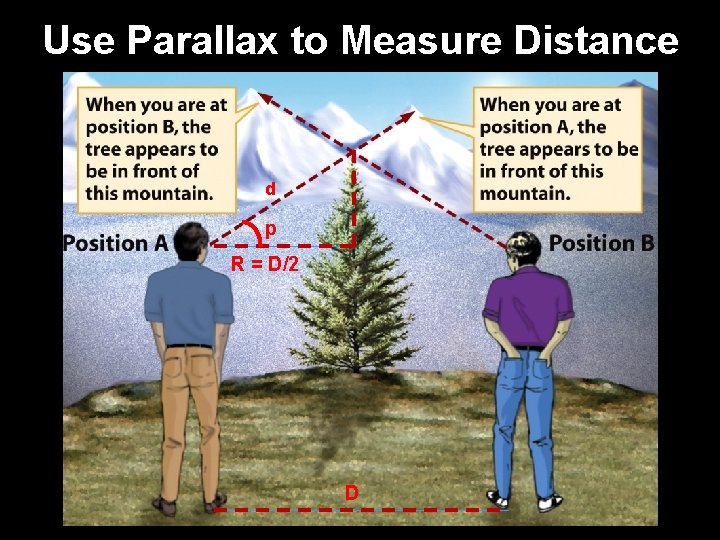
Use Parallax to Measure Distance d p R = D/2 D

Stellar Parallax — works for ~ 1000 Stars
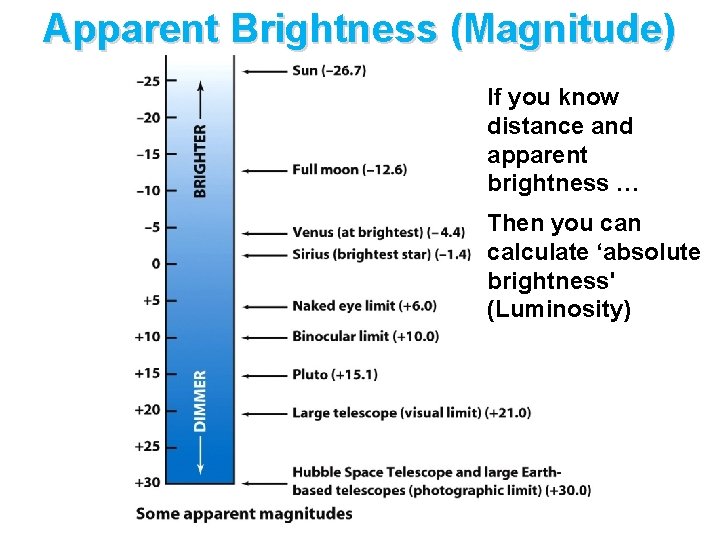
Apparent Brightness (Magnitude) If you know distance and apparent brightness … Then you can calculate ‘absolute brightness' (Luminosity)
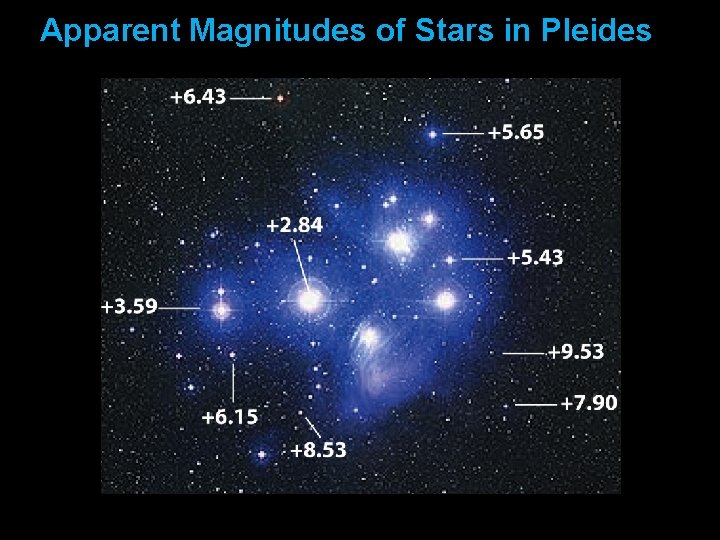
Apparent Magnitudes of Stars in Pleides

Size of a Star Measure Spectrum Measure parallax Measure brightness Calculate Radius
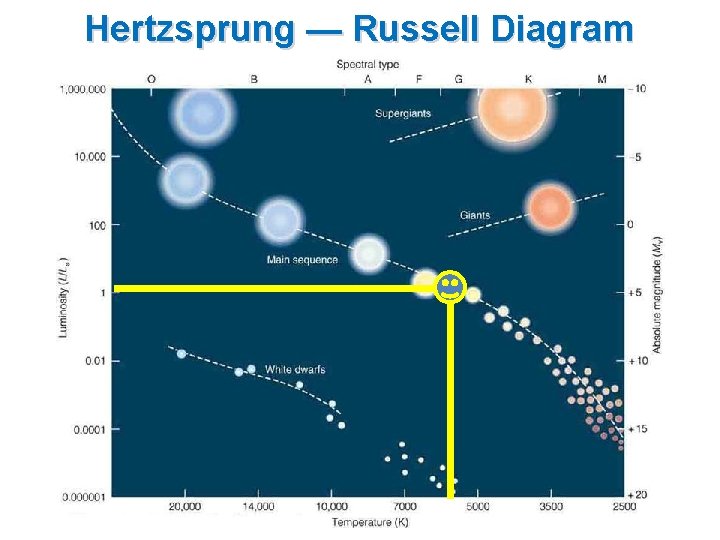
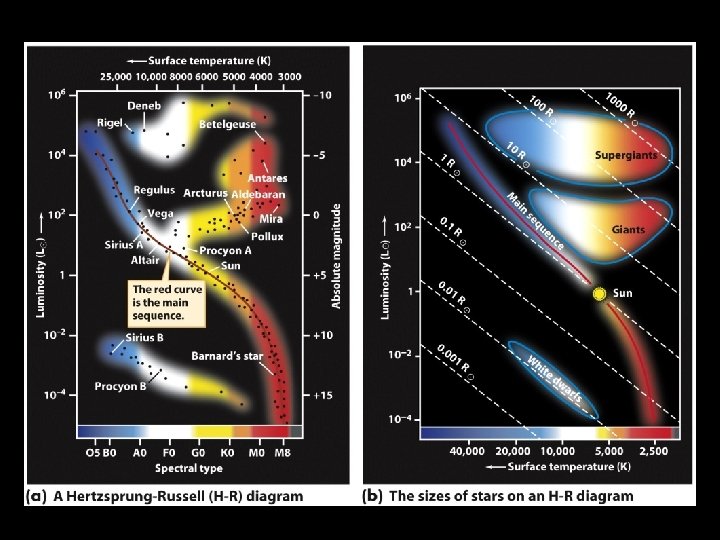
Hertzsprung — Russell Diagram
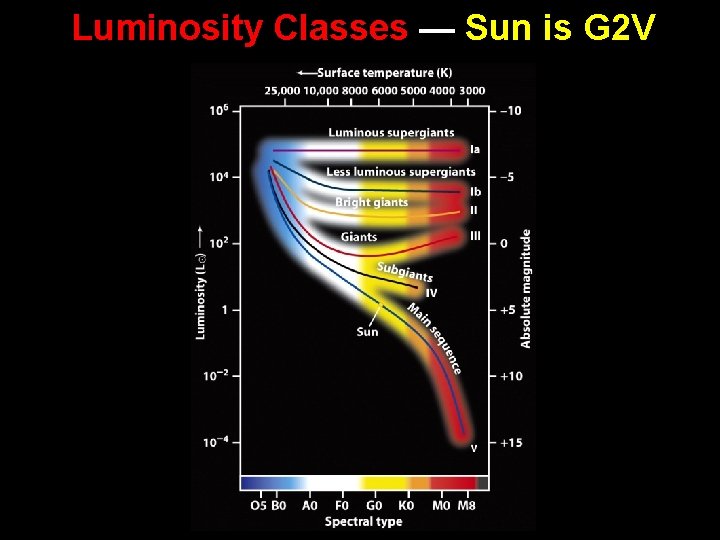
Luminosity Classes — Sun is G 2 V
Question What is the spectral type of the Sun? A. B. C. D. E. K 9 WOOF G 2 V F 7 V A#1 OB 1 KNOB
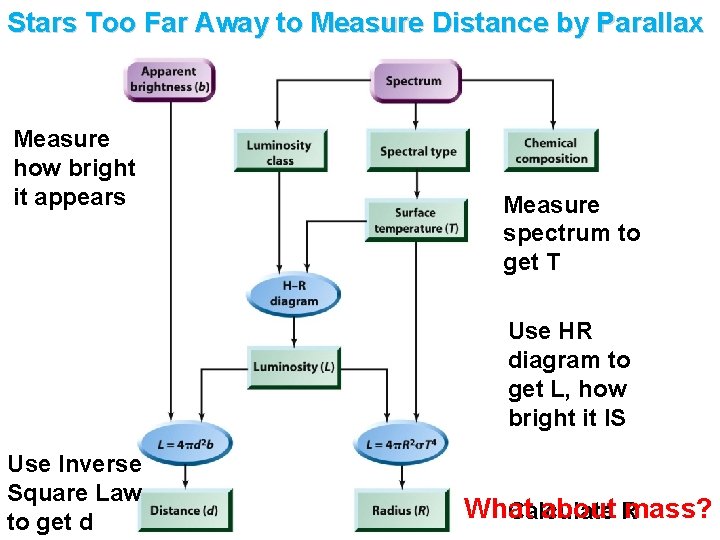
Stars Too Far Away to Measure Distance by Parallax Measure how bright it appears Measure spectrum to get T Use HR diagram to get L, how bright it IS Use Inverse Square Law to get d What about Rmass? Calculate
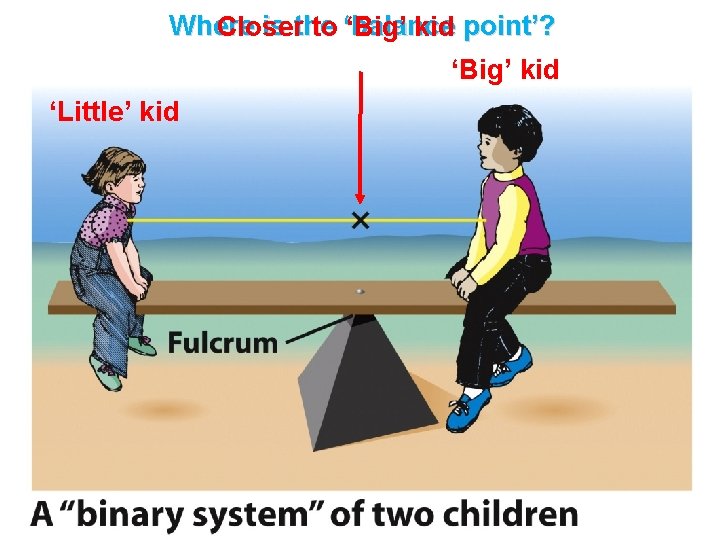
Where is the Closer to ‘balance ‘Big’ kid point’? ‘Big’ kid ‘Little’ kid
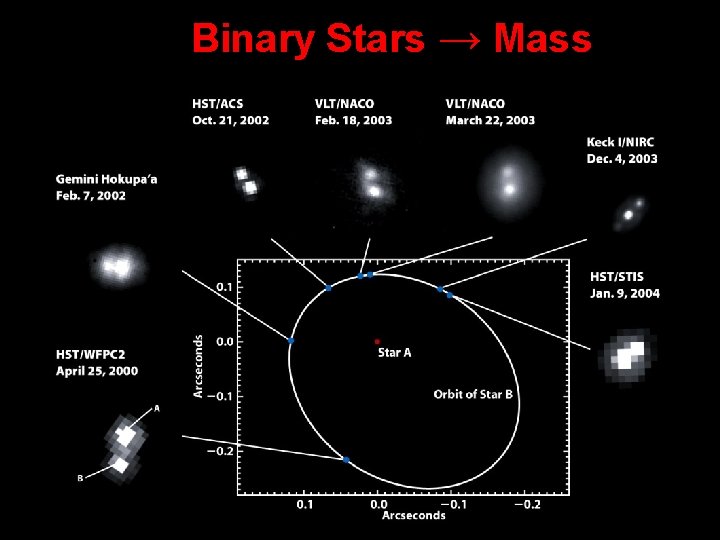
Binary Stars → Mass
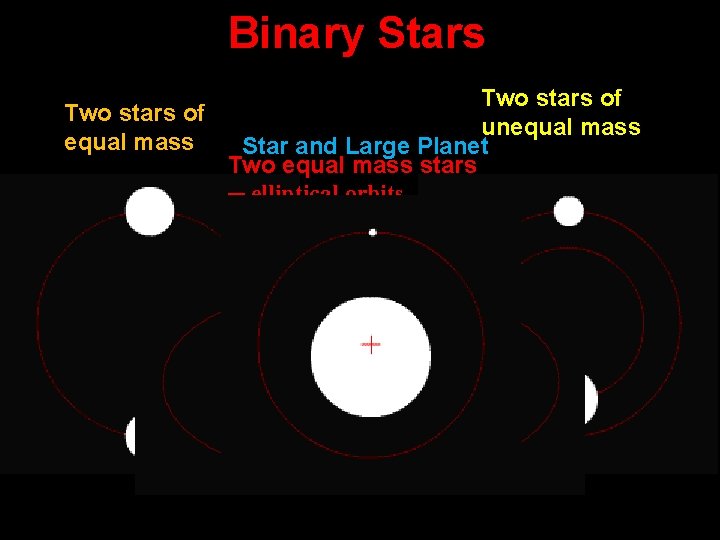
Binary Stars Two stars of unequal mass Star and Large Planet Two equal mass stars ─ elliptical orbits
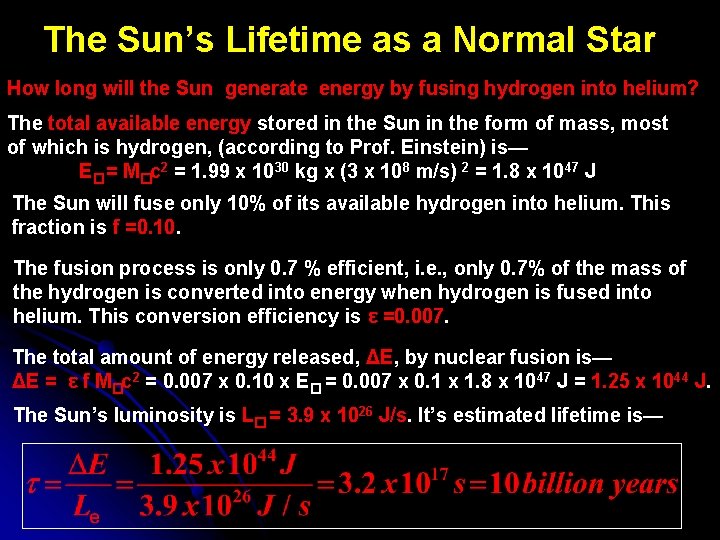
The Sun’s Lifetime as a Normal Star How long will the Sun generate energy by fusing hydrogen into helium? The total available energy stored in the Sun in the form of mass, most of which is hydrogen, (according to Prof. Einstein) is— E�= M�c 2 = 1. 99 x 1030 kg x (3 x 108 m/s) 2 = 1. 8 x 1047 J The Sun will fuse only 10% of its available hydrogen into helium. This fraction is f =0. 10. The fusion process is only 0. 7 % efficient, i. e. , only 0. 7% of the mass of the hydrogen is converted into energy when hydrogen is fused into helium. This conversion efficiency is ε =0. 007. The total amount of energy released, ΔE, by nuclear fusion is— ΔE = ε f M�c 2 = 0. 007 x 0. 10 x E� = 0. 007 x 0. 1 x 1. 8 x 1047 J = 1. 25 x 1044 J. The Sun’s luminosity is L� = 3. 9 x 1026 J/s. It’s estimated lifetime is—
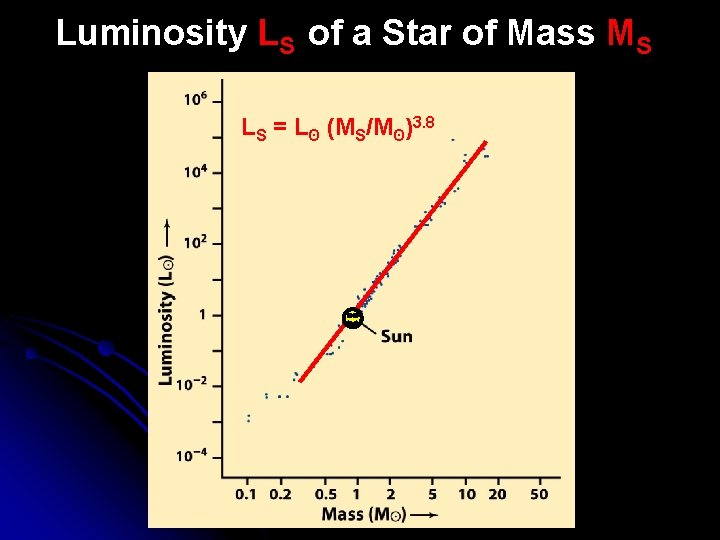
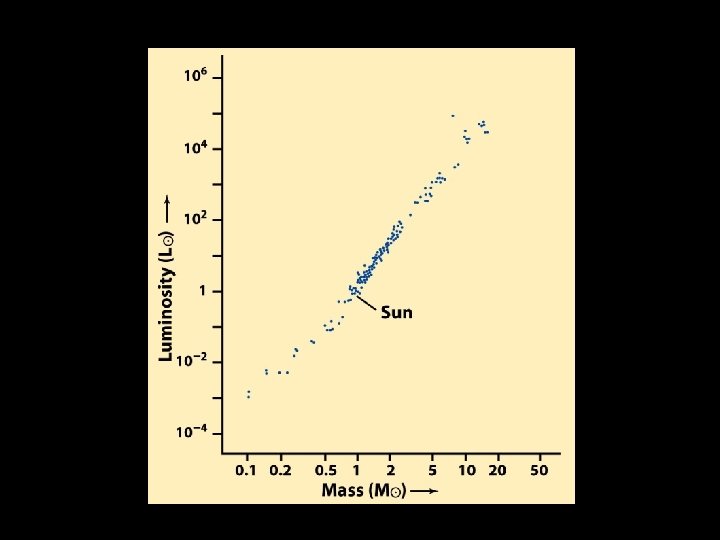
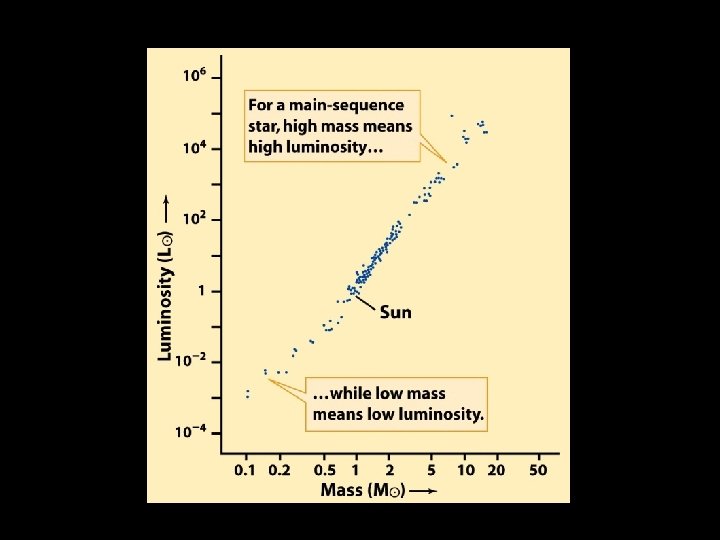
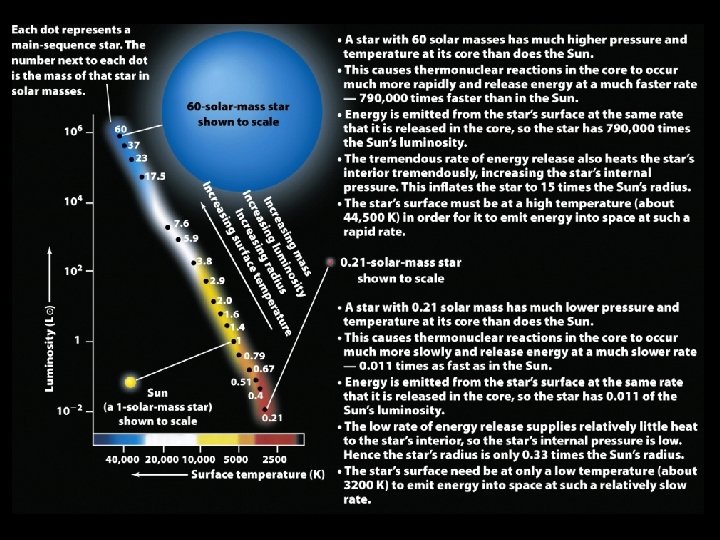
Luminosity LS of a Star of Mass MS LS = Lʘ (MS/Mʘ)3. 8
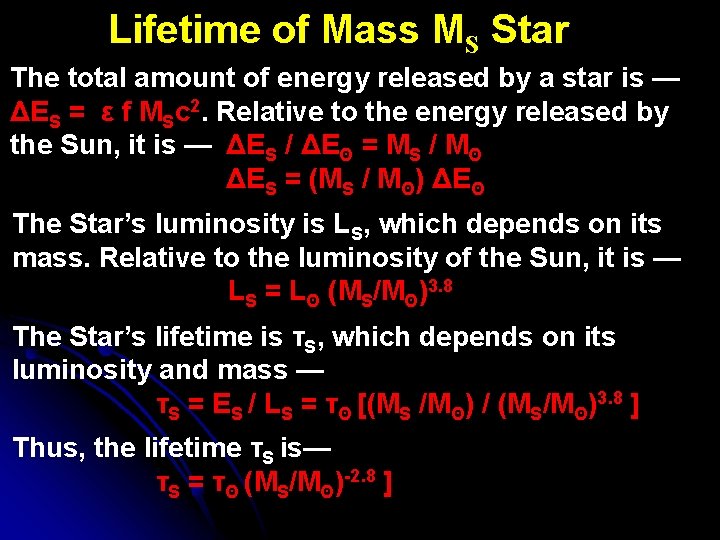
Lifetime of Mass MS Star The total amount of energy released by a star is — ΔES = ε f MSc 2. Relative to the energy released by the Sun, it is — ΔES / ΔEʘ = MS / Mʘ ΔES = (MS / Mʘ) ΔEʘ The Star’s luminosity is LS, which depends on its mass. Relative to the luminosity of the Sun, it is — LS = Lʘ (MS/Mʘ)3. 8 The Star’s lifetime is τS, which depends on its luminosity and mass — τS = ES / LS = τʘ [(MS /Mʘ) / (MS/Mʘ)3. 8 ] Thus, the lifetime τS is— τS = τʘ (MS/Mʘ)-2. 8 ]
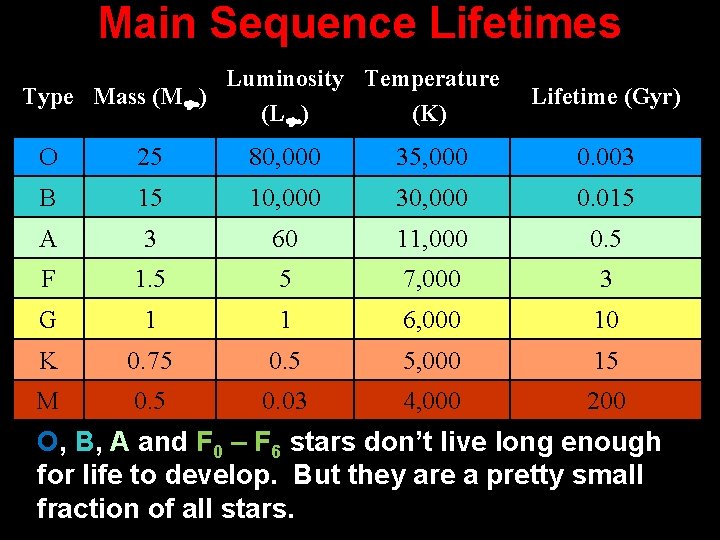
Main Sequence Lifetimes Luminosity Temperature Type Mass (M ) (L ) (K) Lifetime (Gyr) O 25 80, 000 35, 000 0. 003 B 15 10, 000 30, 000 0. 015 A 3 60 11, 000 0. 5 F 1. 5 5 7, 000 3 G 1 1 6, 000 10 K 0. 75 0. 5 5, 000 15 M 0. 5 0. 03 4, 000 200 O, B, A and F 0 – F 6 stars don’t live long enough for life to develop. But they are a pretty small fraction of all stars.
Question A star more massive than our Sun will _. A. have a longer lifetime B. have a shorter lifetime C. have the same lifetime as the Sun D. have a longer lifetime or a shorter lifetime depending on its chemical composition E. live forever
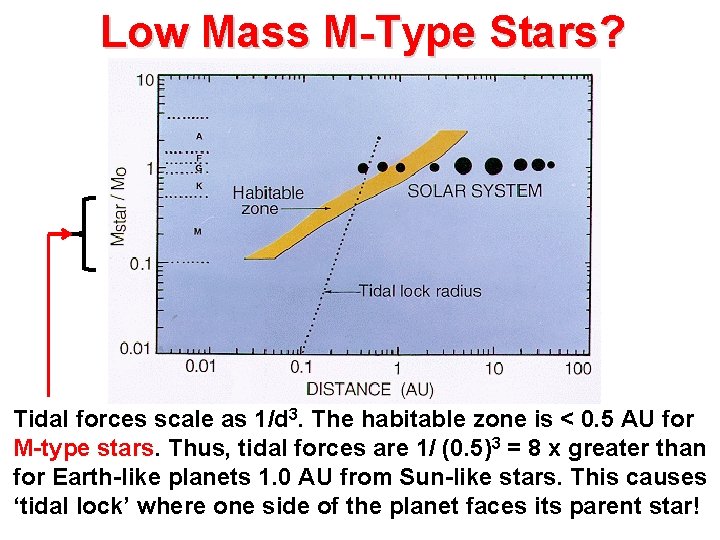
Low Mass M-Type Stars? Tidal forces scale as 1/d 3. The habitable zone is < 0. 5 AU for M-type stars. Thus, tidal forces are 1/ (0. 5)3 = 8 x greater than for Earth-like planets 1. 0 AU from Sun-like stars. This causes ‘tidal lock’ where one side of the planet faces its parent star!
Low Mass K – Type Stars? Planets around cooler, red dwarf stars and brown dwarfs may have much less of the same prebiotic chemicals such as Hydrogen Cyanide that are incorporated into Earth life as brighter, Sol-type stars K and M stars typically emit flares and much uv which would sterilize life. Planets that form around K and M stars tend to be small, lose internal heat too rapidly to remain geologically active.
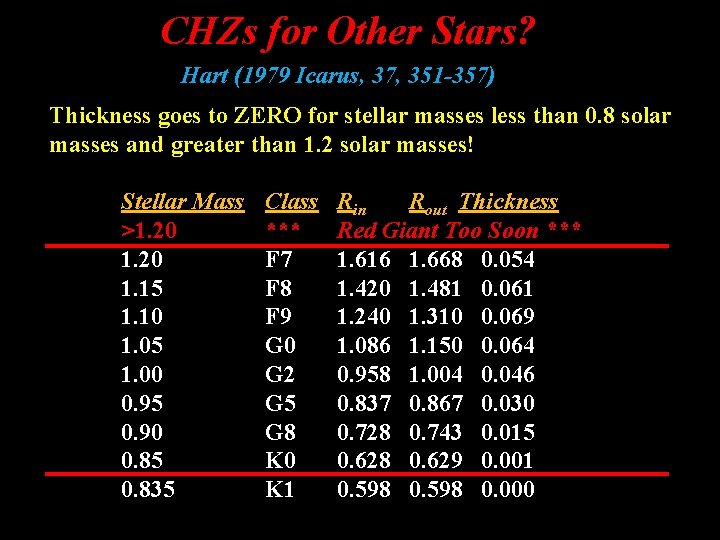
CHZs for Other Stars? Hart (1979 Icarus, 37, 351 -357) Thickness goes to ZERO for stellar masses less than 0. 8 solar masses and greater than 1. 2 solar masses! Stellar Mass >1. 20 1. 15 1. 10 1. 05 1. 00 0. 95 0. 90 0. 85 0. 835 Class *** F 7 F 8 F 9 G 0 G 2 G 5 G 8 K 0 K 1 Rin Rout Thickness Red Giant Too Soon *** 1. 616 1. 668 0. 054 1. 420 1. 481 0. 061 1. 240 1. 310 0. 069 1. 086 1. 150 0. 064 0. 958 1. 004 0. 046 0. 837 0. 867 0. 030 0. 728 0. 743 0. 015 0. 628 0. 629 0. 001 0. 598 0. 000
Question Even though K- and M-type stars have very long lifetimes, why might they not have many habitable planets around them? A. Their habitable zones are too wide B. Planets don’t form around K- and Mtype stars C. They typically emit flares and an enormous amount of ultraviolet light D. They contain too few heavy elements to form planets E. Their habitable zones are very narrow
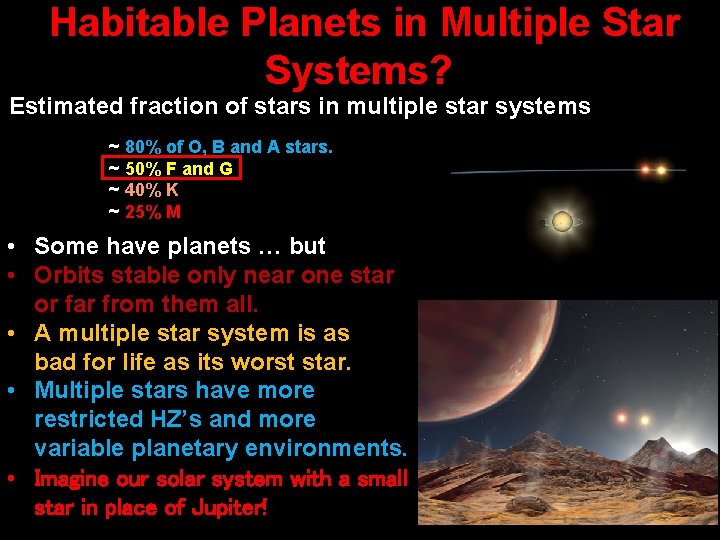
Habitable Planets in Multiple Star Systems? Estimated fraction of stars in multiple star systems ~ 80% of O, B and A stars. ~ 50% F and G ~ 40% K ~ 25% M • Some have planets … but • Orbits stable only near one star or far from them all. • A multiple star system is as bad for life as its worst star. • Multiple stars have more restricted HZ’s and more variable planetary environments. • Imagine our solar system with a small star in place of Jupiter!
Stable Orbits in Binary Systems • If a planet orbits one star in a binary system and the orbital distance exceeds about one fifth of the closest approach of the other star, then the gravitational pull of that second star can disrupt the orbit of the planet. • A planet could also orbit both stars if the planet does not come closer to either stars than about 3. 5 times the separation distance between the two stars. • In star systems with more than two stars, the limits on stable orbital distance are so stringent that the presence of Earth-type planets in a habitable zone are unlikely…but not impossible.
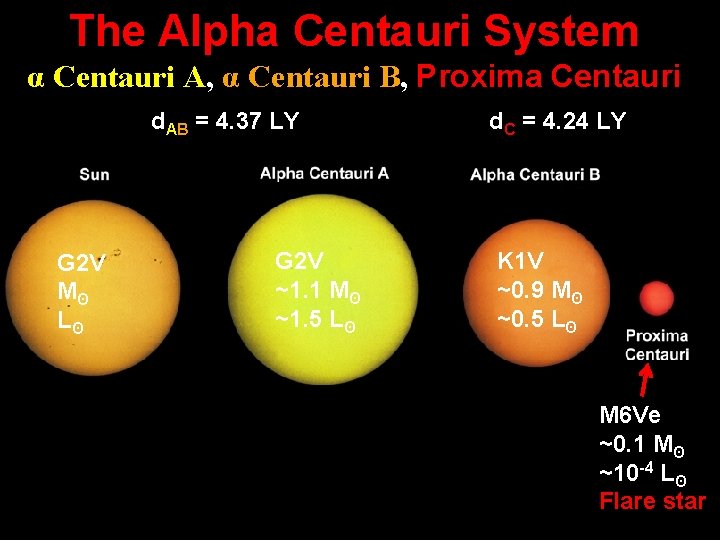
The Alpha Centauri System α Centauri A, α Centauri B, Proxima Centauri d. AB = 4. 37 LY G 2 V Mʘ Lʘ G 2 V ~1. 1 Mʘ ~1. 5 Lʘ d. C = 4. 24 LY K 1 V ~0. 9 Mʘ ~0. 5 Lʘ M 6 Ve ~0. 1 Mʘ ~10 -4 Lʘ Flare star
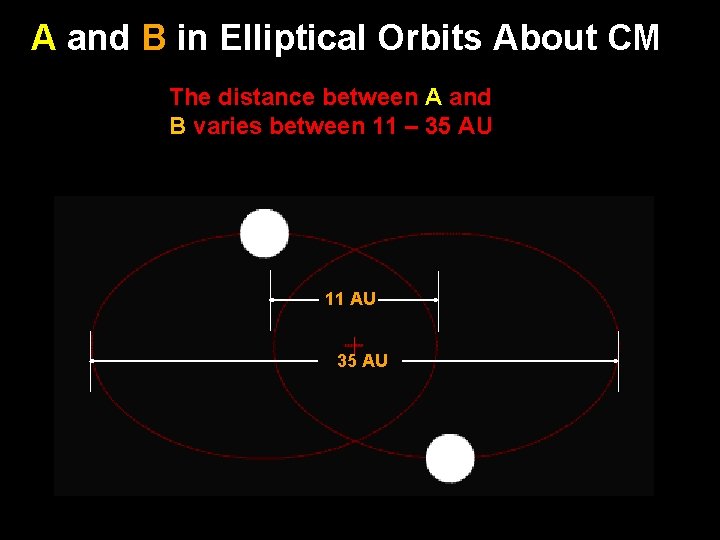
A and B in Elliptical Orbits About CM The distance between A and B varies between 11 – 35 AU 11 AU 35 AU
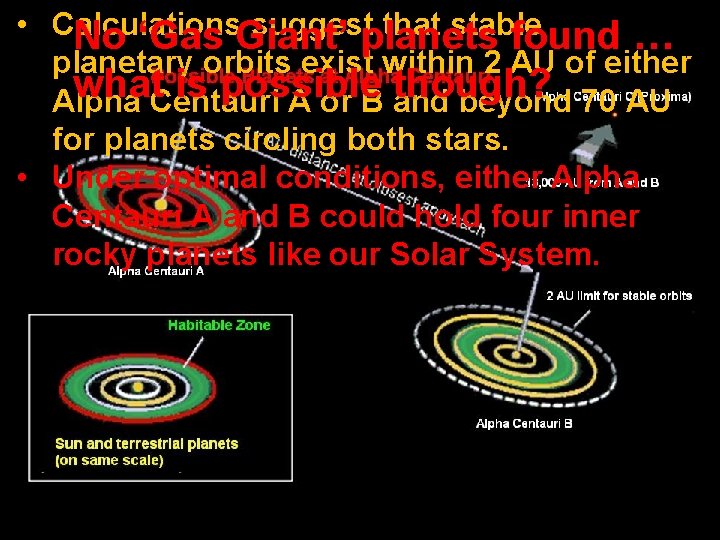
• Calculations suggest that stable No ‘Gas Giant’ planets found … planetary orbits exist within 2 AU of either what. Centauri is possible Alpha A or B though? and beyond 70 AU for planets circling both stars. • Under optimal conditions, either Alpha Centauri A and B could hold four inner rocky planets like our Solar System.
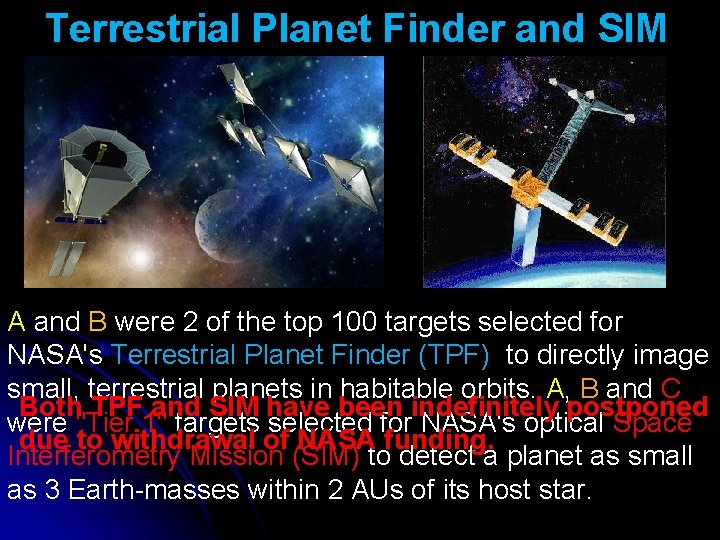
Terrestrial Planet Finder and SIM A and B were 2 of the top 100 targets selected for NASA's Terrestrial Planet Finder (TPF) to directly image small, terrestrial planets in habitable orbits. A, B and C Both TPF and SIM have been indefinitely postponed were "Tier 1" targets selected for NASA's optical Space due to withdrawal of NASA funding. Interferometry Mission (SIM) to detect a planet as small as 3 Earth-masses within 2 AUs of its host star.
Pro’s and Con’s Pro’s • The AB system is significantly more enriched (1. 7 to 1. 8 times) in elements heavier than hydrogen ("high metallicity") than our own Solar System. Hence, either Con’s stars A or B could have one or two "rocky" planets in • Orbits be stable more than 250 Myr. orbitalmight zonesnot where liquid for water is possible. • • Proxima Centauri Age ~ 4850 Gyr would have disrupted formation of cloudzones: around AB. • Oort Habitable • Terrestrial could be bone dry or lack atmosphere • A ~ 1. 25 planets AU (no cometary bombardment or source of hydrated • B ~ 0. 75 AU compounds ‘ice limit’). • Habitablefrom zonebeyond unaffected by other star.
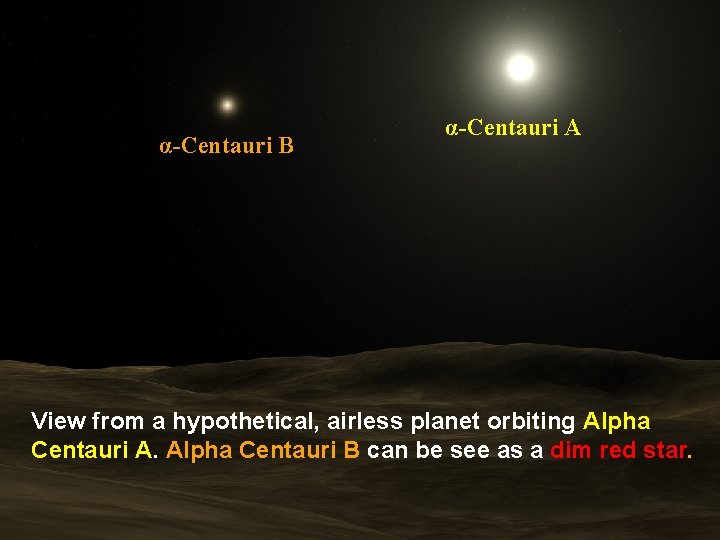
α-Centauri B α-Centauri A View from a hypothetical, airless planet orbiting Alpha Centauri A. Alpha Centauri B can be see as a dim red star.
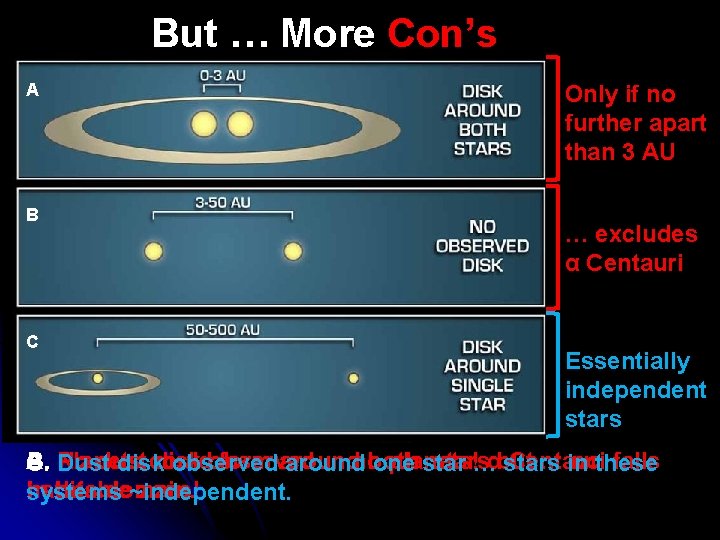
A B C But … More Con’s … Only if no further apart than 3 AU … excludes α Centauri Essentially independent stars A. B. Dust Planets No dust could disk observed form around … no both planets! stars Centauri … in nothese falls C. disk observed around one star …αbut stars habitable in this domain. zone! systems ~independent.
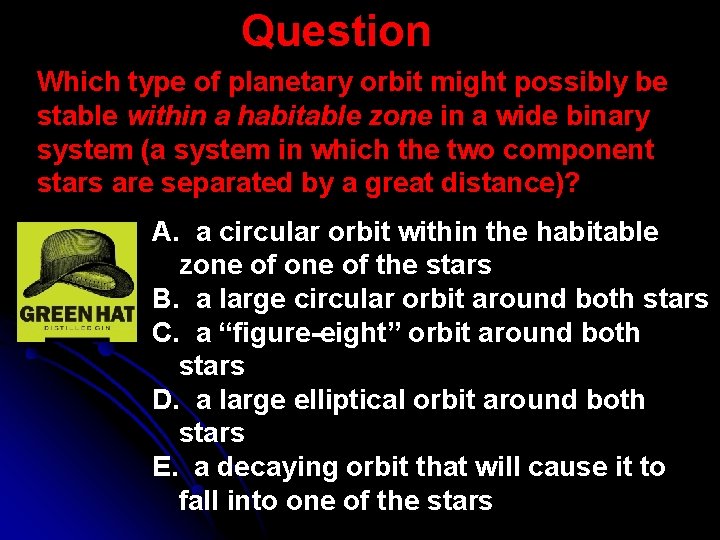
Question Which type of planetary orbit might possibly be stable within a habitable zone in a wide binary system (a system in which the two component stars are separated by a great distance)? A. a circular orbit within the habitable zone of the stars B. a large circular orbit around both stars C. a “figure-eight” orbit around both stars D. a large elliptical orbit around both stars E. a decaying orbit that will cause it to fall into one of the stars
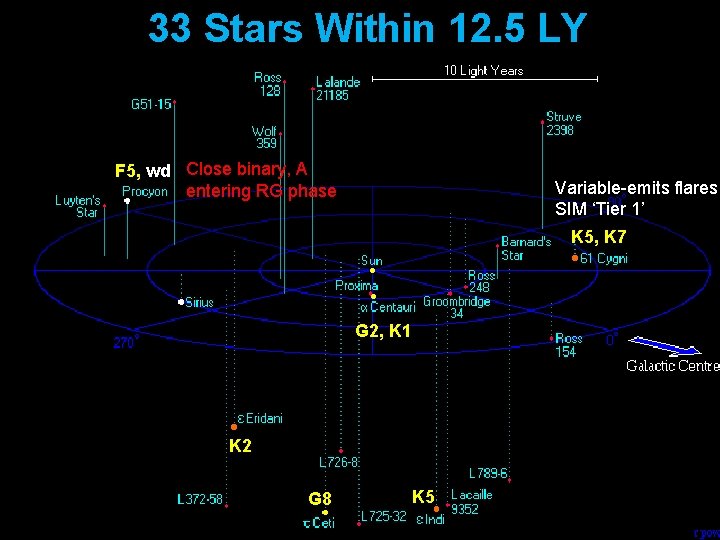
33 Stars Within 12. 5 LY F 5, wd Close binary, A entering RG phase Variable-emits flares SIM ‘Tier 1’ K 5, K 7 G 2, K 1 K 2 G 8 K 5
Trappist – 1
Proxima – b
Ross 128 – b
Top Candidates Margaret Turnbull of the Carnegie Institute pored over vast amounts of catalogue data and came up with a list of 17, 129 stars released in 2003. Top SETI stars (Stars similar to Sun): • Beta Canum Venaticorum G 0 V, (27 LY), 1. 15 Lʘ • Gliese 67 G 1. 5 V MV (41 LY) , 1. 45 Lʘ … but has red dwarf companion that orbits 4. 3 AU < R < 10. 5 AU … but orbital parameters highly uncertain. • HD 211415 G 1 -3 V-MV, (44 LY), 1. 09 Lʘ … but has red dwarf companion at 41 AU • 18 Scorpii G 1 -5 V-Va, (45. 7 LY), 1. 06 Lʘ … but might be more variable than Sun and might have stellar companion at 361 AU • 51 Pegasus G 5 V, (50. 9 LY), 1. 30 Lʘ … but has 51 Peg b (Bellerophon) 0. 5 MJ planet in very close 0. 05 AU orbit (1 st extrasolar planet found). … precipitated hypotheses of planet migration.
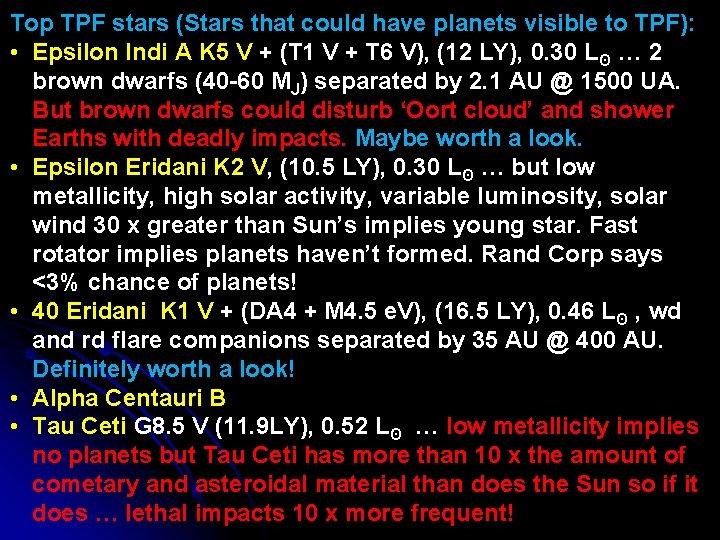
Top TPF stars (Stars that could have planets visible to TPF): • Epsilon Indi A K 5 V + (T 1 V + T 6 V), (12 LY), 0. 30 Lʘ … 2 brown dwarfs (40 -60 MJ) separated by 2. 1 AU @ 1500 UA. But brown dwarfs could disturb ‘Oort cloud’ and shower Earths with deadly impacts. Maybe worth a look. • Epsilon Eridani K 2 V, (10. 5 LY), 0. 30 Lʘ … but low metallicity, high solar activity, variable luminosity, solar wind 30 x greater than Sun’s implies young star. Fast rotator implies planets haven’t formed. Rand Corp says <3% chance of planets! • 40 Eridani K 1 V + (DA 4 + M 4. 5 e. V), (16. 5 LY), 0. 46 Lʘ , wd and rd flare companions separated by 35 AU @ 400 AU. Definitely worth a look! • Alpha Centauri B • Tau Ceti G 8. 5 V (11. 9 LY), 0. 52 Lʘ … low metallicity implies no planets but Tau Ceti has more than 10 x the amount of cometary and asteroidal material than does the Sun so if it does … lethal impacts 10 x more frequent!
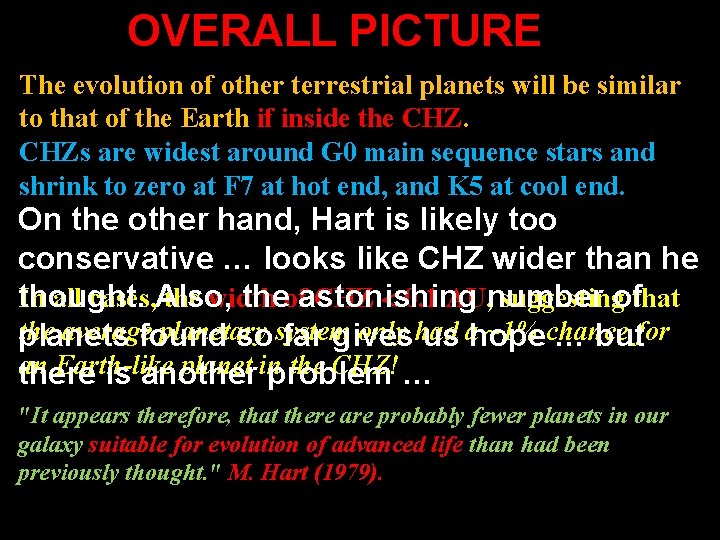
OVERALL PICTURE The evolution of other terrestrial planets will be similar to that of the Earth if inside the CHZs are widest around G 0 main sequence stars and shrink to zero at F 7 at hot end, and K 5 at cool end. On the other hand, Hart is likely too conservative … looks like CHZ wider than he In all cases, Also, the width CHZ 0. 1 AU, number suggestingofthat thought. theofastonishing the averagefound planetary only had ~1% chance planets so system far gives us ahope … butfor an Earth-like planet in the CHZ! … there is another problem "It appears therefore, that there are probably fewer planets in our galaxy suitable for evolution of advanced life than had been previously thought. " M. Hart (1979).
- Slides: 48