
CLASSIFYING POLYNOMIALS POLYNOMIAL is a sum A or
- Slides: 14
CLASSIFYING POLYNOMIALS
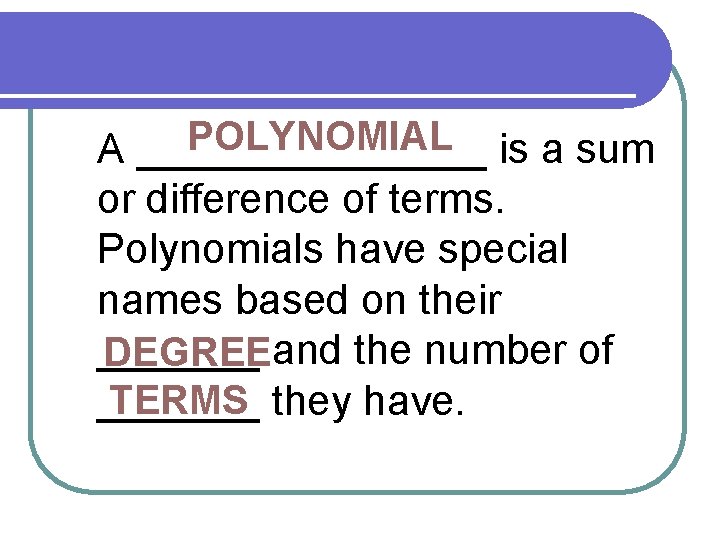
POLYNOMIAL is a sum A ________ or difference of terms. Polynomials have special names based on their _______ DEGREEand the number of TERMS they have. _______
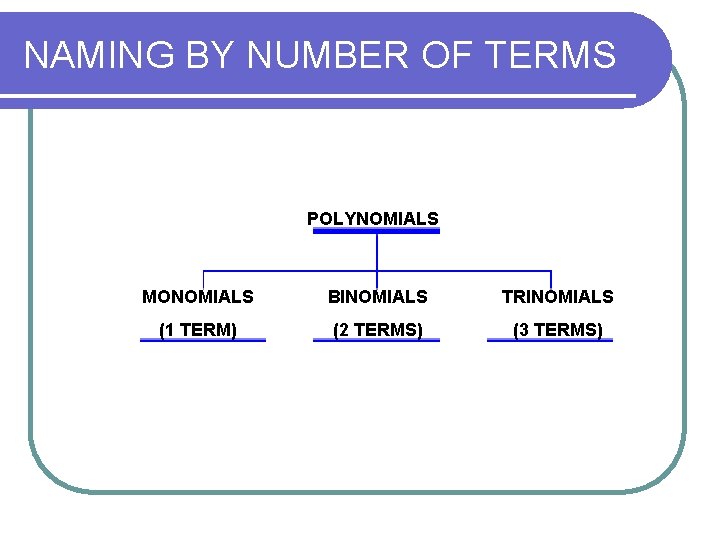
NAMING BY NUMBER OF TERMS POLYNOMIALS MONOMIALS BINOMIALS TRINOMIALS (1 TERM) (2 TERMS) (3 TERMS)
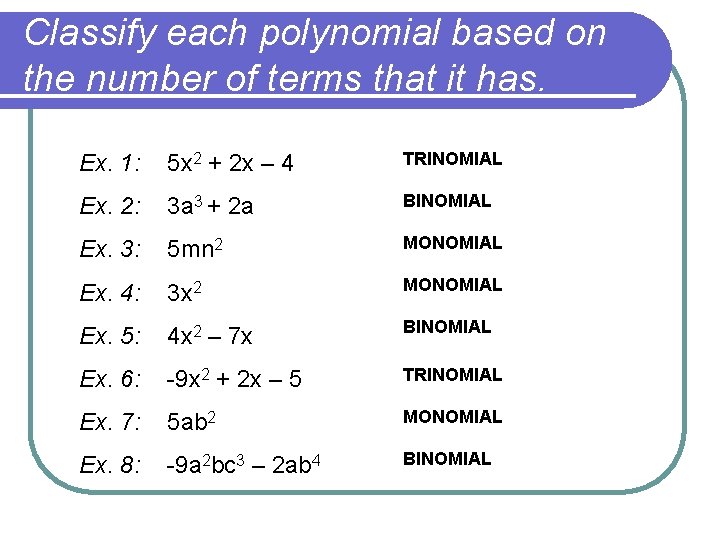
Classify each polynomial based on the number of terms that it has. Ex. 1: 5 x 2 + 2 x – 4 TRINOMIAL Ex. 2: 3 a 3 + 2 a BINOMIAL Ex. 3: 5 mn 2 MONOMIAL Ex. 4: 3 x 2 MONOMIAL Ex. 5: 4 x 2 – 7 x BINOMIAL Ex. 6: -9 x 2 + 2 x – 5 TRINOMIAL Ex. 7: 5 ab 2 MONOMIAL Ex. 8: -9 a 2 bc 3 – 2 ab 4 BINOMIAL
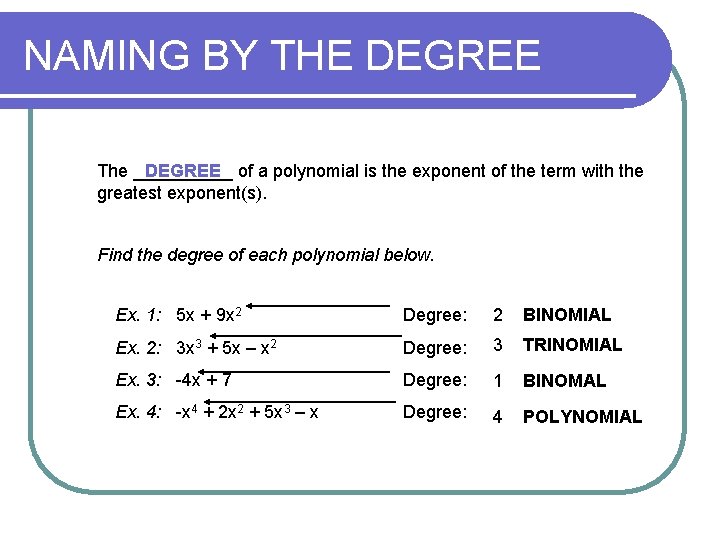
NAMING BY THE DEGREE The _____ DEGREE of a polynomial is the exponent of the term with the greatest exponent(s). Find the degree of each polynomial below. Ex. 1: 5 x + 9 x 2 Degree: 2 BINOMIAL Ex. 2: 3 x 3 + 5 x – x 2 Degree: 3 TRINOMIAL Ex. 3: -4 x + 7 Degree: 1 BINOMAL Ex. 4: -x 4 + 2 x 2 + 5 x 3 – x Degree: 4 POLYNOMIAL
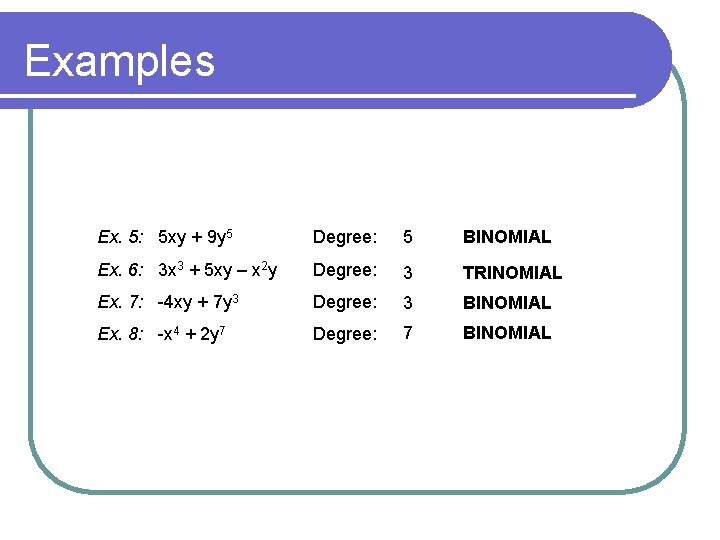
Examples Ex. 5: 5 xy + 9 y 5 Degree: 5 BINOMIAL Ex. 6: 3 x 3 + 5 xy – x 2 y Degree: 3 TRINOMIAL Ex. 7: -4 xy + 7 y 3 Degree: 3 BINOMIAL Ex. 8: -x 4 + 2 y 7 Degree: 7 BINOMIAL
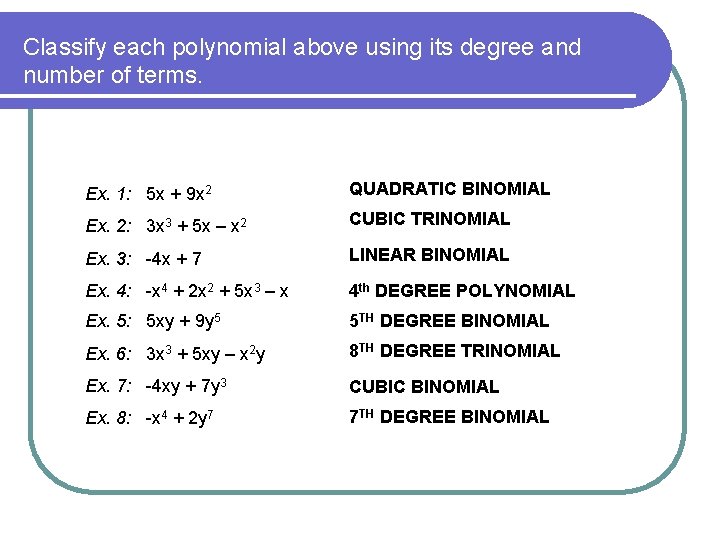
Classify each polynomial above using its degree and number of terms. Ex. 1: 5 x + 9 x 2 QUADRATIC BINOMIAL Ex. 2: 3 x 3 + 5 x – x 2 CUBIC TRINOMIAL Ex. 3: -4 x + 7 LINEAR BINOMIAL Ex. 4: -x 4 + 2 x 2 + 5 x 3 – x 4 th DEGREE POLYNOMIAL Ex. 5: 5 xy + 9 y 5 5 TH DEGREE BINOMIAL Ex. 6: 3 x 3 + 5 xy – x 2 y 8 TH DEGREE TRINOMIAL Ex. 7: -4 xy + 7 y 3 CUBIC BINOMIAL Ex. 8: -x 4 + 2 y 7 7 TH DEGREE BINOMIAL
Multiplying Polynomials
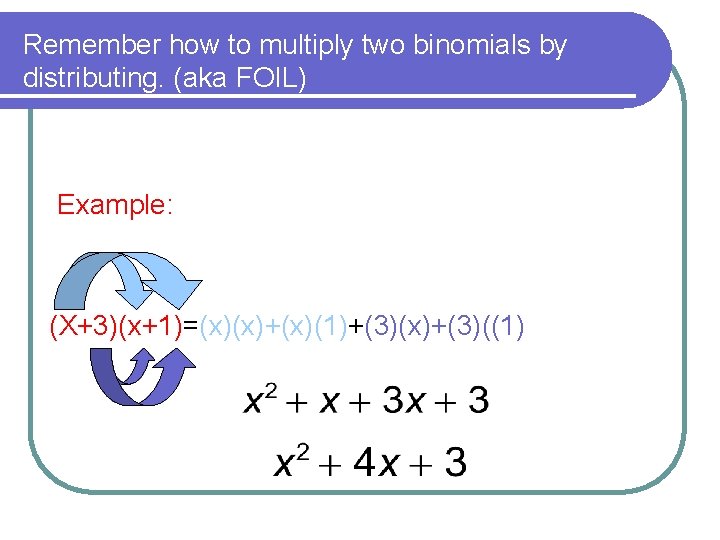
Remember how to multiply two binomials by distributing. (aka FOIL) Example: (X+3)(x+1)=(x)(x)+(x)(1)+(3)(x)+(3)((1)
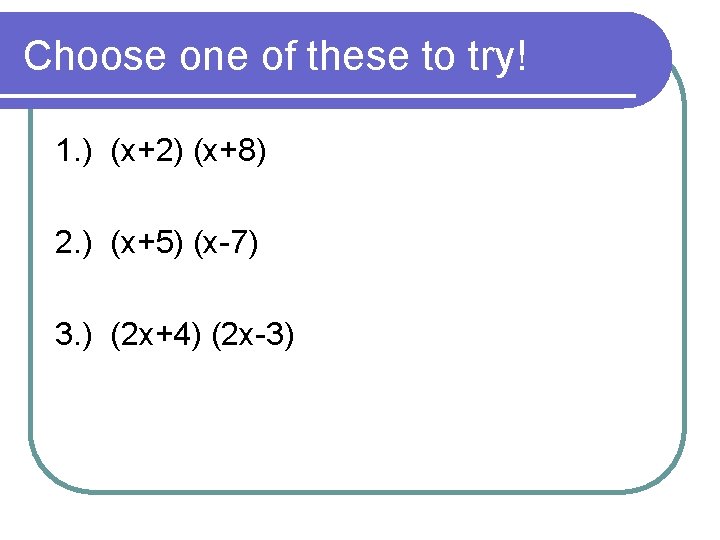
Choose one of these to try! 1. ) (x+2) (x+8) 2. ) (x+5) (x-7) 3. ) (2 x+4) (2 x-3)
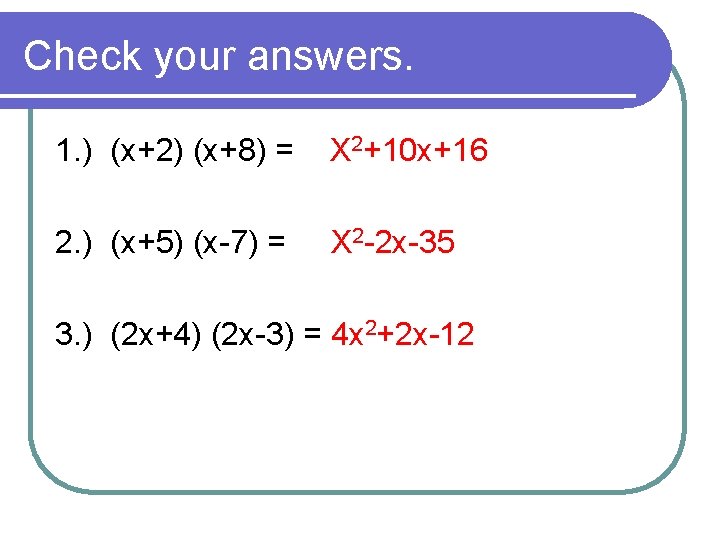
Check your answers. 1. ) (x+2) (x+8) = X 2+10 x+16 2. ) (x+5) (x-7) = X 2 -2 x-35 3. ) (2 x+4) (2 x-3) = 4 x 2+2 x-12
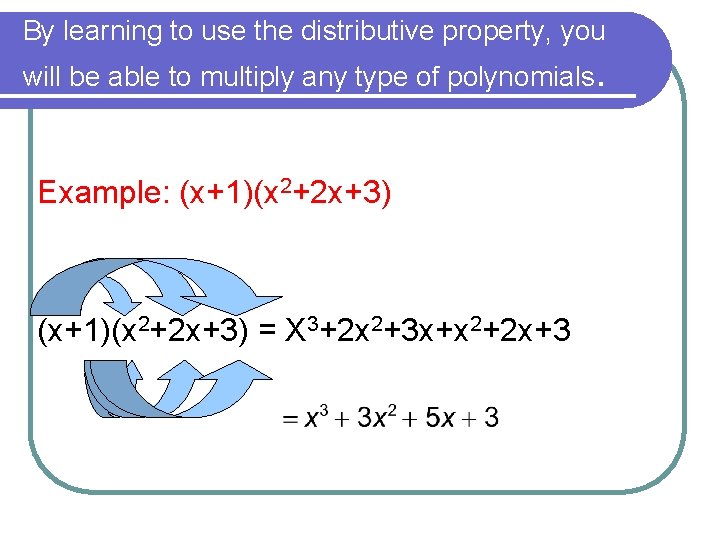
By learning to use the distributive property, you will be able to multiply any type of polynomials. Example: (x+1)(x 2+2 x+3) = X 3+2 x 2+3 x+x 2+2 x+3
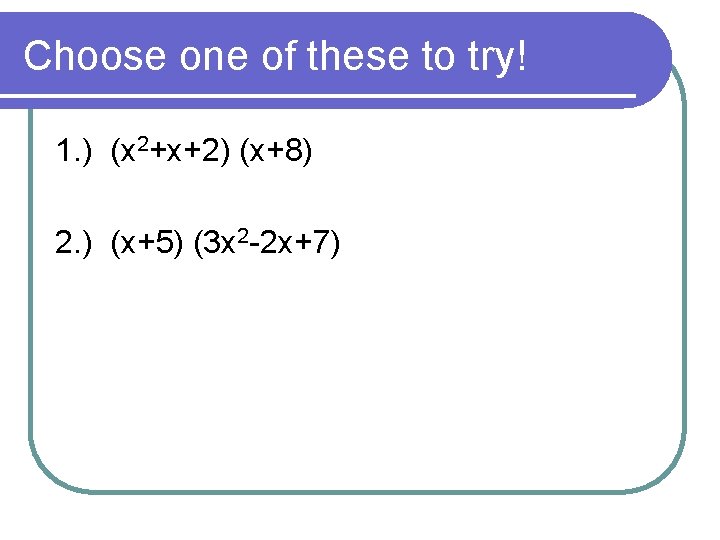
Choose one of these to try! 1. ) (x 2+x+2) (x+8) 2. ) (x+5) (3 x 2 -2 x+7)
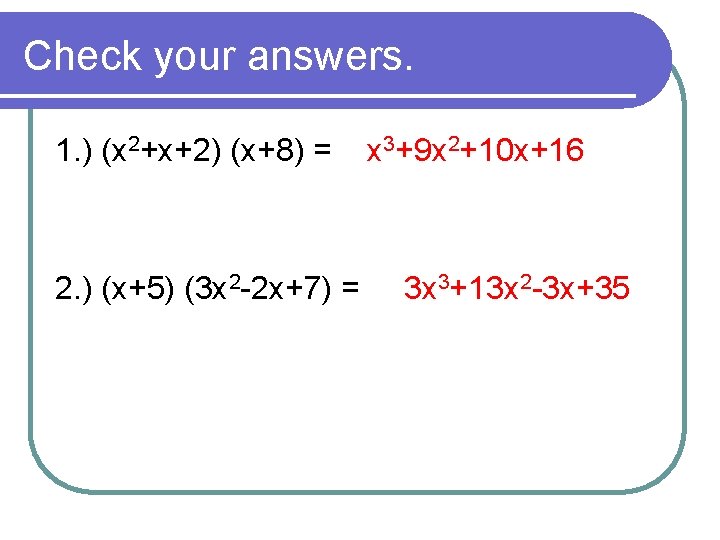
Check your answers. 1. ) (x 2+x+2) (x+8) = 2. ) (x+5) (3 x 2 -2 x+7) = x 3+9 x 2+10 x+16 3 x 3+13 x 2 -3 x+35