
Classifying Organisms Chapter 6 Why do Scientists Classify

- Slides: 13
Classifying Organisms Chapter 6
Why do Scientists Classify? Imagine a grocery store… How are they organized? What would happen if they were not organized? How is your life organized?
Why do Scientists Classify? Almost 2 million kinds of organisms on Earth Need to keep organized! (Easier to study!) Classification = process of grouping things based on their similarities
Why do Scientists Classify? Taxonomy =scientific study of how living things are classified Useful because: once classified, scientists will know a lot about an organism
Early Classification Systems Aristotle (4 th century B. C. ) -observed animals -watched appearance, behavior, movement -fly, swim, and walk/crawl/run -observed similarities and differences -used differences to divide into smaller subgroups
Linnaeus Carolus Linnaeus (1750 s) -used observations as basis of his system -placed organisms based on observable features Devised naming system for organisms: Binomial Nomenclature
Linnaeus Binomial Nomenclature =2 part naming system -uses Latin words Genus species Felis concolor Genus is capitalized; species is NOT. If you can’t italicize, underline the genus and species!
Classification Today Species with similar evolutionary histories are classified more closely together. -when organisms share a common ancestor, they share an evolutionary history
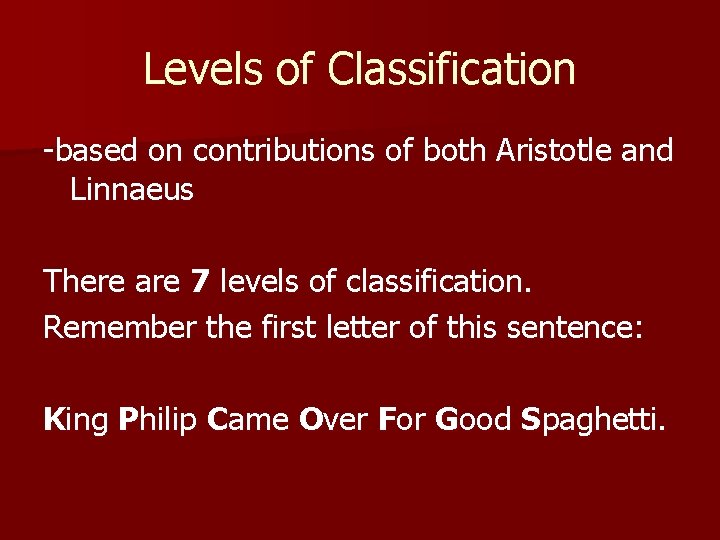
Levels of Classification -based on contributions of both Aristotle and Linnaeus There are 7 levels of classification. Remember the first letter of this sentence: King Philip Came Over For Good Spaghetti.
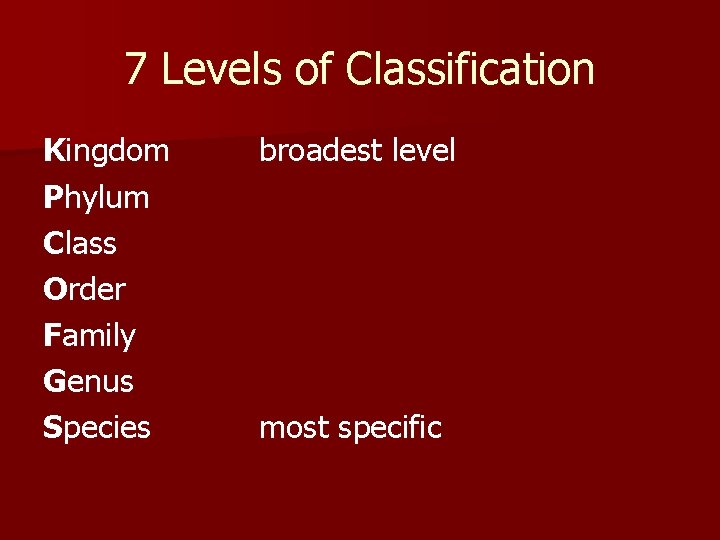
7 Levels of Classification Kingdom Phylum Class Order Family Genus Species broadest level most specific
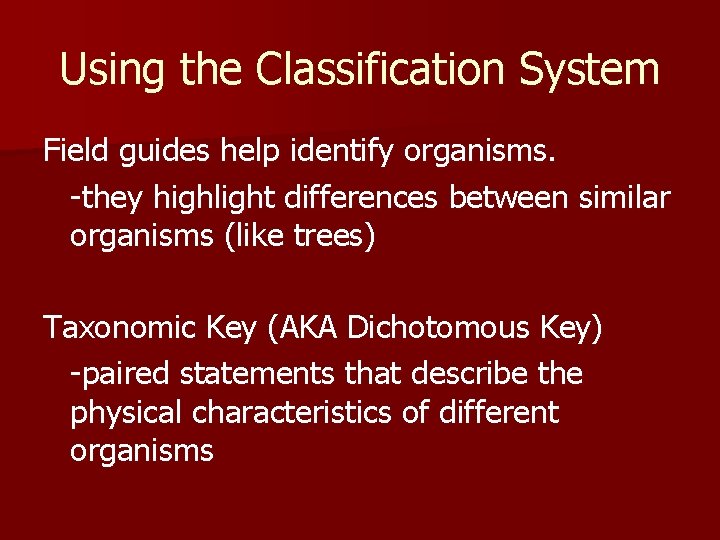
Using the Classification System Field guides help identify organisms. -they highlight differences between similar organisms (like trees) Taxonomic Key (AKA Dichotomous Key) -paired statements that describe the physical characteristics of different organisms
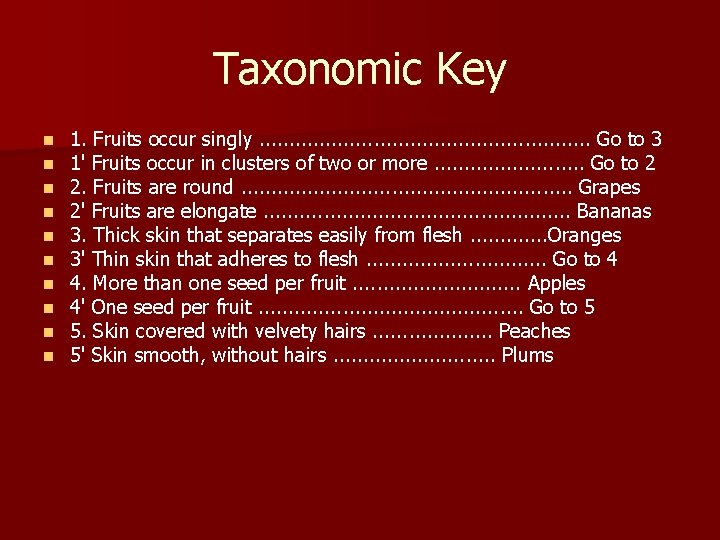
Taxonomic Key n n n n n 1. Fruits occur singly. . . . Go to 3 1' Fruits occur in clusters of two or more. . . Go to 2 2. Fruits are round. . . . Grapes 2' Fruits are elongate. . . . Bananas 3. Thick skin that separates easily from flesh. . . Oranges 3' Thin skin that adheres to flesh. . . . Go to 4 4. More than one seed per fruit. . . . Apples 4' One seed per fruit. . . Go to 5 5. Skin covered with velvety hairs. . . . . Peaches 5' Skin smooth, without hairs. . . . Plums