
Classifying Matter Why Do We Classify Matter We




- Slides: 10
Classifying Matter
Why Do We Classify Matter? We classify matter in order to understand the composition of elements, mixtures, pure substances, solutions, and suspensions
Pure Substances Matter that always has the same composition is classified as a pure substance Examples: Table Salt Table Sugar Pure substance can be classified into two categories, elements and compounds
Elements An element is a substance that cannot be broken down into simpler substances An element has a fixed composition because it contains only one type of atom Examples: Aluminum Gold Carbon
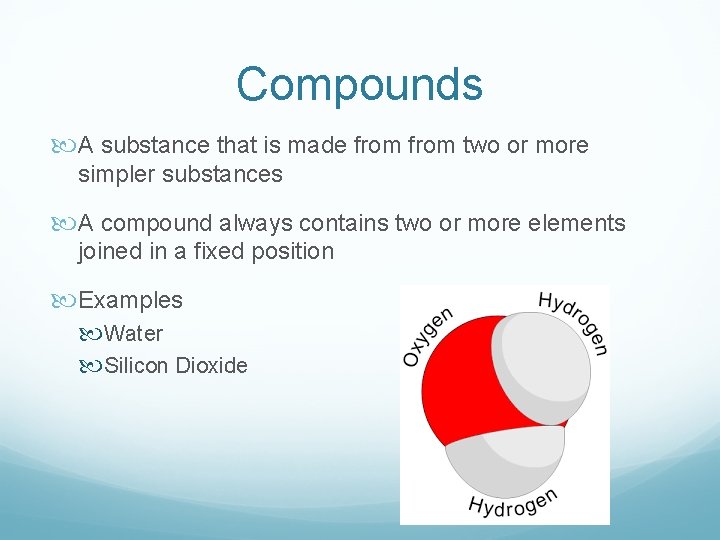
Compounds A substance that is made from two or more simpler substances A compound always contains two or more elements joined in a fixed position Examples Water Silicon Dioxide
Mixtures tend to retain some of the properties of their individual substances The properties of a mixture can vary because the composition of a mixture is not fixed Mixtures can be: Heterogeneous Homogeneous
Heterogeneous Mixtures In a heterogeneous mixture, the parts of the mixture are noticeably different from one another Examples: Sand Salsa
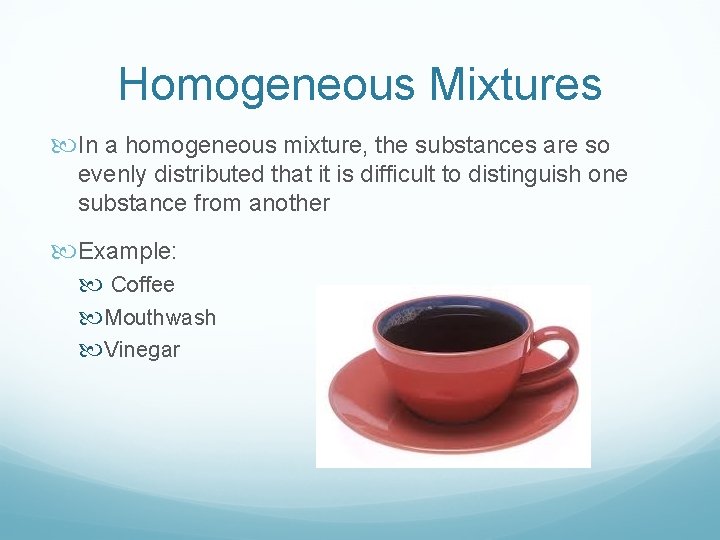
Homogeneous Mixtures In a homogeneous mixture, the substances are so evenly distributed that it is difficult to distinguish one substance from another Example: Coffee Mouthwash Vinegar
Solutions When substances dissolve, and form a homogeneous mixture, it is called a solution Liquid solutions are easy to recognize because they do not separate into layers over time Individual substances cannot be filtered Examples Windshield wiper fluid Water
Suspensions separate into layers over time Heterogeneous mixtures Example: Sand Water and Oil