
Classifying Living Things Did you know that there


- Slides: 26
Classifying Living Things
Did you know that there are probably more than 10 million species (kinds) of living things in the world? Have you ever wondered how scientists keep all these different kinds of organisms straight? Classification is the organizing of things according to their similarities. Scientists use classification to sort out living things and understand them better.
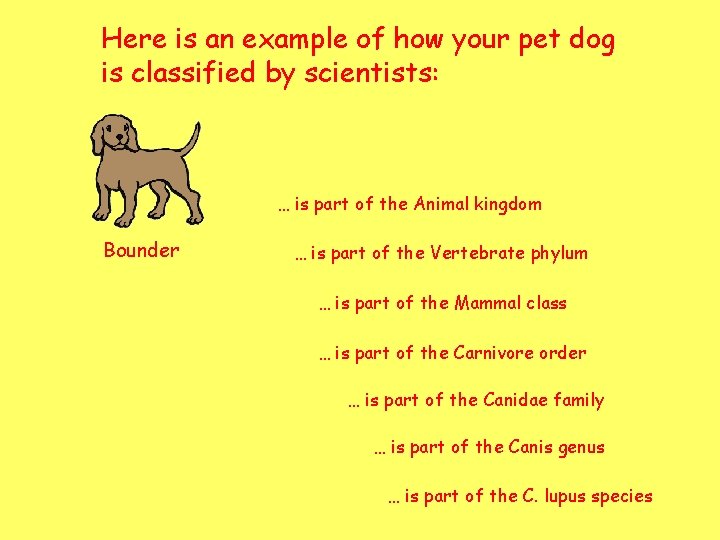
Here is an example of how your pet dog is classified by scientists: … is part of the Animal kingdom Bounder … is part of the Vertebrate phylum … is part of the Mammal class … is part of the Carnivore order … is part of the Canidae family … is part of the Canis genus … is part of the C. lupus species
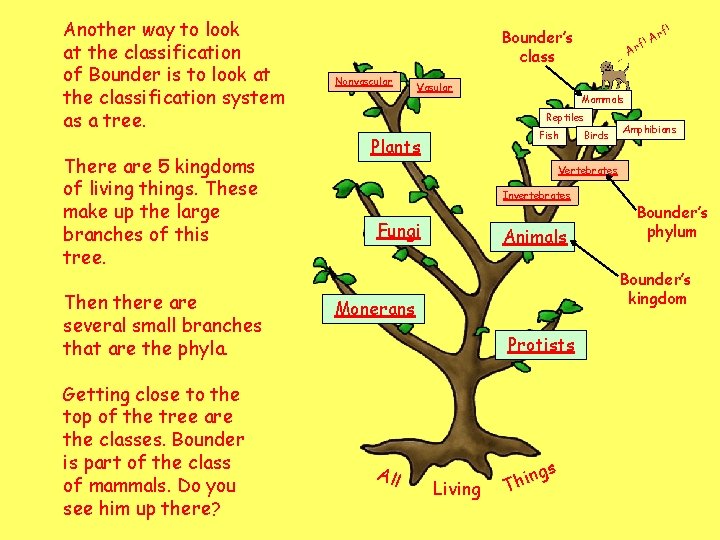
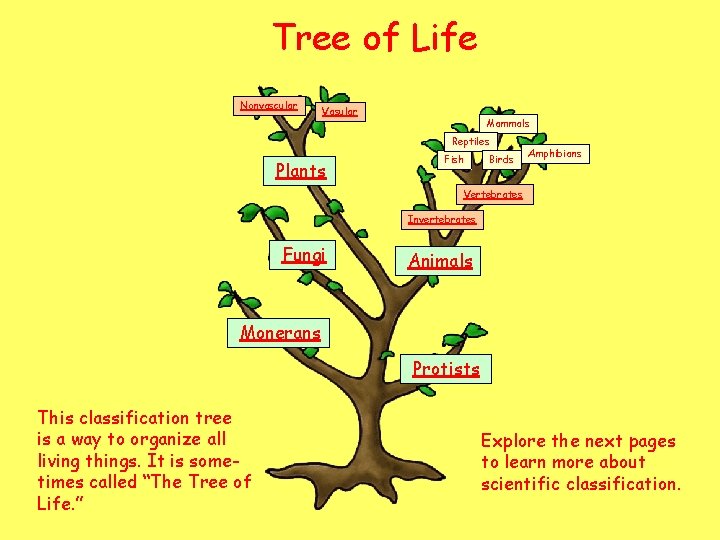
Another way to look at the classification of Bounder is to look at the classification system as a tree. There are 5 kingdoms of living things. These make up the large branches of this tree. Then there are several small branches that are the phyla. Getting close to the top of the tree are the classes. Bounder is part of the class of mammals. Do you see him up there? rf! Bounder’s class Nonvascular Vasular A rf! …A Mammals Reptiles Fish Plants Birds Amphibians Vertebrates Invertebrates Fungi Animals Bounder’s kingdom Monerans Protists All Bounder’s phylum Living gs n i Th
Tree of Life Nonvascular Vasular Mammals Reptiles Plants Fish Birds Amphibians Vertebrates Invertebrates Fungi Animals Monerans Protists This classification tree is a way to organize all living things. It is sometimes called “The Tree of Life. ” Explore the next pages to learn more about scientific classification.
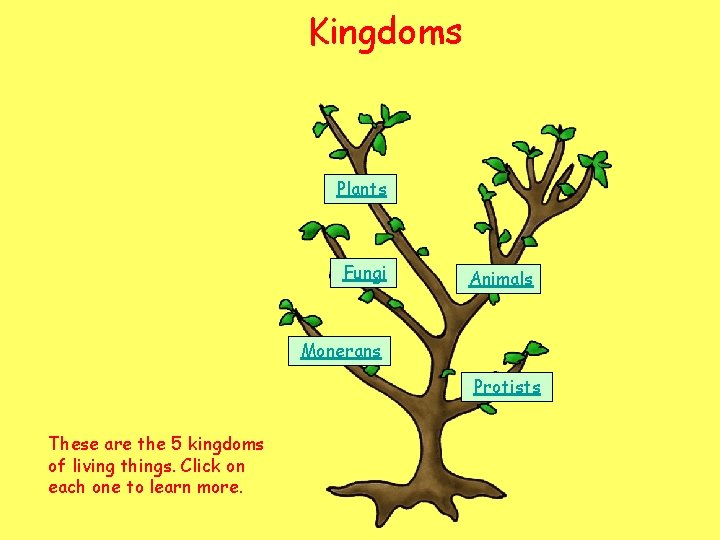
Kingdoms Plants Fungi Animals Monerans Protists These are the 5 kingdoms of living things. Click on each one to learn more.
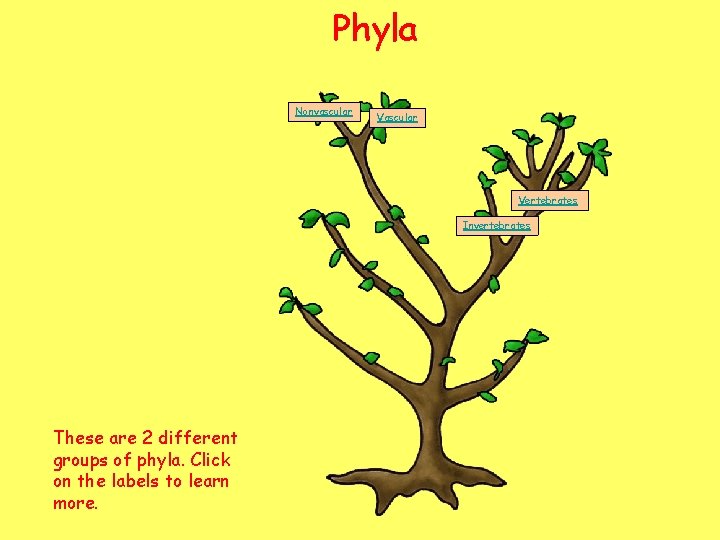
Phyla Nonvascular Vertebrates Invertebrates These are 2 different groups of phyla. Click on the labels to learn more.
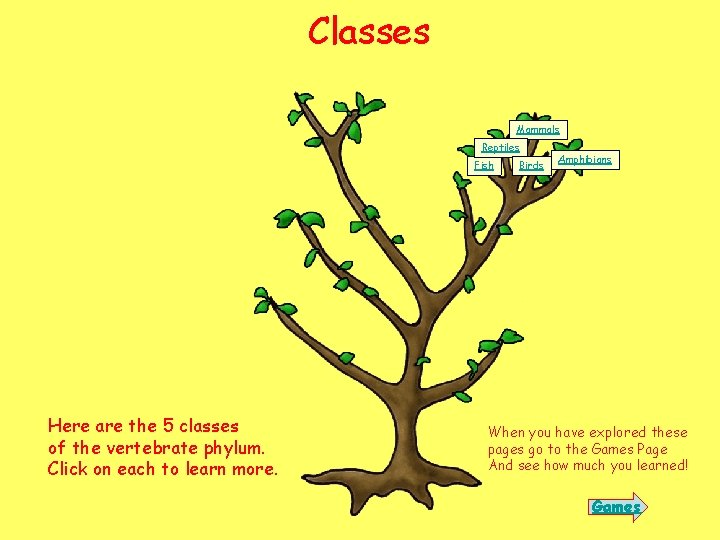
Classes Mammals Reptiles Fish Here are the 5 classes of the vertebrate phylum. Click on each to learn more. Birds Amphibians When you have explored these pages go to the Games Page And see how much you learned! Games
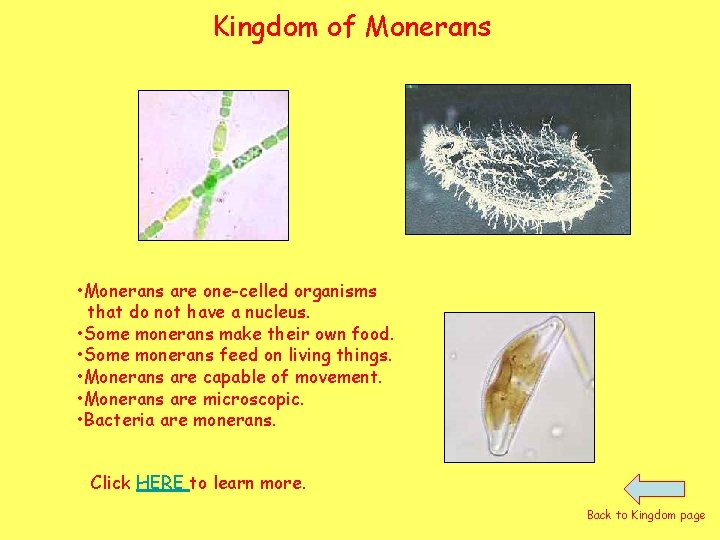
Kingdom of Monerans • Monerans are one-celled organisms that do not have a nucleus. • Some monerans make their own food. • Some monerans feed on living things. • Monerans are capable of movement. • Monerans are microscopic. • Bacteria are monerans. Click HERE to learn more. Back to Kingdom page
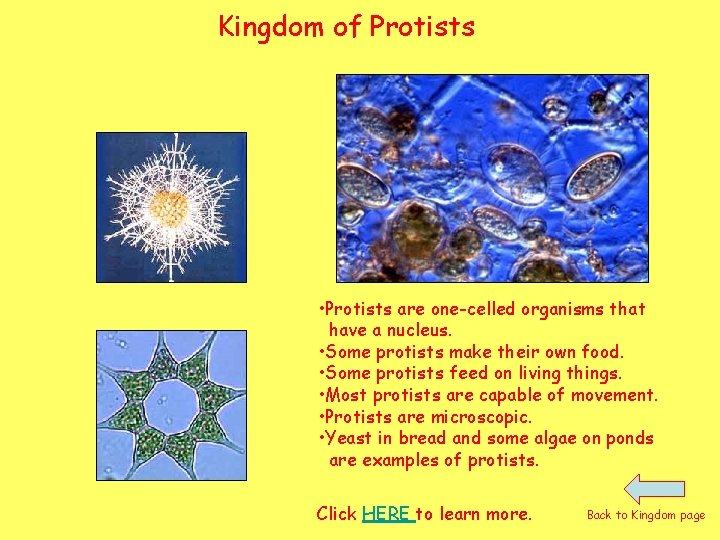
Kingdom of Protists • Protists are one-celled organisms that have a nucleus. • Some protists make their own food. • Some protists feed on living things. • Most protists are capable of movement. • Protists are microscopic. • Yeast in bread and some algae on ponds are examples of protists. Click HERE to learn more. Back to Kingdom page
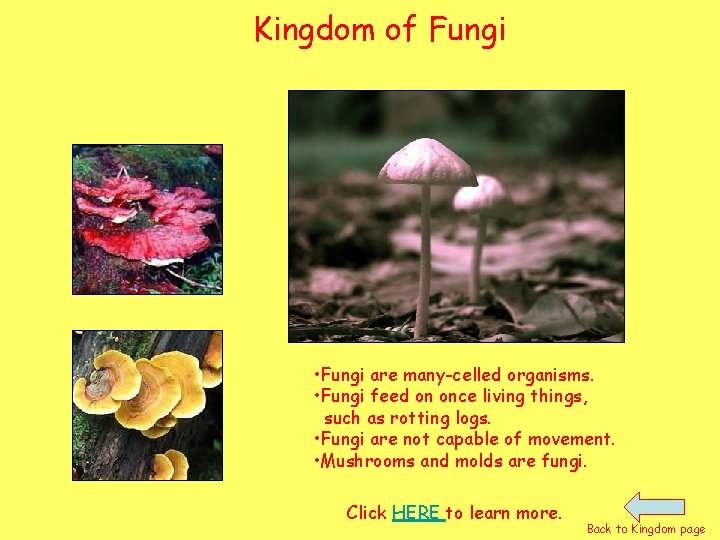
Kingdom of Fungi • Fungi are many-celled organisms. • Fungi feed on once living things, such as rotting logs. • Fungi are not capable of movement. • Mushrooms and molds are fungi. Click HERE to learn more. Back to Kingdom page
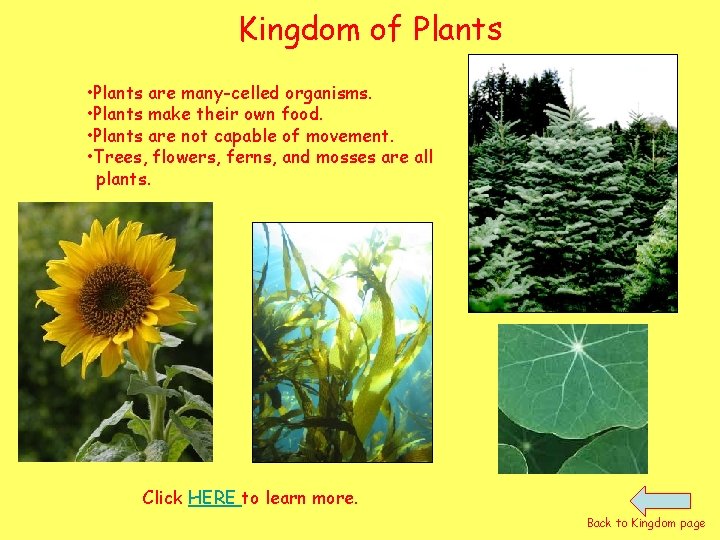
Kingdom of Plants • Plants are many-celled organisms. • Plants make their own food. • Plants are not capable of movement. • Trees, flowers, ferns, and mosses are all plants. Click HERE to learn more. Back to Kingdom page
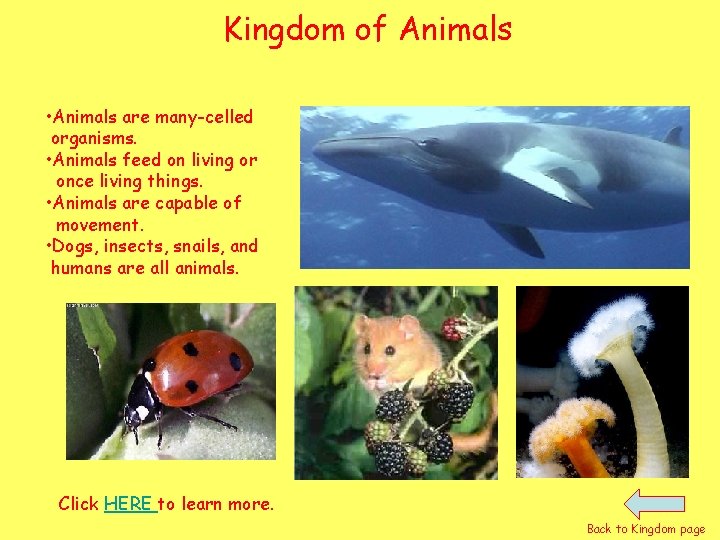
Kingdom of Animals • Animals are many-celled organisms. • Animals feed on living or once living things. • Animals are capable of movement. • Dogs, insects, snails, and humans are all animals. Click HERE to learn more. Back to Kingdom page
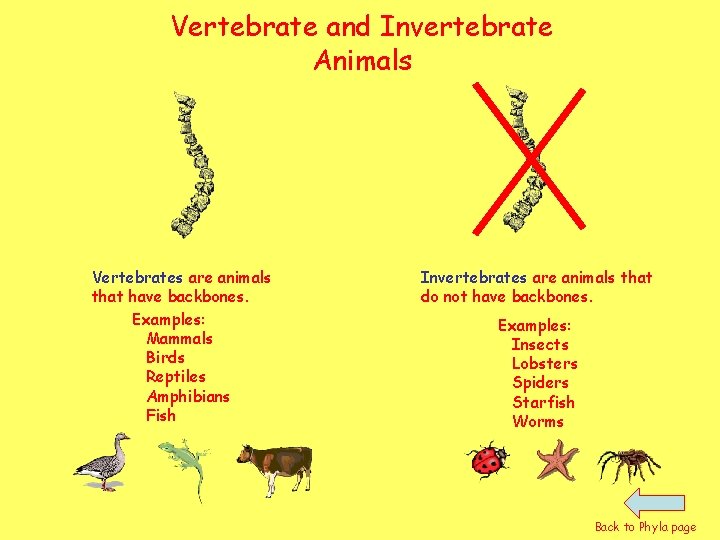
Vertebrate and Invertebrate Animals Vertebrates are animals that have backbones. Examples: Mammals Birds Reptiles Amphibians Fish Invertebrates are animals that do not have backbones. Examples: Insects Lobsters Spiders Starfish Worms Back to Phyla page
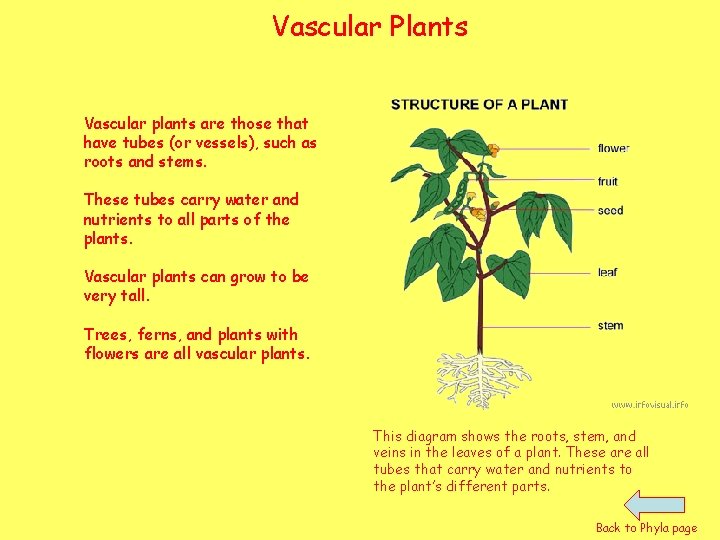
Vascular Plants Vascular plants are those that have tubes (or vessels), such as roots and stems. These tubes carry water and nutrients to all parts of the plants. Vascular plants can grow to be very tall. Trees, ferns, and plants with flowers are all vascular plants. This diagram shows the roots, stem, and veins in the leaves of a plant. These are all tubes that carry water and nutrients to the plant’s different parts. Back to Phyla page
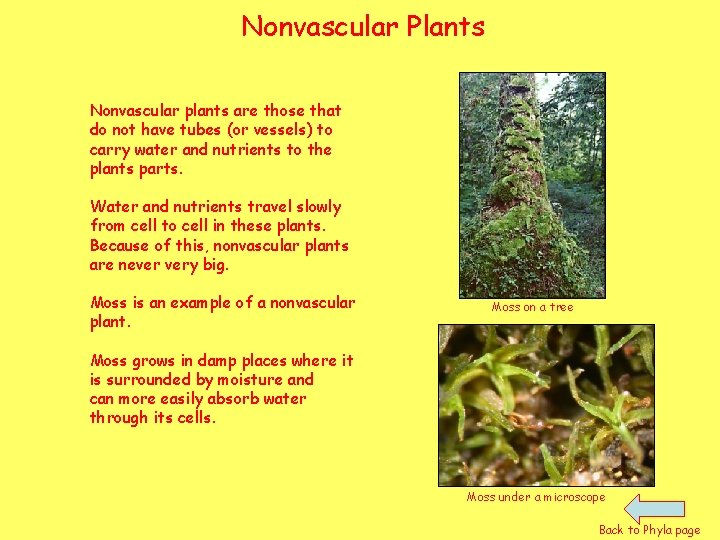
Nonvascular Plants Nonvascular plants are those that do not have tubes (or vessels) to carry water and nutrients to the plants parts. Water and nutrients travel slowly from cell to cell in these plants. Because of this, nonvascular plants are never very big. Moss is an example of a nonvascular plant. Moss on a tree Moss grows in damp places where it is surrounded by moisture and can more easily absorb water through its cells. Moss under a microscope Back to Phyla page
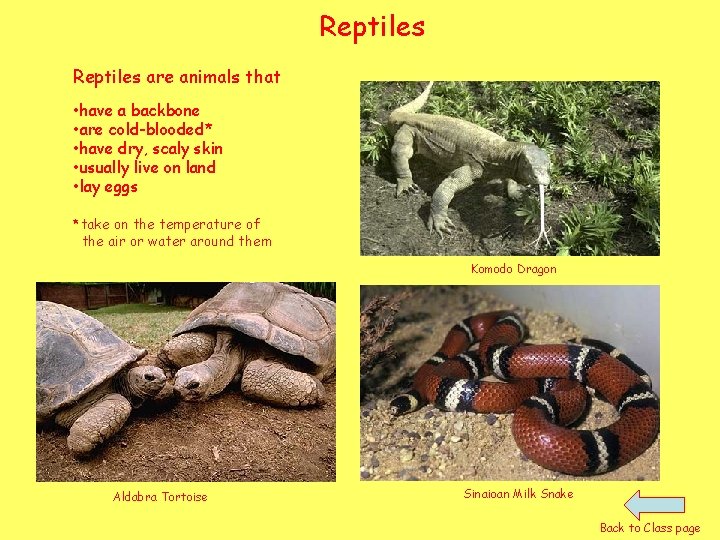
Reptiles are animals that • have a backbone • are cold-blooded* • have dry, scaly skin • usually live on land • lay eggs *take on the temperature of the air or water around them Komodo Dragon Aldabra Tortoise Sinaioan Milk Snake Back to Class page
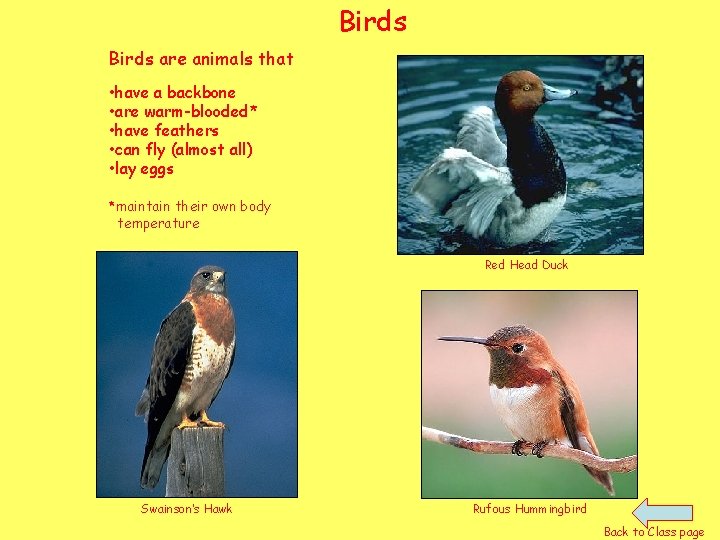
Birds are animals that • have a backbone • are warm-blooded* • have feathers • can fly (almost all) • lay eggs *maintain their own body temperature Red Head Duck Swainson’s Hawk Rufous Hummingbird Back to Class page
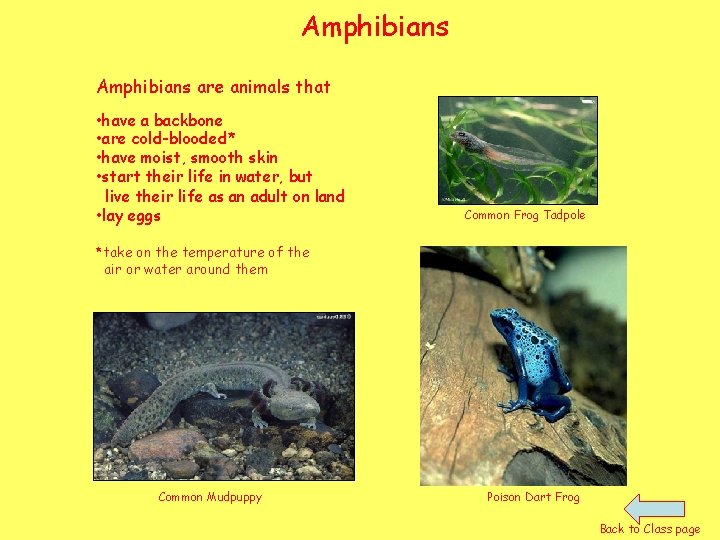
Amphibians are animals that • have a backbone • are cold-blooded* • have moist, smooth skin • start their life in water, but live their life as an adult on land • lay eggs Common Frog Tadpole *take on the temperature of the air or water around them Common Mudpuppy Poison Dart Frog Back to Class page
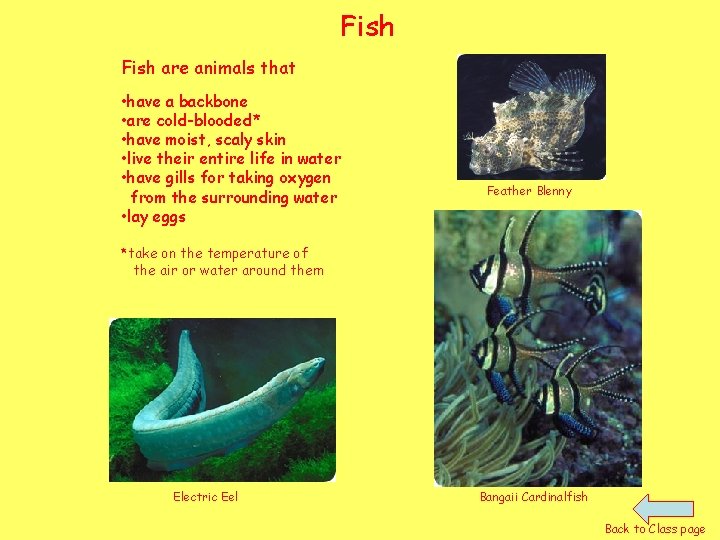
Fish are animals that • have a backbone • are cold-blooded* • have moist, scaly skin • live their entire life in water • have gills for taking oxygen from the surrounding water • lay eggs Feather Blenny *take on the temperature of the air or water around them Electric Eel Bangaii Cardinalfish Back to Class page
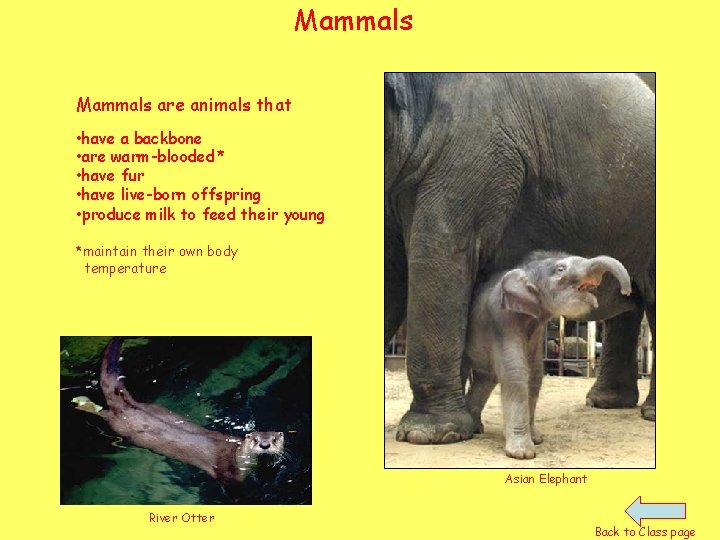
Mammals are animals that • have a backbone • are warm-blooded* • have fur • have live-born offspring • produce milk to feed their young *maintain their own body temperature Asian Elephant River Otter Back to Class page
Games and Quizzes Practice classifying animals into different classes in this game. Click “click here to begin” at the web page. Just for fun, watch some of this student-made movie about invertebrates. In the first scene you will see 3 vertebrates. What are they? Test your knowledge of living things classification in this crossword puzzle. Print the puzzle on paper to do your work. sessalc otni slamina gnittup ecitcar. P. semag eseht htiw smodgnik dna )emag ro ziuq hcae ot teg ot )semag eseht htiw pleh ot knab dro
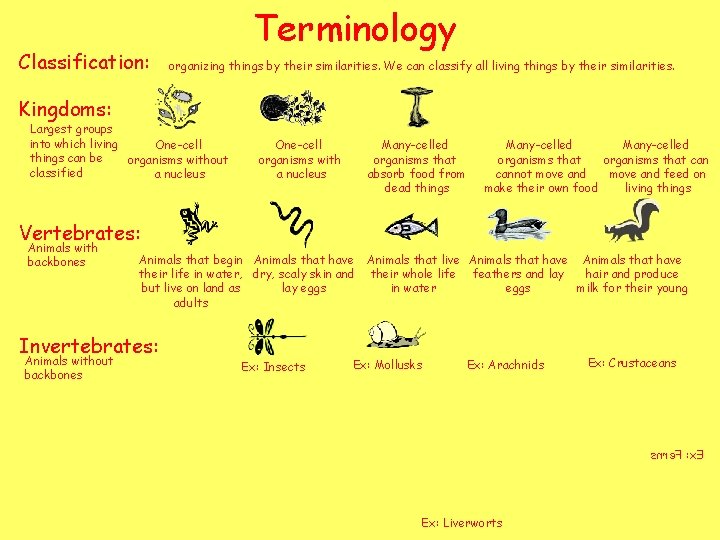
Classification: Terminology organizing things by their similarities. We can classify all living things by their similarities. Kingdoms: Largest groups into which living One-cell things can be organisms without classified a nucleus One-cell organisms with a nucleus Many-celled organisms that absorb food from dead things Many-celled organisms that cannot move and feed on make their own food living things Vertebrates: Animals with backbones Animals that begin Animals that have Animals that live Animals that have their life in water, dry, scaly skin and their whole life feathers and lay hair and produce but live on land as lay eggs in water eggs milk for their young adults Invertebrates: Animals without backbones Ex: Insects Ex: Mollusks Ex: Arachnids Ex: Crustaceans snre. F : x. E Ex: Liverworts
Credits Slides 1 & 2: Praying mantis - http: //www. pbase. com/hsandler/image/31785681 Snake - http: //www. pitt. edu/~mcs 2/herp/snake. pics/Clonophis_kirtlandii. jpg Badger - http: //www. municipiodenogales. org/images/BADGER. jpg Cat - http: //www. merryair. com/catpage. htm Crab - http: //viewfromtheloft. typepad. com/photos/birds/crab. jpg Leech – http: //www. berkeley. edu/news/media/releases/2004/08/images/leech. jpg Pine cones – http: //www. octoberphotography. com/blog%20 photos/Dec. %202005/pinecones. jpg Cucumbers - http: //www. seedsofchange. com/product_shots/PS 14572 B. jpg Moneran - http: //www. kidsbiology. com/biology_basics/five_kingdoms_life/moneran 2. php Mushrooms - http: //www. stock-photography. co. za/images/mushrooms_wild_4979. jpg Lichen - http: //www. dimijianimages. com/More-page 4 -mutualisms/lichens-Tasmania. TN. jpg Goldfish - http: //cavyspirit. com/images/goldfish%20 in%20 bowl. jpg Peas - http: //www. turnerphotographics. com/ag/graphics/9810042. jpg Eagle - http: //www. impressionsofnature. net/images/gallery/thumbnails/ABE-50336 -Flying-bald-eagle. jpg Elephant - http: //www. natureartists. com/art/resized/599_behindthebush 1. jpg Chimp - http: //www. african-safari-pictures. com/image-files/baby-chimpanzee-picture. jpg Pumpkins - http: //shecodes. smugmug. com/keyword/pumpkin Protist - http: //www. kidsbiology. com/images/protista. jpg Tomato - http: //www. goodearthliveherbs. com/images/vegetable_patio_tomato_plants 2. jpg Worm - http: //www. kitchengardens. dial. pipex. com/earthworm. jpg Seaweed - http: //tepserver. ucsd. edu/~eshepard/Images/KELP. jpg Pine tree - http: //www. halesteward. com/new-photos/property/pine-tree-med. jpg Protist - http: //www. kidsbiology. com/biology_basics/five_kingdoms_life/protist 3. php Ladybug - http: //surgery-graphics. med. umich. edu/~matt/archives/images/Ladybug. jpg Whale – http: //www. underwater. com. au/article. php/id/1265/ Dianthus - http: //www. stauder. net/bildearkiv/Dianthus%20 allwoodii%20 alpinus. jpg
Credits (continued) Slide 3: Microsoft clip art Slide 4 -8: Clip art by Enoch Ihde Slide 9: http: //www. kidsbiology. com/biology_basics/five_kingdoms_life/moneran 2. php Slide 10: http: //www. kidsbiology. com/biology_basics/five_kingdoms_life/protist 3. php Slide 11: http: //www. kidsbiology. com/biology_basics/five_kingdoms_life/fungi 4. php http: //ezzelino. ifa. hawaii. edu/~bresolin/infrared/images/10. %20 Mushroom. jpg Slide 12: http: //www. kidsbiology. com/biology_basics/five_kingdoms_life/plant 5. php http: //www. battagliaranch. com/photos/400_Noble-Fir. jpg http: //upload. wikimedia. org/wikipedia/commons/thumb/a/a 9/A_sunflower. jpg http: //tepserver. ucsd. edu/~eshepard/Images/KELP. jpg Slide 13: http: //www. underwater. com. au/article. php/id/1265/ http: //surgery-graphics. med. umich. edu/~matt/archives/images/Ladybug. jpg http: //www. greggman. com/gallery/photos/2001 -07 -21 -a. htm http: //www. african-safari-pictures. com/image-files/baby-chimpanzee. jpg Slide 14: http: //www. karensclassroom. com/treasuretrove/gradetwo/animals/backbone. jpg Microsoft clip art Slide 15: http: //www. infovisual. info/01 01/img_en/003%20 Structure%20 of%20 a%20 plant. jpg Slide 16: http: //ls. berkeley. edu/images/divisions/bio/gallery_ib/moss-lg. jpg http: //www. sethwhite. org/ images/science/other%20 science%20 related%20 photos/moss% 20 under%20 microscope%204. jpg Slide 17 -18: http: //nationalzoo. si. edu/Animals/Photo. Gallery Slide 19: http: //www. digimorph. org/specimens/Necturus_maculosus/mudpuppy. jpg http: //web. ukonline. co. uk/m. hoult/a_an_r/images/tadpole. jpg http: //nationalzoo. si. edu/Animals/Photo. Gallery
Credits (continued) Slide 20: -- http: //www. aqua. org/animals_electriceel. html http: //www. aqua. org/animals_featherblenny. html http: //www. aqua. org/animals_bangaiicardinalfish. html Slide 21: http: //nationalzoo. si. edu/Animals/Photo. Gallery Slide 22: http: //lockwoodwebs. com/composting/bacteria 3. gif http: //img. tfd. com/dict/101/268337 -moneran. gif Microsoft clip art Slide 23: Microsoft clip art Clip art by Enoch Ihde