
Classifying Chemical Reactions 3 25 03 Kentlake Science
- Slides: 23
Classifying Chemical Reactions 3 -25 -03 Kentlake Science Department
The Nature of Chemical Reactions Substances that undergo a chemical reaction experience a change in their physical and chemical properties. 3 -25 -03 Kentlake Science Department 2
Chemical Equations • Chemical reactions are described by: – Word Equations – Formula Equations 3 -25 -03 Kentlake Science Department 3
Reactants • The substances present before a chemical reaction occurs. 3 -25 -03 Kentlake Science Department 4
Products • The substances that result from the chemical reaction. 3 -25 -03 Kentlake Science Department 5
Chemical Reactions • Occur so that atoms can become more stable. 3 -25 -03 Kentlake Science Department 6
Law Conservation of Matter • Because the number and kind of atoms on the reactant side are the same as the number and kind of atoms on the product side. 3 -25 -03 Kentlake Science Department 7
Coefficients • Is a number written before the formula. • It indicates the number of reactants or products involved. 3 -25 -03 Kentlake Science Department 8
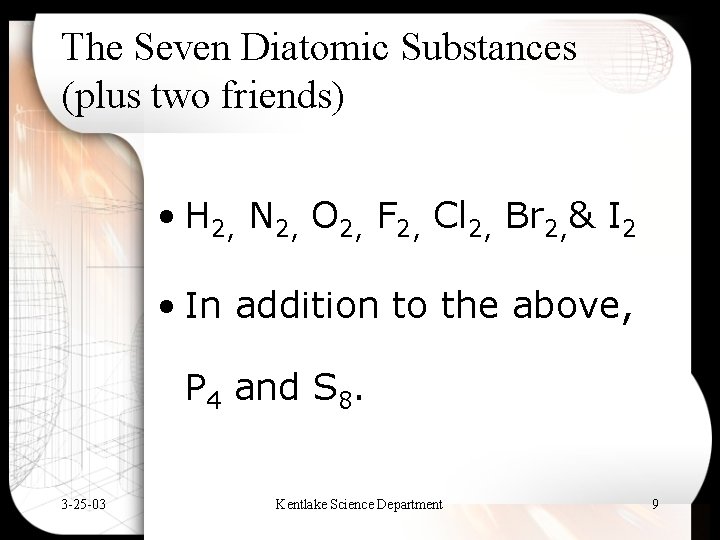
The Seven Diatomic Substances (plus two friends) • H 2, N 2, O 2, F 2, Cl 2, Br 2, & I 2 • In addition to the above, P 4 and S 8. 3 -25 -03 Kentlake Science Department 9
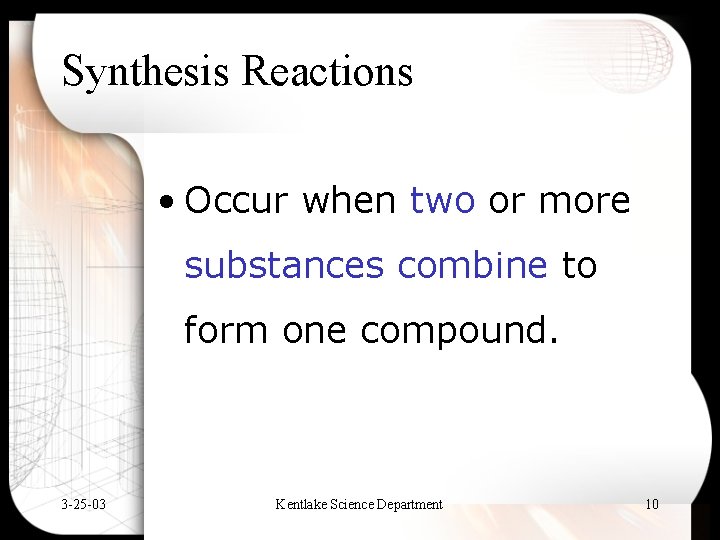
Synthesis Reactions • Occur when two or more substances combine to form one compound. 3 -25 -03 Kentlake Science Department 10
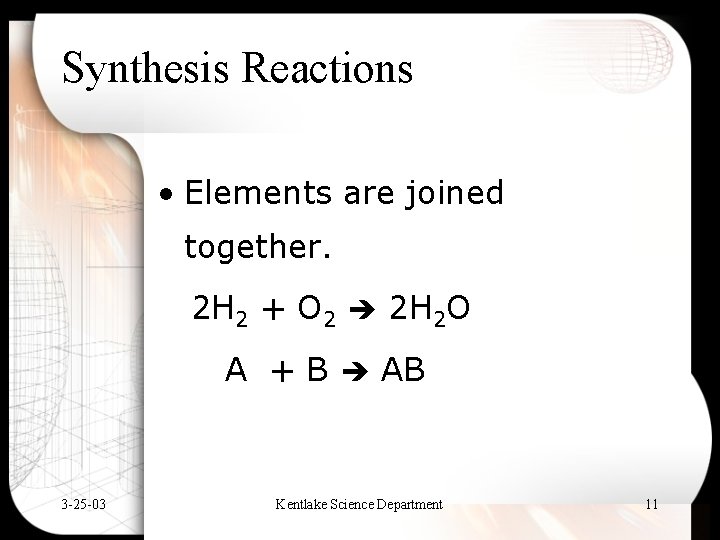
Synthesis Reactions • Elements are joined together. 2 H 2 + O 2 2 H 2 O A + B AB 3 -25 -03 Kentlake Science Department 11
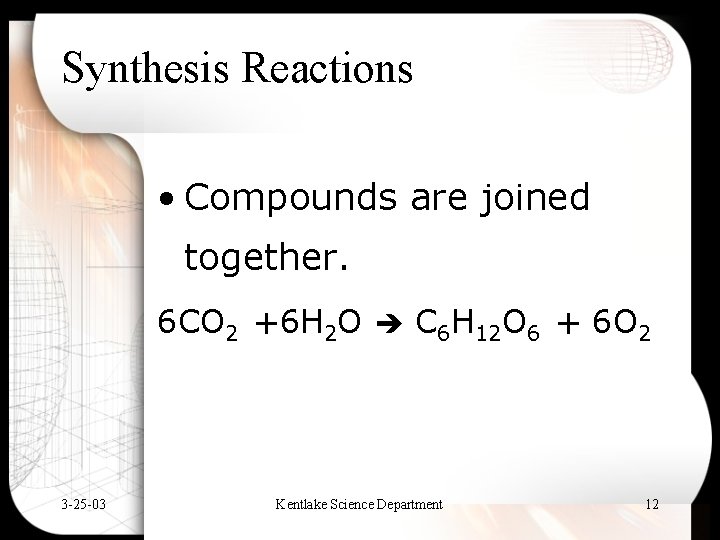
Synthesis Reactions • Compounds are joined together. 6 CO 2 +6 H 2 O C 6 H 12 O 6 + 6 O 2 3 -25 -03 Kentlake Science Department 12
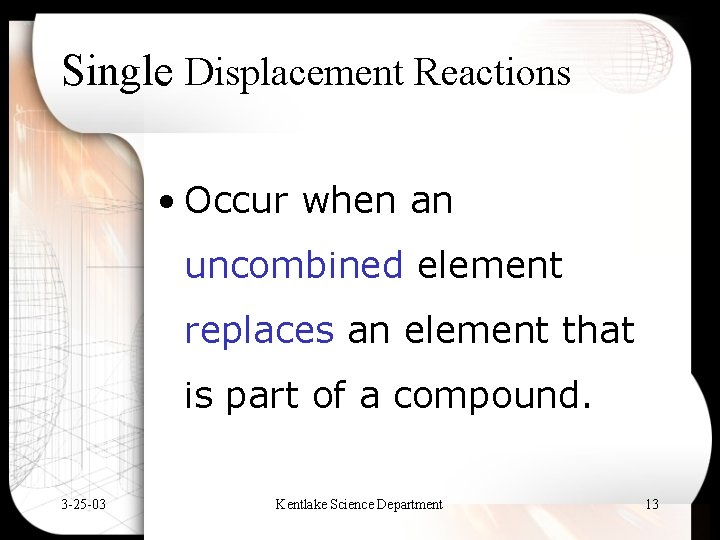
Single Displacement Reactions • Occur when an uncombined element replaces an element that is part of a compound. 3 -25 -03 Kentlake Science Department 13
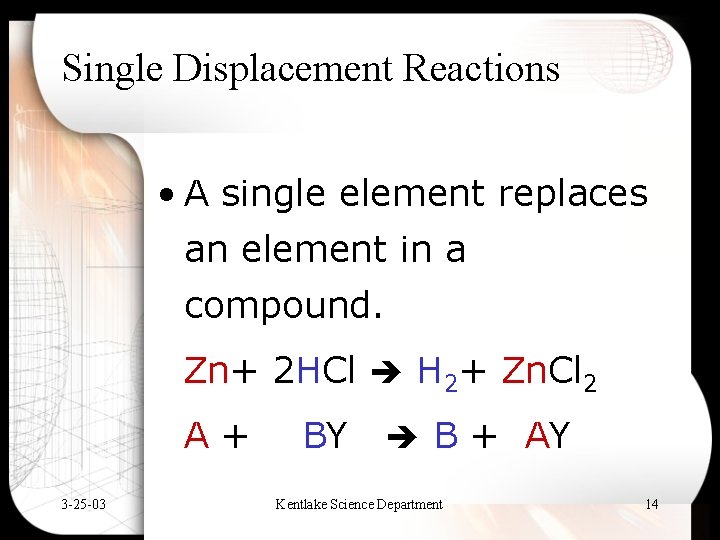
Single Displacement Reactions • A single element replaces an element in a compound. Zn+ 2 HCl H 2+ Zn. Cl 2 A+ 3 -25 -03 BY B + AY Kentlake Science Department 14
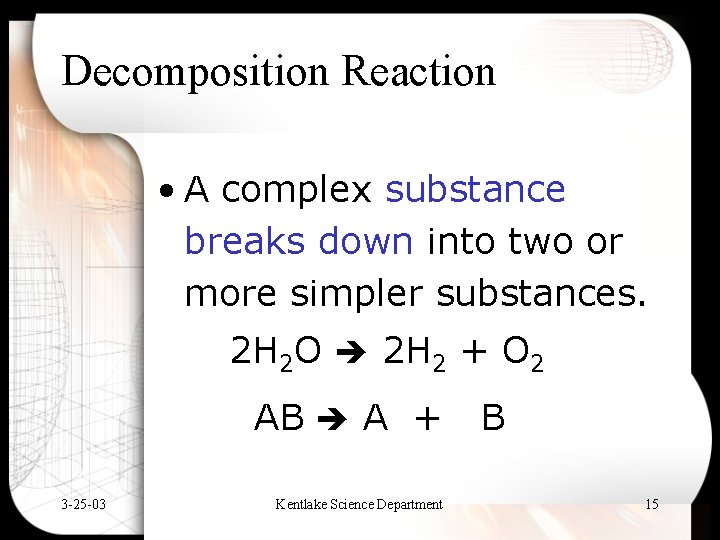
Decomposition Reaction • A complex substance breaks down into two or more simpler substances. 2 H 2 O 2 H 2 + O 2 AB A + 3 -25 -03 Kentlake Science Department B 15
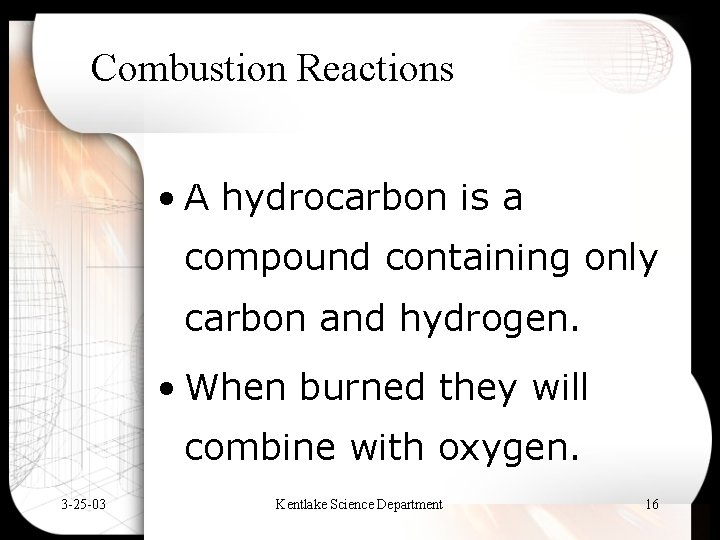
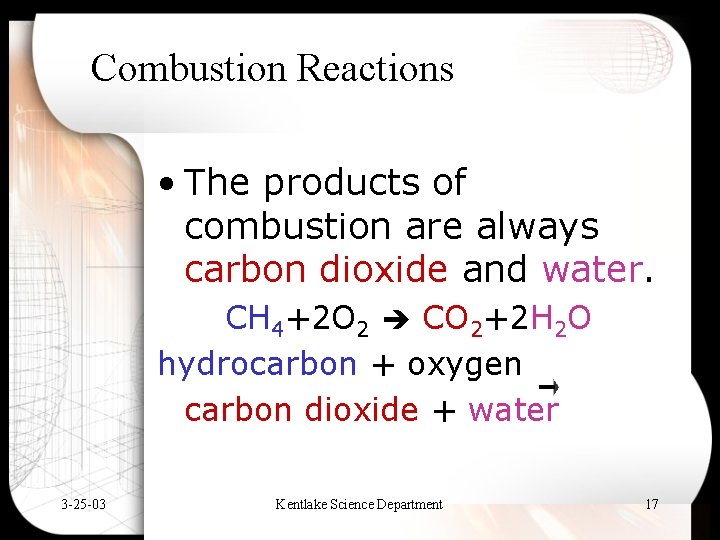
Combustion Reactions • A hydrocarbon is a compound containing only carbon and hydrogen. • When burned they will combine with oxygen. 3 -25 -03 Kentlake Science Department 16
Combustion Reactions • The products of combustion are always carbon dioxide and water. CH 4+2 O 2 CO 2+2 H 2 O hydrocarbon + oxygen carbon dioxide + water 3 -25 -03 Kentlake Science Department 17
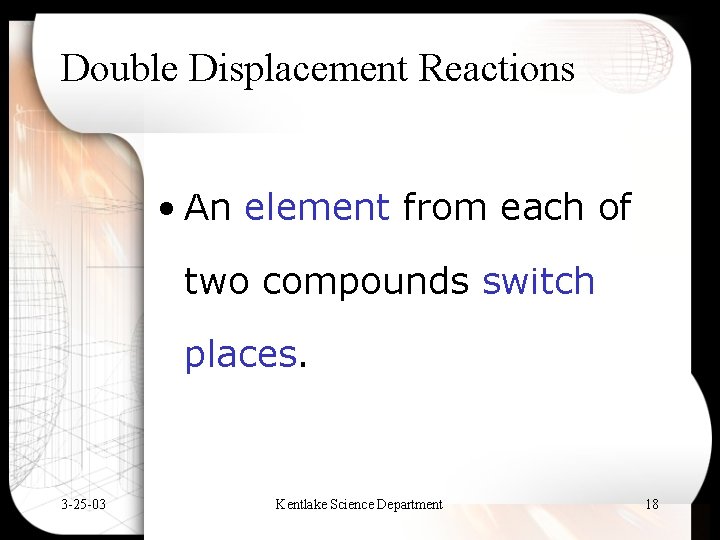
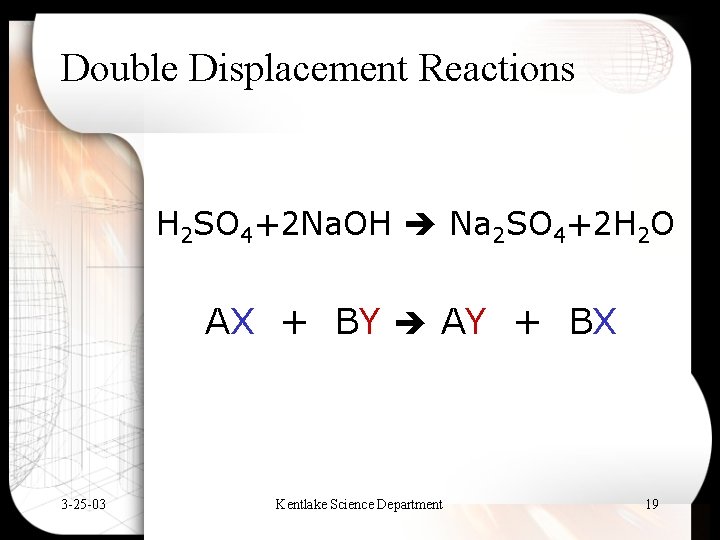
Double Displacement Reactions • An element from each of two compounds switch places. 3 -25 -03 Kentlake Science Department 18
Double Displacement Reactions H 2 SO 4+2 Na. OH Na 2 SO 4+2 H 2 O AX + BY AY + BX 3 -25 -03 Kentlake Science Department 19
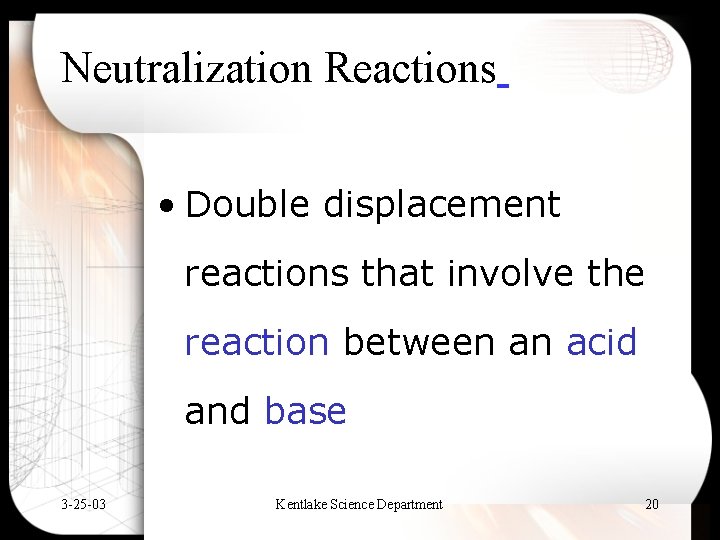
Neutralization Reactions • Double displacement reactions that involve the reaction between an acid and base 3 -25 -03 Kentlake Science Department 20
Neutralization Reactions • Forms a salt and water. • Heat is usually given off in neutralization reactions. 3 -25 -03 Kentlake Science Department 21
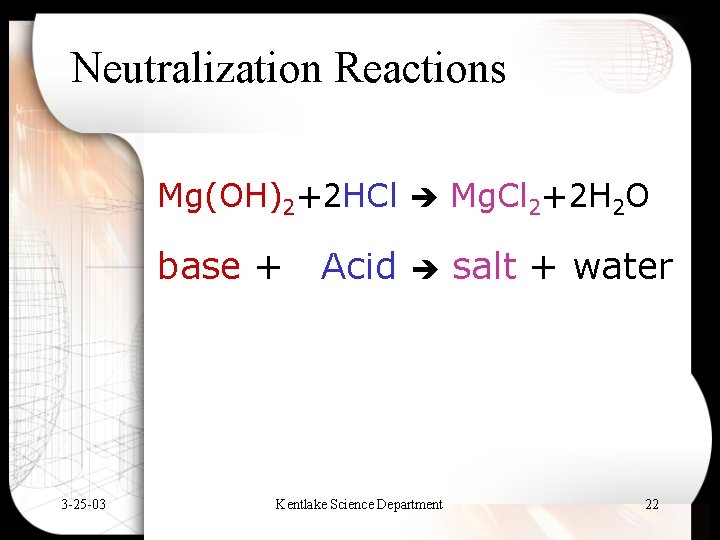
Neutralization Reactions Mg(OH)2+2 HCl Mg. Cl 2+2 H 2 O base + 3 -25 -03 Acid Kentlake Science Department salt + water 22
Internet References • Balancing Equations 3 -25 -03 Kentlake Science Department 23