
Classified Balance Sheet Data grouped according to major
Classified Balance Sheet • Data grouped according to major categories • Makes it easier to analyze the information on the balance sheet
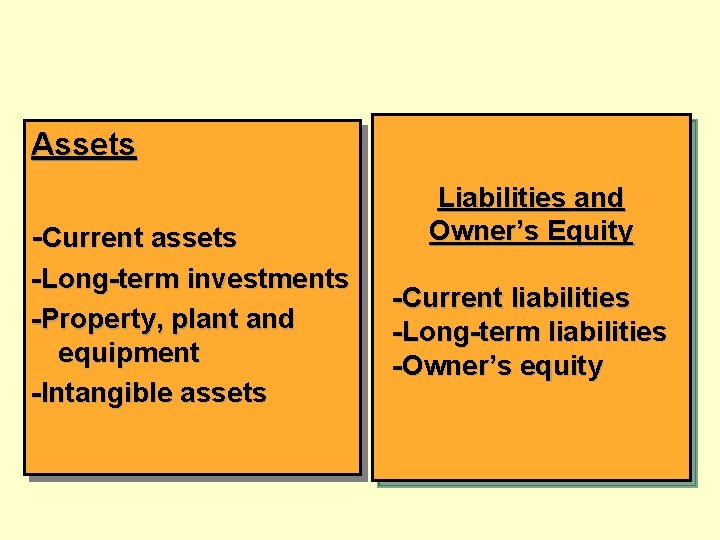
Assets -Current assets -Long-term investments -Property, plant and equipment -Intangible assets Liabilities and Owner’s Equity -Current liabilities -Long-term liabilities -Owner’s equity
Balance Sheet Group Headings • Current Assets – Assets that will be converted into cash (or used) during the year • Listed in the order of liquidity Examples: – Cash, short-term investments, accounts receivable, inventory, pre-paids
Long-Term Investments • Investments that are expected to be held for many years • Not readily marketable or expected to be converted into cash within one year Examples: – Investments in shares or bonds of another company, investment in land held for resale – Long-term assets held for their usefulness in producing goods or services
Property, Plant and Equipment • Long-lived tangible assets that are used in the business and not intended for sale Examples: land, buildings, machinery Intangible Assets • Long-lived assets that do not have physical substance Examples: goodwill, patents, copyrights, trademarks, trade names, licences
Current Liabilities • Short-term debts, payment is expected to occur within one year of the date of the balance sheet • Listed first in the liabilities and equity section of the balance sheet Examples: – accounts payable, interest payable, salaries payable, unearned revenue, current maturities of long-term debt
Long-term liabilities • Debts of the business that are not due within one year Examples: – Future income taxes, long-term notes payable, bonds payable, mortgages payable, lease liabilities
Equity Content of the equity section varies with the form of business organization: – Proprietorship: one capital account under the heading “Owner’s Equity” – Partnership: Capital account for each partner under the heading “Partners’ Equity” – Corporation: shareholders’ equity consists of two sections: “Share Capital” and “Retained Earnings” • Capital – Owner’s claim on assets – Organized to show the beginning balance, the increase or decrease (profit or loss), the decrease through owner’s withdrawals and the ending balance
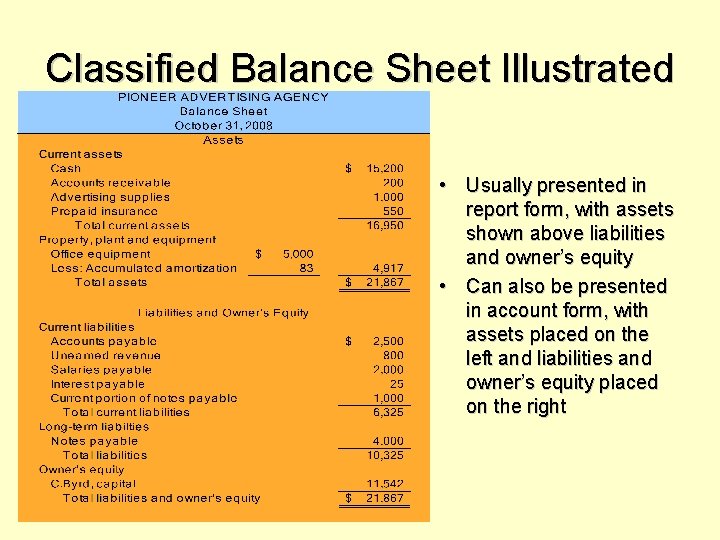
Classified Balance Sheet Illustrated • Usually presented in report form, with assets shown above liabilities and owner’s equity • Can also be presented in account form, with assets placed on the left and liabilities and owner’s equity placed on the right
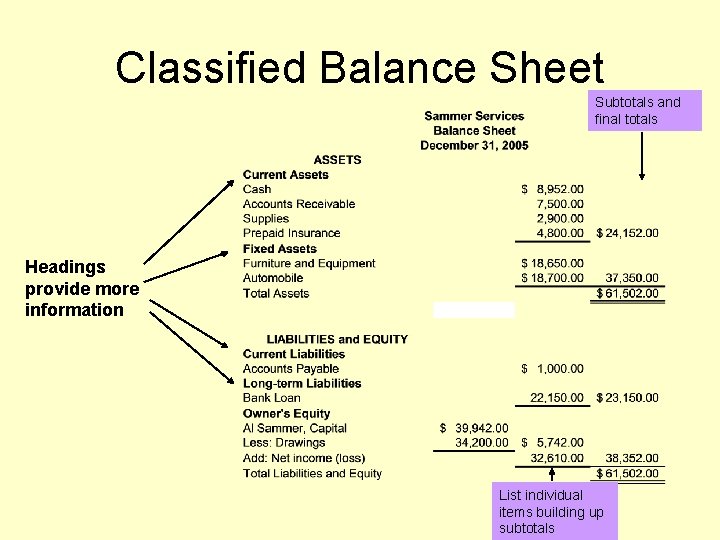
Classified Balance Sheet Subtotals and final totals Headings provide more information List individual items building up subtotals
Using Information in the Financial Statements • Liquidity: the ability to pay obligations as they come due within the next year • Working capital: an important measure of liquidity = Current assets - Current liabilities • Current ratio: a second, more useful measure of short-term debt-paying ability = Current assets ÷ Current liabilities
- Slides: 11