
Classifications of Igneous Rocks Chapter 2 Classification of

- Slides: 30
Classifications of Igneous Rocks Chapter 2
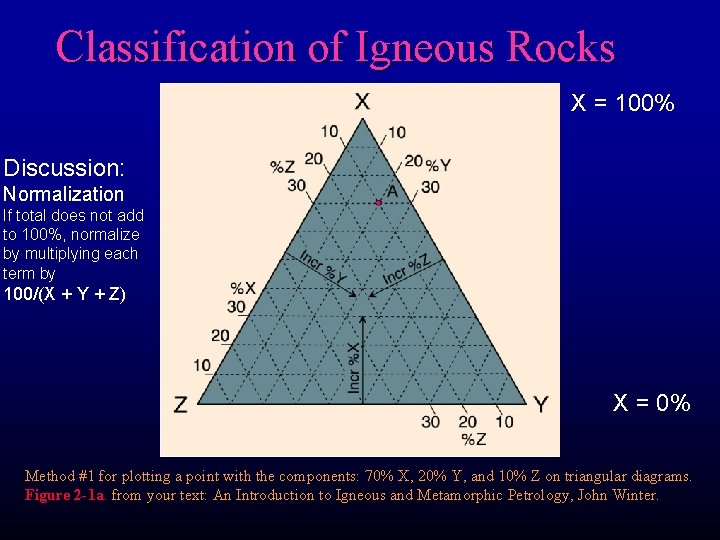
Classification of Igneous Rocks X = 100% Discussion: Normalization If total does not add to 100%, normalize by multiplying each term by 100/(X + Y + Z) X = 0% Method #1 for plotting a point with the components: 70% X, 20% Y, and 10% Z on triangular diagrams. Figure 2 -1 a. from your text: An Introduction to Igneous and Metamorphic Petrology, John Winter.
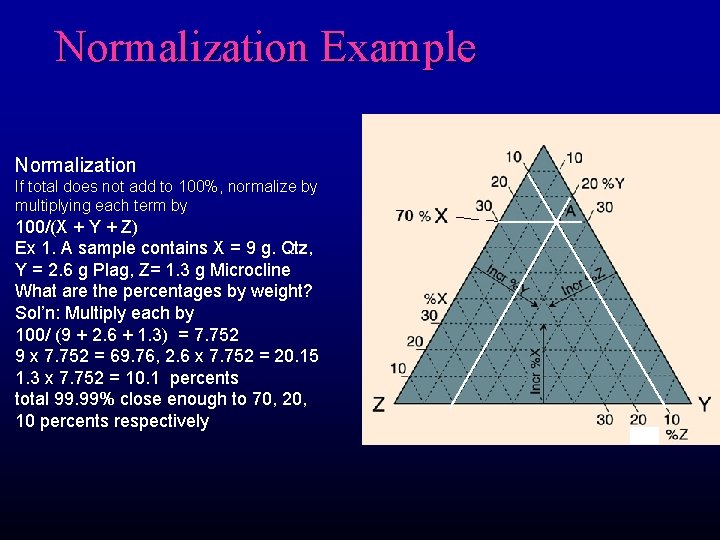
Normalization Example Normalization If total does not add to 100%, normalize by multiplying each term by 100/(X + Y + Z) Ex 1. A sample contains X = 9 g. Qtz, Y = 2. 6 g Plag, Z= 1. 3 g Microcline What are the percentages by weight? Sol’n: Multiply each by 100/ (9 + 2. 6 + 1. 3) = 7. 752 9 x 7. 752 = 69. 76, 2. 6 x 7. 752 = 20. 15 1. 3 x 7. 752 = 10. 1 percents total 99. 99% close enough to 70, 20, 10 percents respectively
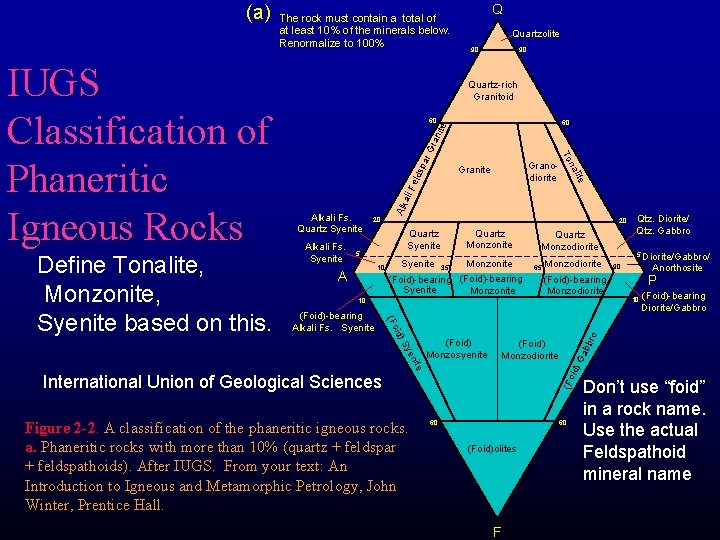
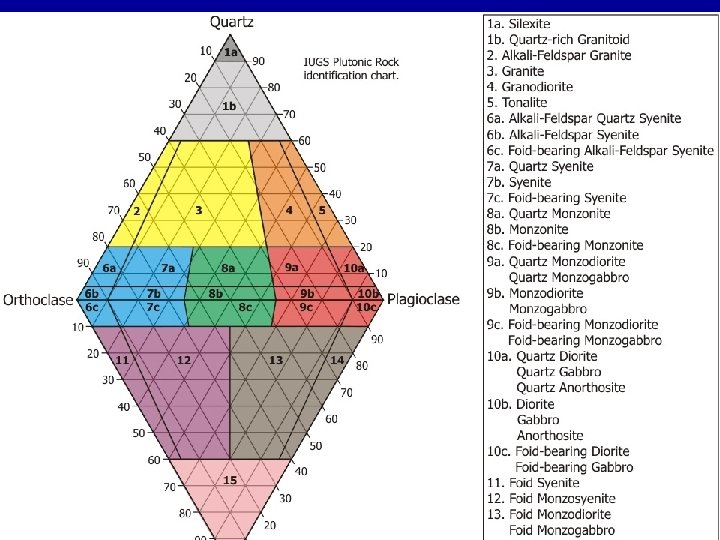
Quartzolite 90 90 Quartz-rich Granitoid 60 lds Fe ali lite Granodiorite Granite na par Gra n ite 60 Alkali Fs. Quartz Syenite Alkali Fs. Syenite 20 20 5 10 A Quartz Monzonite Quartz Syenite Monzonite (Foid)-bearing Syenite Monzonite 35 Quartz Monzodiorite 65 Monzodiorite (Foid)-bearing Monzodiorite 10 5 Diorite/Gabbro/ 90 Anorthosite P 10 (Foid)-bearing Diorite/Gabbro Ga b (Foid) Monzodiorite e it en Sy (Foid) Monzosyenite id) (Foid)-bearing Alkali Fs. Syenite Qtz. Diorite/ Qtz. Gabbro (Fo Define Tonalite, Monzonite, Syenite based on this. Q To IUGS Classification of Phaneritic Igneous Rocks The rock must contain a total of at least 10% of the minerals below. Renormalize to 100% Alk (a) Figure 2 -2. A classification of the phaneritic igneous rocks. a. Phaneritic rocks with more than 10% (quartz + feldspar + feldspathoids). After IUGS. From your text: An Introduction to Igneous and Metamorphic Petrology, John Winter, Prentice Hall. (Fo International Union of Geological Sciences 60 60 (Foid)olites F Don’t use “foid” in a rock name. Use the actual Feldspathoid mineral name
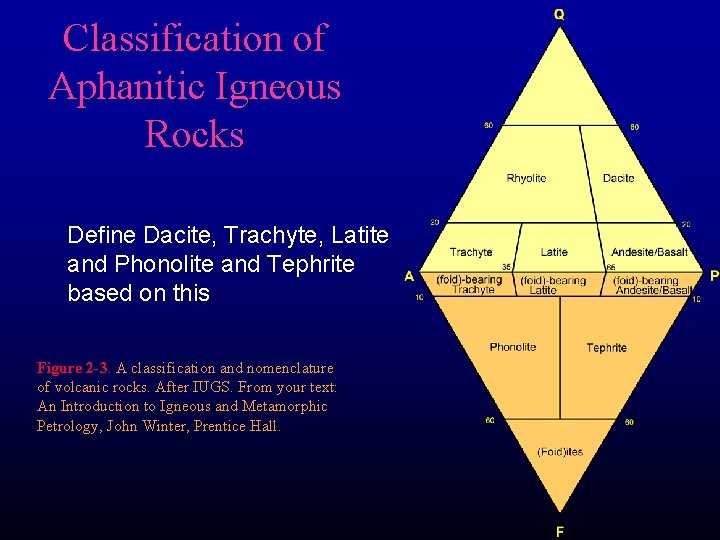
Classification of Aphanitic Igneous Rocks Define Dacite, Trachyte, Latite and Phonolite and Tephrite based on this Figure 2 -3. A classification and nomenclature of volcanic rocks. After IUGS. From your text: An Introduction to Igneous and Metamorphic Petrology, John Winter, Prentice Hall.
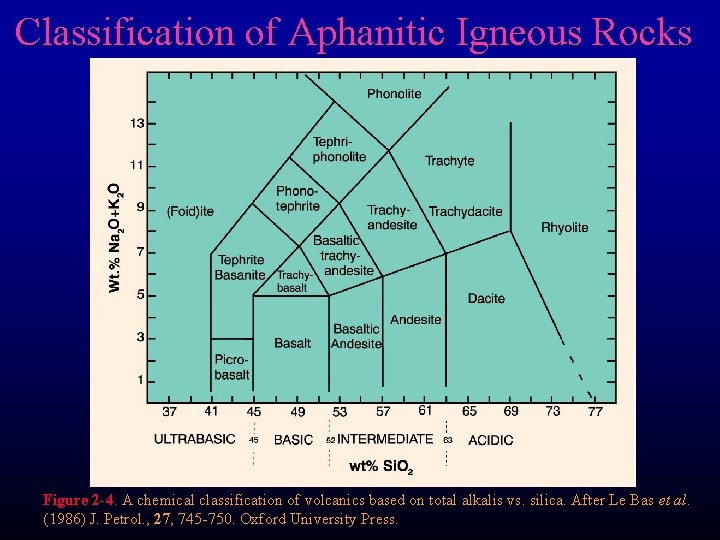
Classification of Aphanitic Igneous Rocks Figure 2 -4. A chemical classification of volcanics based on total alkalis vs. silica. After Le Bas et al. (1986) J. Petrol. , 27, 745 -750. Oxford University Press.
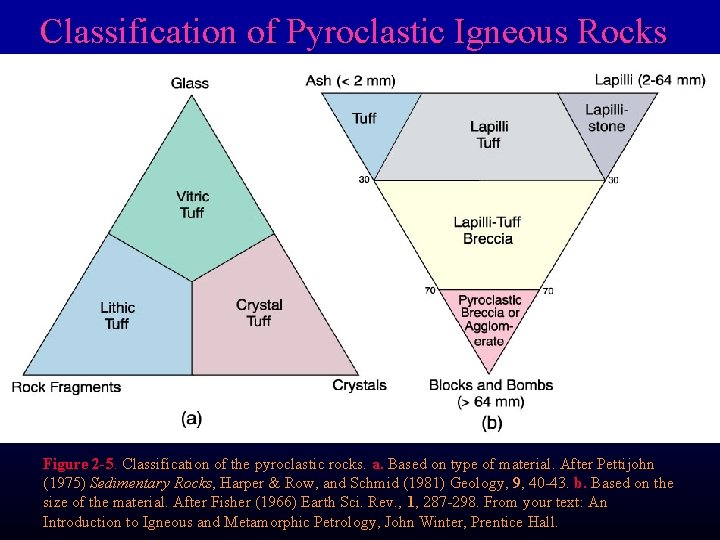
Classification of Pyroclastic Igneous Rocks Figure 2 -5. Classification of the pyroclastic rocks. a. Based on type of material. After Pettijohn (1975) Sedimentary Rocks, Harper & Row, and Schmid (1981) Geology, 9, 40 -43. b. Based on the size of the material. After Fisher (1966) Earth Sci. Rev. , 1, 287 -298. From your text: An Introduction to Igneous and Metamorphic Petrology, John Winter, Prentice Hall.
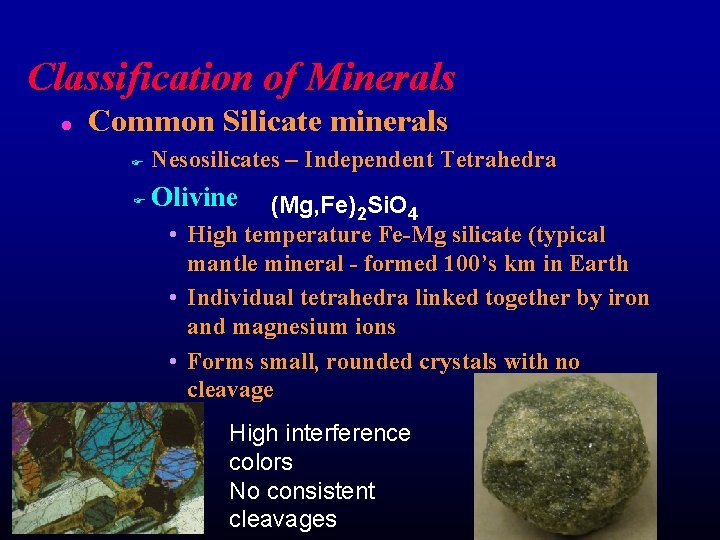
Classification of Minerals l Common Silicate minerals F Nesosilicates – Independent Tetrahedra F Olivine (Mg, Fe)2 Si. O 4 • High temperature Fe-Mg silicate (typical mantle mineral - formed 100’s km in Earth • Individual tetrahedra linked together by iron and magnesium ions • Forms small, rounded crystals with no cleavage High interference colors No consistent cleavages
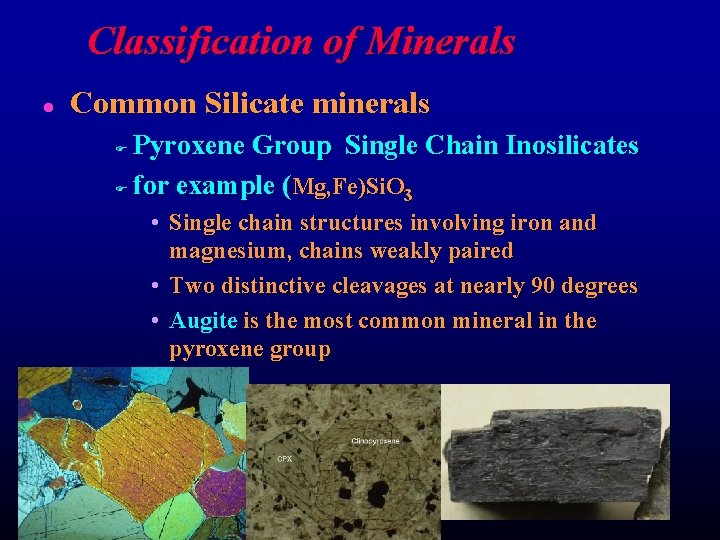
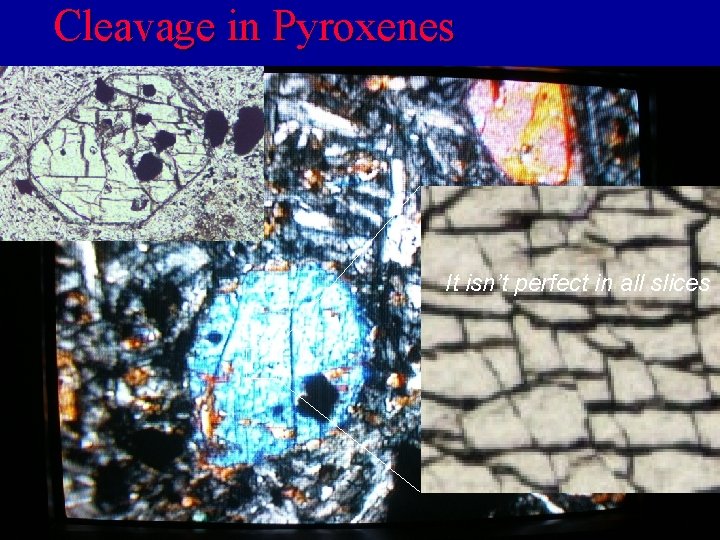
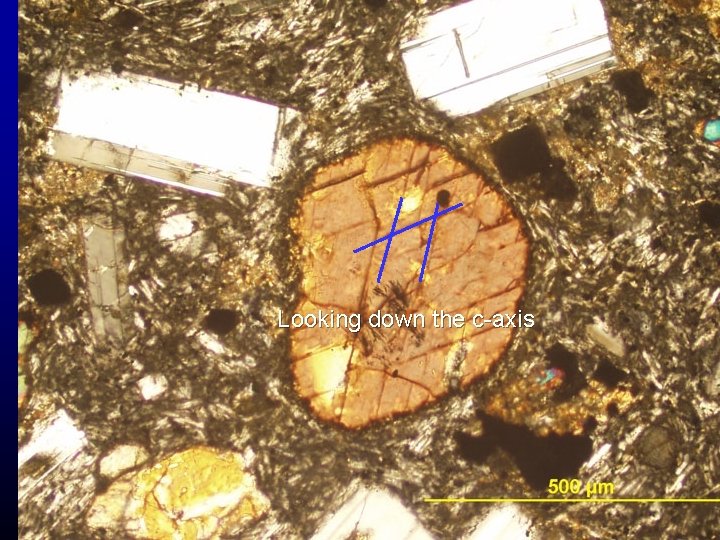
Classification of Minerals l Common Silicate minerals Pyroxene Group Single Chain Inosilicates F for example (Mg, Fe)Si. O 3 F • Single chain structures involving iron and magnesium, chains weakly paired • Two distinctive cleavages at nearly 90 degrees • Augite is the most common mineral in the pyroxene group
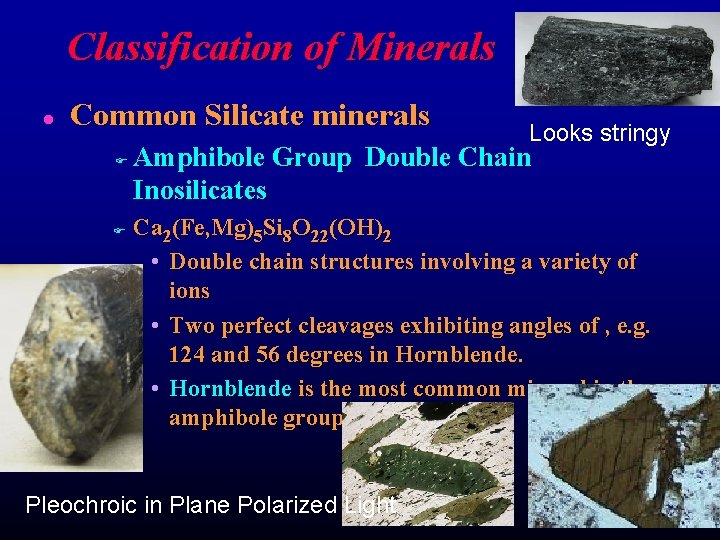
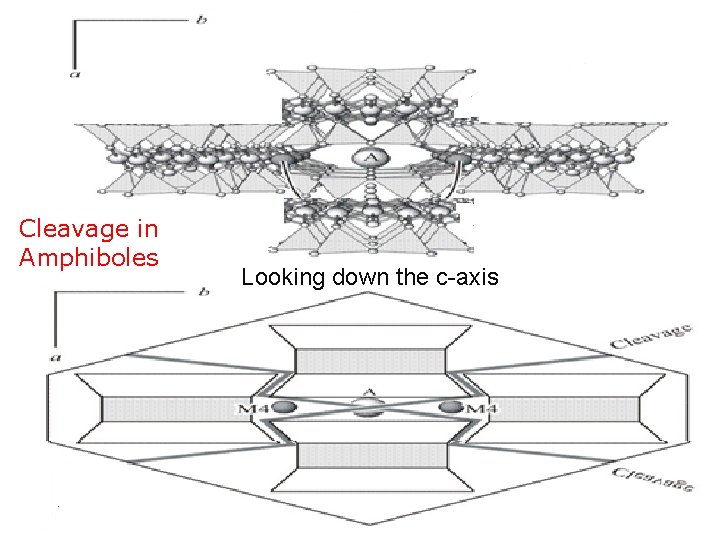
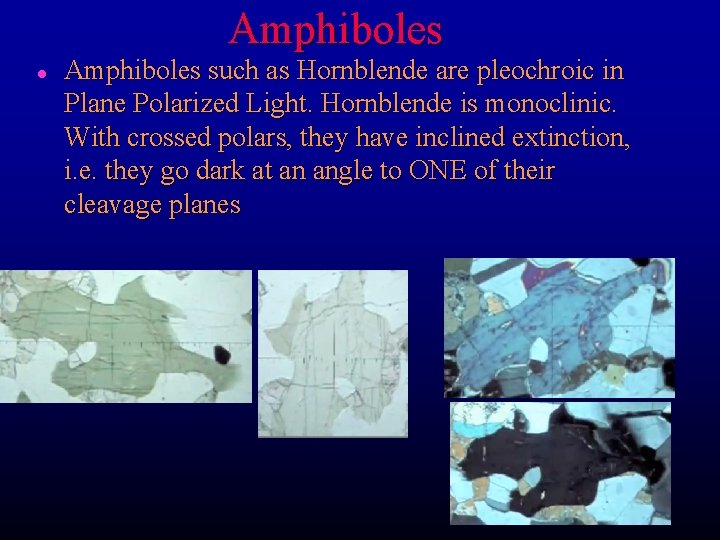
Classification of Minerals l Common Silicate minerals F F Looks stringy Amphibole Group Double Chain Inosilicates Ca 2(Fe, Mg)5 Si 8 O 22(OH)2 • Double chain structures involving a variety of ions • Two perfect cleavages exhibiting angles of , e. g. 124 and 56 degrees in Hornblende. • Hornblende is the most common mineral in the amphibole group Pleochroic in Plane Polarized Light
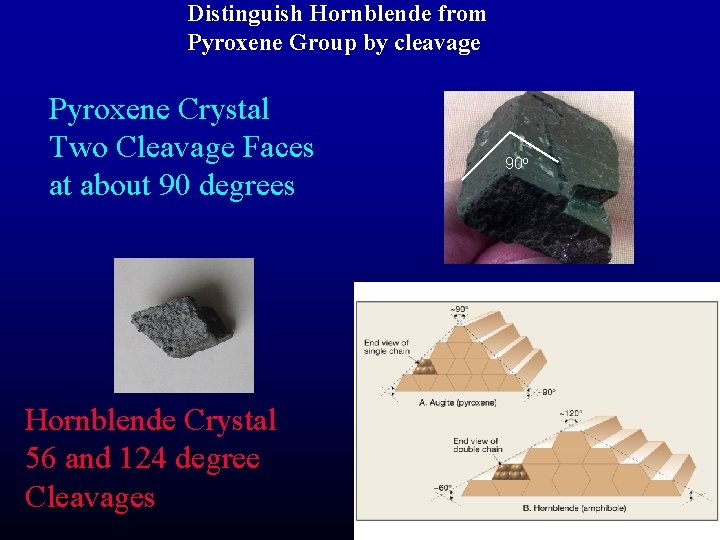
Distinguish Hornblende from Pyroxene Group by cleavage Pyroxene Crystal Two Cleavage Faces at about 90 degrees Hornblende Crystal 56 and 124 degree Cleavages 90 o
Cleavage in Pyroxenes It isn’t perfect in all slices
Cleavage in Amphiboles Looking down the c-axis
Looking down the c-axis
Amphiboles l Amphiboles such as Hornblende are pleochroic in Plane Polarized Light. Hornblende is monoclinic. With crossed polars, they have inclined extinction, i. e. they go dark at an angle to ONE of their cleavage planes
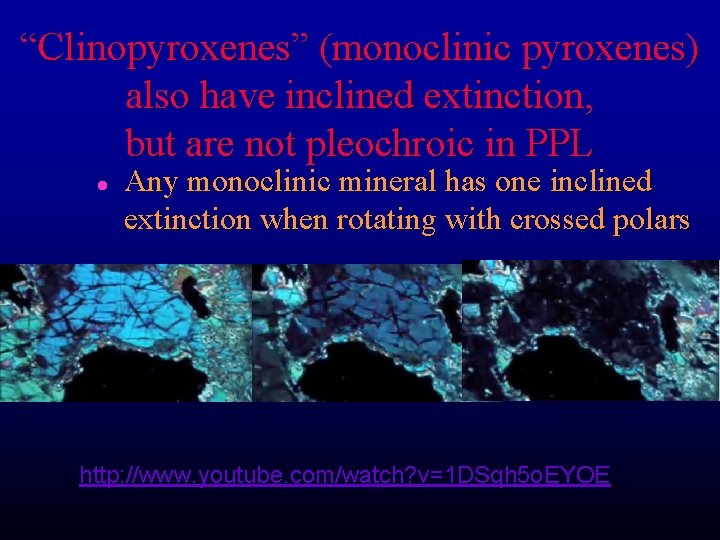
“Clinopyroxenes” (monoclinic pyroxenes) also have inclined extinction, but are not pleochroic in PPL l Any monoclinic mineral has one inclined extinction when rotating with crossed polars http: //www. youtube. com/watch? v=1 DSqh 5 o. EYOE
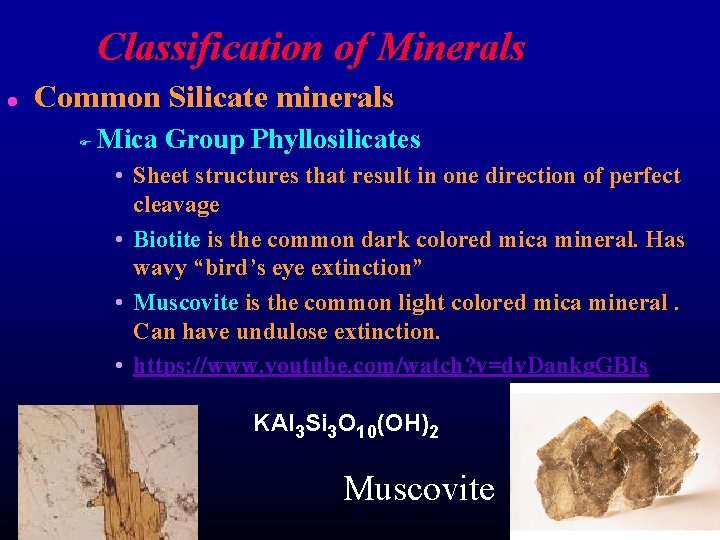
Classification of Minerals l Common Silicate minerals F Mica Group Phyllosilicates • Sheet structures that result in one direction of perfect cleavage • Biotite is the common dark colored mica mineral. Has wavy “bird’s eye extinction” • Muscovite is the common light colored mica mineral. Can have undulose extinction. • https: //www. youtube. com/watch? v=dv. Dankg. GBIs KAl 3 Si 3 O 10(OH)2 Muscovite
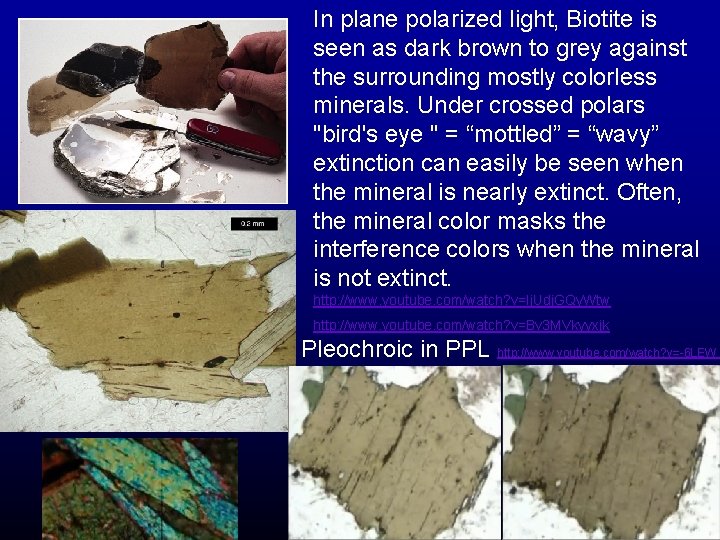
In plane polarized light, Biotite is seen as dark brown to grey against the surrounding mostly colorless minerals. Under crossed polars "bird's eye " = “mottled” = “wavy” extinction can easily be seen when the mineral is nearly extinct. Often, the mineral color masks the interference colors when the mineral is not extinct. http: //www. youtube. com/watch? v=Ij. Udj. GQy. Wtw http: //www. youtube. com/watch? v=Bv 3 MVkyyxjk Pleochroic in PPL http: //www. youtube. com/watch? v=-6 LEW_
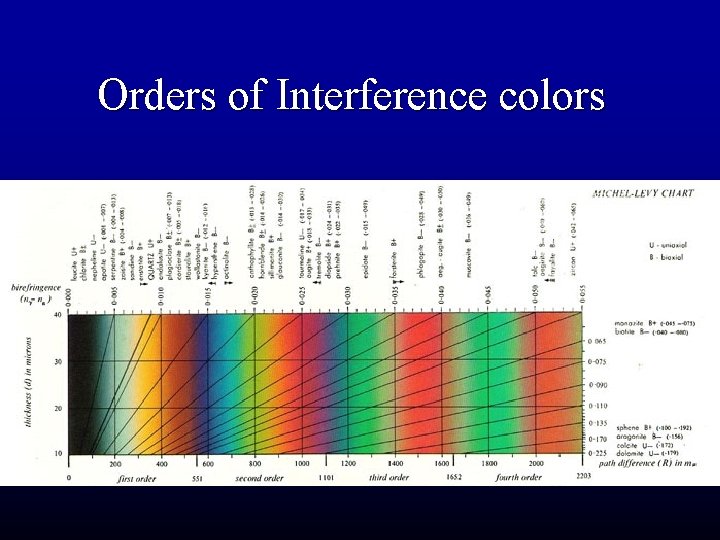
Orders of Interference colors
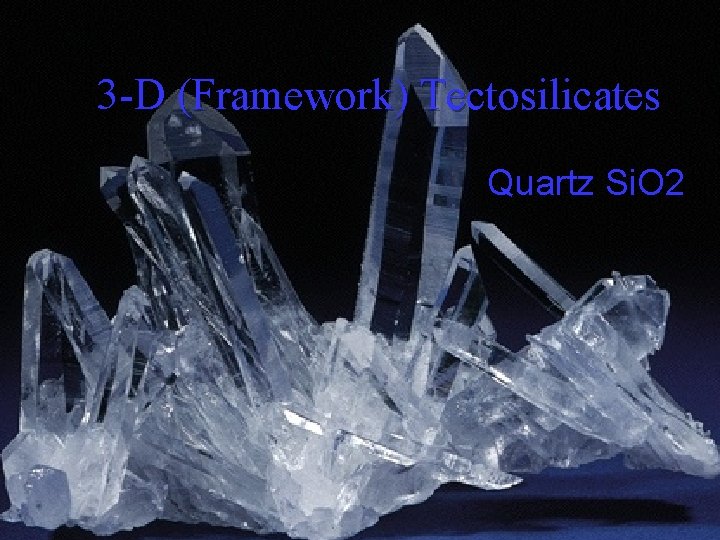
3 -D (Framework) Tectosilicates Quartz Si. O 2
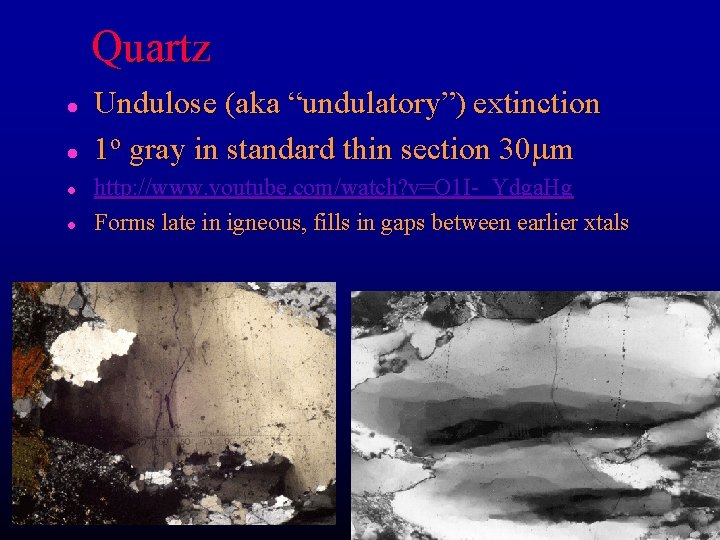
Quartz l l Undulose (aka “undulatory”) extinction 1 o gray in standard thin section 30 mm http: //www. youtube. com/watch? v=O 1 I-_Ydga. Hg Forms late in igneous, fills in gaps between earlier xtals
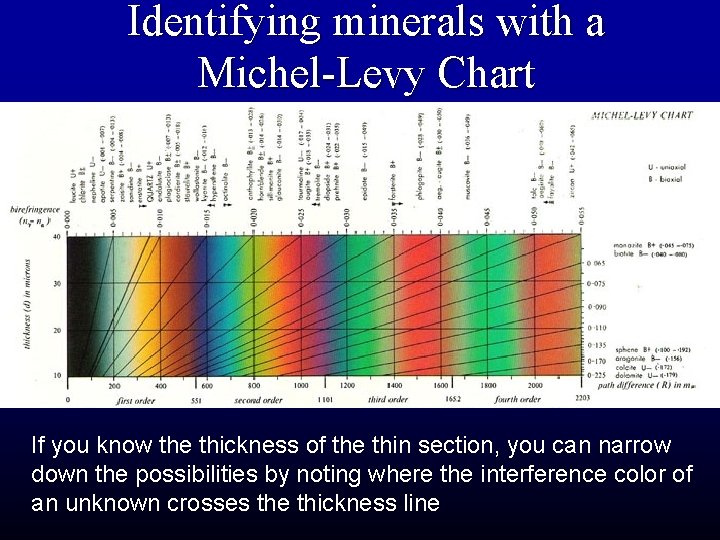
Identifying minerals with a Michel-Levy Chart If you know the thickness of the thin section, you can narrow down the possibilities by noting where the interference color of an unknown crosses the thickness line
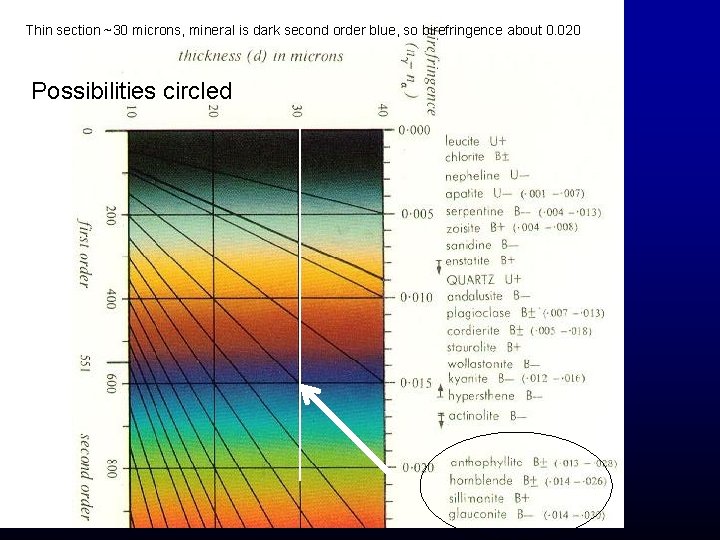
Thin section ~30 microns, mineral is dark second order blue, so birefringence about 0. 020 Possibilities circled
Feldspars l l Common Silicate minerals Tectosilicates F Feldspar Group • Most common mineral group • 3 -dimensional framework of tetrahedra exhibit two directions of perfect cleavage at 90 degrees • K-spars (potassium feldspar) and Plagioclases (sodium to calcium feldspar solutions) are the two most common groups • Pearly to vitreous Luster
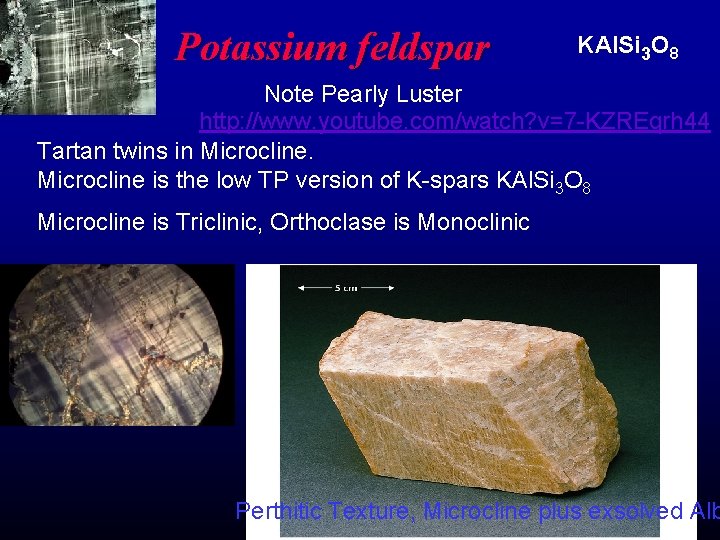
Potassium feldspar KAl. Si 3 O 8 Note Pearly Luster http: //www. youtube. com/watch? v=7 -KZREqrh 44 Tartan twins in Microcline is the low TP version of K-spars KAl. Si 3 O 8 Microcline is Triclinic, Orthoclase is Monoclinic Perthitic Texture, Microcline plus exsolved Alb
Plagioclase feldspar (Ca, Na)Al. Si 3 O 8 Note the Twinning, seems to have ‘stripes’ http: //www. youtube. com/watch? v=g. Lc. VT_6 y-M Labradorite Albite Na. Al. Si 3 O 8
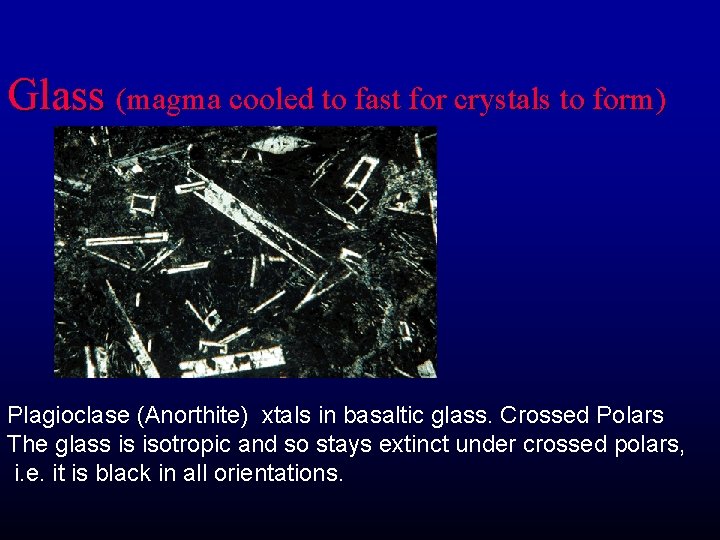
Glass (magma cooled to fast for crystals to form) Plagioclase (Anorthite) xtals in basaltic glass. Crossed Polars The glass is isotropic and so stays extinct under crossed polars, i. e. it is black in all orientations.
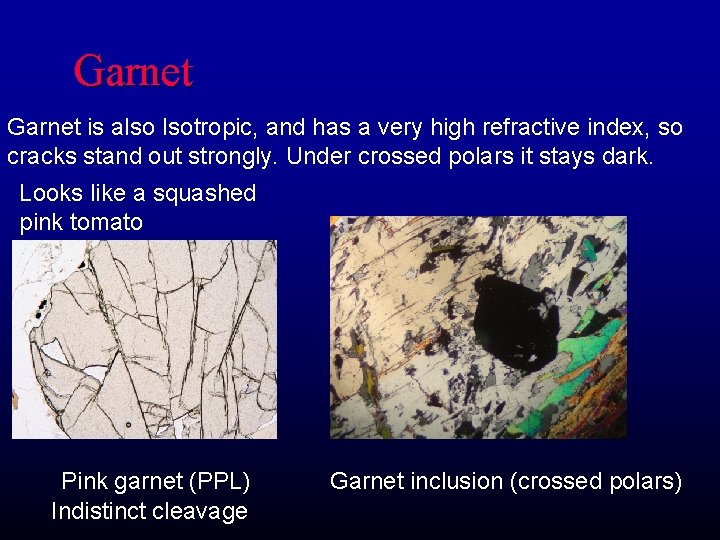
Garnet is also Isotropic, and has a very high refractive index, so cracks stand out strongly. Under crossed polars it stays dark. Looks like a squashed pink tomato Pink garnet (PPL) Indistinct cleavage Garnet inclusion (crossed polars)
Next week: Chapter 3 Textures of Igneous Rocks