
Classification What is Classification Classification is the division

- Slides: 46
Classification
What is Classification? Classification is the division of organisms into groups based on specific characteristics Biologists use classification to organize living things into groups so that they are easier to study. Aristotle was the first scientist to classify organisms. He organized animals in 3 groups: those that fly, those that swim, and those that walk, crawl, or run.
What is taxonomy? Taxonomy is the science of describing, naming, and classifying organisms. Carolus Linnaeus was the first scientist to group organisms by their observable features. He created a naming system for organisms called binomial nomenclature.
What is binomial nomenclature? Binomial Nomenclature is a naming system in which organisms are given two-part names. Scientific names are written in Latin and italics. Part 1 is the organisms GENUS name. It is always capitalized. Part 2 is the organisms SPECIES name. It is always in lower case. EX: Felis concolor = Montain Lion/Cougar/Puma
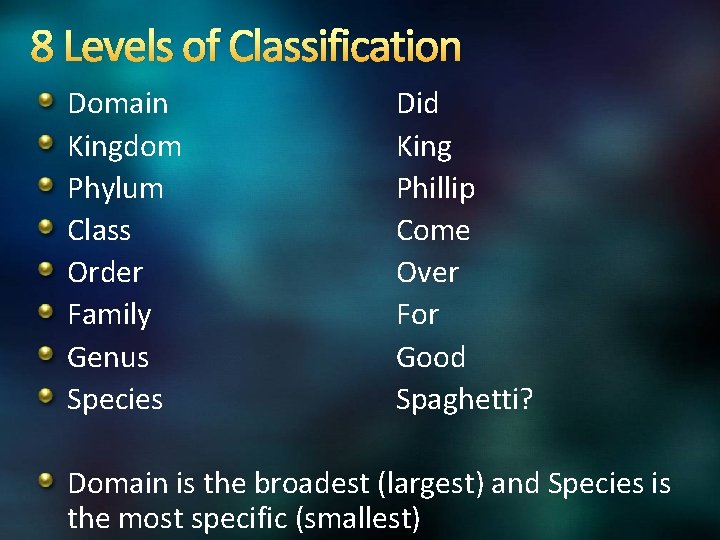
8 Levels of Classification Domain Kingdom Phylum Class Order Family Genus Species Did King Phillip Come Over For Good Spaghetti? Domain is the broadest (largest) and Species is the most specific (smallest)
Dichotomous Key A tool used to help identify organisms. Consists of a series of paired statements that describe the physical characteristics of different organisms. Another tool to help identify organisms is a field guide.
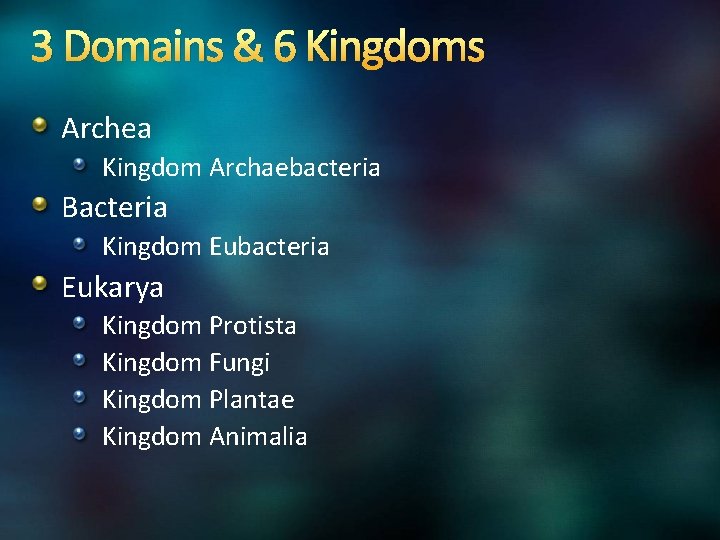
3 Domains & 6 Kingdoms Archea Kingdom Archaebacteria Bacteria Kingdom Eubacteria Eukarya Kingdom Protista Kingdom Fungi Kingdom Plantae Kingdom Animalia
Kingdom Archaebacteria means “ancient bacteria”; believed to have been around before the dinosaurs. Contains unicellular prokaryotes that like extreme conditions 3 types: Heat lovers – live in ocean vents & hot springs; can survive temperatures 140⁰F – 176⁰F. Some can survive temperatures up to 482⁰F Salt lovers – live in areas with high salt concentration like the Dead Sea and Salt Lake Methane makers – give off gas and live in swamps and animal intestines
Kingdom Eubacteria Also unicellular prokaryotes; however, they live in milder conditions. Can be used to flavor cheese, make yogurt, aide in digestion, and can make you sick. 3 shapes: Bacilli – rod shaped Cocci – spherical Spirilla – spiral shaped Some bacteria move using a flagella. The flagella spins to push the bacteria through water or other liquida
Viruses A virus is a small, nonliving particle that invades and then reproduces inside a living cell (host). Viruses are nonliving because they are not cells; they do not use energy to grow or respond to surroundings, and they cannot take in food, make food, or excrete wastes. Do not have scientific names; named after the diseases they cause. (i. e. the polio virus causes polio) 4 basic shapes: crystals, spheres, cylinders, or spacecraft. A virus can remain dormant, or hidden, for some time before becoming active.
Kingdom Protista All protists are eukaryotic and live in moist surroundings. Protists can be multicellular or unicellular; they can also be autotrophic or heterotrophic or both. Often called the “junk drawer” kingdom because these organisms do not quite fit into any other classification kingdom.
Kingdom Protista Continued 3 main types Animal-like Protists: called protozoans; can move Protozoans with Pseudopods: called Sarcodines pseudopod means “false foot”. These protozoans have temporary bulges in the cell membrane that fill with cytoplasm pushing the organisms forward. (Ex: Amoeba) Protozoans with Cilia: called Ciliates. Cilia are hairlike projections that move in a wavelike pattern to assist in movement, obtaining food, and sensing the environment. (Ex: Paramecium) Protozoans with Flagella: called Zooflagellates. Move using a flagellum that spins or whips back and forth to assist in movement. Often live inside other organisms. Sporozoans: parasites that feed on the cells and body fluids of their hosts. (Ex: Plasmodium which causes Maleria)
Kingdom Protista Continued Fungus-like Protists Like fungi in that they heterotrophs, have cell walls, and use spores to reproduce; different from fungi in that the protists are able to move at some point in their lives. Three types: water mold, downy mildew, and slime mold Plant-like Protists; Commonly called algae All are autotrophic; however there can be different types & colors of algae (due to different pigments; can be unicellular or multicellular Includes seaweed, diatoms, dinoflagellates, euglenoids; red algae, green algae, brown algae
Kingdom Fungi Primarily multicellular eukaryotes that obtain nutrients by breaking down substances and absorbing the nutrients. Grow hyphae (branching threadlike tubes)into food source, digestive chemicals ooze out and break down the food and absorb the nutrients theough hyphae Reproduce through asexual & sexual reproduction via spores Fruiting bodies are the reproductive hyphae that produce spores. Budding – a type of asexual reproduction in which no spores are produced. Occurs in unicellular fungi such as yeast.
Kingdom Fungi Continued There are 4 types of fungi Threadlike Fungi - ~600 types of mold; spores are produced in threadlike hyphae Sac Fungi – 30, 000 species including yeast and truffles. Spores are made in structures that look like sacs. Club Fungi – 25, 000 species including mushrooms. Spores are produced in structures that look like clubs. Imperfect Fungi – 25, 000 species including Penicillium which is used to make penicillin and blue cheese.
Kingdom Animalia Contains multicellular, eukaryotic organisms that lack cell walls, can usually move around, and quickly respond to surroundings. Must obtain food by eating other organisms (heterotrophs) Obtain water, food, & oxygen from their environment Are catagorized as vertebrates, having a backbone, or invertebrates, with no backbone.
Animal Symmetry The bodies of complex animals have either radial or bilateral symmetry. Radial More than 1 line of symmetry goes through a central point Live in water Unable to search for prey Bilateral Only 1 line of symmetry goes through a central point. Larger, more complex animals Able to search for prey and excape predators
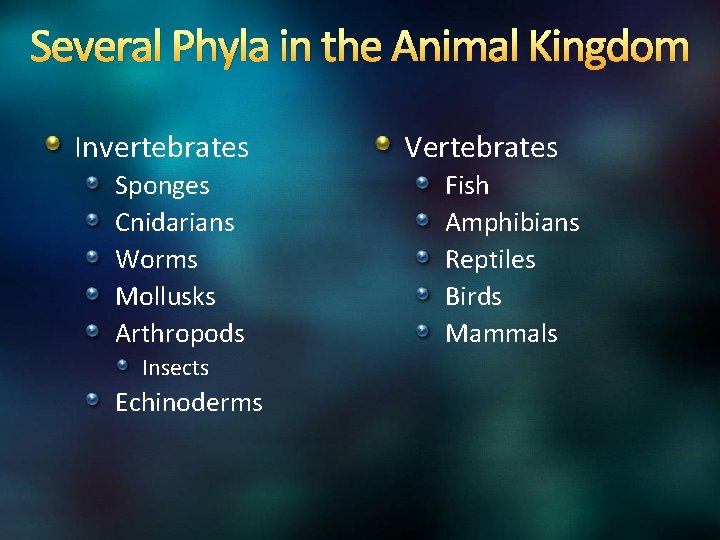
Several Phyla in the Animal Kingdom Invertebrates Sponges Cnidarians Worms Mollusks Arthropods Insects Echinoderms Vertebrates Fish Amphibians Reptiles Birds Mammals
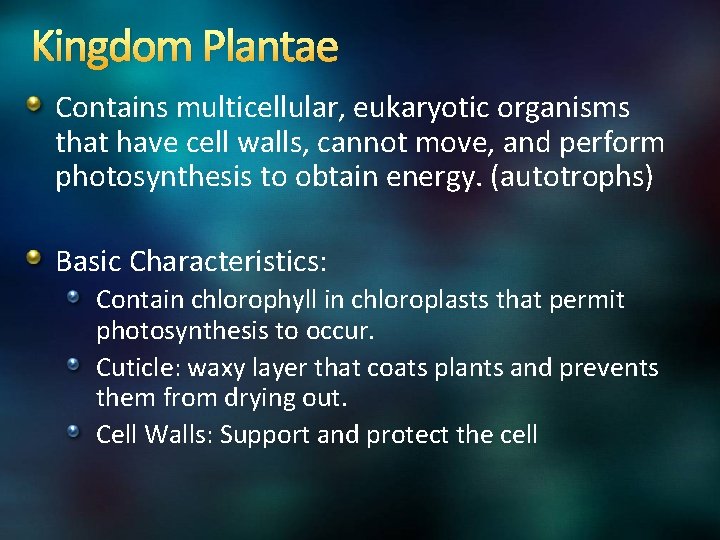
Kingdom Plantae Contains multicellular, eukaryotic organisms that have cell walls, cannot move, and perform photosynthesis to obtain energy. (autotrophs) Basic Characteristics: Contain chlorophyll in chloroplasts that permit photosynthesis to occur. Cuticle: waxy layer that coats plants and prevents them from drying out. Cell Walls: Support and protect the cell
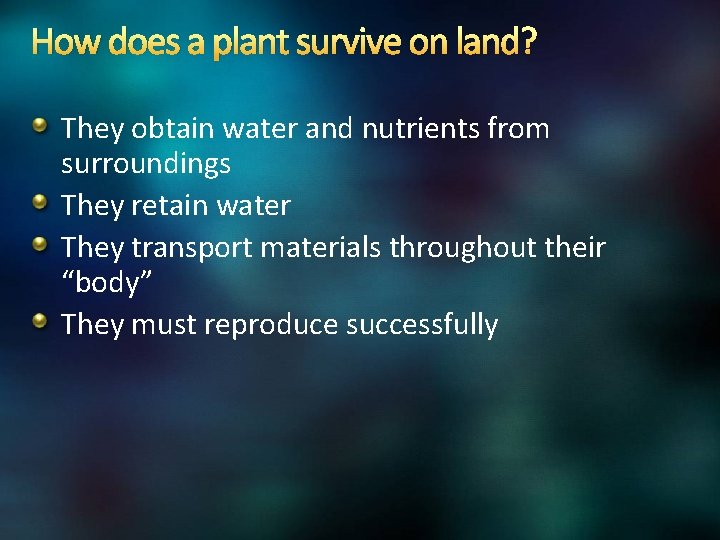
How does a plant survive on land? They obtain water and nutrients from surroundings They retain water They transport materials throughout their “body” They must reproduce successfully
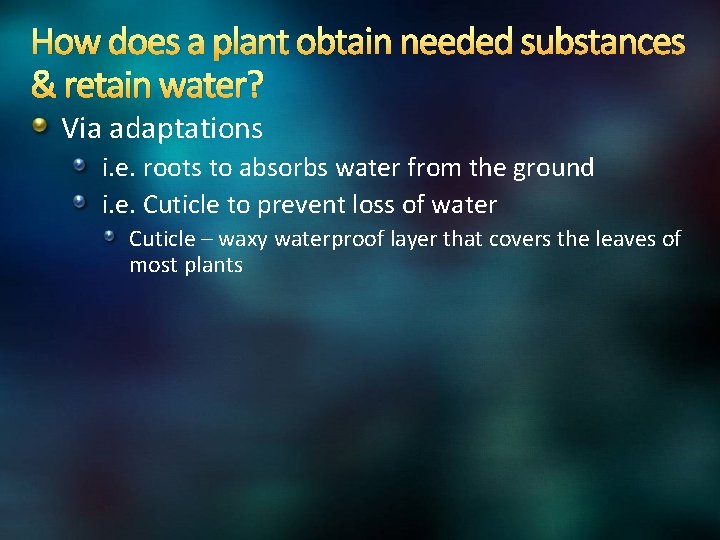
How does a plant obtain needed substances & retain water? Via adaptations i. e. roots to absorbs water from the ground i. e. Cuticle to prevent loss of water Cuticle – waxy waterproof layer that covers the leaves of most plants
How does a plant transport materials? Vascular tissue – internal system of tubelike structures through which water and nutrients move inside the plant.
How does a Plant Reproduce? All plants undergo sexual reproduction Involves Fertilization – occurs when a sperm cell unites with an egg cell Fertilized Egg is called a zygote. 2 stages of Life Cycle: Sporophyte: plant produces spores Gametophyte: plant produces gametes Gamete – sperm cell or egg cell
Nonvascular & Vascular Plants
Nonvascular Plants that are low-growing and lack vascular tissue Vascular tissue: system of tube-like structures that transport water and other materials Nonvascular plants can only pass materials from one cell to the next
Nonvascular Plants Continued Only have the rigid cell wall for support – hence why they are small and low to the ground Require water to survive, but lack roots. Therefore, water is obtained from surroundings. Example Plants: Moss, Liverworts, Hornworts
Seedless Vascular Plants Have vascular tissue; this provides for faster transport of materials throughout the plant, support for the plants allowing them to grow stronger and taller, and the ability to live better on land than nonvascular plants.
Seedless Vascular Plants Con’t… Use spores to reproduce Plants release spores into surroundings, where they grow into gametophytes. Water must be available for fertilization when the gametophytes produce egg and sperm cells Examples: Ferns, Club Mosses, and Horsetails
What is a seed plant? Plants that have vascular tissue and use seeds to reproduce. Bodies include leaves, stems, and roots.
Vascular Tissue Recall that vascular tissue is a system of tubelike structures that transport water and other materials Two Types: Phloem: transports food Xylem: transports water and nutrients
Seeds are structures that contain a young plant inside a protective covering. Seed plants do not need water in their surroundings to reproduce because the sperm cells are delivered to an area around the eggs. After the sperm fertilizes the egg, a seed develops to protect the young plant.
Seeds Continued… A seed has 3 important parts Embryo Stored food Seed coat
Seed Dispersal After seeds are formed they need to be scattered to grow. 3 main ways Ingestion “Hitch-hiking” Wind
Germination is the early growth stage of an embryo Begins when the seed absorbs water from the environment First roots grow downward – leaves and stem grow upward Further from “home” = Better chance for survival
Leaves Capture the sun’s energy and carries out process of photosynthesis. Top and bottom layers protect the inside Xylem and Phloem rest between Underside has stomata (pores) which controls when gases enter and leave
Transpiration Process in which water evaporates from a plant’s leaves Can be slowed down by closing the stomata (often occurs in high heat)
Stems 2 important functions Carry substances between roots and leaves Provides support / holds up leaves to the sun Can be herbaceous (soft) or woody. Also contains phloem and xylem Phloem has cambium which divides to form new phloem and xylem
Roots anchor a plant into the ground; absorbs water and nutrients from the ground Two Types Taproot (1 thick, main root) Fibrous (thin, branching roots)
Gymnosperms Defn: seed plant that produced naked seeds Other characteristics: Needlelike or scalelike leaves Deep growing root systems 4 Groups: Cycads: look like a palm tree w/ cones Ginkgo: only 1 still survives: Ginkgo Biloba Gnetophytes: Trees/shrubs/vines grow in hot, dry deserts & tropical rain forests Conifers: Cone-bearing; largest group of gymnosperms
Gymnosperms Continued Reproduction Cones – reproductive structure (2 types: male & female) Male cones produce pollen Pollen – contains microscopic cells that later produce sperm cells Female cones contain an ovule at the base Ovule – structure that contains an egg cell After fertilization the ovule develops into a seed
Gymnosperms Continued Reproductive Process: 1 st : Pollen falls from male cone onto a female cone (often pollen is carried by the wind) 2 nd: sperm cell and egg cell join together in an ovule on the female cone 3 rd: fertilization occurs and zygote develops into the embryo part of the seed.
Angiosperms Defn: plant that produces seeds that are enclosed in a fruit. Other Characteristics: Produce flowers & fruits
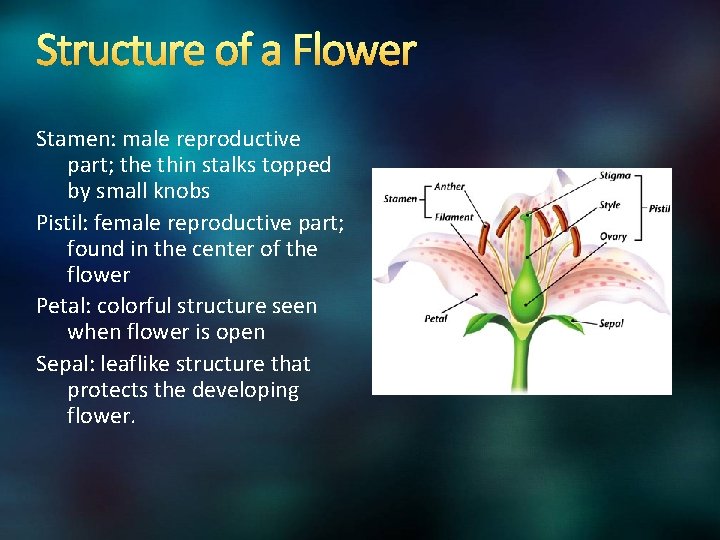
Structure of a Flower Stamen: male reproductive part; the thin stalks topped by small knobs Pistil: female reproductive part; found in the center of the flower Petal: colorful structure seen when flower is open Sepal: leaflike structure that protects the developing flower.
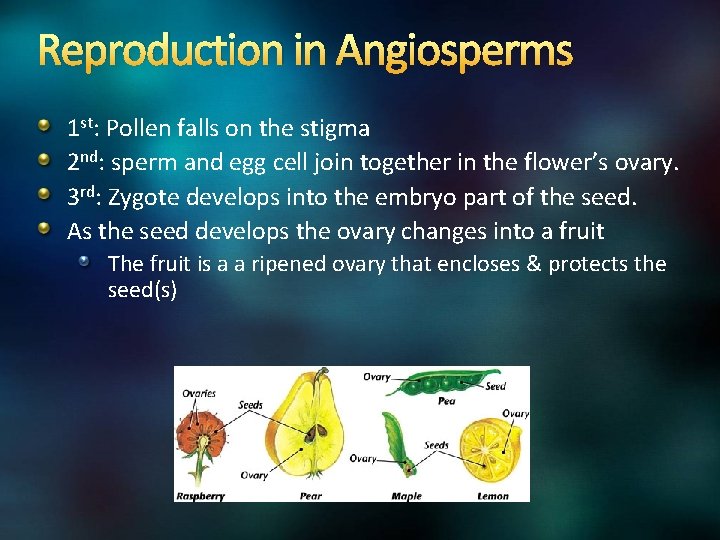
Reproduction in Angiosperms 1 st: Pollen falls on the stigma 2 nd: sperm and egg cell join together in the flower’s ovary. 3 rd: Zygote develops into the embryo part of the seed. As the seed develops the ovary changes into a fruit The fruit is a a ripened ovary that encloses & protects the seed(s)
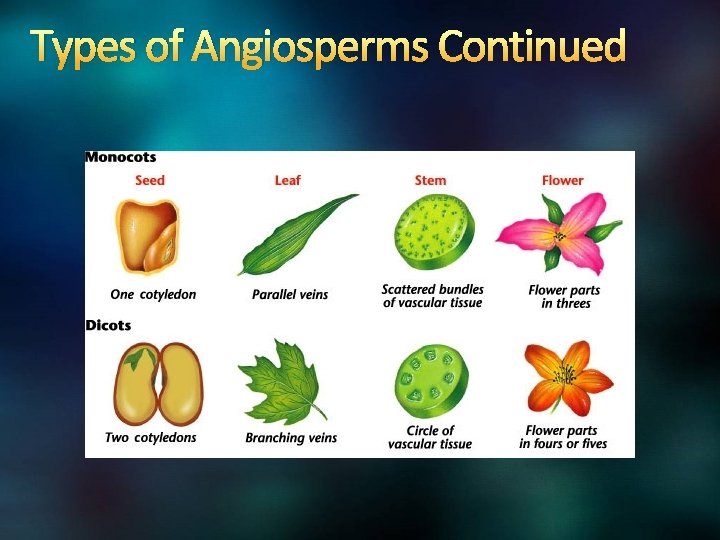
Types of Angiosperms Monocots: 1 seed leaf Flowers have 3 petals or multiples of 3 Long, slender leaves Vascular tissue is scattered randomly through stem Dicots: two seed leaves Flowers have 4/5 petals or multiples of 4/5 Wide leaves Vascular tissue arranged in a circle
Types of Angiosperms Continued