
Classification Topic 5 3 and 5 4 Binomial
Classification Topic 5. 3 and 5. 4
Binomial Nomenclature • The binomial system of nomenclature is the formal system by which all living species are classified (taxonomy) • It was initially developed by a Swedish botanist named Carolus Linnaeus in 1735 • It is periodically assessed and updated at a series of international congresses which occur every 4 years
Binomial Nomenclature • The binomial system of nomenclature provides value because: • It allows for the identification and comparison of organisms based on recognized characteristics • It allows all organisms to be named according to a globally recognized scheme • It can show closely related organisms are, allowing for the prediction of evolutionary links • It makes it easier to collect, sort and group information about organisms
Binomial Nomenclature • According to the binomial system of nomenclature, every organism is designated a scientific name with two parts: • Genus is written first and is capitalized (e. g. Homo) • Species follows and is written in lower case (e. g. Homo sapiens) • Some species may occasionally have a sub-species designation (e. g. Homo sapiens –modern man) How to write a scientific name: • Typed = italics • Handwritten = underline •
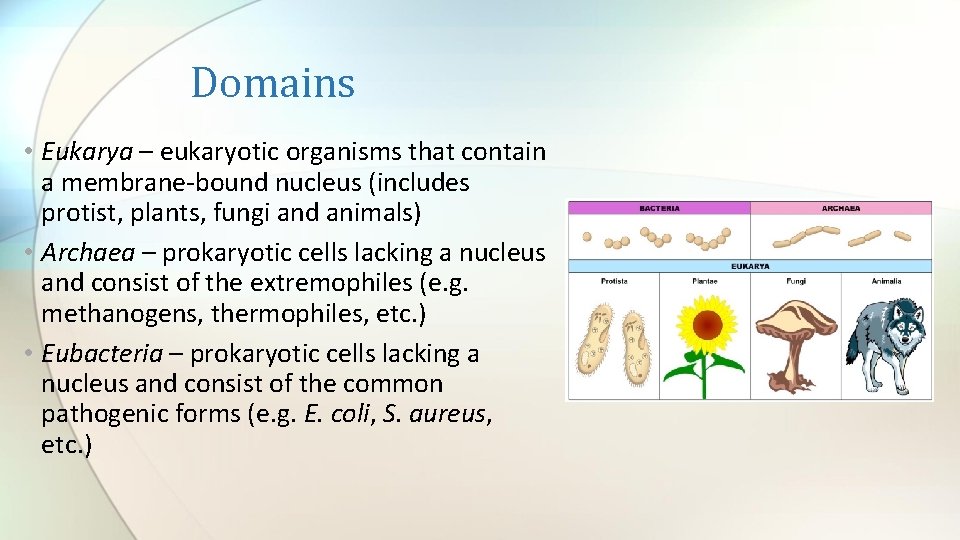
Domains • Eukarya – eukaryotic organisms that contain a membrane-bound nucleus (includes protist, plants, fungi and animals) • Archaea – prokaryotic cells lacking a nucleus and consist of the extremophiles (e. g. methanogens, thermophiles, etc. ) • Eubacteria – prokaryotic cells lacking a nucleus and consist of the common pathogenic forms (e. g. E. coli, S. aureus, etc. )
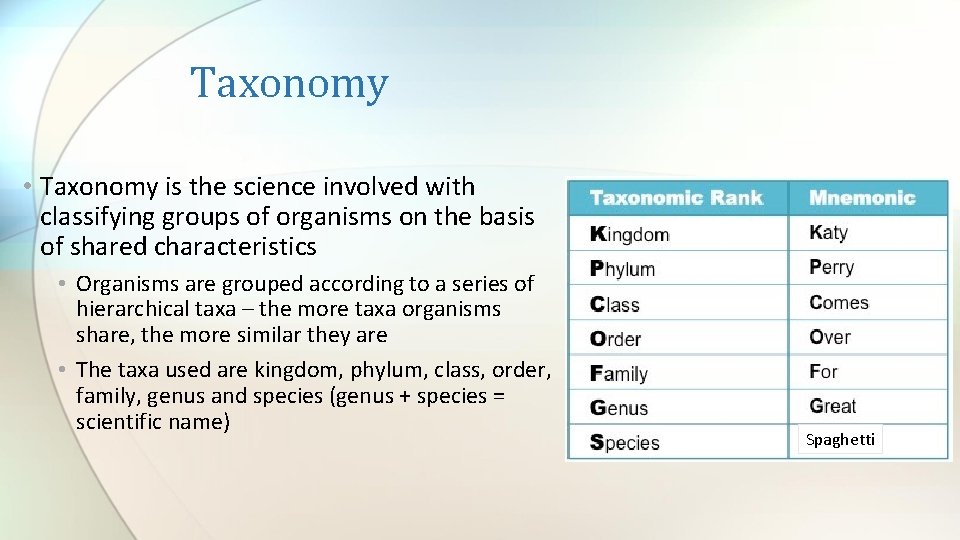
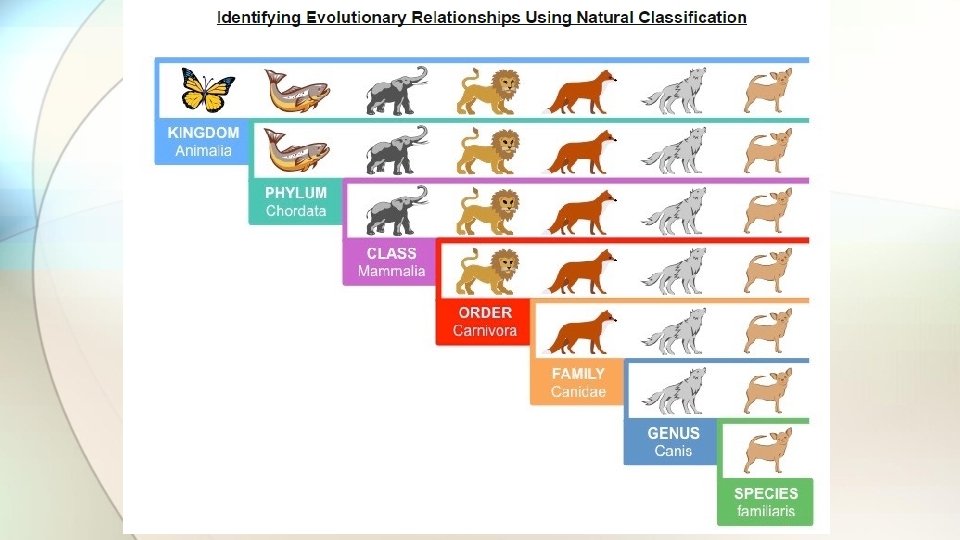
Taxonomy • Taxonomy is the science involved with classifying groups of organisms on the basis of shared characteristics • Organisms are grouped according to a series of hierarchical taxa – the more taxa organisms share, the more similar they are • The taxa used are kingdom, phylum, class, order, family, genus and species (genus + species = scientific name) Spaghetti
Types of Classification • Artificial classification involves selecting unifying characteristics first and then grouping organisms accordingly • Advantage - easy to develop and relatively stable (unlikely to change) • Disadvantage - do not generally show evolutionary relationships and for this reason are not commonly used • For example, if organisms were classified according to the presence of fins then whales would be grouped with fish • If organisms were classified based on the presence of shells then snails would be grouped with turtles and not with squid
Types of Classification • Natural classification involves grouping organisms based on similarities first and then identifying shared characteristics • All members of a particular group would have shared a common ancestor • This means that natural classification schemes can be used to predict characteristics shared by species within a group • Advantage - identifies traits based on groupings, rather than assigning groups based on traits • Disadvantage - are highly mutable and tend to change as new information is discovered
Types of Classification • Phylogenetic classification – is now being used to differentiate organisms based on genetics • Organisms who share a greater level of homology in their DNA or amino acid sequences are expected to be more closely related
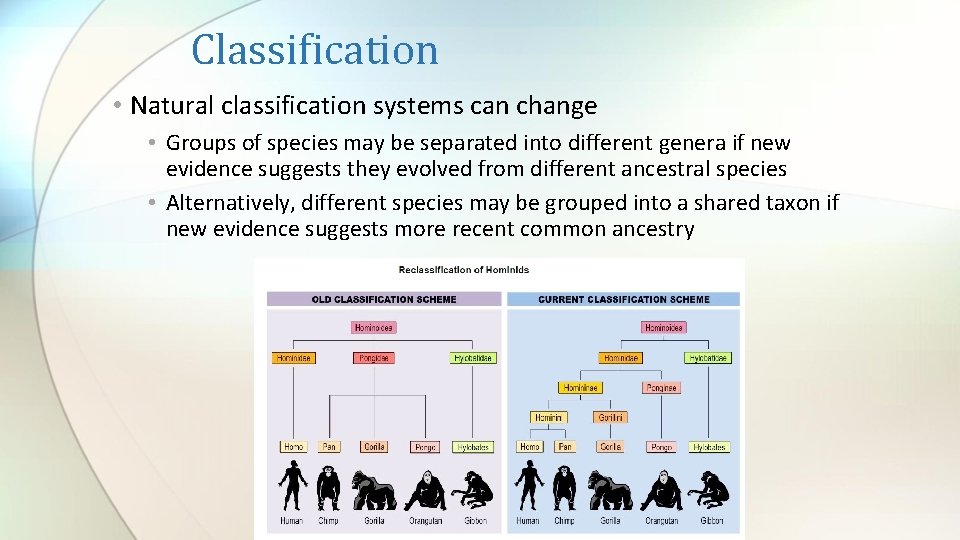
Classification • Natural classification systems can change • Groups of species may be separated into different genera if new evidence suggests they evolved from different ancestral species • Alternatively, different species may be grouped into a shared taxon if new evidence suggests more recent common ancestry
- Slides: 11