
Classification the Six Kingdoms Note Book On the
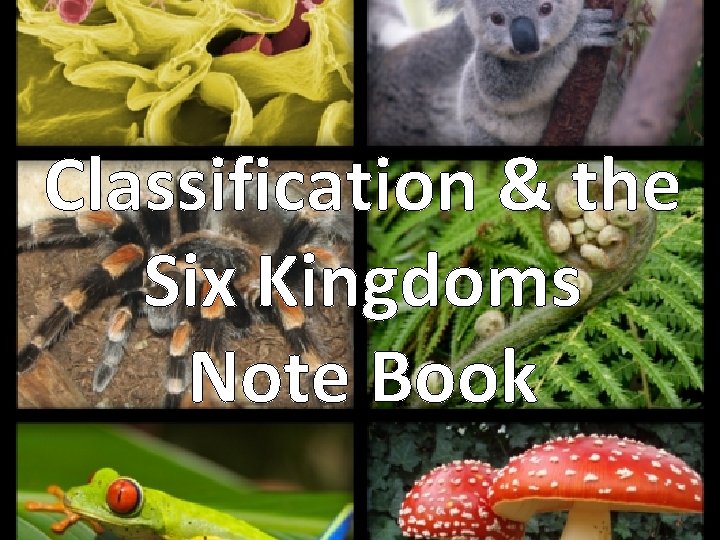
Classification & the Six Kingdoms Note Book
On the upper half of your cover (above the dotted line) create a family tree diagram of the kingdoms below showing the evolutionary connections • Archaea are prokaryotes that live in extreme environments • Bacteria are prokaryotes that live in the same environments as Humans • Protista are eukaryotic single celled organisms some are fungi-like, some are plant-like and some are animal-like • Plantae are eukaryotic multicellular organisms that are not mobile and photosynthesize • Fungi are eukaryotic multicellular organisms that are not mobile and heterotrophic • Animalia are eukaryotic multicellular organisms that are mobile and heterotrophic
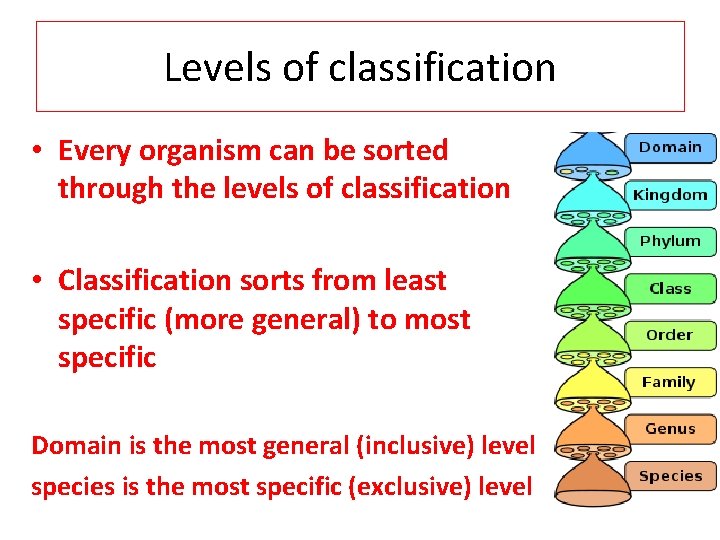
Levels of classification • Every organism can be sorted through the levels of classification • Classification sorts from least specific (more general) to most specific Domain is the most general (inclusive) level species is the most specific (exclusive) level
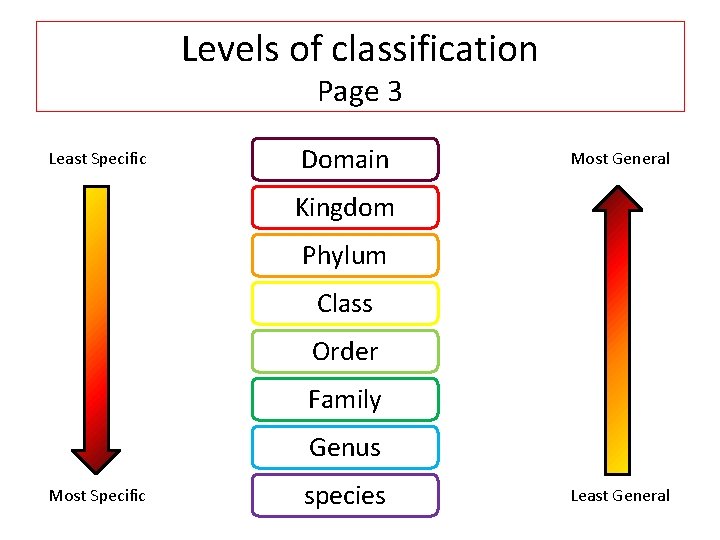
Levels of classification Page 3 Least Specific Domain Most General Kingdom Phylum Class Order Family Genus Most Specific species Least General

Levels of Classification Page 3 • Make a mnemonic sentence to help you remember the order of the levels of classification (Domain species) • Ex: Dumb King Philip Could Only Fry Green spinach
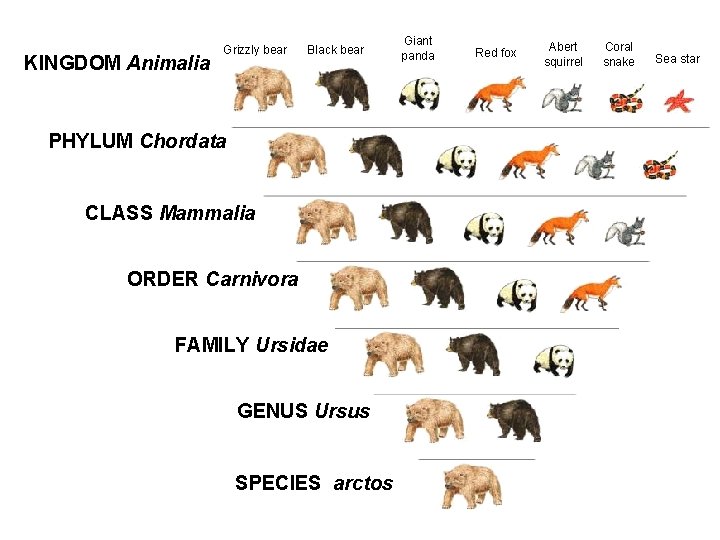
KINGDOM Animalia Grizzly bear Black bear PHYLUM Chordata CLASS Mammalia ORDER Carnivora FAMILY Ursidae GENUS Ursus SPECIES arctos Giant panda Red fox Abert squirrel Coral snake Sea star
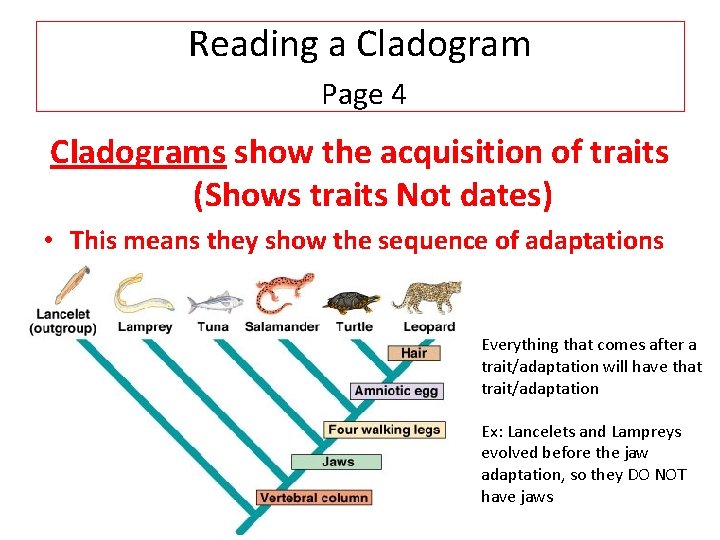
Reading a Cladogram Page 4 Cladograms show the acquisition of traits (Shows traits Not dates) • This means they show the sequence of adaptations Everything that comes after a trait/adaptation will have that trait/adaptation Ex: Lancelets and Lampreys evolved before the jaw adaptation, so they DO NOT have jaws
Binomial nomenclature Page 5 • Carolus Linnaeus (1707 -1778) – Botanist – Wanted a better way to classify organisms other than by common name. Why would using common names of organisms be problematic for scientists?
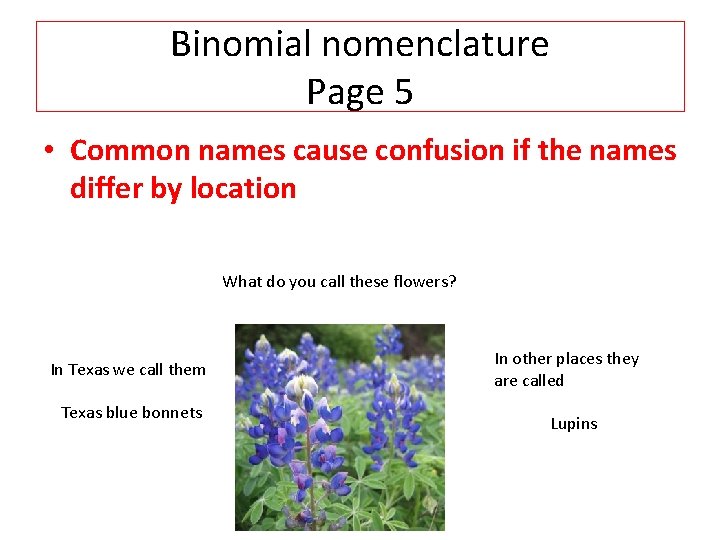
Binomial nomenclature Page 5 • Common names cause confusion if the names differ by location What do you call these flowers? In Texas we call them Texas blue bonnets In other places they are called Lupins
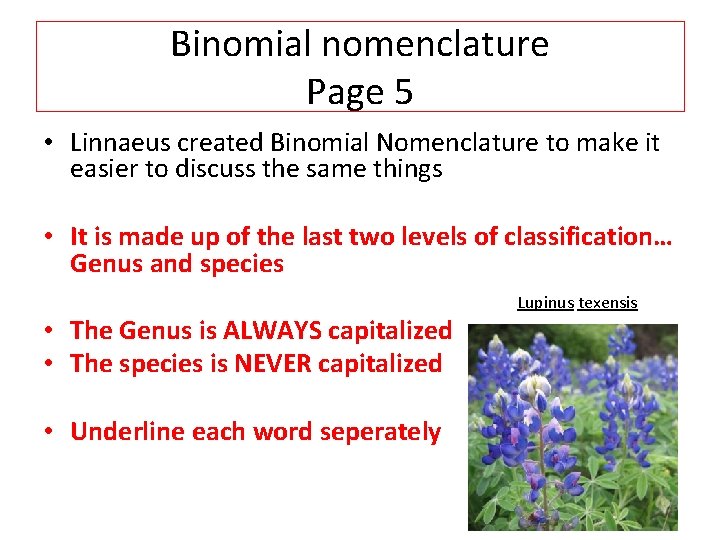
Binomial nomenclature Page 5 • Linnaeus created Binomial Nomenclature to make it easier to discuss the same things • It is made up of the last two levels of classification… Genus and species • The Genus is ALWAYS capitalized • The species is NEVER capitalized • Underline each word seperately Lupinus texensis
Binomial nomenclature Page 5 Examples: • • Human – Homo sapien Chimpanzee – Pan trogolodyte Dog – Canis familiaris California Redwood – Sequoia sempervirens Lynx – Lynx rufus Bobcat – Lynx canadensis “E. coli” bacteria – Escherichia coli
Prokaryotes Domain Archaea Domain Bacterial Shapes and Grouping – Draw the 3 shapes and the groupings from the next two slides Examples: 6 7
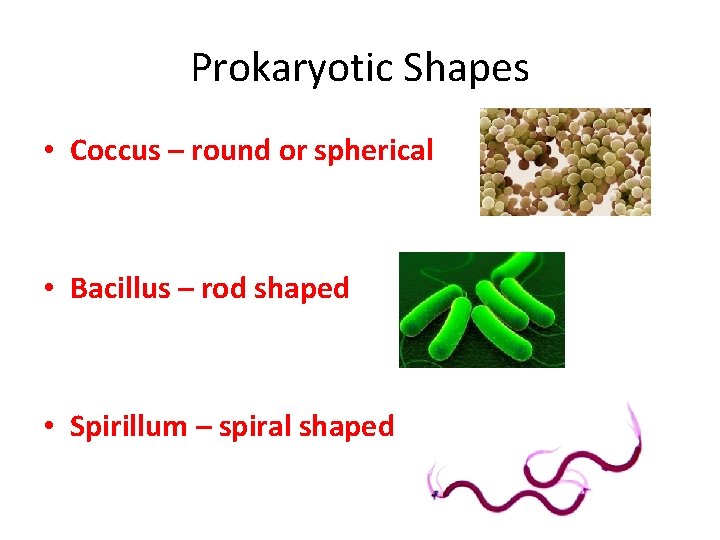
Prokaryotic Shapes • Coccus – round or spherical • Bacillus – rod shaped • Spirillum – spiral shaped
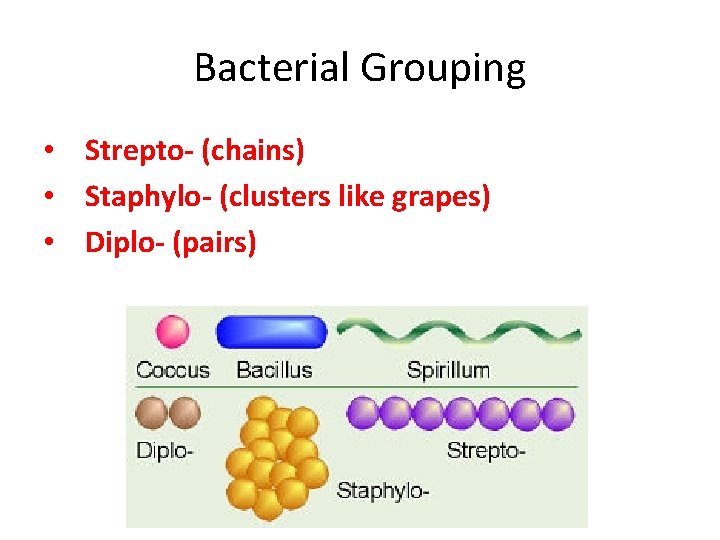
Bacterial Grouping • Strepto- (chains) • Staphylo- (clusters like grapes) • Diplo- (pairs)
Domain Archaea Page 6 (upper half) • All organisms in this domain are Prokaryotic • Contains 1 Kingdom – Archaeabacteria Examples: • Thermophiles, Halophiles and Methanogens
Domain Bacteria Page 7 (Upper half) • All organisms in this domain are Prokaryotic • Contains 1 Kingdom – Eubacteria Examples: • Most common bacteria
Domain Eukarya Page 6 & 7 (bottom) • All organisms in this domain are Eukaryotic – Remember: all cells here must have… Membrane Bound Organelles • Contains 4 kingdoms – Protista, Fungi, Plantae and Animalia
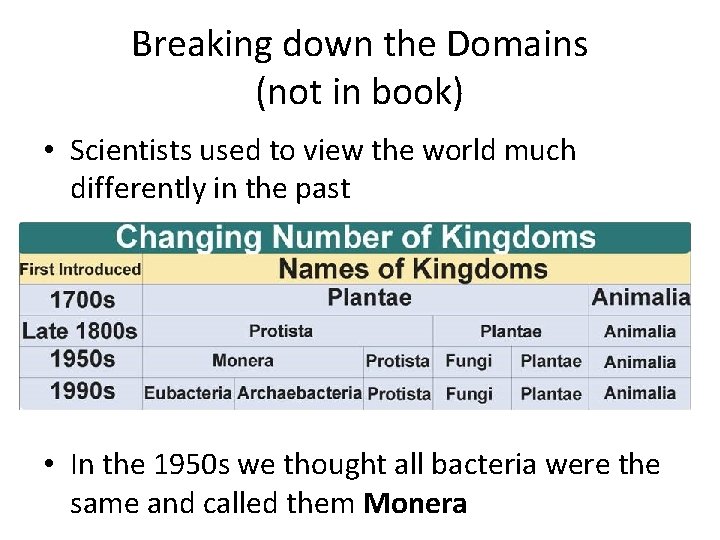
Breaking down the Domains (not in book) • Scientists used to view the world much differently in the past • In the 1950 s we thought all bacteria were the same and called them Monera
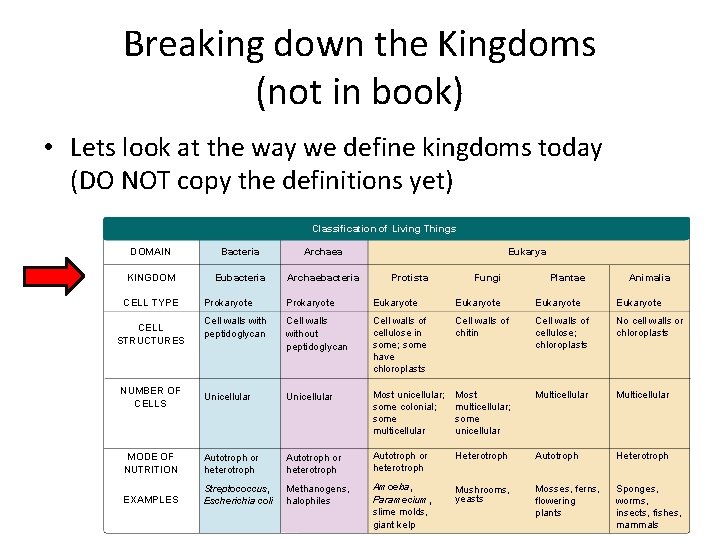
Breaking down the Kingdoms (not in book) • Lets look at the way we define kingdoms today (DO NOT copy the definitions yet) Classification of Living Things DOMAIN Bacteria Archaea KINGDOM Eubacteria Archaebacteria CELL TYPE Eukarya Protista Fungi Plantae Animalia Prokaryote Eukaryote Cell walls with peptidoglycan Cell walls without peptidoglycan Cell walls of cellulose in some; some have chloroplasts Cell walls of chitin Cell walls of cellulose; chloroplasts No cell walls or chloroplasts Unicellular Most unicellular; some colonial; some multicellular Most multicellular; some unicellular Multicellular MODE OF NUTRITION Autotroph or heterotroph Heterotroph Autotroph Heterotroph EXAMPLES Streptococcus, Escherichia coli Methanogens, halophiles Amoeba, Paramecium, slime molds, giant kelp Mushrooms, yeasts Mosses, ferns, flowering plants Sponges, worms, insects, fishes, mammals CELL STRUCTURES NUMBER OF CELLS
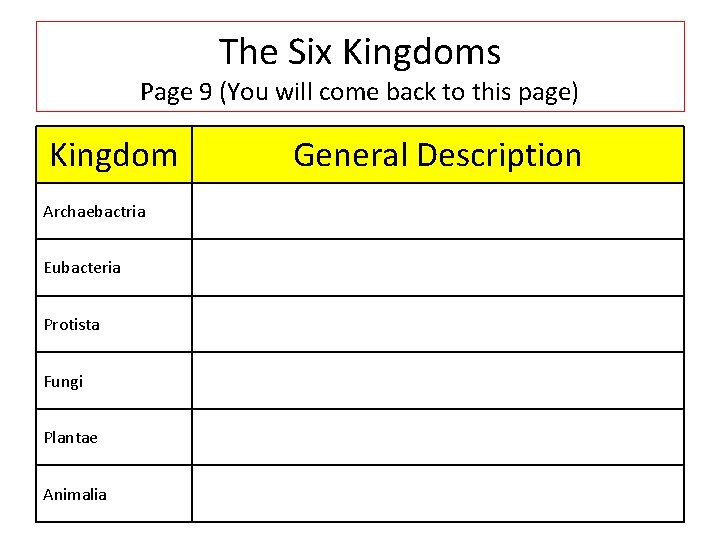
The Six Kingdoms Page 9 (You will come back to this page) Kingdom Archaebactria Eubacteria Protista Fungi Plantae Animalia General Description
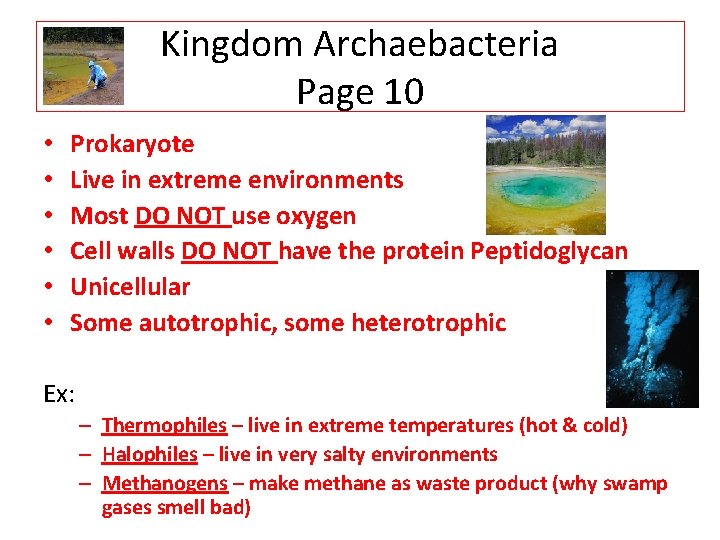
Kingdom Archaebacteria Page 10 • • • Prokaryote Live in extreme environments Most DO NOT use oxygen Cell walls DO NOT have the protein Peptidoglycan Unicellular Some autotrophic, some heterotrophic Ex: – Thermophiles – live in extreme temperatures (hot & cold) – Halophiles – live in very salty environments – Methanogens – make methane as waste product (why swamp gases smell bad)
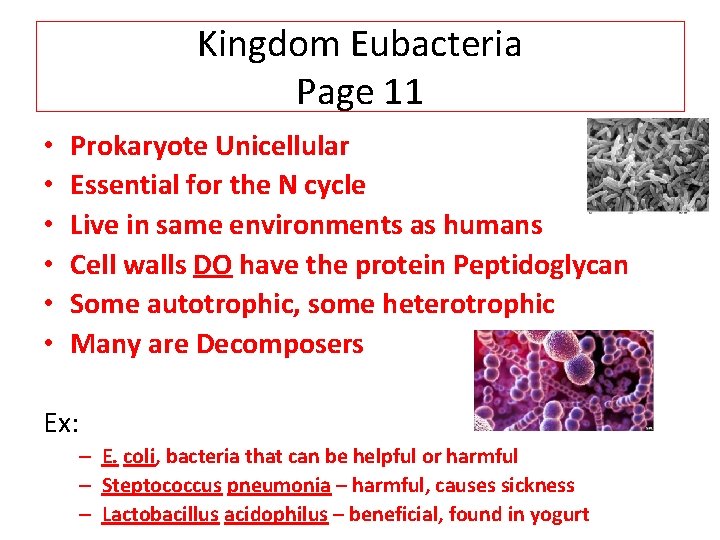
Kingdom Eubacteria Page 11 • • • Prokaryote Unicellular Essential for the N cycle Live in same environments as humans Cell walls DO have the protein Peptidoglycan Some autotrophic, some heterotrophic Many are Decomposers Ex: – E. coli, bacteria that can be helpful or harmful – Steptococcus pneumonia – harmful, causes sickness – Lactobacillus acidophilus – beneficial, found in yogurt
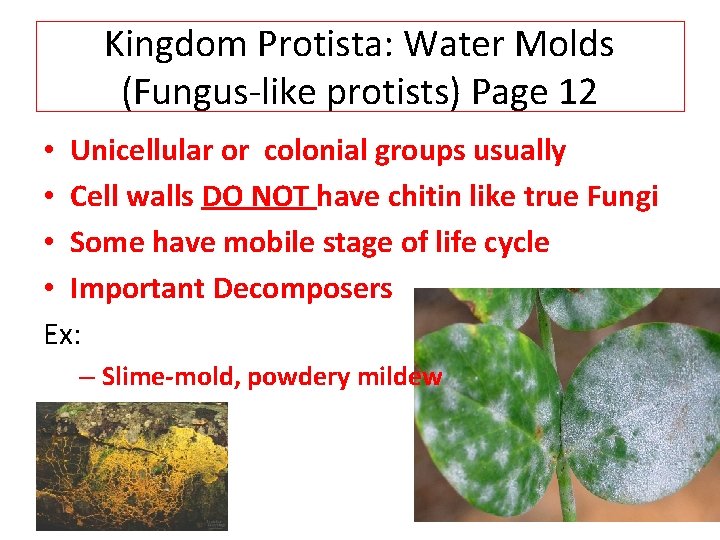
Kingdom Protista: Water Molds (Fungus-like protists) Page 12 • Unicellular or colonial groups usually • Cell walls DO NOT have chitin like true Fungi • Some have mobile stage of life cycle • Important Decomposers Ex: – Slime-mold, powdery mildew
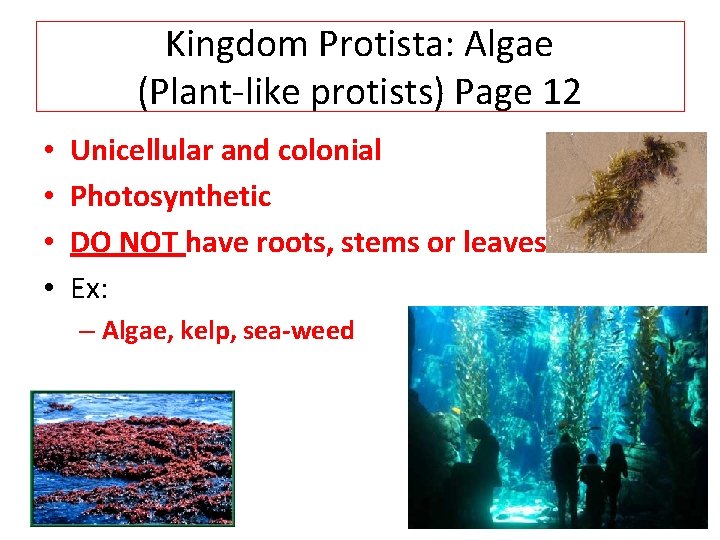
Kingdom Protista: Algae (Plant-like protists) Page 12 • • Unicellular and colonial Photosynthetic DO NOT have roots, stems or leaves Ex: – Algae, kelp, sea-weed
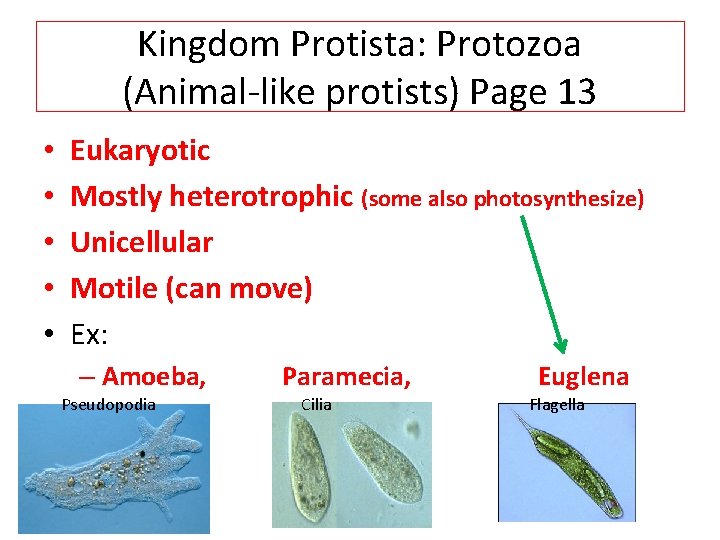
Kingdom Protista: Protozoa (Animal-like protists) Page 13 • • • Eukaryotic Mostly heterotrophic (some also photosynthesize) Unicellular Motile (can move) Ex: – Amoeba, Pseudopodia Paramecia, Cilia Euglena Flagella
• Amoeba in motion • Paramecium in motion • Euglena in motion
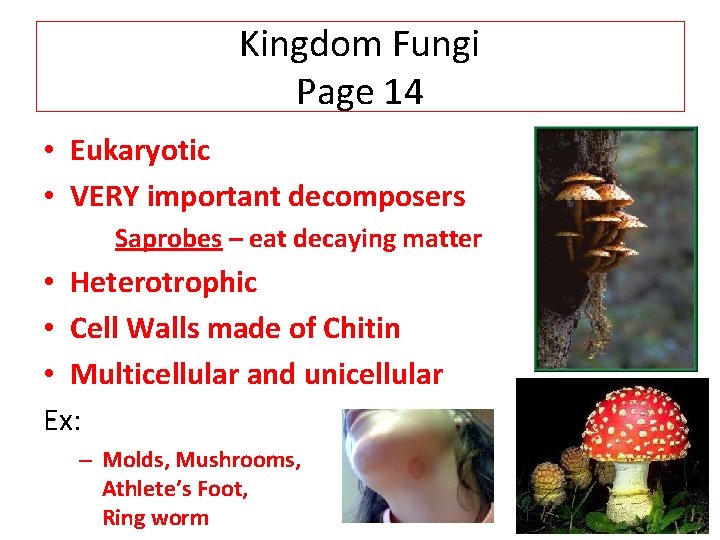
Kingdom Fungi Page 14 • Eukaryotic • VERY important decomposers Saprobes – eat decaying matter • Heterotrophic • Cell Walls made of Chitin • Multicellular and unicellular Ex: – Molds, Mushrooms, Athlete’s Foot, Ring worm
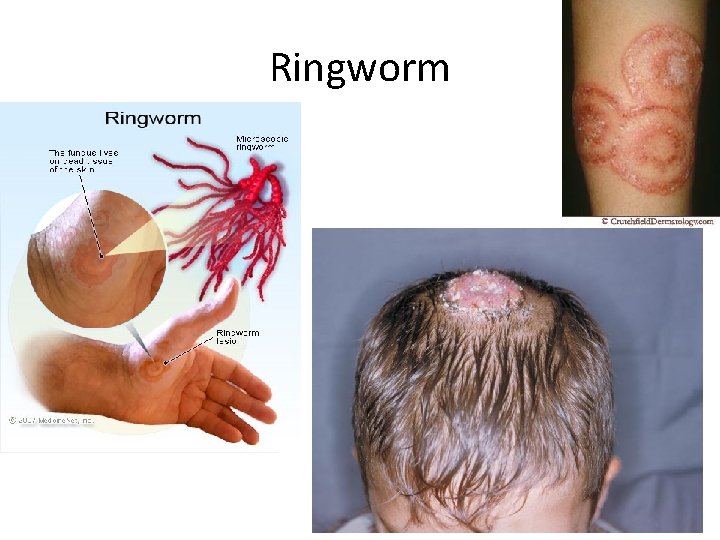
Ringworm
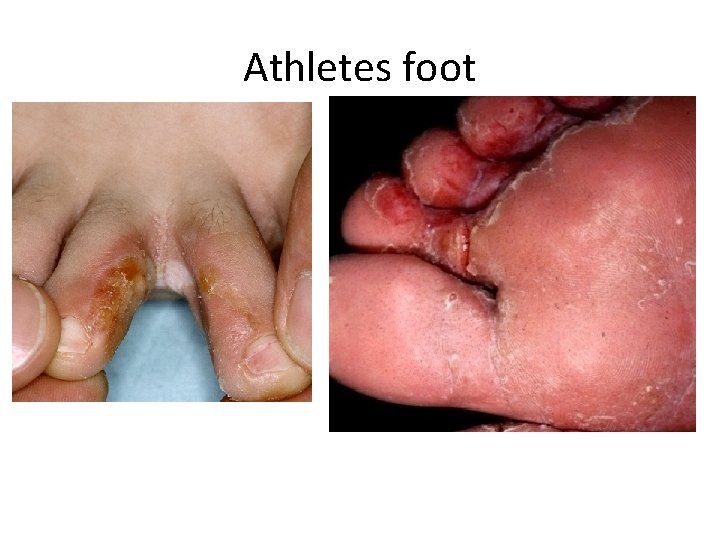
Athletes foot
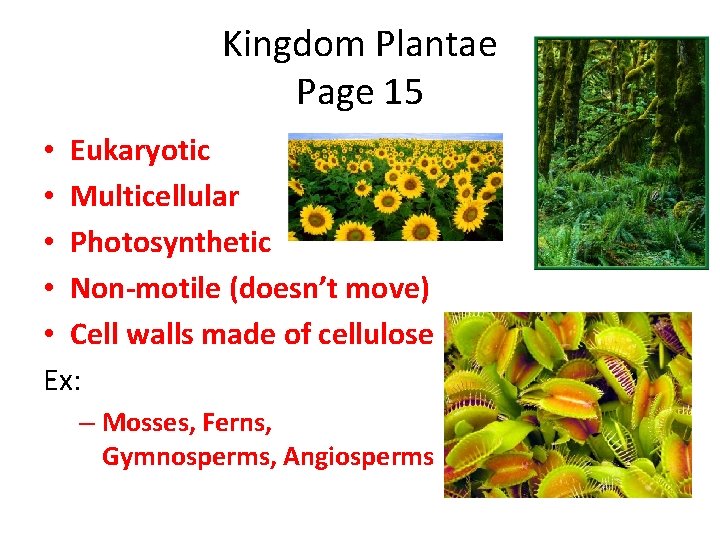
Kingdom Plantae Page 15 • Eukaryotic • Multicellular • Photosynthetic • Non-motile (doesn’t move) • Cell walls made of cellulose Ex: – Mosses, Ferns, Gymnosperms, Angiosperms
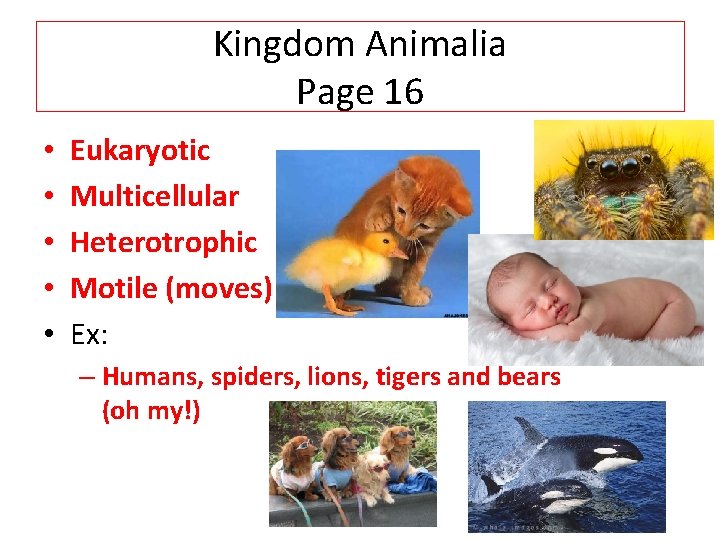
Kingdom Animalia Page 16 • • • Eukaryotic Multicellular Heterotrophic Motile (moves) Ex: – Humans, spiders, lions, tigers and bears (oh my!)

REFLECTION • Go back to Page 8 & 9 and fill in the pages based on what you just wrote for the 6 kingdoms
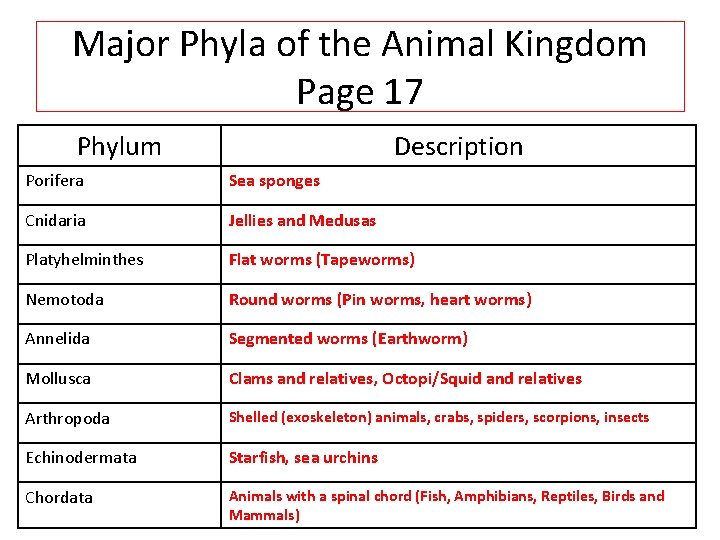
Major Phyla of the Animal Kingdom Page 17 Phylum Description Porifera Sea sponges Cnidaria Jellies and Medusas Platyhelminthes Flat worms (Tapeworms) Nemotoda Round worms (Pin worms, heart worms) Annelida Segmented worms (Earthworm) Mollusca Clams and relatives, Octopi/Squid and relatives Arthropoda Shelled (exoskeleton) animals, crabs, spiders, scorpions, insects Echinodermata Starfish, sea urchins Chordata Animals with a spinal chord (Fish, Amphibians, Reptiles, Birds and Mammals)
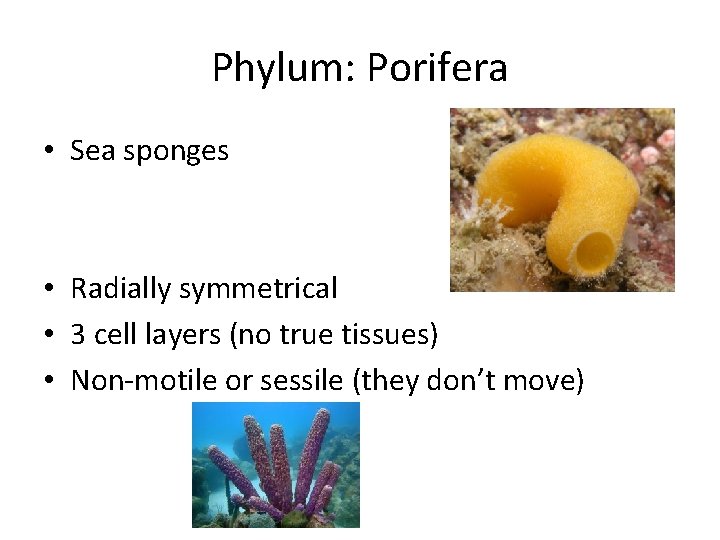
Phylum: Porifera • Sea sponges • Radially symmetrical • 3 cell layers (no true tissues) • Non-motile or sessile (they don’t move)
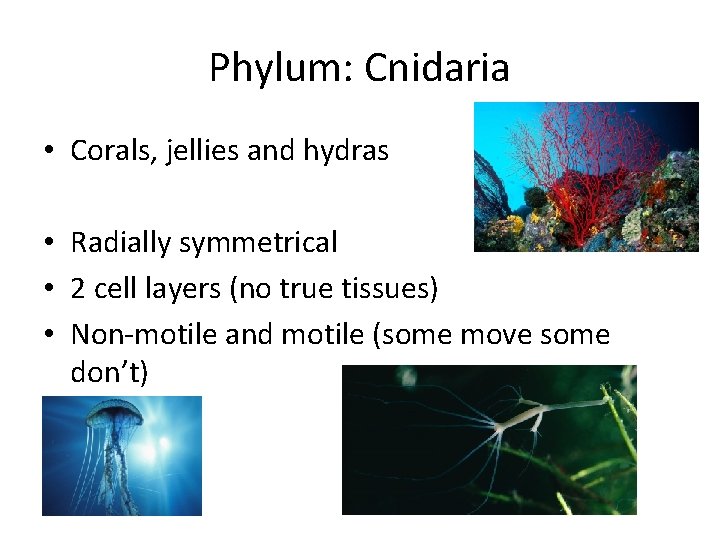
Phylum: Cnidaria • Corals, jellies and hydras • Radially symmetrical • 2 cell layers (no true tissues) • Non-motile and motile (some move some don’t)
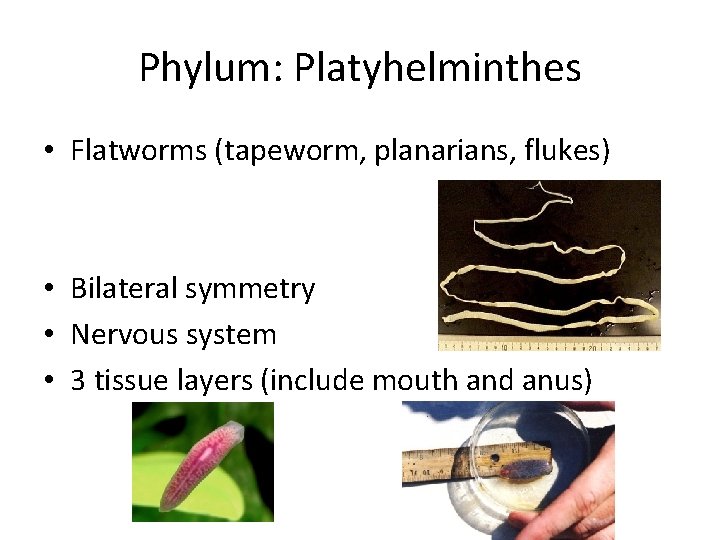
Phylum: Platyhelminthes • Flatworms (tapeworm, planarians, flukes) • Bilateral symmetry • Nervous system • 3 tissue layers (include mouth and anus)
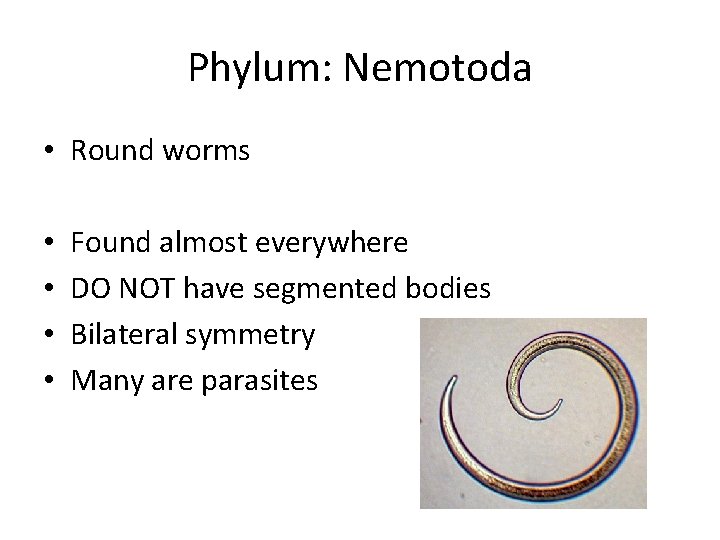
Phylum: Nemotoda • Round worms • • Found almost everywhere DO NOT have segmented bodies Bilateral symmetry Many are parasites
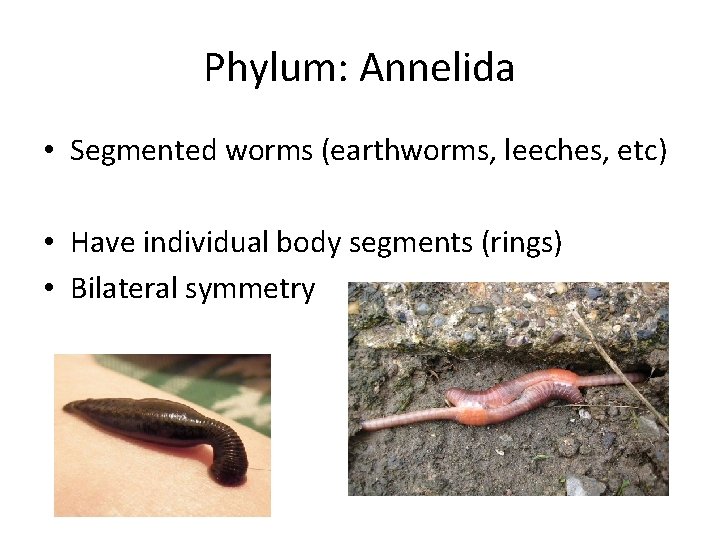
Phylum: Annelida • Segmented worms (earthworms, leeches, etc) • Have individual body segments (rings) • Bilateral symmetry
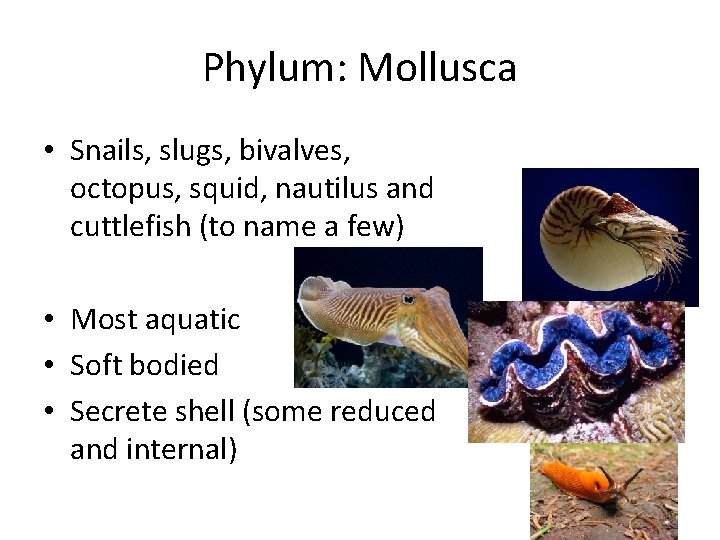
Phylum: Mollusca • Snails, slugs, bivalves, octopus, squid, nautilus and cuttlefish (to name a few) • Most aquatic • Soft bodied • Secrete shell (some reduced and internal)
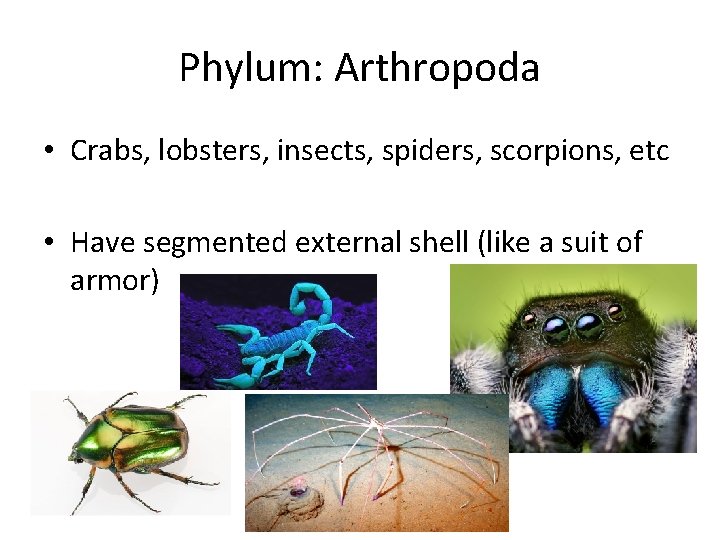
Phylum: Arthropoda • Crabs, lobsters, insects, spiders, scorpions, etc • Have segmented external shell (like a suit of armor)
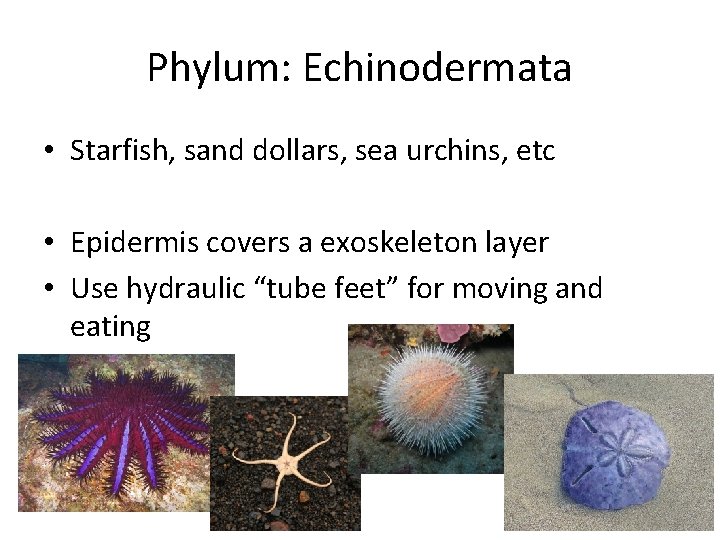
Phylum: Echinodermata • Starfish, sand dollars, sea urchins, etc • Epidermis covers a exoskeleton layer • Use hydraulic “tube feet” for moving and eating
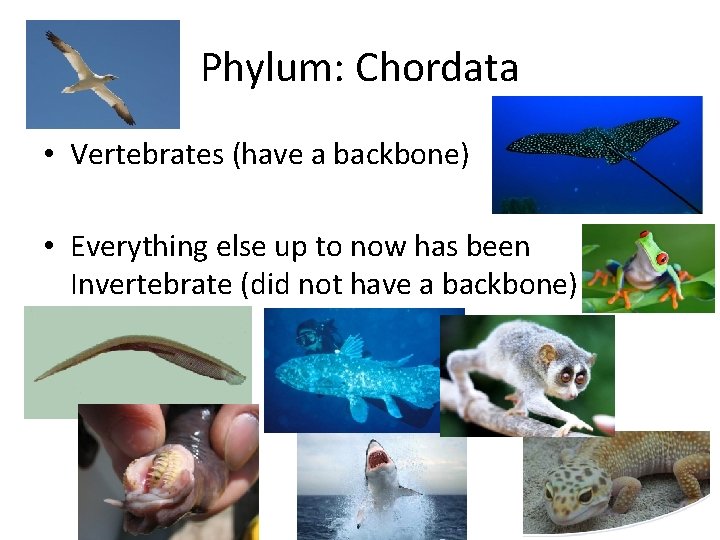
Phylum: Chordata • Vertebrates (have a backbone) • Everything else up to now has been Invertebrate (did not have a backbone)
Classification of Vertebrates (Page 18) bottom • • Agnatha – jawless fish Chondrichthyes – cartilaginous fish, sharks Osteichthyes – bony fish Amphibia Reptilia Aves – birds Mammalia
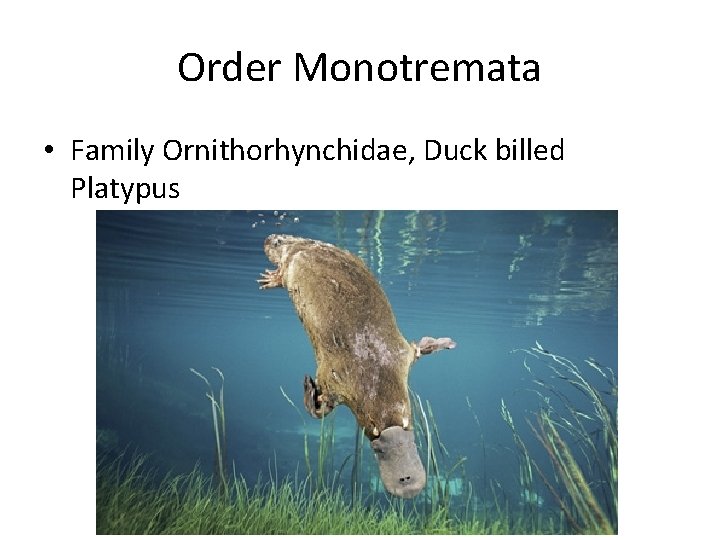
Order Monotremata • Family Ornithorhynchidae, Duck billed Platypus
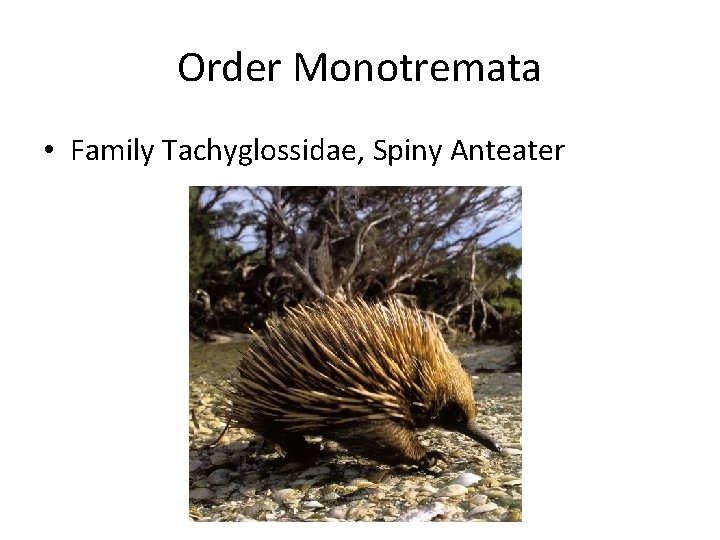
Order Monotremata • Family Tachyglossidae, Spiny Anteater
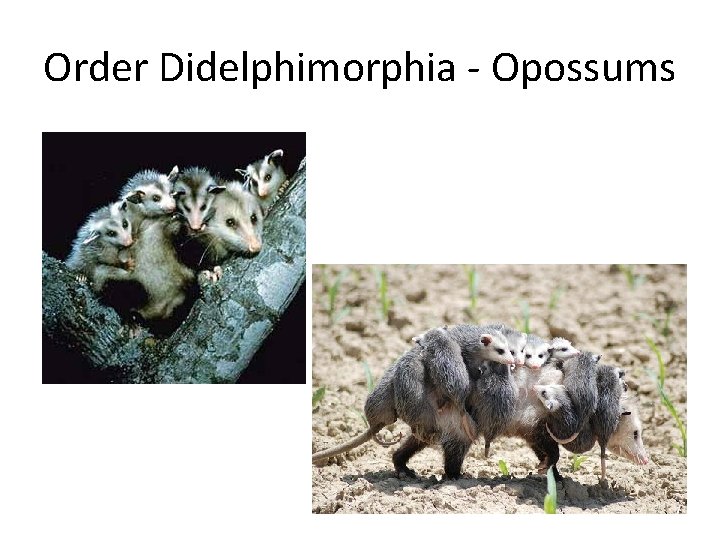
Order Didelphimorphia - Opossums
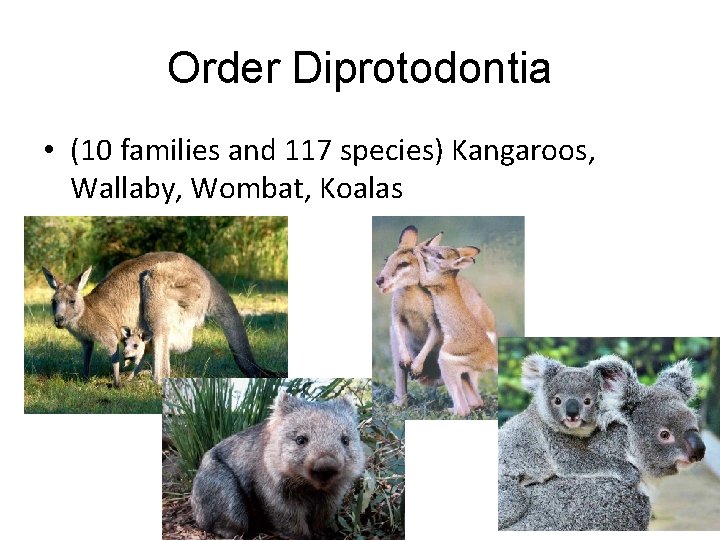
Order Diprotodontia • (10 families and 117 species) Kangaroos, Wallaby, Wombat, Koalas
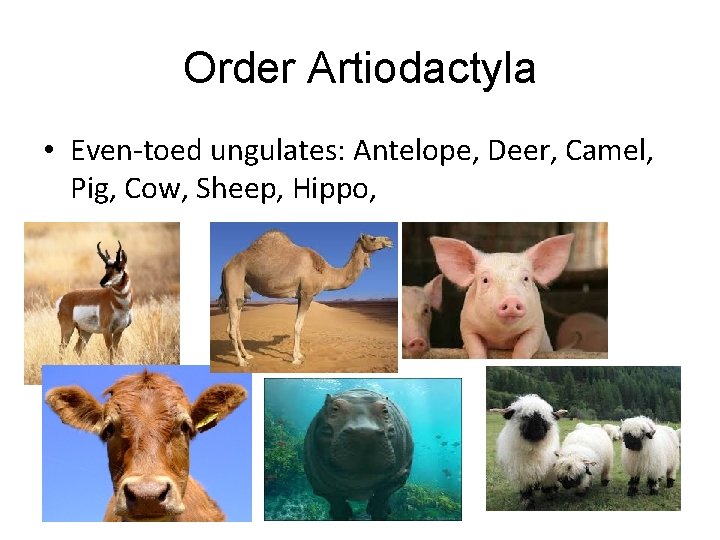
Order Artiodactyla • Even-toed ungulates: Antelope, Deer, Camel, Pig, Cow, Sheep, Hippo,
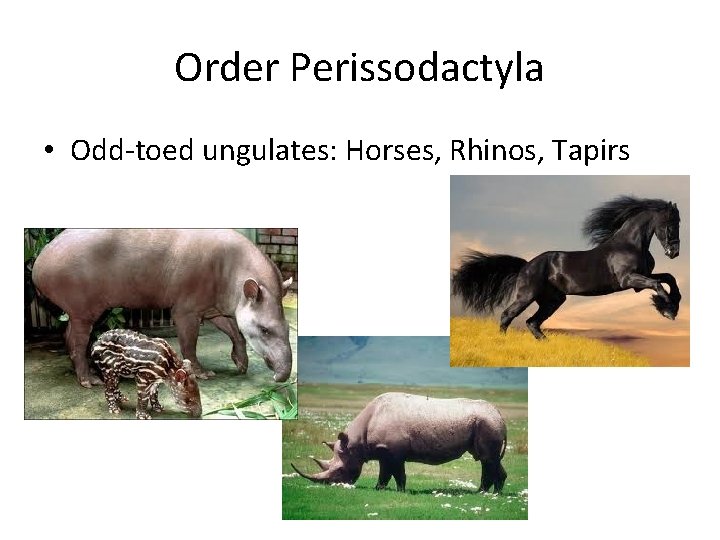
Order Perissodactyla • Odd-toed ungulates: Horses, Rhinos, Tapirs
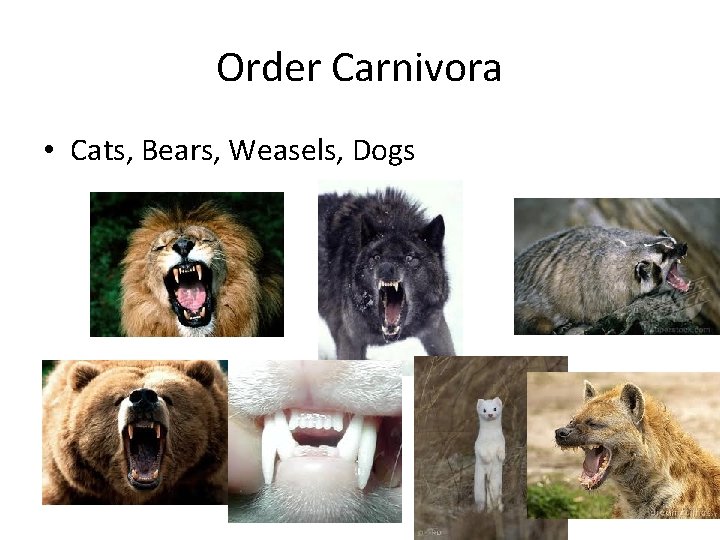
Order Carnivora • Cats, Bears, Weasels, Dogs
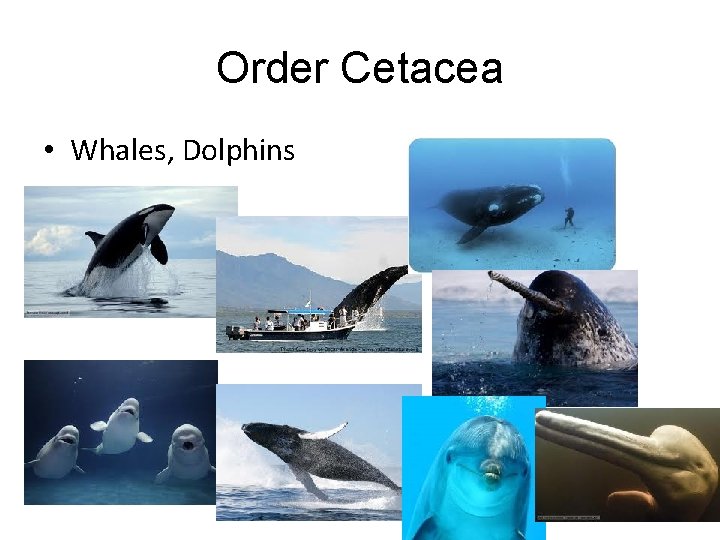
Order Cetacea • Whales, Dolphins
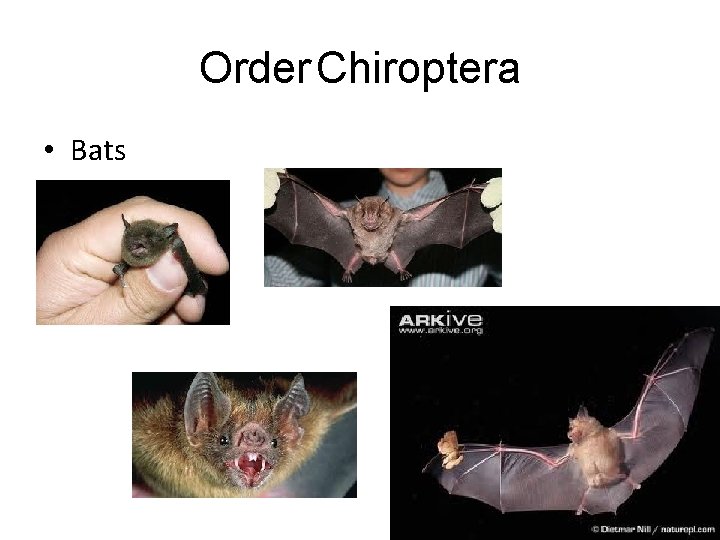
Order Chiroptera • Bats
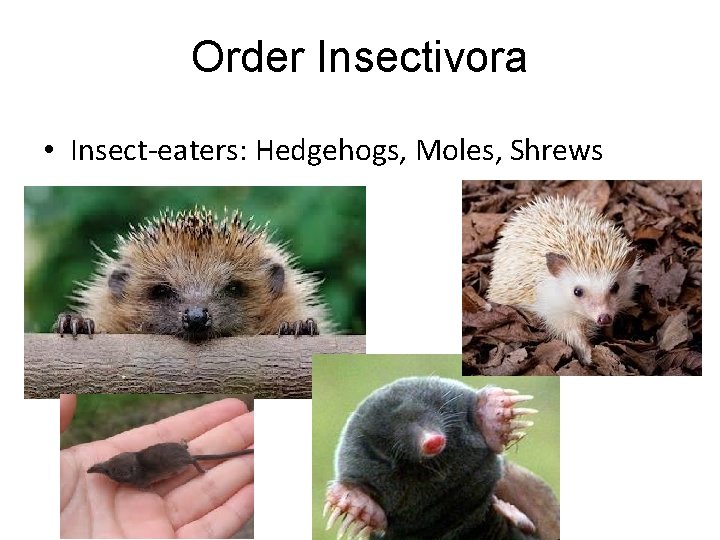
Order Insectivora • Insect-eaters: Hedgehogs, Moles, Shrews
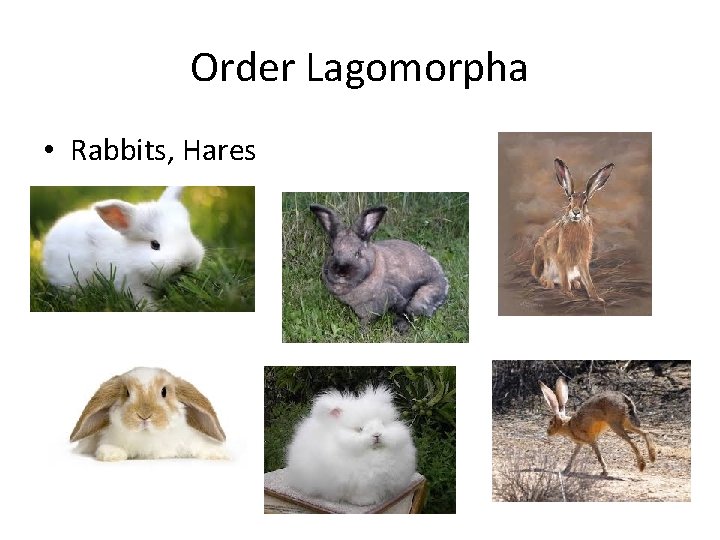
Order Lagomorpha • Rabbits, Hares
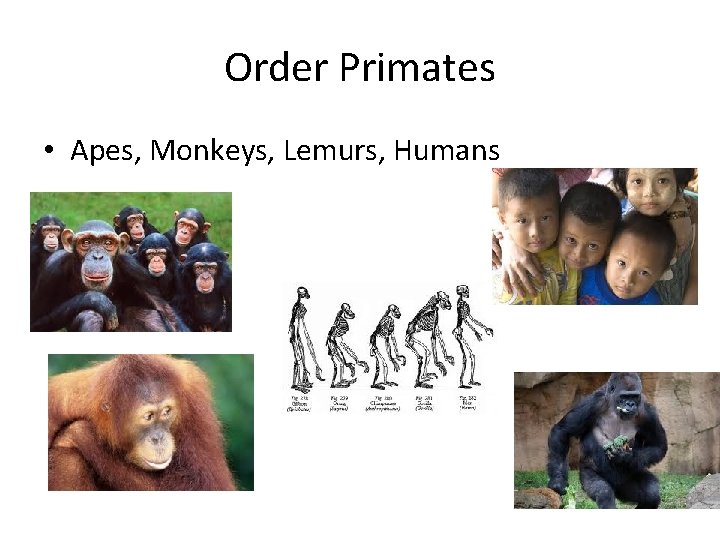
Order Primates • Apes, Monkeys, Lemurs, Humans
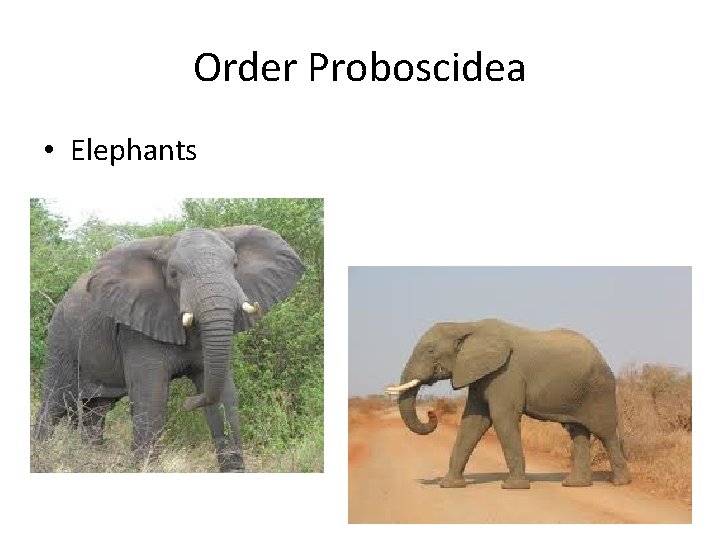
Order Proboscidea • Elephants
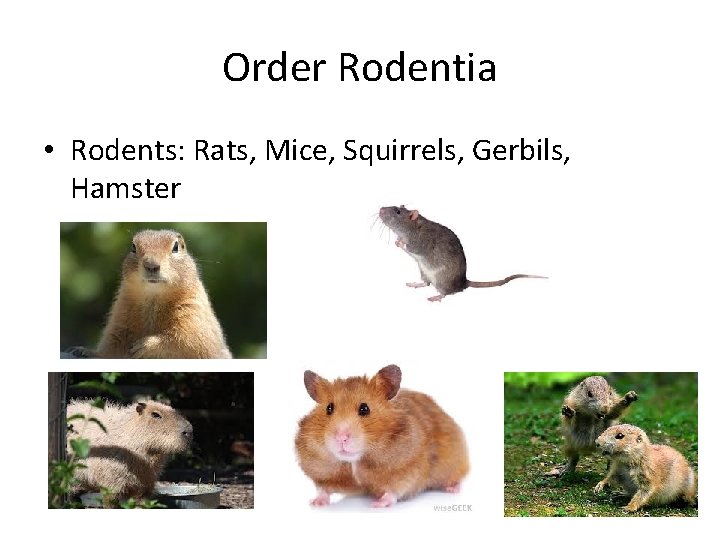
Order Rodentia • Rodents: Rats, Mice, Squirrels, Gerbils, Hamster
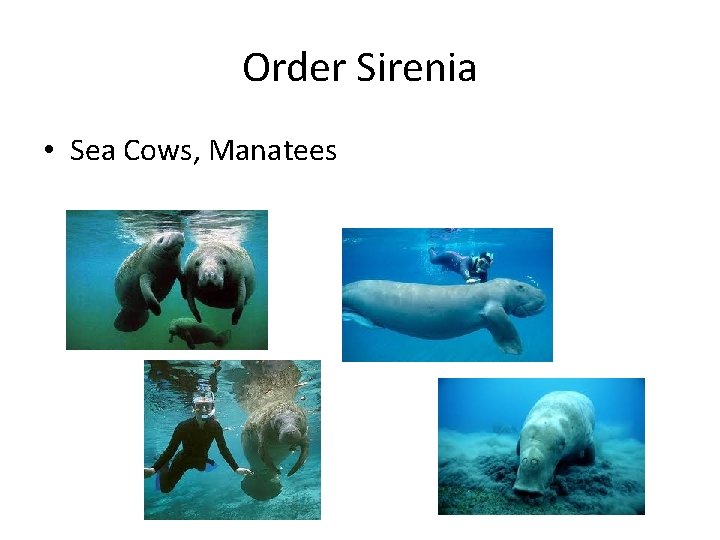
Order Sirenia • Sea Cows, Manatees
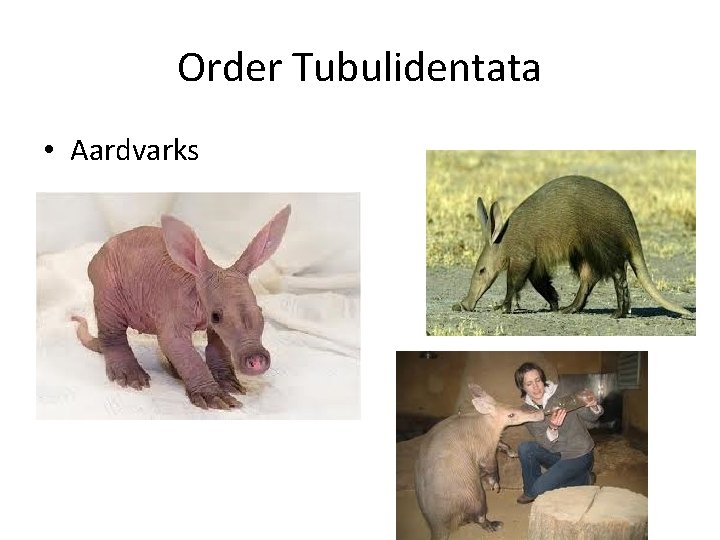
Order Tubulidentata • Aardvarks
![Order Edentata [also called Xenarthra] • Sloths, Armadillos](http://slidetodoc.com/presentation_image_h2/792f676de447a488833cb669d88d1bcc/image-60.jpg "Order Edentata [also called Xenarthra] • Sloths, Armadillos")
Order Edentata [also called Xenarthra] • Sloths, Armadillos
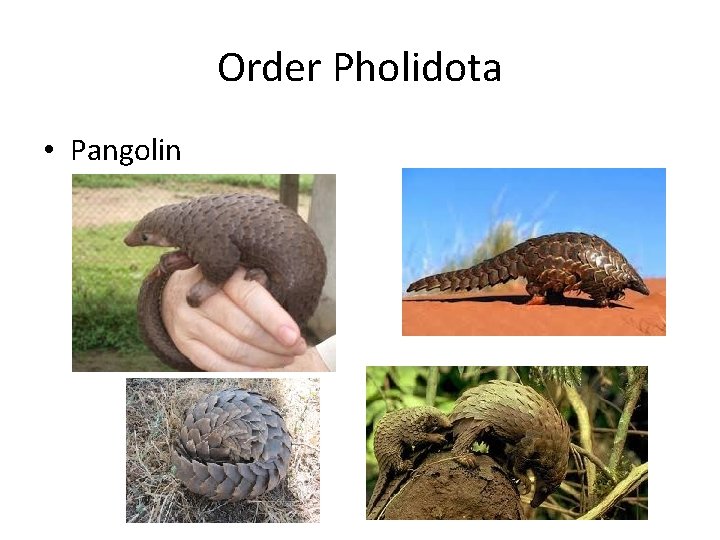
Order Pholidota • Pangolin
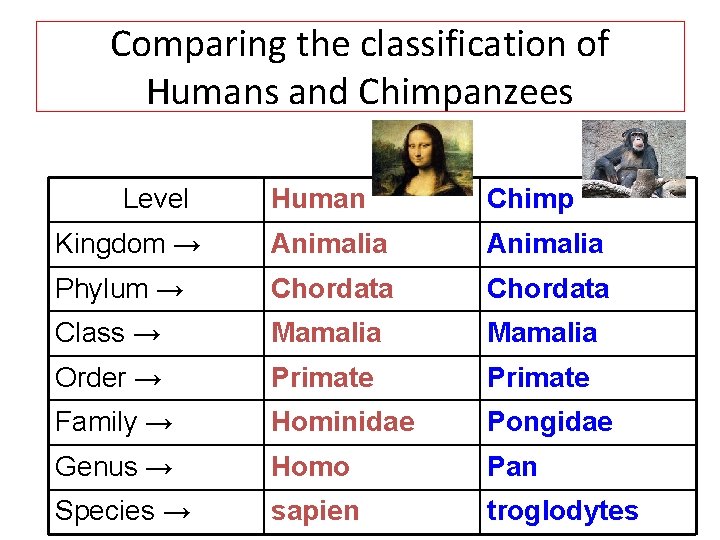
Comparing the classification of Humans and Chimpanzees Level Human Chimp Kingdom → Animalia Phylum → Chordata Class → Mamalia Order → Primate Family → Hominidae Pongidae Genus → Homo Pan Species → sapien troglodytes
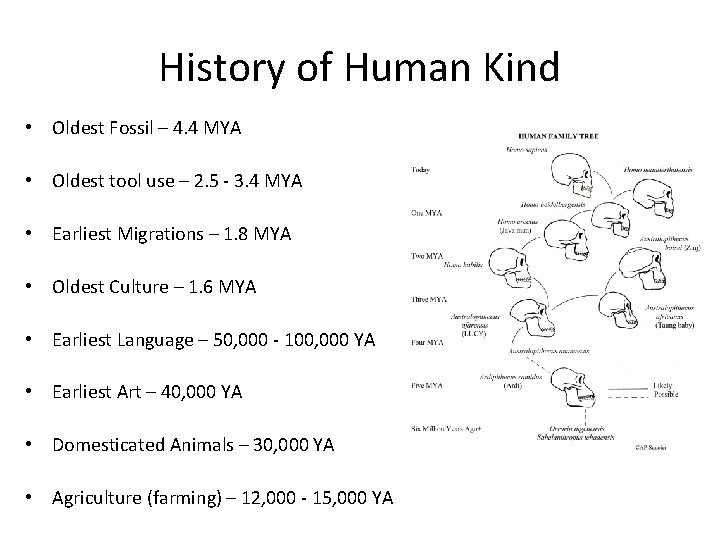
History of Human Kind • Oldest Fossil – 4. 4 MYA • Oldest tool use – 2. 5 - 3. 4 MYA • Earliest Migrations – 1. 8 MYA • Oldest Culture – 1. 6 MYA • Earliest Language – 50, 000 - 100, 000 YA • Earliest Art – 40, 000 YA • Domesticated Animals – 30, 000 YA • Agriculture (farming) – 12, 000 - 15, 000 YA
Front Cover • Go back to your cover and draw the diagram on the next slide, on the bottom half of your cover page. • This is one of the most current theories as to what the tree of life looks like for the 6 kingdoms showing who evolved from whom.
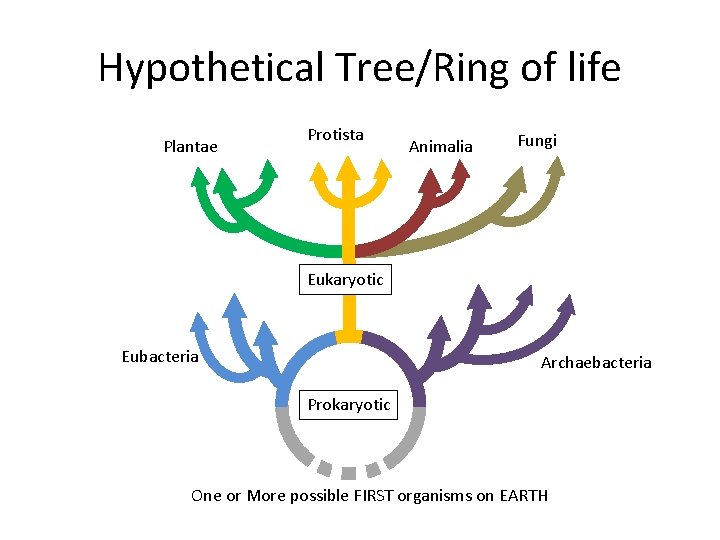
Hypothetical Tree/Ring of life Plantae Protista Animalia Fungi Eukaryotic Eubacteria Archaebacteria Prokaryotic One or More possible FIRST organisms on EARTH

STOP NOTES HERE Bonus material follows
Vocabulary • Page 464 –Sections 18 -1 –Section 18 -2 –Section 18 -3
Human. Evolution • Did Climate Change Drive Human Evolution? • Listen To the Story on NPR
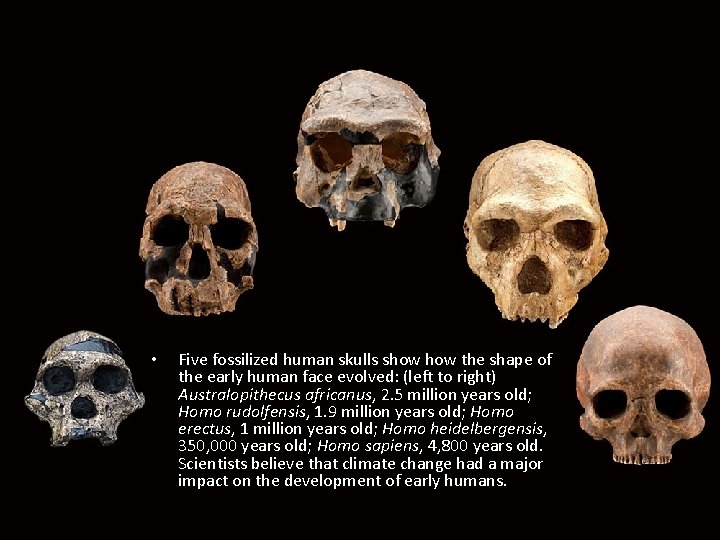
• • Five fossilized human skulls show the shape of the early human face evolved: (left to right) Australopithecus africanus, 2. 5 million years old; Homo rudolfensis, 1. 9 million years old; Homo erectus, 1 million years old; Homo heidelbergensis, 350, 000 years old; Homo sapiens, 4, 800 years old. Scientists believe that climate change had a major impact on the development of early humans.
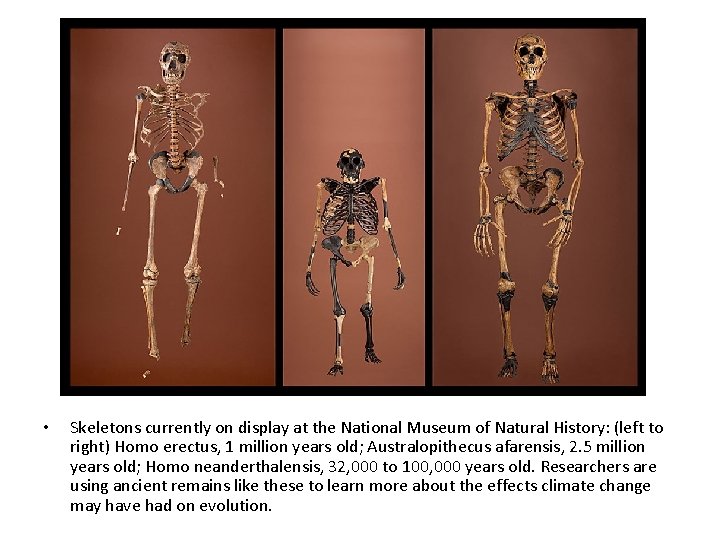
• Skeletons currently on display at the National Museum of Natural History: (left to right) Homo erectus, 1 million years old; Australopithecus afarensis, 2. 5 million years old; Homo neanderthalensis, 32, 000 to 100, 000 years old. Researchers are using ancient remains like these to learn more about the effects climate change may have had on evolution.
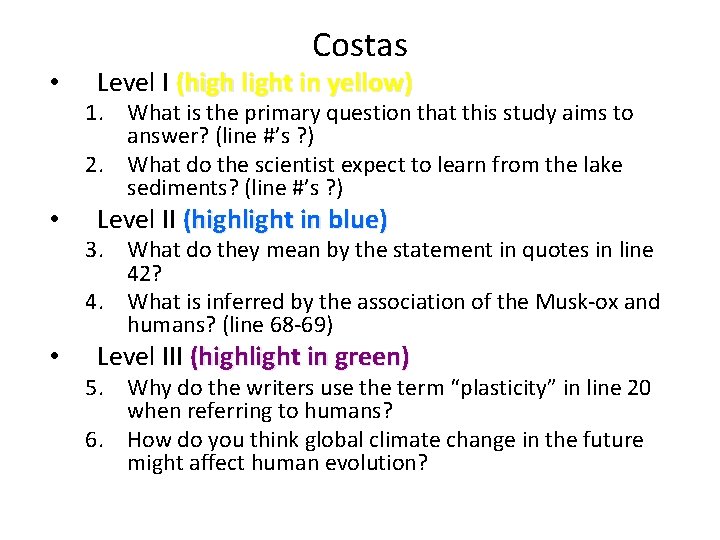
• Costas Level I (high light in yellow) 1. What is the primary question that this study aims to answer? (line #’s ? ) 2. What do the scientist expect to learn from the lake sediments? (line #’s ? ) • Level II (highlight in blue) 3. What do they mean by the statement in quotes in line 42? 4. What is inferred by the association of the Musk-ox and humans? (line 68 -69) • Level III (highlight in green) 5. Why do the writers use the term “plasticity” in line 20 when referring to humans? 6. How do you think global climate change in the future might affect human evolution?

Bonus Question • What does a LIMNOLOGIST study and why?
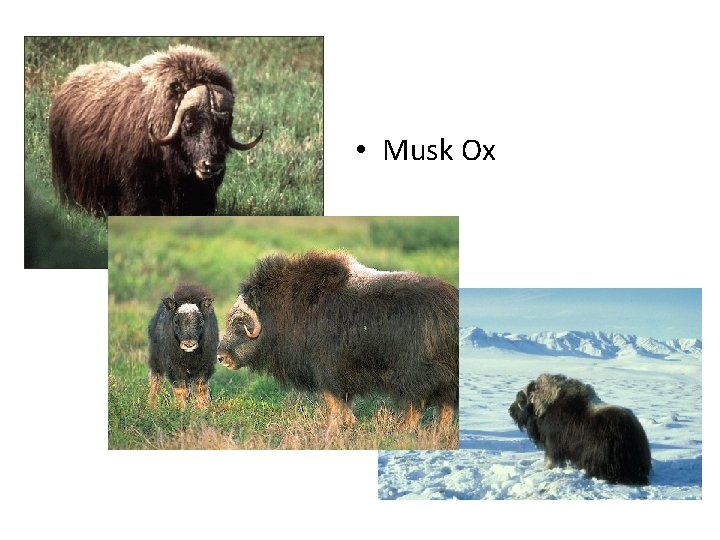
• Musk Ox
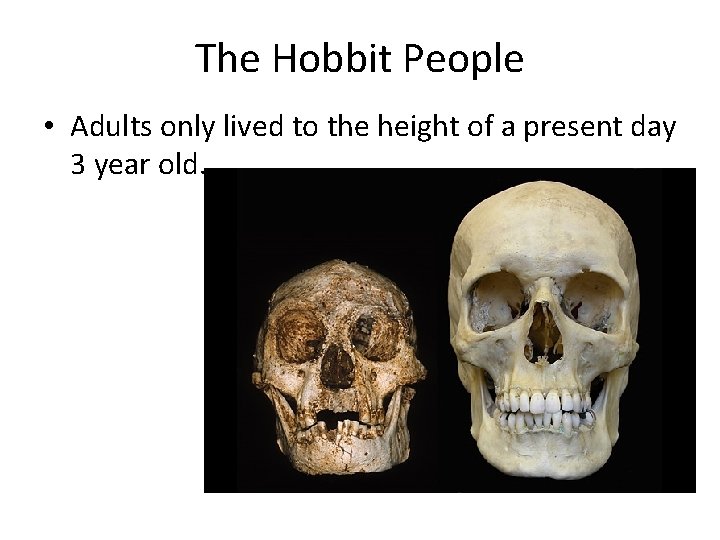
The Hobbit People • Adults only lived to the height of a present day 3 year old.
- Slides: 74