
Classification Test Grade Subject Date grade 7 th
Classification Test Grade: Subject: Date: «grade» 7 th Grade Life Science «date»

1 The seven levels of classification, from general to specific are: Put in order from general to specific: 1. order 2. phylum 3. class 4. kingdom 5. species 6. genus 7. family
2 Each class in the levels of classification is divided into a A B C D kingdom phylum order family
3 Scientific names are written in. . . A B C D Latin Spanish English French
4 What rule should you follow when writing scientific names? A B C D the species name begins with a capital letter the genus name begins with a capital lettergenus and species begin with capital both letters all of the above
The scientific name for the house cat is Felis Domesticus. What is the genus to which this animal belongs? 5 A B C D Felis Domesticus house cat
6 Homo sapiens is the scientific name for the. . . A chimpanzee B dog C human D gorilla
The two-part naming system used to give organisms a scientific name is called. . . 7 A binomial naming or nomenclature B binomial taxonomy C trinomial naming or nomenclature
8 Carolus Linnaeus is known for. . . A B C D identifying new organisms founding the science of taxonomy discovering the dichotomous key the first scientist to swim the Atlantic Ocean
9 How many kingdoms are recognized in the world today?
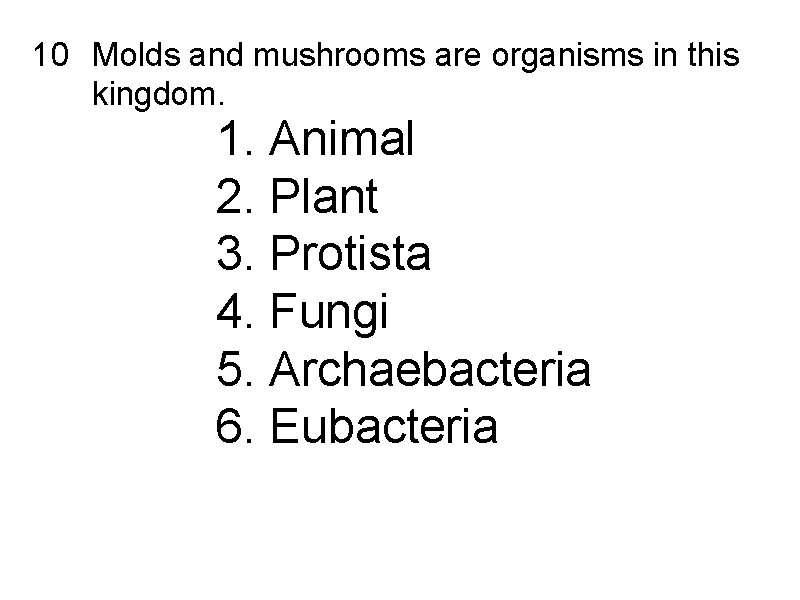
10 Molds and mushrooms are organisms in this kingdom. 1. Animal 2. Plant 3. Protista 4. Fungi 5. Archaebacteria 6. Eubacteria
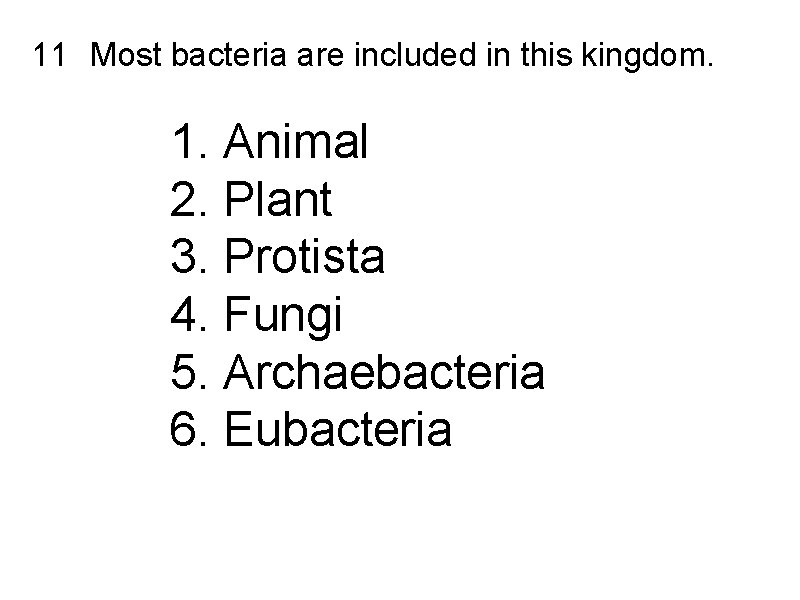
11 Most bacteria are included in this kingdom. 1. Animal 2. Plant 3. Protista 4. Fungi 5. Archaebacteria 6. Eubacteria
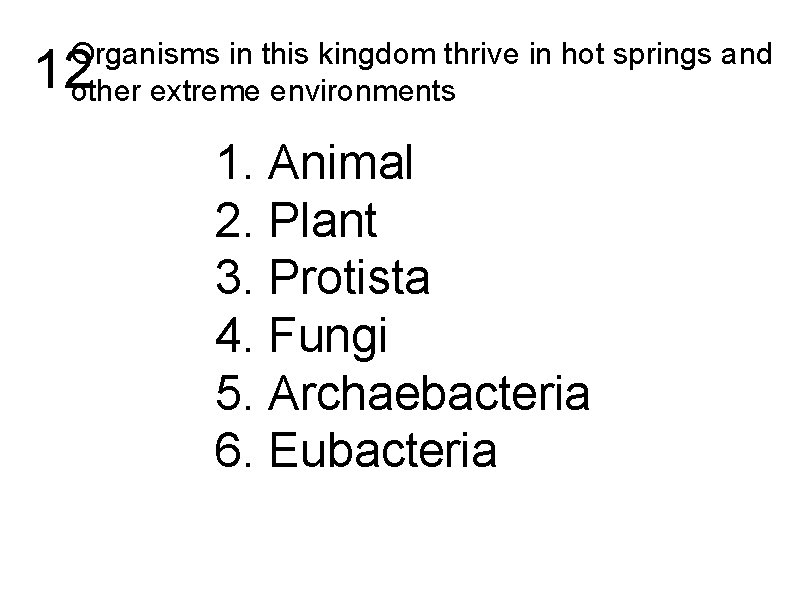
Organisms in this kingdom thrive in hot springs and other extreme environments 12 1. Animal 2. Plant 3. Protista 4. Fungi 5. Archaebacteria 6. Eubacteria
Organisms in this kindgom move by themselves and usually have advanced nervous systems that allow them to respond to their envirnoment. 13 1. Animal 2. Plant 3. Protista 4. Fungi 5. Archaebacteria 6. Eubacteria
Organisms in this kingdom can make their own food through photosynthesis. 14 1. Animal 2. Plant 3. Protista 4. Fungi 5. Archaebacteria 6. Eubacteria
15 Single-celled organisms that have eukaryotic cells. 1. Animal 2. Plant 3. Protista 4. Fungi 5. Archaebacteria 6. Eubacteria
16 An evergreen tree is a member of the Fungi kingdom True False
17 Multiple organisms can have the same scientific name True False
Wolves, Canis lupus, and dogs, Canus familiaris belong to different genuses. 18 True False
Only Kingdom Eubacteria have organisms that contain prokaryotic cells. 19 True False
An identification tool that uses pairs of descriptive statements to identify organisms is called a dichotomous key. 20 True False

Attachments
- Slides: 22