
Classification Sorting It All Out Why Classify Imagine


- Slides: 16
Classification Sorting It All Out
Why Classify? Imagine that you live in a tropical rain forest and are responsible for getting your own food, shelter, and clothing to survive. You will need to know which plants you can eat and which are poisonous. You will need to know which animals to eat and which may eat you. You will need to organize the living things around you into categories, or classify them.
Classification is the arrangement of organisms into orderly groups based on their similarities.
How to Classify In order to classify an organism, a biologist must use a system that groups organisms according to shared characteristics and their relationships between one another. There are seven levels of classification used by biologists.
Naming Names When classifying organisms, scientists give them scientific names Scientific Names are always the same for a specific organism no matter how many common names it might have
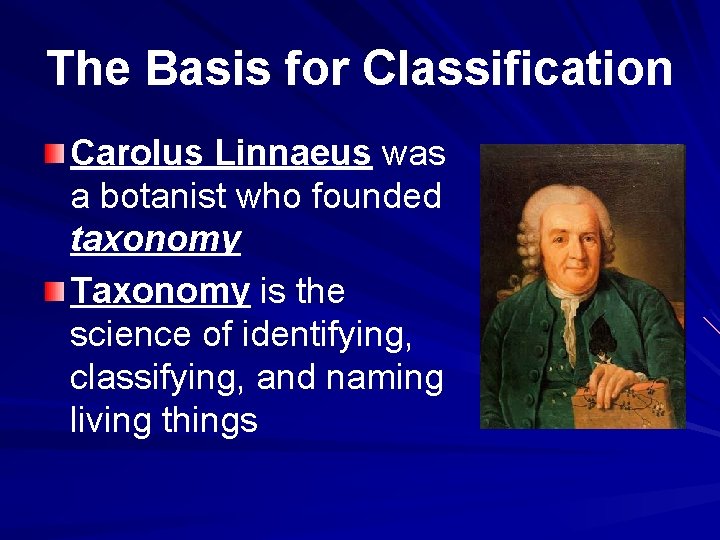
The Basis for Classification Carolus Linnaeus was a botanist who founded taxonomy Taxonomy is the science of identifying, classifying, and naming living things
Levels of Classification 1. Kingdoms 2. Phylum 3. Class 4. Order 5. Family 6. Genus 7. Species
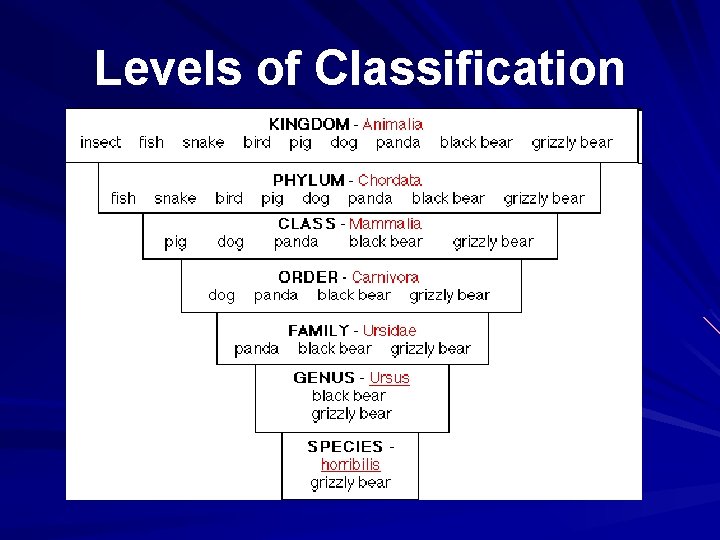
Levels of Classification Kingdoms are the largest, most general groups The members of one phylum are more like each other than they are like members of another phylum Classes are more specific than Phyla and are further divided into Orders are separated into families Families are sorted into genus Genus is sorted into species Species contains only one kind of animal
Levels of Classification
Naming Names continued… Linnaeus simplified by giving each species a two-part scientific name The first part identifies the genus, the second part identifies the species Example: the Indian Elephant is Elephas maximus
It’s All Greek to Me! Scientific names seem difficult to understand because they are in Latin or Greek They are actually full of meaning Example: Tyrannosaurus rex Tyrannosaurus means “tyrant lizard” Rex means “king”
Why are Scientific Names Important? What name do you call an animal that is small, black and white, and smelly? A skunk has several names in English and has even more names in other languages. Biologists need to know that they are talking about the same animal, therefore its scientific name is Mephitis mephitis
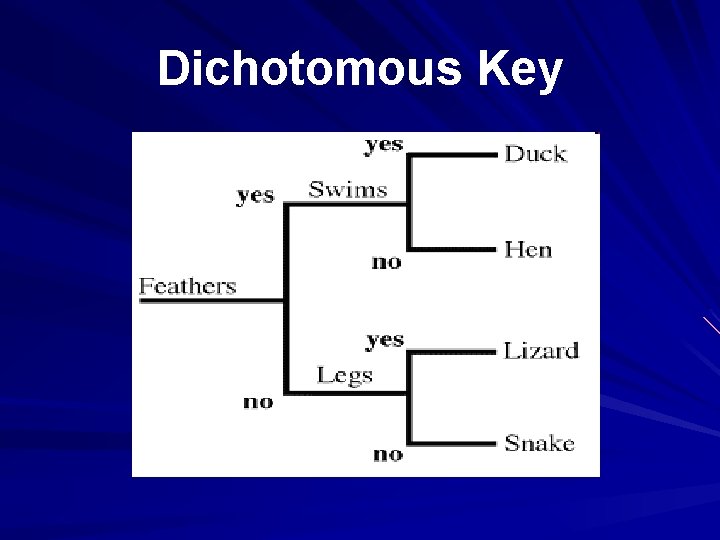
Dichotomous Keys aid in identifying unknown organisms It consists of several pairs of descriptive statements that have only two possible responses, either “yes” or “no” From there, the person trying to identify the unknown organism chooses the appropriate responses.
Dichotomous Key
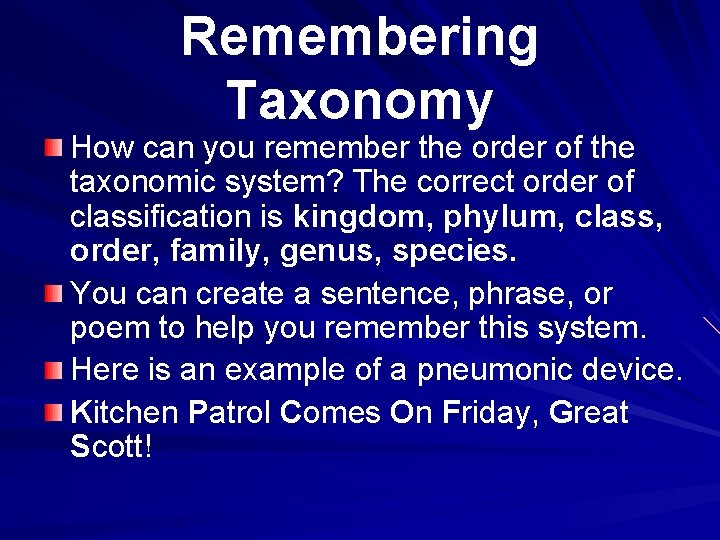
Remembering Taxonomy How can you remember the order of the taxonomic system? The correct order of classification is kingdom, phylum, class, order, family, genus, species. You can create a sentence, phrase, or poem to help you remember this system. Here is an example of a pneumonic device. Kitchen Patrol Comes On Friday, Great Scott!
Remembering Taxonomy Work with your group members to come up with your own pneumonic device. K__________ P__________ C__________ O__________ F__________ G__________ S__________