
Classification Section 1 The Importance of Classification Section


- Slides: 17
Classification Section 1: The Importance of Classification Section 1
Classification Section 1 Key Ideas • Why do biologists have taxonomic systems? • What makes up the scientific name of a species? • What is the structure of the modern Linnaean system of classification?
Classification Section 1 The Need for Systems • About 1. 7 million species have been named and described by scientists. • Scientists think that millions more are undiscovered. • The practice of naming and classifying organisms is called taxonomy.
Classification The Need for Systems, continued • Taxonomic Systems – consistent way to name and categorize organisms – do not use common names – use categories to organize organisms. Section 1
Classification Section 1 Scientific Nomenclature • Various naming systems were invented in the early days of European biology. • Names for taxa were inconsistent between these systems. • The only taxon which was consistent was the genus, which was a taxon used to group similar species.
Classification Section 1 Scientific Nomenclature, continued • A simpler and more consistent system was developed by Swedish biologist Carl Linnaeus in the 1750 s. • Linnaeus introduced a two-word naming system called binomial nomenclature. • His system included the genus name and a single descriptive word for each species.
Classification Section 1 Scientific Nomenclature, continued Naming Rules • The unique, two-part name for a species is now called a scientific name. • Scientific names must conform to rules established by an international commission of scientists.
Classification Section 1 Scientific Nomenclature, continued • No two species can have the same scientific name. • All scientific names are made up of two Latin or Latin-like terms. • All the members of a genus share the genus name as the first term. • The second term is called the species identifier, and is often descriptive.
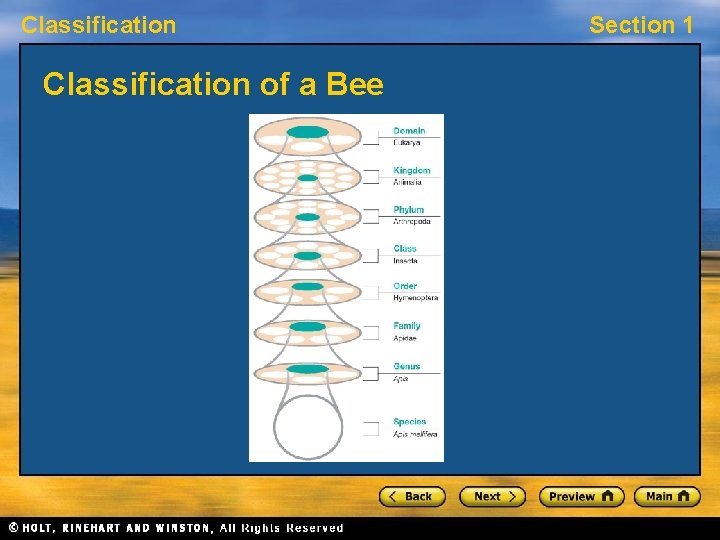
Classification Section 1 Scientific Nomenclature, continued • For example, the scientific name Apis mellifera belongs to the European honeybee. • The term mellifera derives from the Latin word for honey. • The genus name should be capitalized and the species identifier should be lowercase. • Both terms should be italicized.
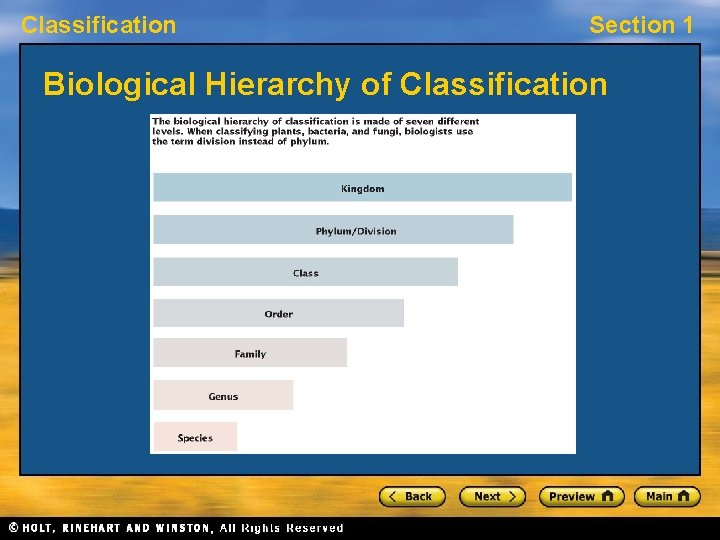
Classification Section 1 The Linnaean System • Linnaeus devised a system to classify all plants and animals that were known during his time. • The eight basic levels of modern classification are domain, kingdom, phylum, class, order, family, genus, species.
Classification Section 1 Biological Hierarchy of Classification
Classification Section 1 The Linnaean System, continued • Each level has its own set of names for taxa at that level. • Each taxon is identified based on shared traits.
Classification of a Bee Section 1
Classification Section 1 The Linnaean System, continued • The category domain has been invented since Linnaeus’ time. • This category recognizes the most basic differences among cell types. • All living things are now grouped into one of three domains.
Classification Section 1 The Linnaean System, continued • The category kingdom encompasses large groups, such as plants, animals, or fungi. • Six kingdoms fit within the three domains. • A phylum is a subgroup within kingdom. • A class is a subgroup within a phylum.
Classification Section 1 The Linnaean System, continued • An order is a subgroup within a class. • A family is a subgroup within an order. • A genus (plural, genera) is a subgroup within family. • Each genus is made up of species with uniquely shared traits, such that the species are thought to be closely related.
Classification Section 1 The Linnaean System, continued • In practice, scientists tend to define species based on unique features. • For example, Homo sapiens is recognized as the only living primate species that walks upright and uses spoken language.