
CLASSIFICATION RESOURCE QUALITY OBJECTIVES AND THE RESERVE THE
CLASSIFICATION, RESOURCE QUALITY OBJECTIVES AND THE RESERVE: THE LETABA RIVER CASE STUDY DELANA LOUW RIVERS FOR AFRICA e. FLOWS CONSULTING LEBO MATLALA (DWS) PIETER VAN ROOYEN & CARYN SEAGO (WRP) EDDIE RIDDELL & JACQUES VENTER (SANPARKS) SEPTEMBER 2018
OUTLINE OF PRESENTATION Ø Introduction Ø Integrated framework (Classification, Reserve RQOs) Ø Description of the Letaba Classification, Reserve and RQO study Ø The scenario process leading to an optimised solution in the Letaba Catchment Ø Implementation of environmental flows in the Letaba, KNP Ø Challenges and lessons learnt specifically to the Letaba Catchment
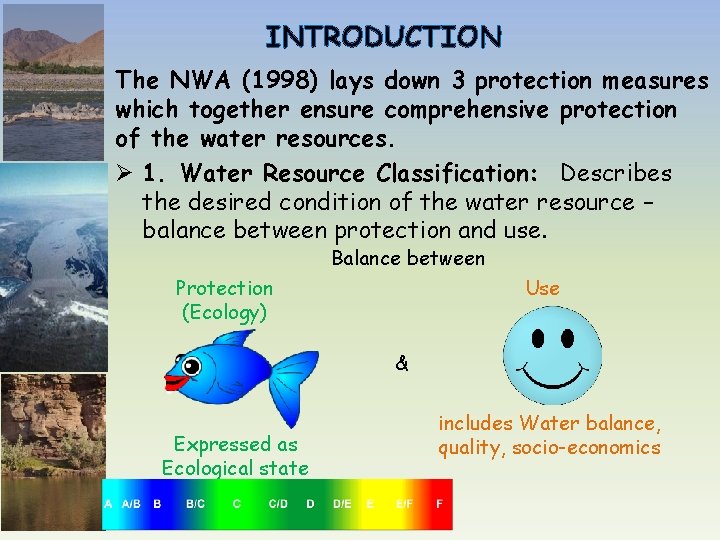
INTRODUCTION The NWA (1998) lays down 3 protection measures which together ensure comprehensive protection of the water resources. Ø 1. Water Resource Classification: Describes the desired condition of the water resource – balance between protection and use. Balance between Use Protection (Ecology) & Expressed as Ecological state includes Water balance, quality, socio-economics
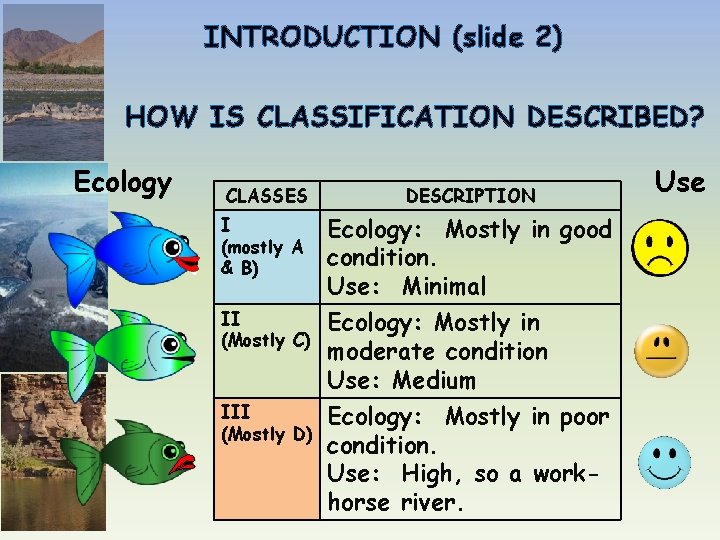
INTRODUCTION (slide 2) HOW IS CLASSIFICATION DESCRIBED? Ecology CLASSES DESCRIPTION I (mostly A & B) Ecology: Mostly in good condition. Use: Minimal II (Mostly C) Ecology: Mostly in moderate condition Use: Medium III (Mostly D) Ecology: Mostly in poor condition. Use: High, so a workhorse river. Use
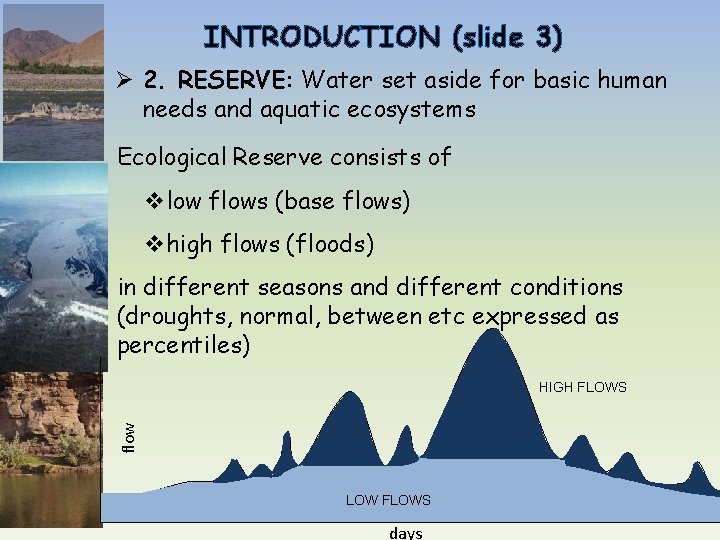
INTRODUCTION (slide 3) Ø 2. RESERVE: Water set aside for basic human needs and aquatic ecosystems Ecological Reserve consists of vlow flows (base flows) vhigh flows (floods) in different seasons and different conditions (droughts, normal, between etc expressed as percentiles) flow HIGH FLOWS LOW FLOWS days
INTRODUCTION (slide 4) Basic Human Needs described as: v. A calculation per quaternary catchment of the source of water and number of households and individuals who are dependant on these sources. vwhich excludes receiving water from a recognised formal water source. v. BHN determinined at various scenarios of which minimum is 25 litres person per day.
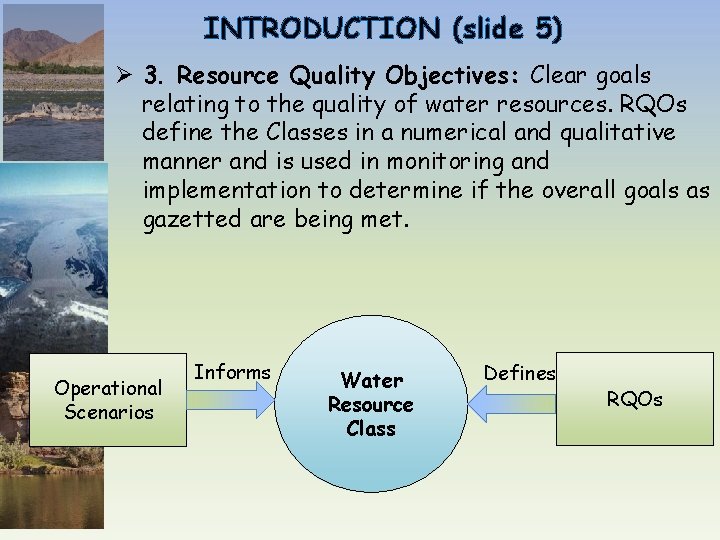
INTRODUCTION (slide 5) Ø 3. Resource Quality Objectives: Clear goals relating to the quality of water resources. RQOs define the Classes in a numerical and qualitative manner and is used in monitoring and implementation to determine if the overall goals as gazetted are being met. Operational Scenarios Informs Water Resource Class Defines RQOs

INTEGRATED FRAMEWORK
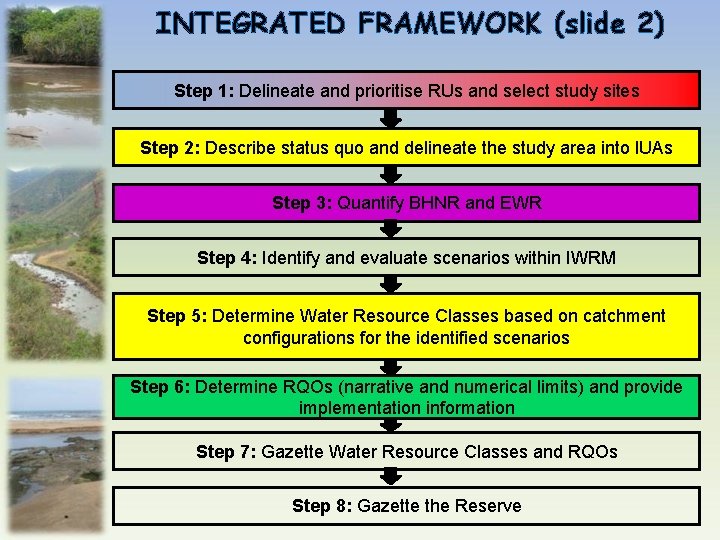
INTEGRATED FRAMEWORK (slide 2) Step 1: Delineate and prioritise RUs and select study sites Step 2: Describe status quo and delineate the study area into IUAs Step 3: Quantify BHNR and EWR Step 4: Identify and evaluate scenarios within IWRM Step 5: Determine Water Resource Classes based on catchment configurations for the identified scenarios Step 6: Determine RQOs (narrative and numerical limits) and provide implementation information Step 7: Gazette Water Resource Classes and RQOs Step 8: Gazette the Reserve
Letaba Classification, Reserve & RQO study: STATUS QUO ASSESSMENT Ø Major dams: Dap Naude, Ebenezer, Magoebaskloof, Tzaneen & Thabina Dams Ø Dense aforestation in upper parts Ø Intensive irrigated agriculture on banks of the Groot Letaba Ø Middel and Klein Letaba mostly rural with intensive irrigation in some areas (middle Letaba and Nsami Dams) Ø Water requirements exceed the available water resources (transfers and building of Nwamitwa Dam being planned). Ø Economic significance dominated by irrigated agriculture & commercial agriculture.
Letaba Classification, Reserve & RQO study: STATUS QUO ASSESSMENT (slide 2) Ø Ecological status quo is a result of large dams, rural settlements, subsistence agriculture (overgrazing, trampling, erosion). Ø Flow modification in terms of decreased flows one of the severe impacts. Ø Lower section of river in conservation areas are a mix of A EC PES for rivers with source in these areas, Ø and C EC PES for the main Letaba River. Ø Letaba Rivers bears the brunt of all the utilisation outside of the conservation areas, as well as sedimentation – the river is physically much smaller than natural within a very large macro-channel which is maintained by the low frequency of large floods that still come through.
Letaba Classification, Reserve & RQO study: HIGH PRIORITY RUs (slide 3) Ø HIGH priority RU: A river reach with a HIGH Integrated Environmental Importance (combination of Ecological importance, Socio-cultural importance and PES) and a HIGH Water Resource Use Importance. I. E. , a river reach that is environmentally important but that is or could be under threat due to its importance for water resource use. Ø 19 high priority RUs. Ø Seven EWR sites occur in these high priority RUs.
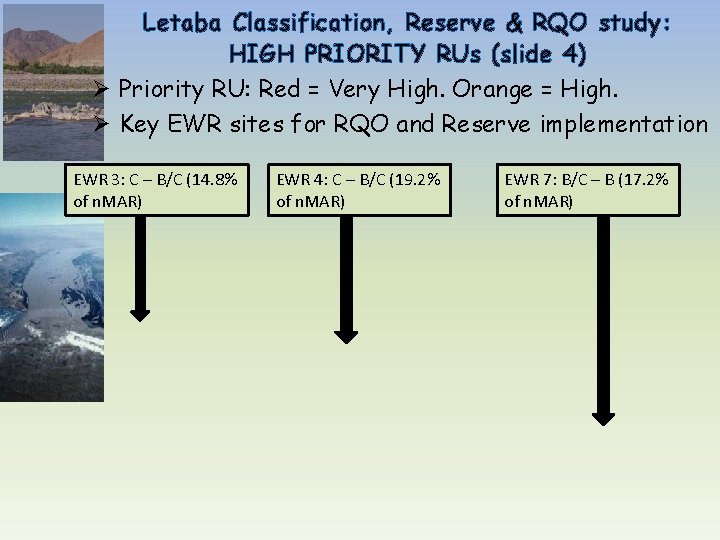
Letaba Classification, Reserve & RQO study: HIGH PRIORITY RUs (slide 4) Ø Priority RU: Red = Very High. Orange = High. Ø Key EWR sites for RQO and Reserve implementation EWR 3: C – B/C (14. 8% of n. MAR) EWR 4: C – B/C (19. 2% of n. MAR) EWR 7: B/C – B (17. 2% of n. MAR)
SCENARIO PROCESS – OPTIMISED SOLUTION Ø Main aim of scenario evaluation process: Find appropriate balance between protection and use. Ø Once the preferred scenario has been selected, the class is defined by the level of environmental protection embedded in that scenario. Ø Three main variables to consider: Ecology, Ecosystem Services, and economic benefits from the use of the water resource. Ø Scenarios considered were: v Maintain PES v Achieve REC v Full water resource development with no releases for ecology v Range of alternative ecological release strategies resulting in a range of ECs
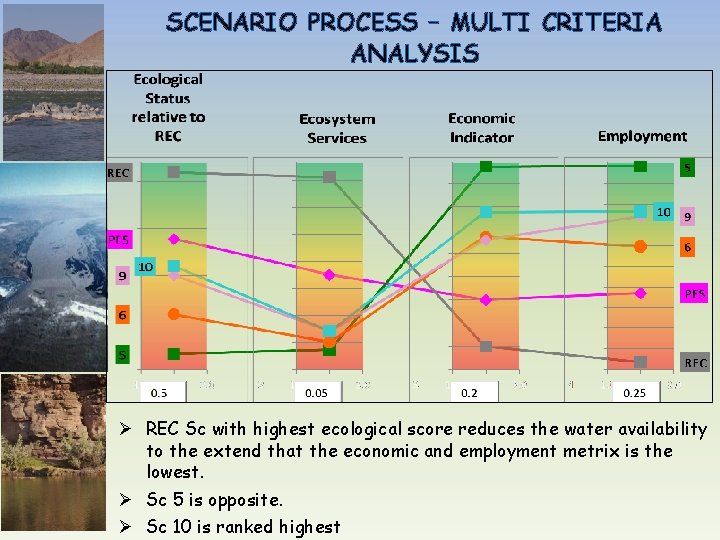
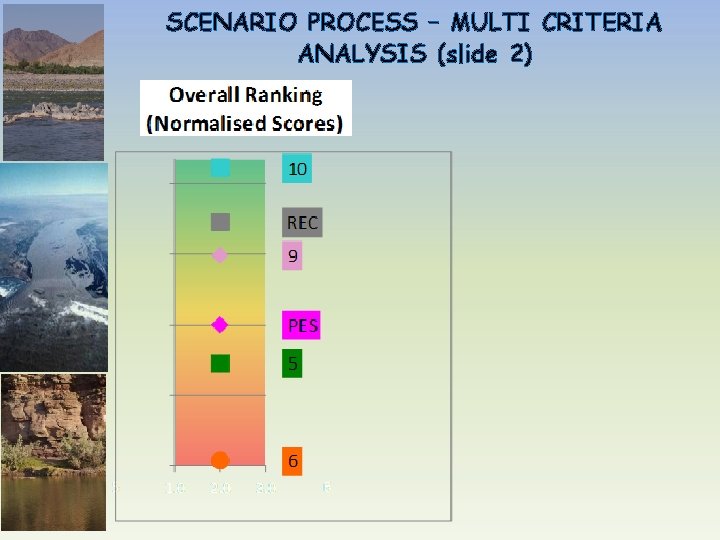
SCENARIO PROCESS – MULTI CRITERIA ANALYSIS Ø REC Sc with highest ecological score reduces the water availability to the extend that the economic and employment metrix is the lowest. Ø Sc 5 is opposite. Ø Sc 10 is ranked highest
SCENARIO PROCESS – MULTI CRITERIA ANALYSIS (slide 2)
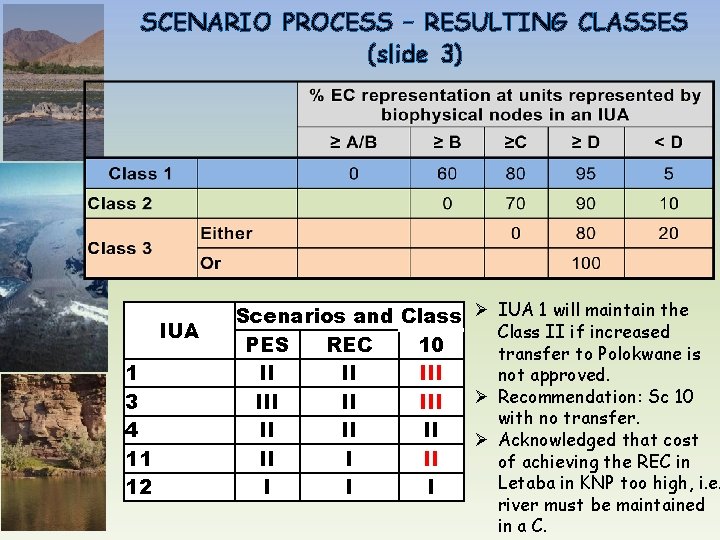
SCENARIO PROCESS – RESULTING CLASSES (slide 3) IUA 1 3 4 11 12 Scenarios and Class Ø IUA 1 will maintain the Class II if increased PES REC 10 transfer to Polokwane is II II III not approved. Ø Recommendation: Sc 10 III II III with no transfer. II II II Ø Acknowledged that cost II I II of achieving the REC in Letaba in KNP too high, i. e. I I I river must be maintained in a C.
IMPLEMENTATION OF ENVIRONMENTAL FLOWS: LETABA in KNP Ø Major challenges for Reserve implementation are that there is insufficient water in most catchments to meet the Reserve and use. Ø NWA allows for compulsory licensing – not yet been implemented. Ø Interim, implementation methods have been piloted on 4 catchments – most successful the Letaba River. Ø Method strives to develop catchment operating rules – work with stakeholders to find consensus. Ø Method essentially entails the calibration of the operating rules of the system with the aid of a water resources model Ø First natural hydrology, 2 nd operating rules.
IMPLEMENTATION OF ENVIRONMENTAL FLOWS: LETABA in KNP (2009) Ø 2009 plan: Real-Time Reserve Implementation Model developed. Ø Assumption that operator of dam does not have access to day-to-day info on river flow. Ø NB component is a near real-time hydro model which estimates the natural flow based on observed rainfall. Ø Rules based on natural flow (using rainfall as surrogate) at an indicator site. Ø Monitoring NB. Ø KNP, Irrigation board, dam operator – all cooperation necessary to make this work. Ø Monitoring NB. . . . .
IMPLEMENTATION OF ENVIRONMENTAL FLOWS: CLASSIFICATION (2012) Ø 2012 plan: Input to an implementation plan developed. Answers the following questions: v What activities are required v When should the activities take place (frequency) v Who is responsible Ø Implementation plan should take account of varying characteristics of the Letaba system, availability & need for monitoring info, ability (currently and in the future) to regulate flow in river reaches as well as existing water resource management activities taking place or being planned. Ø Implementation Management Committee (IPMC) must role out plan
IMPLEMENTATION OF ENVIRONMENTAL FLOWS: CLASSIFICATION (2012 & current) Ø Critical aspect is the DSS to perform simulations and assist in managing the releases for meeting the flow EWRs. Ø This currently exists and is operated by the KNP – rainfall forecasts are obtained and entered in, Reserve is calculated anticipated releases produced. Ø Model must be updated to apply revised hydro and detailed high resolution water resource network model that has been developed. Ø Such an update will have the following benefits:
IMPLEMENTATION OF ENVIRONMENTAL FLOWS: CLASSIFICATION (2012 & current) (slide 2) Ø Such an update will have the following benefits: v Alignment with operation policies & rules as defined in recommended scenario of the classification process (and gazetted) v Accounting for the implications of groundwater abstractions on base flow v Allowing for all abstractions and return flows v Maintain compatibility with water resource planning and operation management activities by using same water resource model. v Ability to undertake risk analysis through stochastic flow generation techniques. Ø Responsibility of updating model lies with DWS WRPS and of operating it with the IPMC
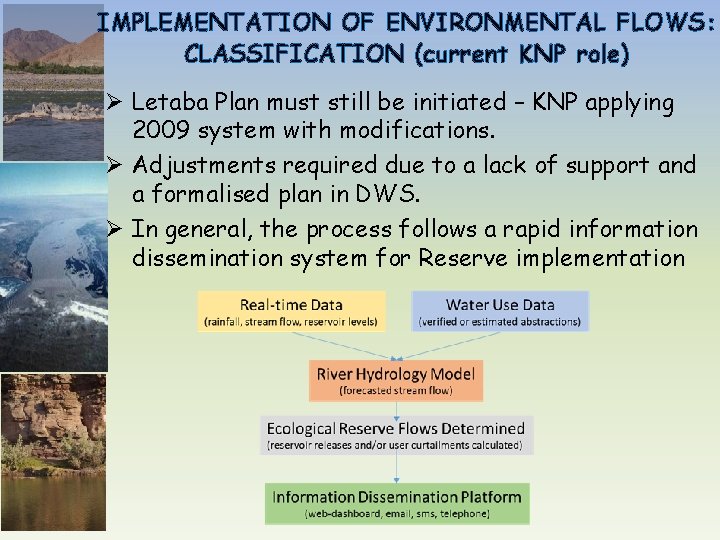
IMPLEMENTATION OF ENVIRONMENTAL FLOWS: CLASSIFICATION (current KNP role) Ø Letaba Plan must still be initiated – KNP applying 2009 system with modifications. Ø Adjustments required due to a lack of support and a formalised plan in DWS. Ø In general, the process follows a rapid information dissemination system for Reserve implementation
CHALLENGES AND LESSONS LEARNT (LETABA) Ø Confidence in Reserve results are linked to observed and modelled present-day data – requires consistent hydrology and based on recent validation of water use. This was possible for Letaba – rarely possible for other studies as groundwater-surface water interactions to be included. Ø Updated Reserve data a must – and same hydrology as for planning and reconciliation studies. Otherwise cannot use Reserve data for sc evaluation. Ø Implementation dependant on obtaining real time hydro data. No gauge in Letaba river that works properly – and Letaba Ranch at border of KNP is used. Gauging limited
CHALLENGES & LESSONS LEARNT (LETABA) (slide 2) Ø Properly defined scenarios essential. Advantage with Letaba was the parallel Reconciliation Strategy (Same water use, hydro and simulation models. Consistent messages to stakeholders. Capacity building on both processes). Ø Crucial that an IPMC be formulated to role out plan. Current model must be updated. Current KNP DSS must be incorporated within the overall DSS to ensure synergy and that the KNP will receive the required support in the management of the Letaba and other key rivers. Ø Role of Classification, RQOs and Reserves in terms of legal obligations must still be challenged. Currently it appears that decision-making and water resource development are often still taking place without due cognisance of the legal obligation with regards to the gazettes.
- Slides: 25