
Classification recommended by the Japanese Association of Acute
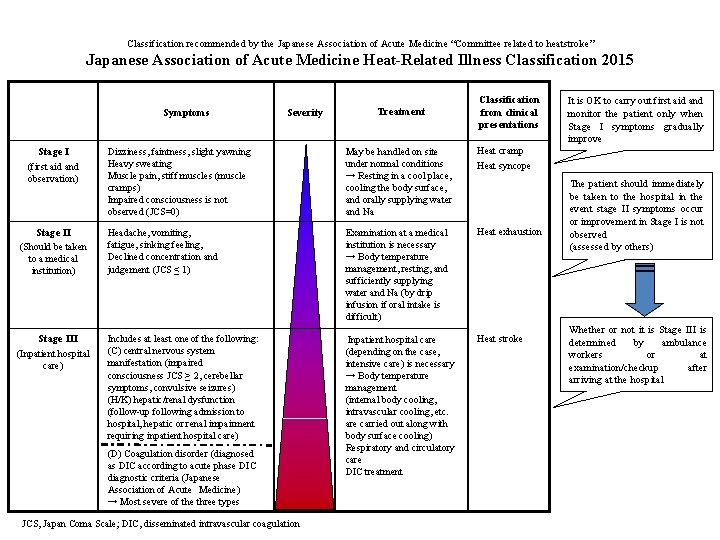
Classification recommended by the Japanese Association of Acute Medicine “Committee related to heatstroke” Japanese Association of Acute Medicine Heat-Related Illness Classification 2015 Symptoms Severity Treatment Classification from clinical presentations Dizziness, faintness, slight yawning Heavy sweating Muscle pain, stiff muscles (muscle cramps) Impaired consciousness is not observed (JCS=0) May be handled on site under normal conditions → Resting in a cool place, cooling the body surface, and orally supplying water and Na Heat cramp Heat syncope Stage II (Should be taken to a medical institution) Headache, vomiting, fatigue, sinking feeling, Declined concentration and judgement (JCS ≤ 1) Examination at a medical institution is necessary → Body temperature management, resting, and sufficiently supplying water and Na (by drip infusion if oral intake is difficult) Heat exhaustion Stage III (Inpatient hospital care) Includes at least one of the following: (C) central nervous system manifestation (impaired consciousness JCS ≥ 2, cerebellar symptoms, convulsive seizures) (H/K) hepatic/renal dysfunction (follow-up following admission to hospital, hepatic or renal impairment requiring inpatient hospital care) Inpatient hospital care (depending on the case, intensive care) is necessary → Body temperature management (internal body cooling, intravascular cooling, etc. are carried out along with body surface cooling) Respiratory and circulatory care DIC treatment Heat stroke Stage I (first aid and observation) (D) Coagulation disorder (diagnosed as DIC according to acute phase DIC diagnostic criteria (Japanese Association of Acute Medicine) → Most severe of the three types JCS, Japan Coma Scale; DIC, disseminated intravascular coagulation It is OK to carry out first aid and monitor the patient only when Stage I symptoms gradually improve The patient should immediately be taken to the hospital in the event stage II symptoms occur or improvement in Stage I is not observed (assessed by others) Whether or not it is Stage III is determined by ambulance workers or at examination/checkup after arriving at the hospital
- Slides: 1