
Classification of Study Designs l Observational studies l



Classification of Study Designs l. Observational studies l. Experimental studies 3

Observational studies Descriptive or case-series B. Cross-sectional studies (prevalence) 1. Disease description 2. Diagnosis and staging 3. Disease processes, mechanisms C. Case-control studies (retrospective) 1. Causes and incidence of disease 2. Identification of risk factors D. Cohort studies (prospective) 1. Causes and incidence of disease 2. Natural history, prognosis 3. Identification of risk factors E. Historical cohort studies A. 4

Experimental studies A. Controlled trials 1. Parallel or concurrent controls a. Randomized b. Not randomized 2. Sequential controls a. Self-controlled b. Crossover 3. External controls (including historical) B. Studies with no controls 5

The Principles of Design of Clinical Trials are Easily Stated l Define a homogeneous population of patients l Enroll every eligible patient l Assign study treatment regimens to enrolled patients l Complete the treatment of every patient according to protocol l Retain every patient in follow-up and complete every scheduled follow-up visit and examination l Include every enrolled patient in the analysis l Use planned analyses to draw conclusions about 7 study hypotheses

Elements of the Study Protocol l l l Background and Rationale Schema Study Objectives and Endpoints The Study Population Recruitment Baseline Assessment Randomization Treatment Regimens Follow-up Procedures and Schedule Data Collection and Quality Control Statistical Considerations Ethical Issues 8















Advantages of Randomization Eliminates Conscious Bias. -Due to physician or patient preference. Averages out Unconscious Bias Due to Unknown Factors Groups are “Alike on Average” -Equally heterogeneous Necessary for the Validity of Distribution-Free Tests (e. g. Wilcoxon test, Sign Test) 24
Disadvantages of Randomization l Ethical Issues l Interference with doctor/patient relationship l Administrative complexity l “Alike on Average” means in the average study; randomization does not guarantee balanced groups 25


Randomized controlled double blind clinical trials
Bias and Random Error l When we Use a Statistic to Estimate a Population Quantity, the Error in the Estimate Has Two Components, Random Error and the Systematic Error Called Bias. l The Goals of Study Design are to Control Systematic Error (Bias) and Minimize Random Error l Random error has no preferred direction. Thus, its average effect over replications is 0 and its effects can be minimized by averaging (The Law of Large Numbers) or by increasing the precision of individual measurements l Bias does have a net direction or magnitude. Bias can not be eliminated by averaging. Instead, it must be addressed by changes in design 28
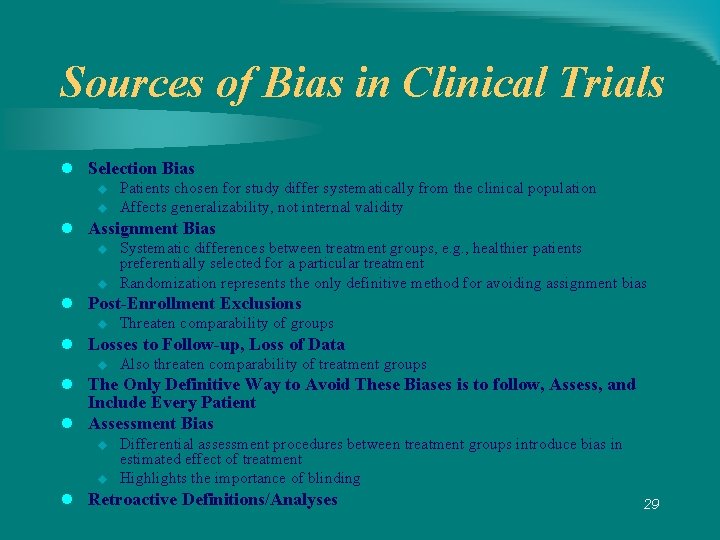
Sources of Bias in Clinical Trials l Selection Bias u Patients chosen for study differ systematically from the clinical population u Affects generalizability, not internal validity l Assignment Bias u Systematic differences between treatment groups, e. g. , healthier patients preferentially selected for a particular treatment u Randomization represents the only definitive method for avoiding assignment bias l Post-Enrollment Exclusions u Threaten comparability of groups l Losses to Follow-up, Loss of Data u Also threaten comparability of treatment groups l The Only Definitive Way to Avoid These Biases is to follow, Assess, and Include Every Patient l Assessment Bias u u Differential assessment procedures between treatment groups introduce bias in estimated effect of treatment Highlights the importance of blinding l Retroactive Definitions/Analyses 29
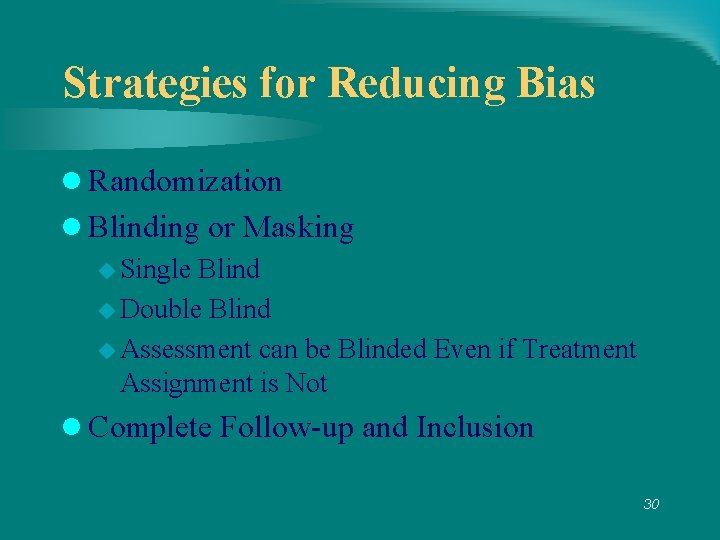
Strategies for Reducing Bias l Randomization l Blinding or Masking u Single Blind u Double Blind u Assessment can be Blinded Even if Treatment Assignment is Not l Complete Follow-up and Inclusion 30
How are These Goals Achieved? l Utilize statistical design to minimize bias and variability u Randomization, stratification, blinding, choice of design. l Establish a sample size sufficient to achieve study goals 31

Experiments Answer a Scientific Question by Isolating the Intervention and the outcome from Extraneous Influences l Goals: u Eliminate systematic error (Bias) u Minimize random error (Variability) u Ensure the generalizability of study findings l Study Design is the Methodology for Achieving these Goals 33

How Are These Goals Achieved? l Specify the source population and the method of sampling in a generalizable way l Prespecify diagnostic, staging, assessment, and follow up procedures l Describe the treatment protocol 34


Comparing Treatments l Fundamental Principle: Groups must be comparable in all important aspects and differ only in the treatment each group receive. u In practical terms, “comparable treatment groups” means” alike on the average”. u l Comparability is Achieved Through Randomization Each patient has the same chance of receiving any of the treatments under study. u Allocation of treatments to participants is carried out using a chance mechanism so that neither the patent nor the physician knows in advance which therapy will be assigned. u 37




- Slides: 41