
Classification of Space Objects Using Machine Learning Methods
Classification of Space Objects Using Machine Learning Methods Mahmoud Khalil Dr. Elena Fantino Prof. Panos Liatsis 12 DEC 2019 Khalifa University Abu Dhabi, UAE
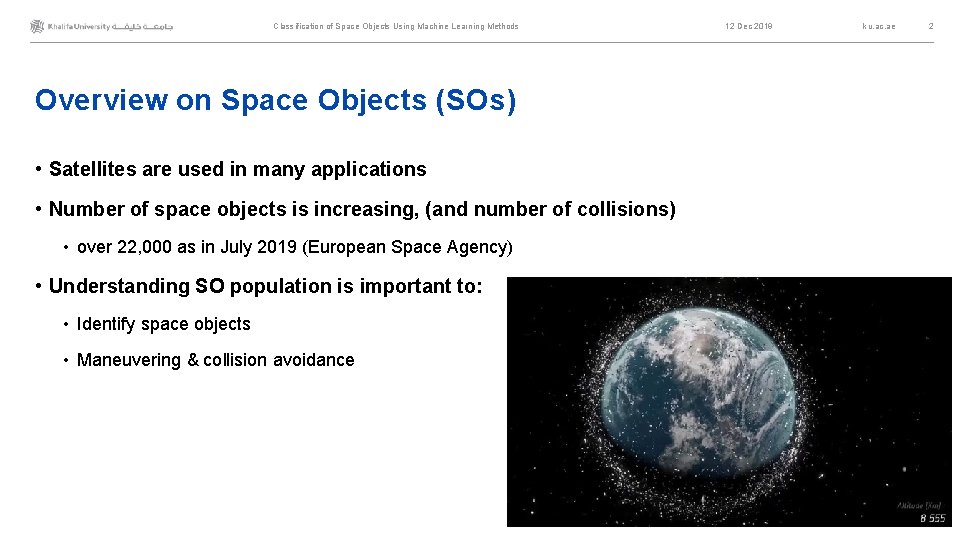
Classification of Space Objects Using Machine Learning Methods Overview on Space Objects (SOs) • Satellites are used in many applications • Number of space objects is increasing, (and number of collisions) • over 22, 000 as in July 2019 (European Space Agency) • Understanding SO population is important to: • Identify space objects • Maneuvering & collision avoidance 12 Dec 2019 ku. ac. ae 2
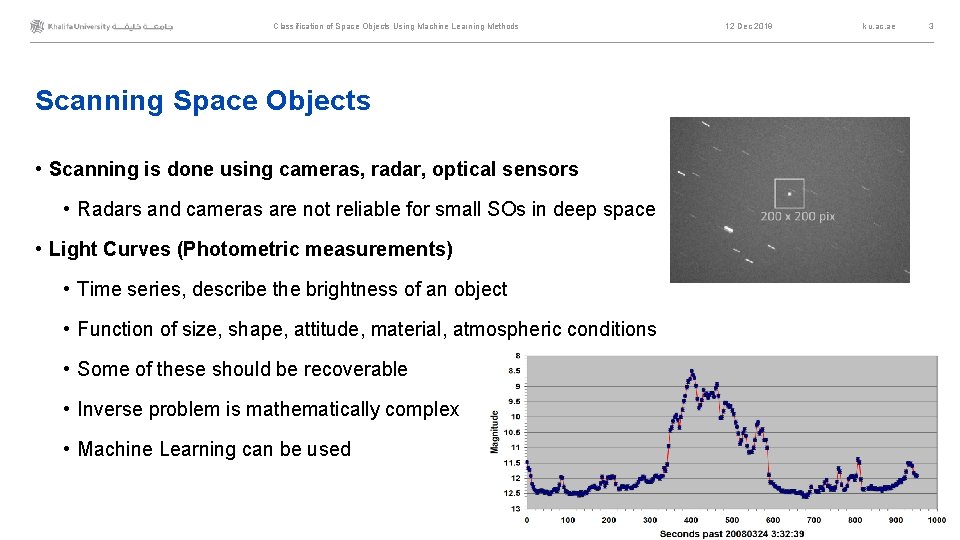
Classification of Space Objects Using Machine Learning Methods Scanning Space Objects • Scanning is done using cameras, radar, optical sensors • Radars and cameras are not reliable for small SOs in deep space • Light Curves (Photometric measurements) • Time series, describe the brightness of an object • Function of size, shape, attitude, material, atmospheric conditions • Some of these should be recoverable • Inverse problem is mathematically complex • Machine Learning can be used 12 Dec 2019 ku. ac. ae 3
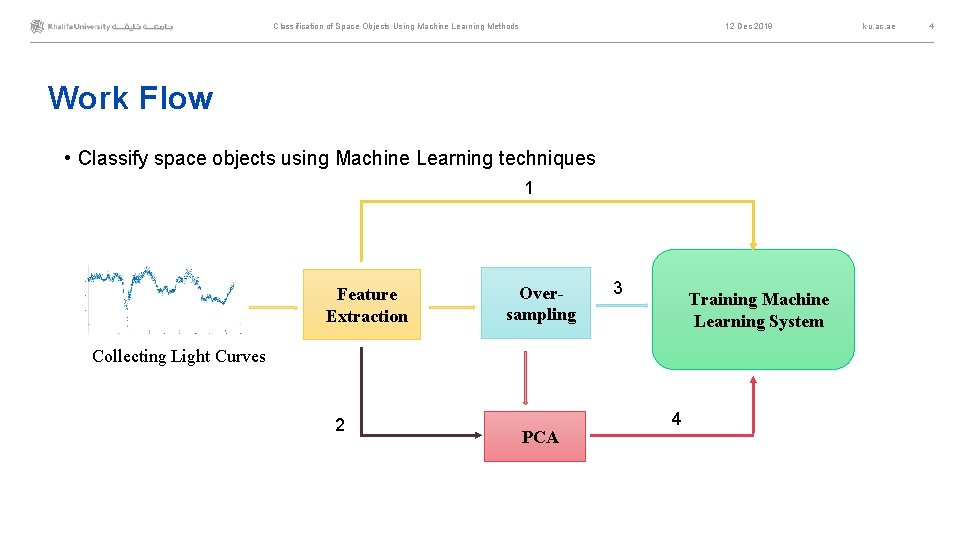
Classification of Space Objects Using Machine Learning Methods 12 Dec 2019 Work Flow • Classify space objects using Machine Learning techniques 1 Feature Extraction Oversampling 3 Training Machine Learning System Collecting Light Curves 2 PCA 4 ku. ac. ae 4
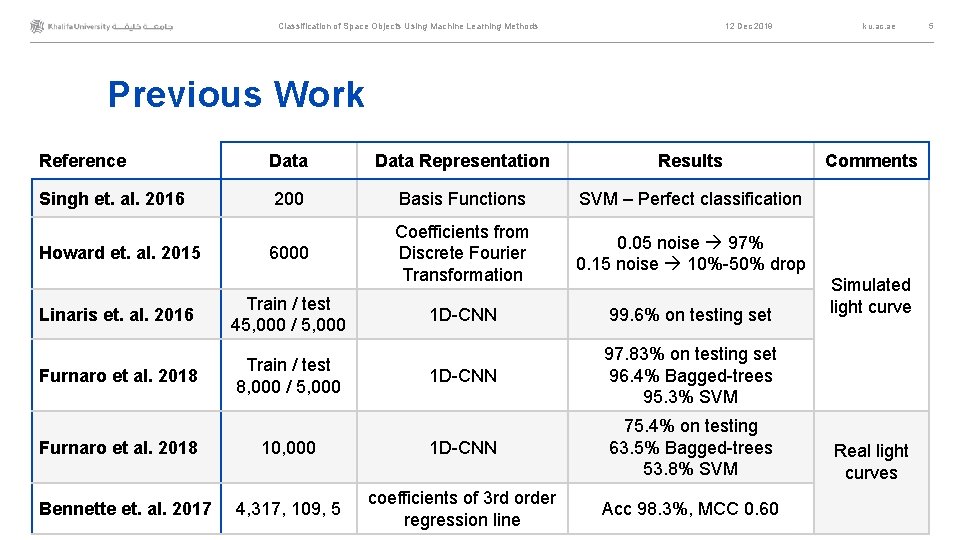
Classification of Space Objects Using Machine Learning Methods 12 Dec 2019 ku. ac. ae Previous Work Reference Data Representation Results Singh et. al. 2016 200 Basis Functions SVM – Perfect classification 6000 Coefficients from Discrete Fourier Transformation 0. 05 noise 97% 0. 15 noise 10%-50% drop 1 D-CNN 99. 6% on testing set 1 D-CNN 97. 83% on testing set 96. 4% Bagged-trees 95. 3% SVM 10, 000 1 D-CNN 75. 4% on testing 63. 5% Bagged-trees 53. 8% SVM 4, 317, 109, 5 coefficients of 3 rd order regression line Acc 98. 3%, MCC 0. 60 Howard et. al. 2015 Linaris et. al. 2016 Train / test 45, 000 / 5, 000 Furnaro et al. 2018 Train / test 8, 000 / 5, 000 Furnaro et al. 2018 Bennette et. al. 2017 Comments Simulated light curve Real light curves 5
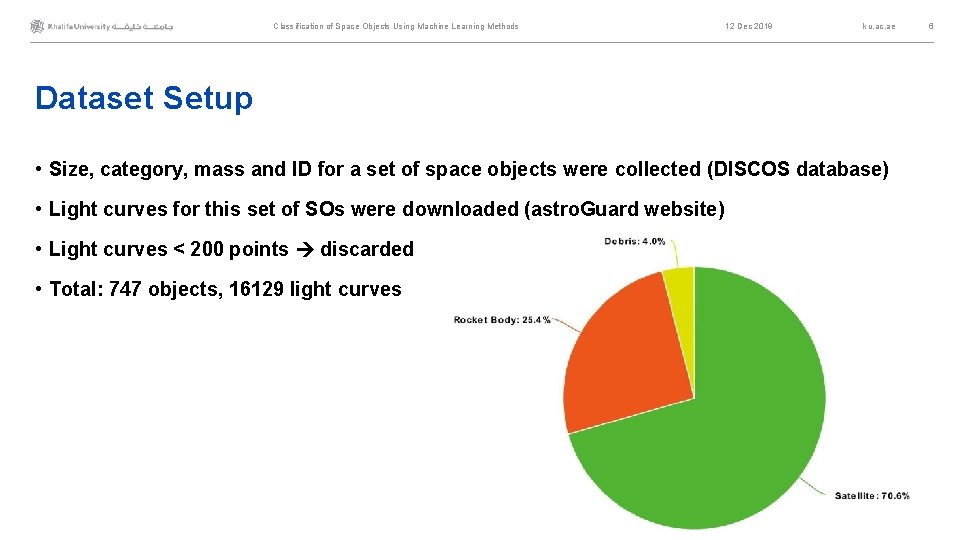
Classification of Space Objects Using Machine Learning Methods 12 Dec 2019 ku. ac. ae Dataset Setup • Size, category, mass and ID for a set of space objects were collected (DISCOS database) • Light curves for this set of SOs were downloaded (astro. Guard website) • Light curves < 200 points discarded • Total: 747 objects, 16129 light curves 6
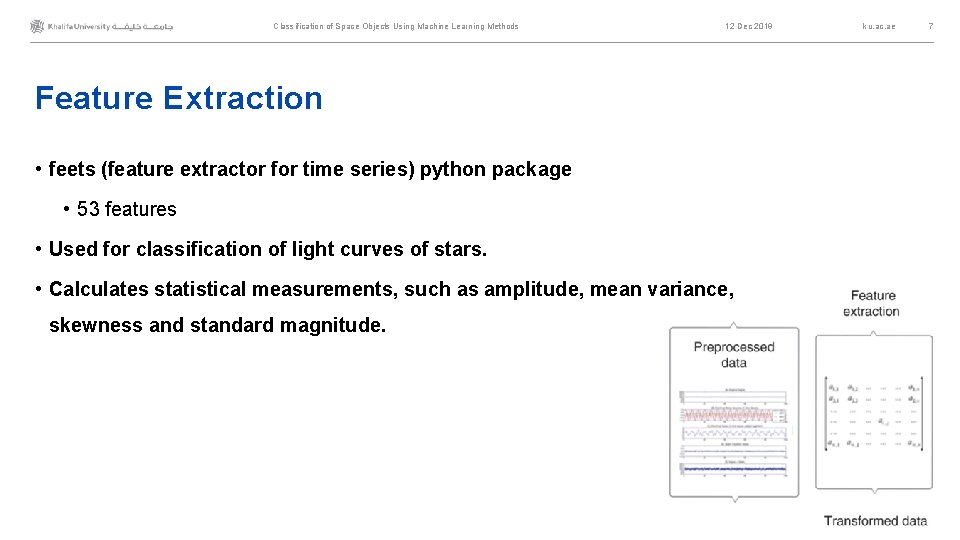
Classification of Space Objects Using Machine Learning Methods 12 Dec 2019 Feature Extraction • feets (feature extractor for time series) python package • 53 features • Used for classification of light curves of stars. • Calculates statistical measurements, such as amplitude, mean variance, skewness and standard magnitude. ku. ac. ae 7
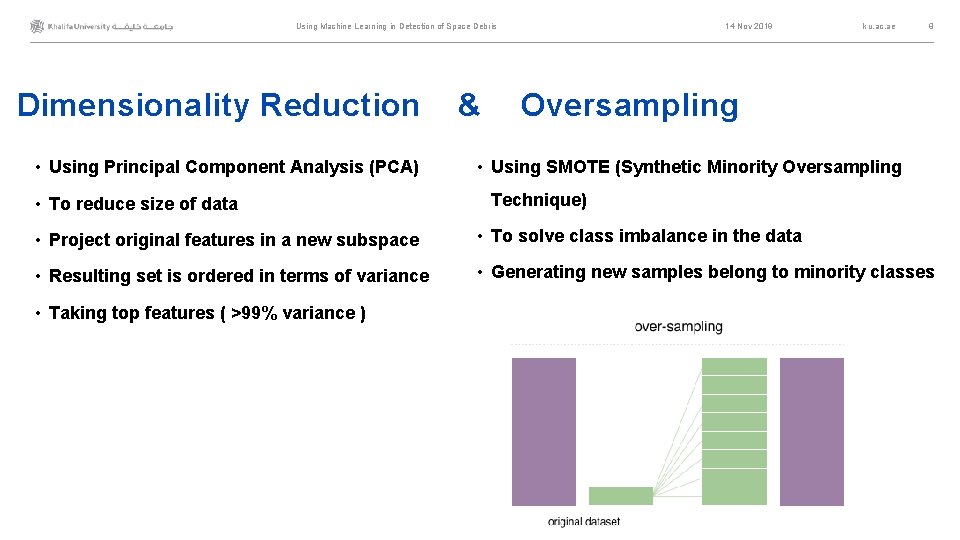
Using Machine Learning in Detection of Space Debris Dimensionality Reduction • Using Principal Component Analysis (PCA) • To reduce size of data & 14 Nov 2019 ku. ac. ae 8 Oversampling • Using SMOTE (Synthetic Minority Oversampling Technique) • Project original features in a new subspace • To solve class imbalance in the data • Resulting set is ordered in terms of variance • Generating new samples belong to minority classes • Taking top features ( >99% variance )
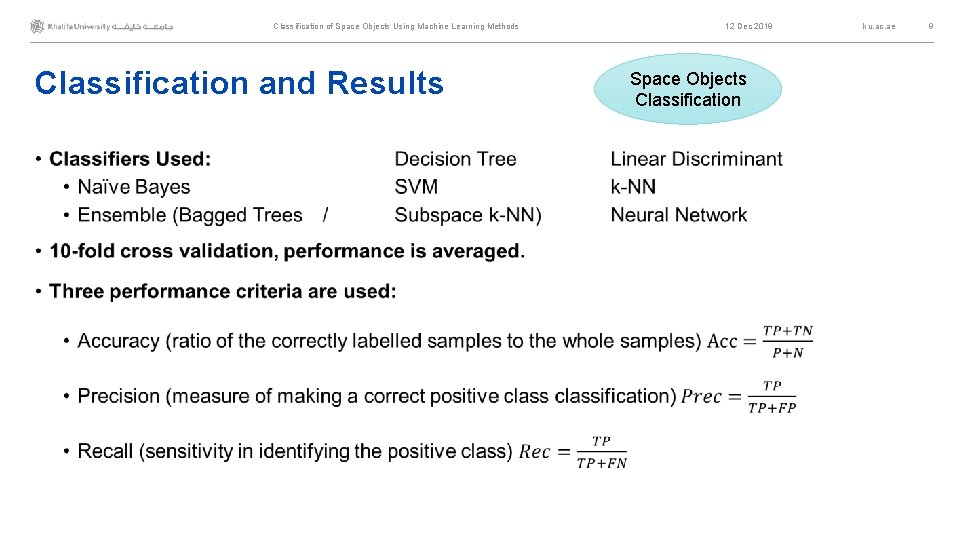
Classification of Space Objects Using Machine Learning Methods Classification and Results • 12 Dec 2019 Space Objects Classification ku. ac. ae 9
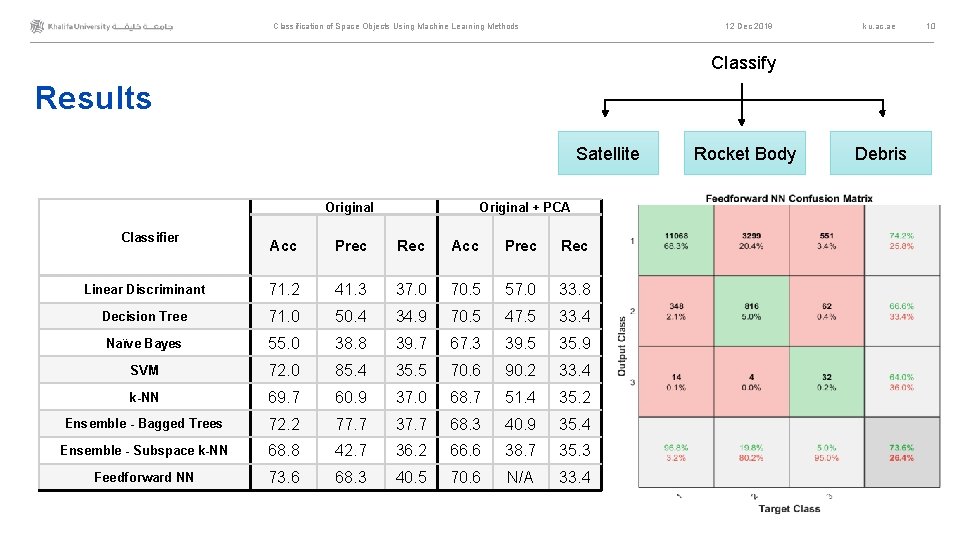
Classification of Space Objects Using Machine Learning Methods 12 Dec 2019 ku. ac. ae Classify Results Satellite Original Classifier Original + PCA Acc Prec Rec Linear Discriminant 71. 2 41. 3 37. 0 70. 5 57. 0 33. 8 Decision Tree 71. 0 50. 4 34. 9 70. 5 47. 5 33. 4 Naïve Bayes 55. 0 38. 8 39. 7 67. 3 39. 5 35. 9 SVM 72. 0 85. 4 35. 5 70. 6 90. 2 33. 4 k-NN 69. 7 60. 9 37. 0 68. 7 51. 4 35. 2 Ensemble - Bagged Trees 72. 2 77. 7 37. 7 68. 3 40. 9 35. 4 Ensemble - Subspace k-NN 68. 8 42. 7 36. 2 66. 6 38. 7 35. 3 Feedforward NN 73. 6 68. 3 40. 5 70. 6 N/A 33. 4 Rocket Body Debris 10
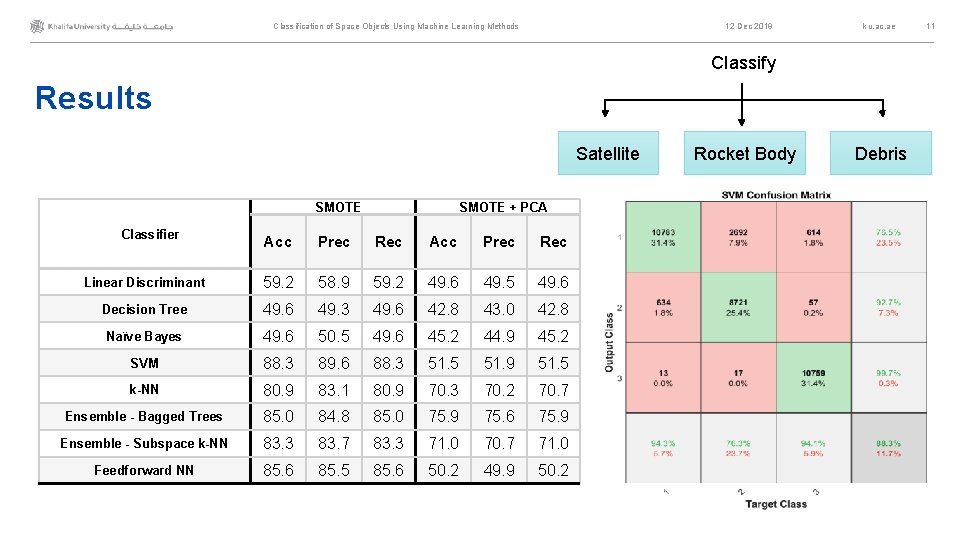
Classification of Space Objects Using Machine Learning Methods 12 Dec 2019 ku. ac. ae Classify Results Satellite SMOTE Classifier SMOTE + PCA Acc Prec Rec Linear Discriminant 59. 2 58. 9 59. 2 49. 6 49. 5 49. 6 Decision Tree 49. 6 49. 3 49. 6 42. 8 43. 0 42. 8 Naïve Bayes 49. 6 50. 5 49. 6 45. 2 44. 9 45. 2 SVM 88. 3 89. 6 88. 3 51. 5 51. 9 51. 5 k-NN 80. 9 83. 1 80. 9 70. 3 70. 2 70. 7 Ensemble - Bagged Trees 85. 0 84. 8 85. 0 75. 9 75. 6 75. 9 Ensemble - Subspace k-NN 83. 3 83. 7 83. 3 71. 0 70. 7 71. 0 Feedforward NN 85. 6 85. 5 85. 6 50. 2 49. 9 50. 2 Rocket Body Debris 11
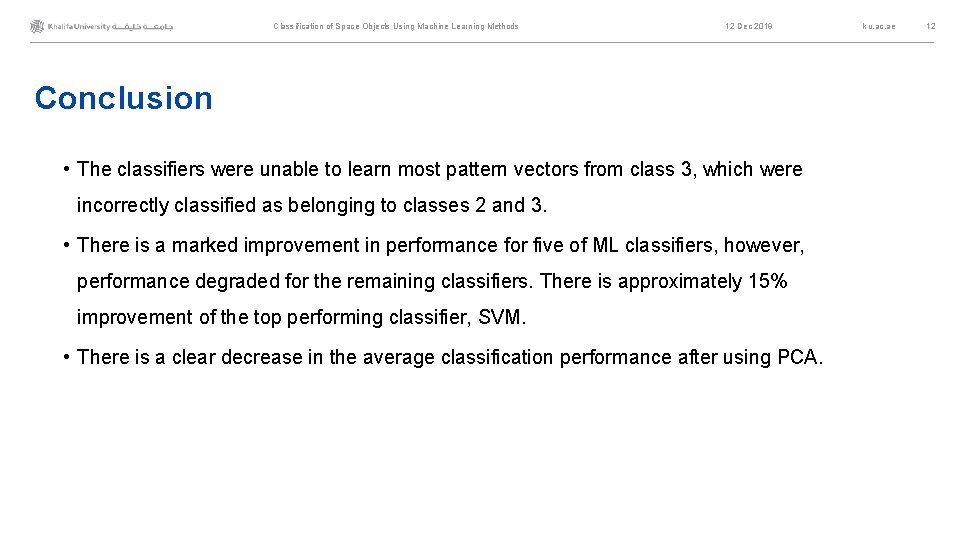
Classification of Space Objects Using Machine Learning Methods 12 Dec 2019 Conclusion • The classifiers were unable to learn most pattern vectors from class 3, which were incorrectly classified as belonging to classes 2 and 3. • There is a marked improvement in performance for five of ML classifiers, however, performance degraded for the remaining classifiers. There is approximately 15% improvement of the top performing classifier, SVM. • There is a clear decrease in the average classification performance after using PCA. ku. ac. ae 12
Classification of Space Objects Using Machine Learning Methods Further Work • Different feature extraction methods • Deep Learning approach: • Convolutional Neural Networks (CNN) – 1 D or 2 D • Recurrent Neural Networks (RNN) – LSTM (Long Short-Term Memory) • Addressing class imbalance: • Cost-sensitive classifiers • Ensemble models 12 Dec 2019 ku. ac. ae 13

Classification of Space Objects Using Machine Learning Methods Thank you 12 Dec 2019 ku. ac. ae 14
- Slides: 14