
Classification of Protein Localization Patterns in 3 D

- Slides: 13
Classification of Protein Localization Patterns in 3 -D Meel Velliste Carnegie Mellon University
Introduction • Need a Systematics for Protein Localization • Need Microscope Automation • Feature based classification of Localization Patterns • Pioneering work done with 2 D images • Now exploring classification of 3 D images
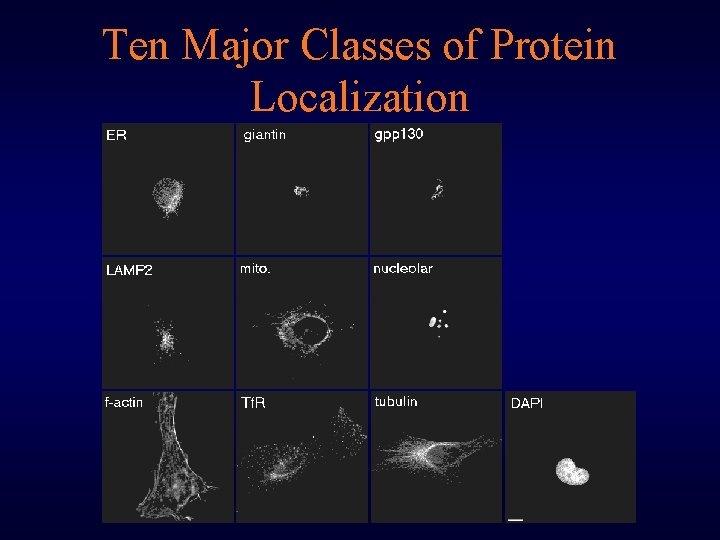
Ten Major Classes of Protein Localization
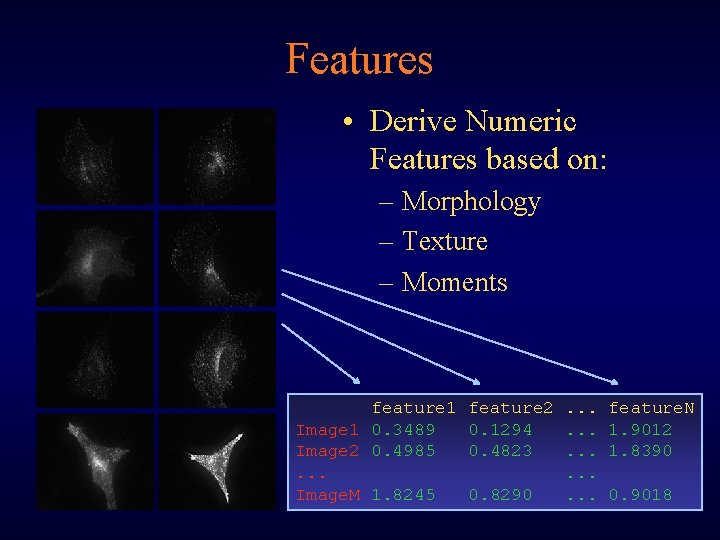
Features • Derive Numeric Features based on: – Morphology – Texture – Moments feature 1 feature 2. . . feature. N Image 1 0. 3489 0. 1294. . . 1. 9012 Image 2 0. 4985 0. 4823. . . 1. 8390. . . Image. M 1. 8245 0. 8290. . . 0. 9018
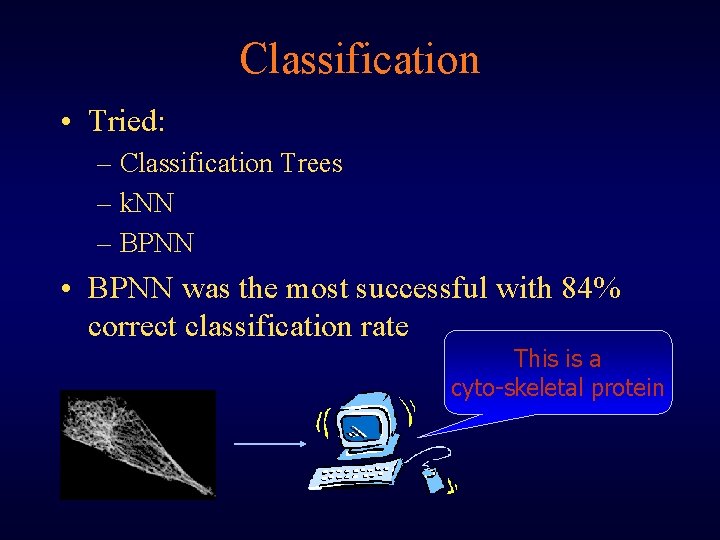
Classification • Tried: – Classification Trees – k. NN – BPNN • BPNN was the most successful with 84% correct classification rate This is a cyto-skeletal protein
Results of 2 -D Classification Overall accuracy = 84%
Motivation for 3 -D Classification • Cells are 3 -dimensional objects • 2 -D images take a slice through the cell • Resultant images are largely dependent on the z-position of the slice • Losing a lot of 3 -D structural information
The Approach • Acquire a set of 3 -D images for the same 10 classes as used in the 2 -D work (have 5 now) • Calculate equivalent features to what was used with the 2 -D images • Compare performance
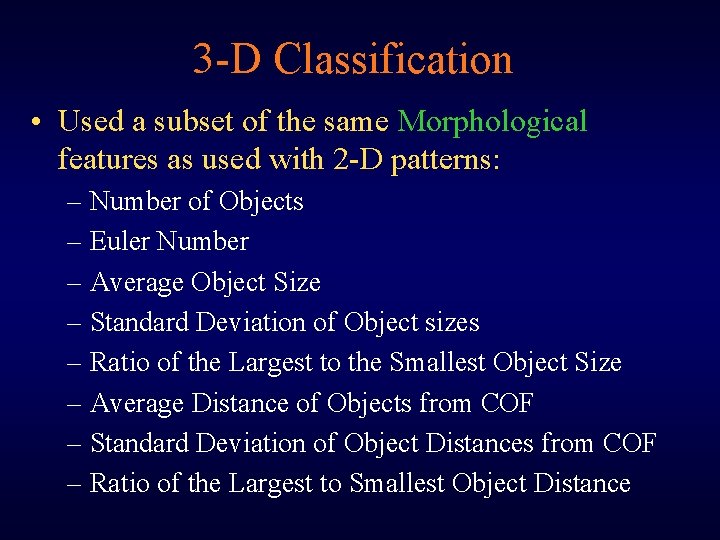
3 -D Classification • Used a subset of the same Morphological features as used with 2 -D patterns: – Number of Objects – Euler Number – Average Object Size – Standard Deviation of Object sizes – Ratio of the Largest to the Smallest Object Size – Average Distance of Objects from COF – Standard Deviation of Object Distances from COF – Ratio of the Largest to Smallest Object Distance
3 -D Classification Results Overall accuracy = 84% (95% with GPP=Giantin)
2 -D Results — Same 8 Features Overall accuracy = 84% (95% with GPP=Giantin)
Conclusion • Further work needed to determine if there is any advantage to using 3 D images over 2 D images • Need to design new features to take advantage of extra information in 3 D images
Acknowledgements • Elizabeth Wu - acquired the 3 -D image set • Michael V. Boland & Robert F. Murphy pioneering work on 2 -D images