
Classification of Polymeric Membranes Symmetric dense porous Asymmetric
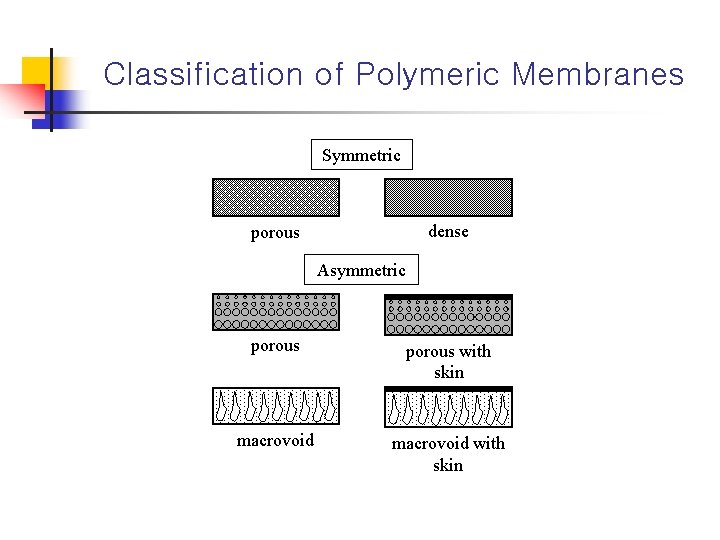
Classification of Polymeric Membranes Symmetric dense porous Asymmetric porous with skin macrovoid with skin
Method for Polymeric Membrane Preparation n TIPS (Thermally Induced Phase Separation); Change in casting solution temperature. Air-Casting and Evaporation; Evaporation of the volatile solvent in casting solution. NIPS (Nonsolvent Induced Phase Separation); Change in composition by the addition of nonsolvent. Exposure to vapor or immersion in nonsolvent bath.
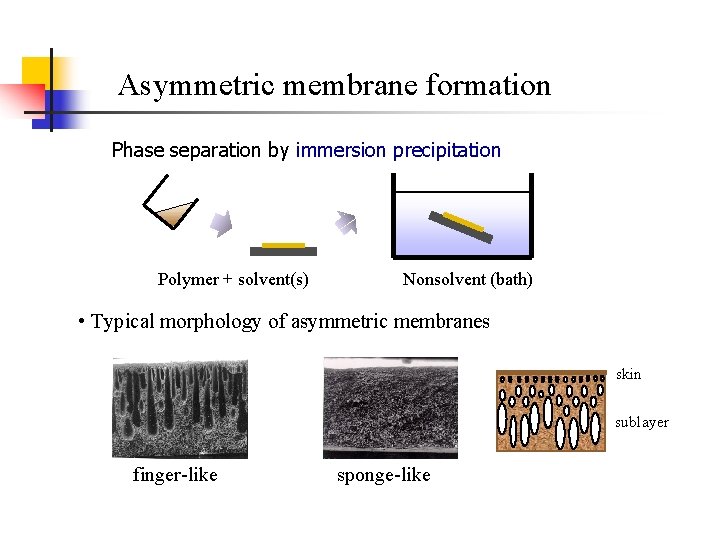
Asymmetric membrane formation Phase separation by immersion precipitation Polymer + solvent(s) Nonsolvent (bath) • Typical morphology of asymmetric membranes skin sublayer finger-like sponge-like
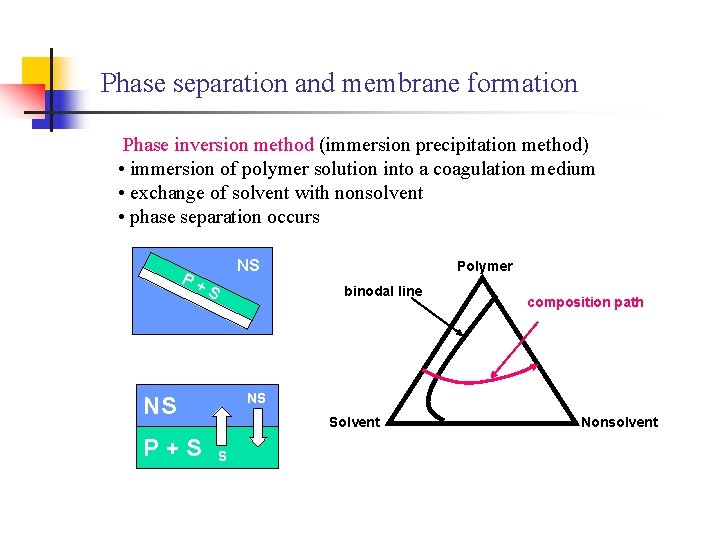
Phase separation and membrane formation Phase inversion method (immersion precipitation method) • immersion of polymer solution into a coagulation medium • exchange of solvent with nonsolvent • phase separation occurs P+ NS S binodal line composition path NS NS P+S Polymer Solvent S Nonsolvent
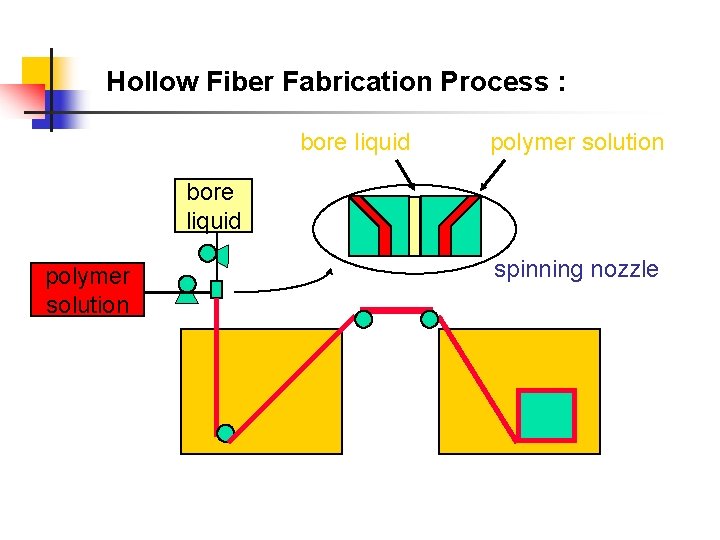
Hollow Fiber Fabrication Process : bore liquid polymer solution spinning nozzle
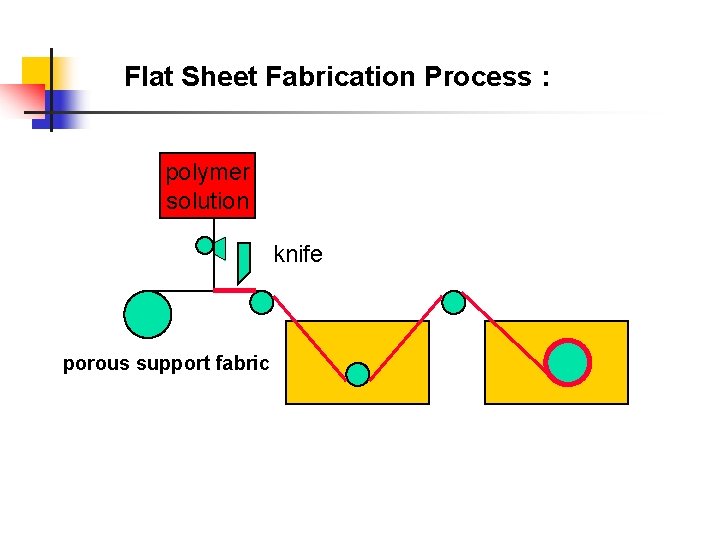
Flat Sheet Fabrication Process : polymer solution knife porous support fabric
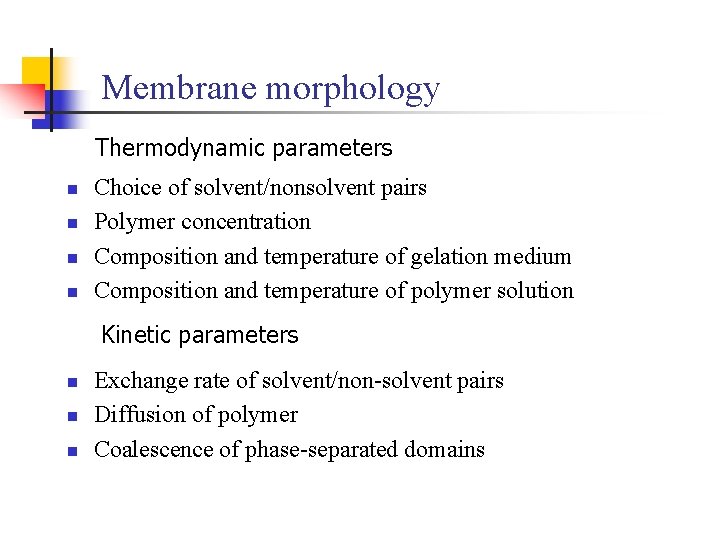
Membrane morphology Thermodynamic parameters n n Choice of solvent/nonsolvent pairs Polymer concentration Composition and temperature of gelation medium Composition and temperature of polymer solution Kinetic parameters n n n Exchange rate of solvent/non-solvent pairs Diffusion of polymer Coalescence of phase-separated domains
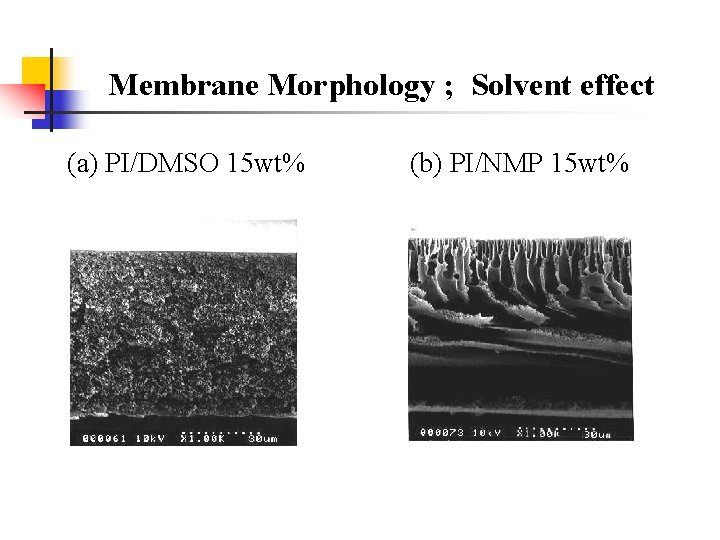
Membrane Morphology ; Solvent effect (a) PI/DMSO 15 wt% (b) PI/NMP 15 wt%
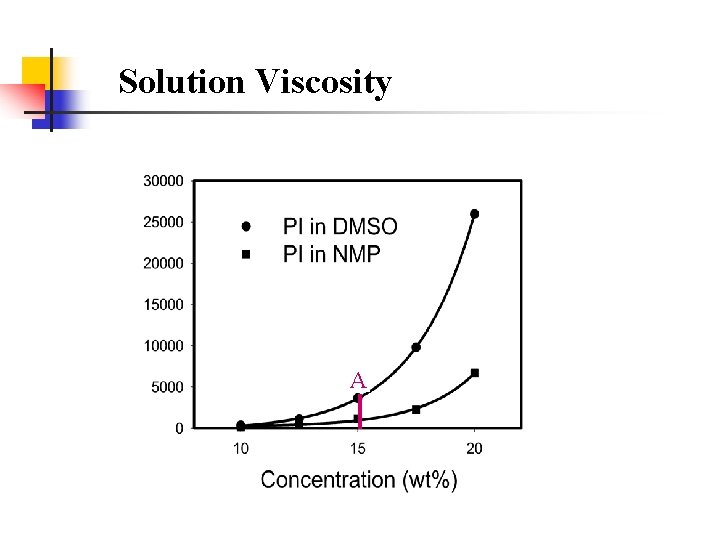
Solution Viscosity A
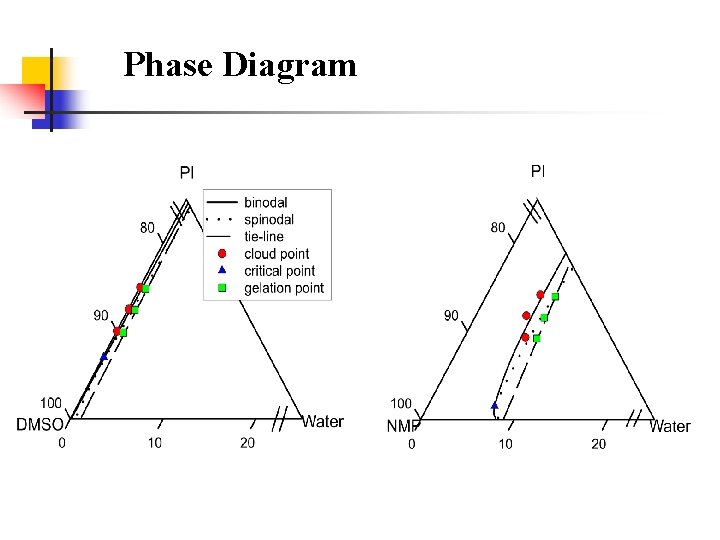
Phase Diagram
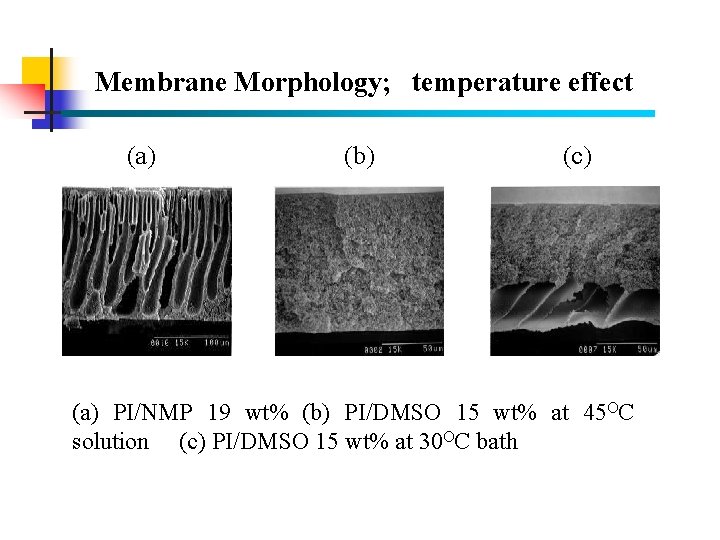
Membrane Morphology; temperature effect (a) (b) (c) (a) PI/NMP 19 wt% (b) PI/DMSO 15 wt% at 45 OC solution (c) PI/DMSO 15 wt% at 30 OC bath
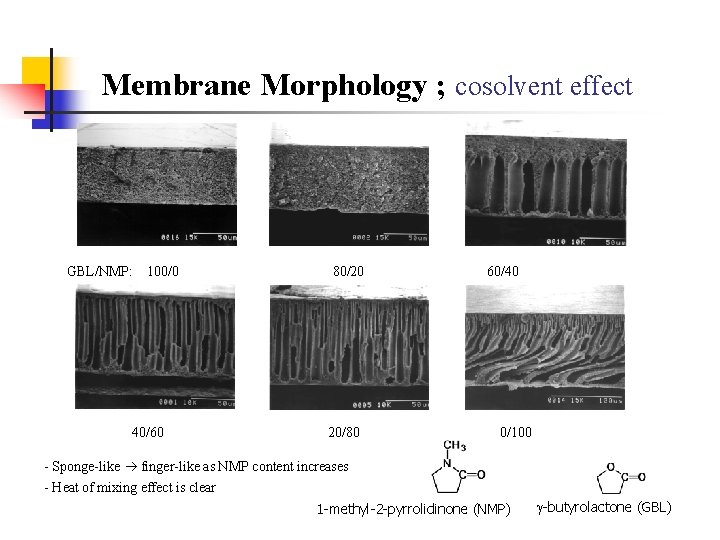
Membrane Morphology ; cosolvent effect GBL/NMP: 100/0 40/60 80/20 20/80 60/40 0/100 - Sponge-like finger-like as NMP content increases - Heat of mixing effect is clear 1 -methyl-2 -pyrrolidinone (NMP) g-butyrolactone (GBL)
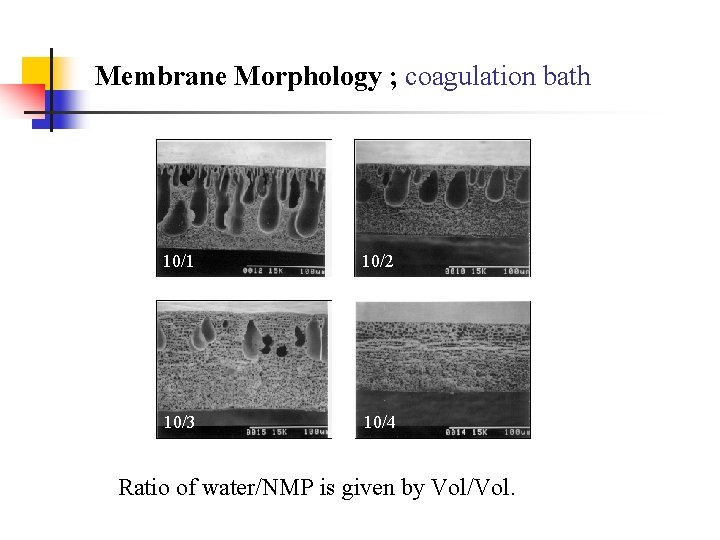
Membrane Morphology ; coagulation bath 10/1 10/2 10/3 10/4 Ratio of water/NMP is given by Vol/Vol.
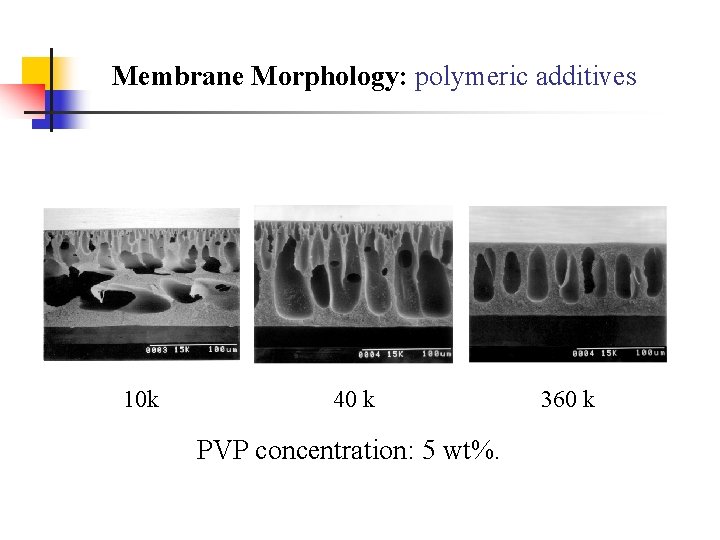
Membrane Morphology: polymeric additives 10 k 40 k PVP concentration: 5 wt%. 360 k
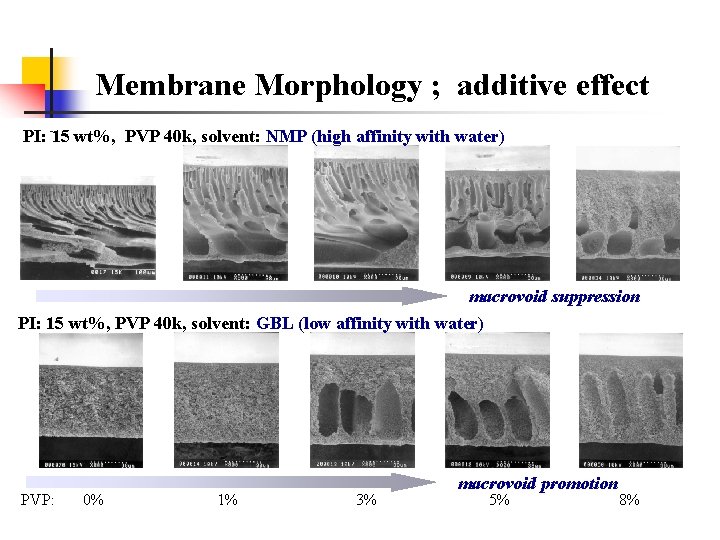
Membrane Morphology ; additive effect PI: 15 wt%, PVP 40 k, solvent: NMP (high affinity with water) macrovoid suppression PI: 15 wt%, PVP 40 k, solvent: GBL (low affinity with water) PVP: 0% 1% 3% macrovoid promotion 5% 8%
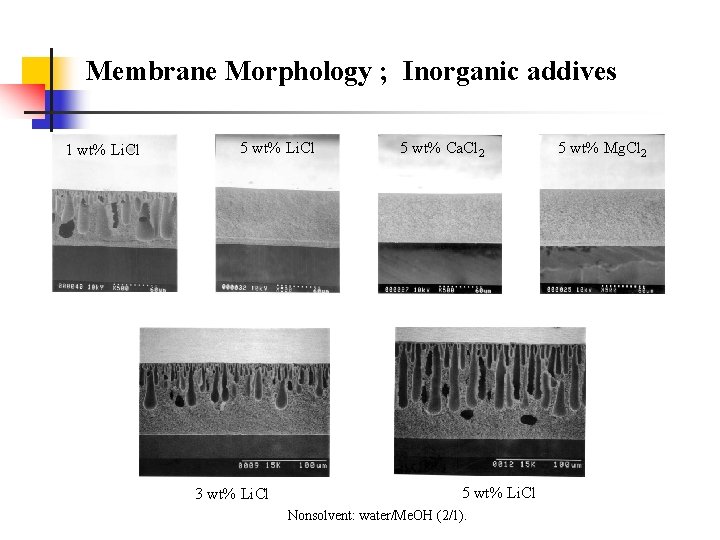
Membrane Morphology ; Inorganic addives 1 wt% Li. Cl 5 wt% Li. Cl 3 wt% Li. Cl 5 wt% Ca. Cl 2 5 wt% Li. Cl Nonsolvent: water/Me. OH (2/1). 5 wt% Mg. Cl 2
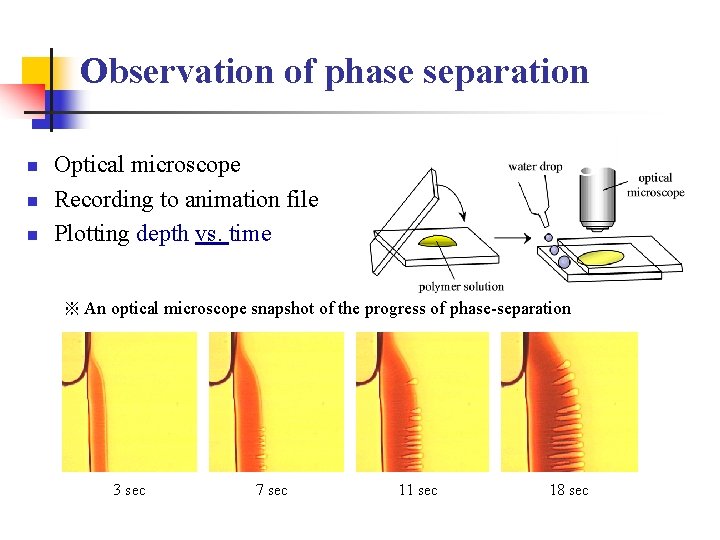
Observation of phase separation n Optical microscope Recording to animation file Plotting depth vs. time ※ An optical microscope snapshot of the progress of phase-separation 3 sec 7 sec 11 sec 18 sec
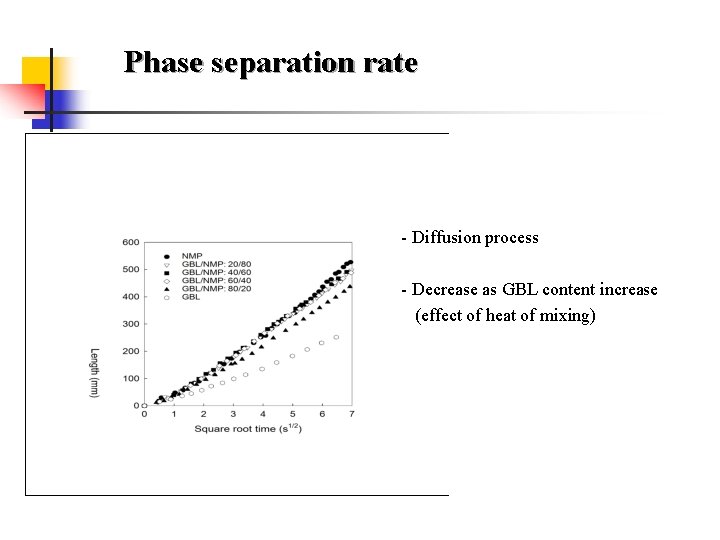
Phase separation rate - Diffusion process - Decrease as GBL content increase (effect of heat of mixing)
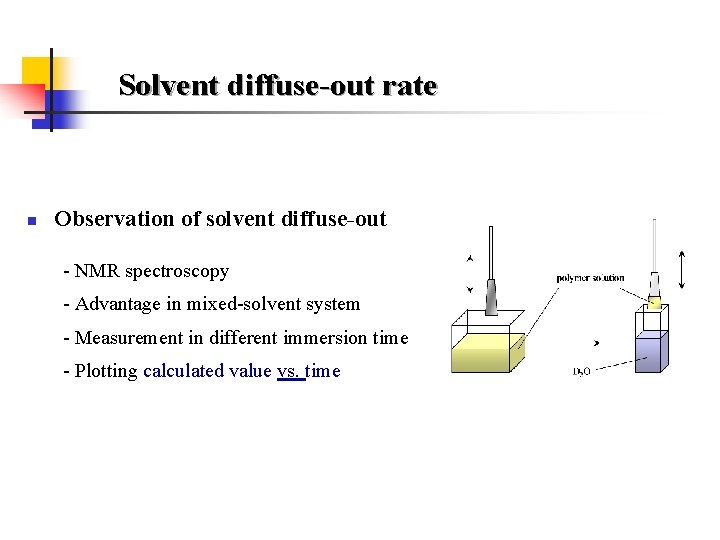
Solvent diffuse-out rate n Observation of solvent diffuse-out - NMR spectroscopy - Advantage in mixed-solvent system - Measurement in different immersion time - Plotting calculated value vs. time
- Slides: 25