
Classification of Organisms and Cladograms Regents Biology The
Classification of Organisms and Cladograms Regents Biology
The Classification Game!! With your table In the following few slides, you will find 14 different organisms, each of them labeled with a letter. In your groups, write down two main classifications (example red/green). Then place the corresponding letters under the correct classification. Regents Biology
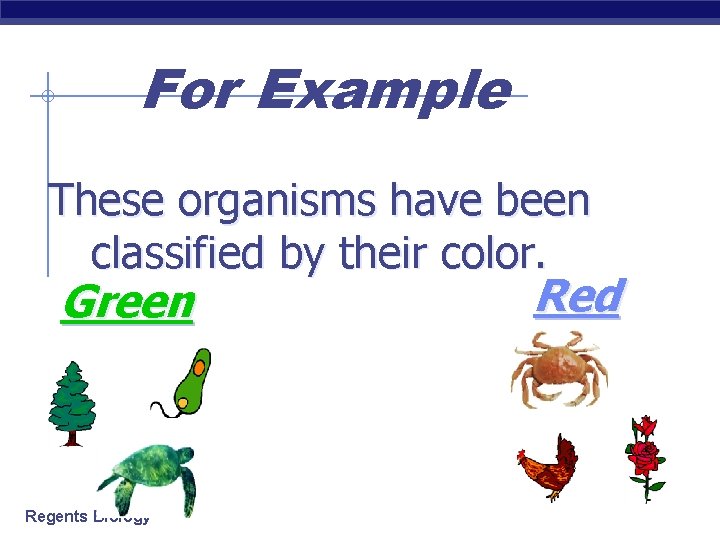
For Example These organisms have been classified by their color. Green Regents Biology Red

ARE YOU READY! Regents Biology

Regents Biology
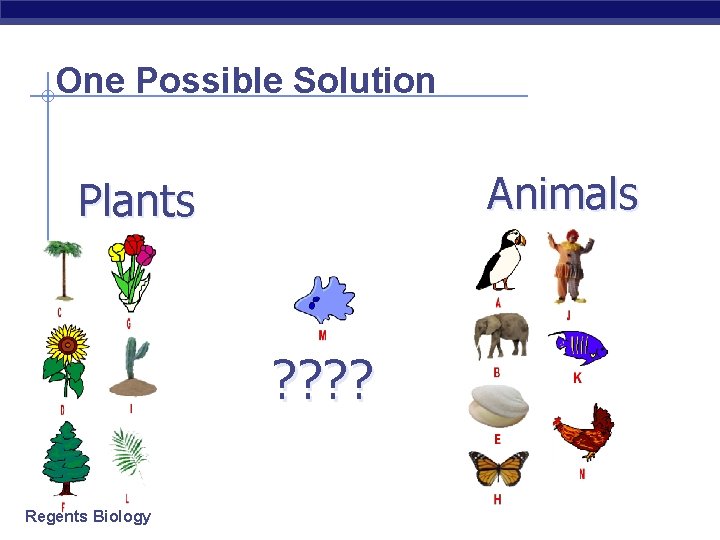
One Possible Solution Animals Plants ? ? Regents Biology
Did You Have Problems? ? There were actually several different ways to go about classifying these 14 organisms. You might have done color, shape, size, number of legs… the possibilities are endless. You might have encountered one or two that really did not fit into either of your two classifications, what should you do when this happens? Make a new classification of course! And this is what scientist have done as well through the years. Regents Biology
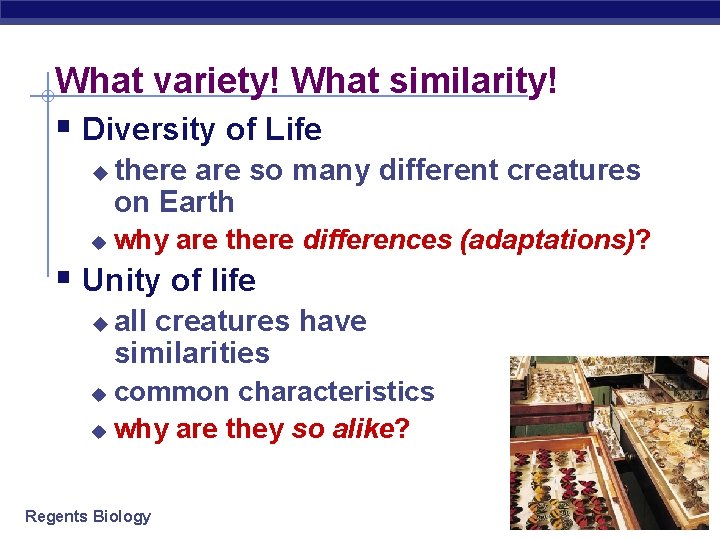
What variety! What similarity! § Diversity of Life u u there are so many different creatures on Earth why are there differences (adaptations)? § Unity of life u all creatures have similarities common characteristics u why are they so alike? u Regents Biology
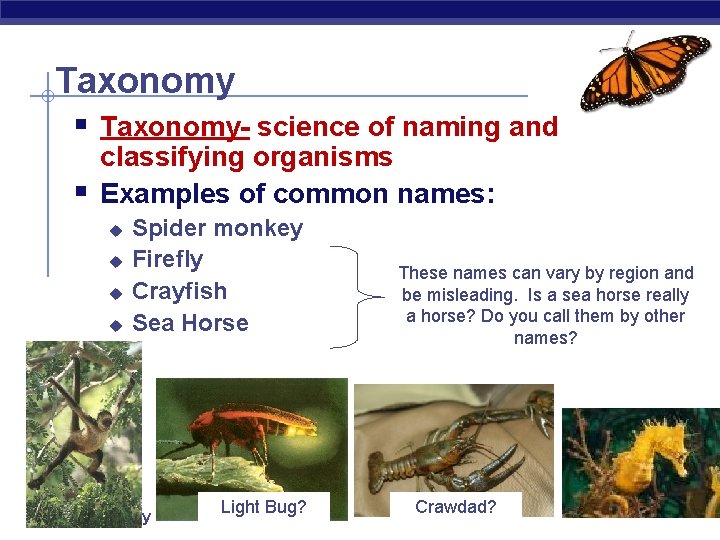
Taxonomy § Taxonomy- science of naming and § classifying organisms Examples of common names: u u Spider monkey Firefly Crayfish Sea Horse Regents Biology Light Bug? These names can vary by region and be misleading. Is a sea horse really a horse? Do you call them by other names? Crawdad?
Carolus Linnaeus § The Linnean system proposed in 1700 s u Binomial Nomenclature- 2 part scientific name u § Genus — larger group to which organism belongs w always capitalized § species — specific name for that organism w always lowercase § Written either italicized OR underlined § example: Linnaeus named humans Homo sapiens w means “wise man” Regents Biology
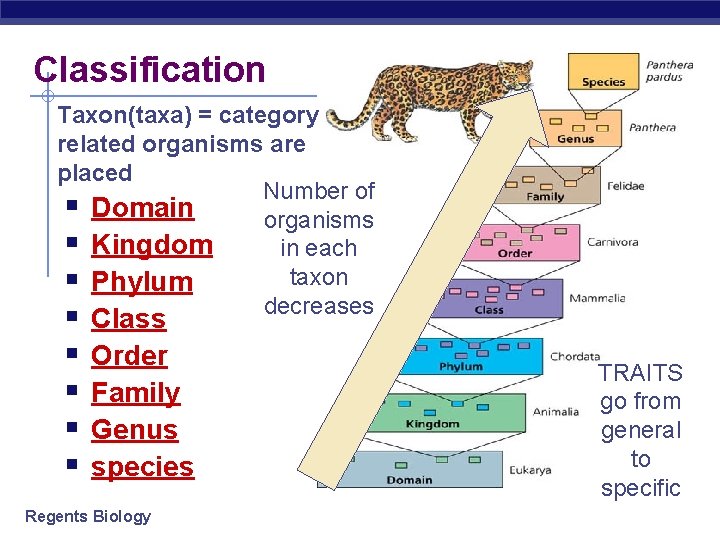
Classification Taxon(taxa) = category related organisms are placed Number of § Domain organisms § Kingdom in each taxon § Phylum decreases § § § Class Order Family Genus species Regents Biology TRAITS go from general to specific

The 8 Taxa (plural for taxon) § Domain § Kingdom § Phylum § Class § Order § Family § Genus § Species Regents Biology Did King Philip Cross Over For Good Spaghetti Dumb Kids Playing Chicken On Freeways Get Smashed
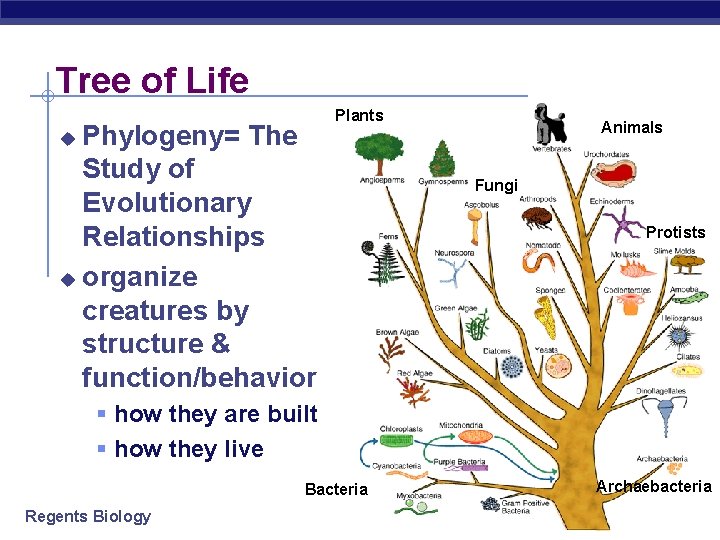
Tree of Life Phylogeny= The Study of Evolutionary Relationships u organize creatures by structure & function/behavior Plants Animals u Fungi Protists § how they are built § how they live Bacteria Regents Biology Archaebacteria
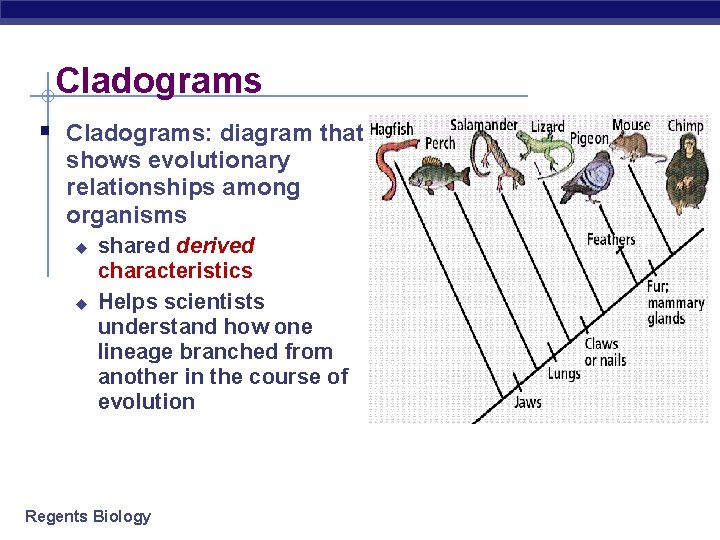
Cladograms § Cladograms: diagram that shows evolutionary relationships among organisms u u shared derived characteristics Helps scientists understand how one lineage branched from another in the course of evolution Regents Biology
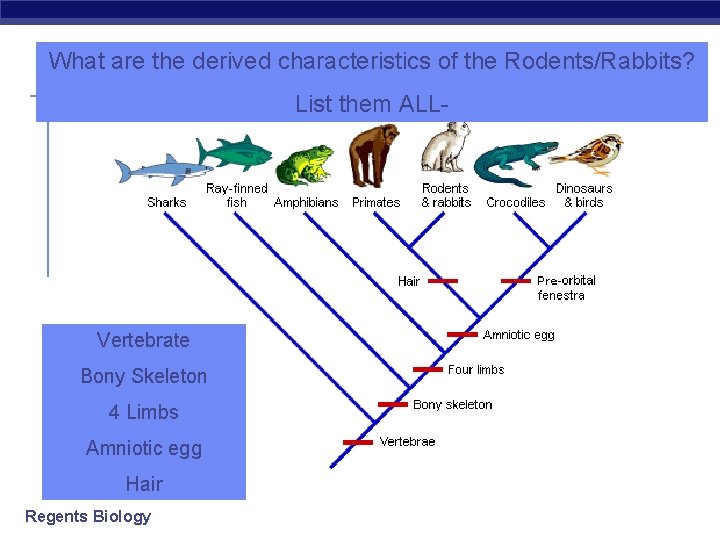
What are the derived characteristics of the Rodents/Rabbits? List them ALL- Vertebrate Bony Skeleton 4 Limbs Amniotic egg Hair Regents Biology
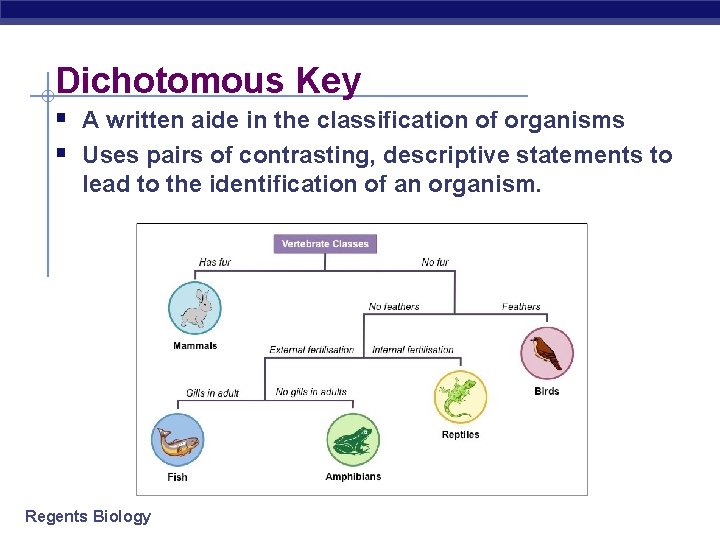
Dichotomous Key § A written aide in the classification of organisms § Uses pairs of contrasting, descriptive statements to lead to the identification of an organism. Regents Biology
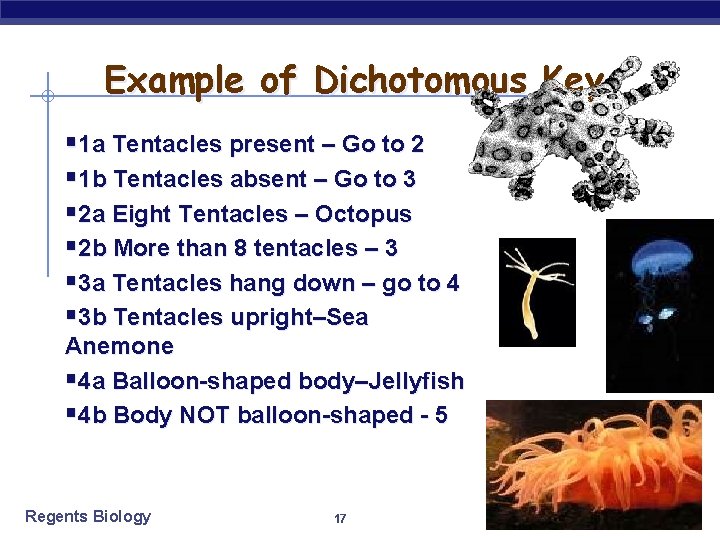
Example of Dichotomous Key § 1 a Tentacles present – Go to 2 § 1 b Tentacles absent – Go to 3 § 2 a Eight Tentacles – Octopus § 2 b More than 8 tentacles – 3 § 3 a Tentacles hang down – go to 4 § 3 b Tentacles upright–Sea Anemone § 4 a Balloon-shaped body–Jellyfish § 4 b Body NOT balloon-shaped - 5 Regents Biology 17
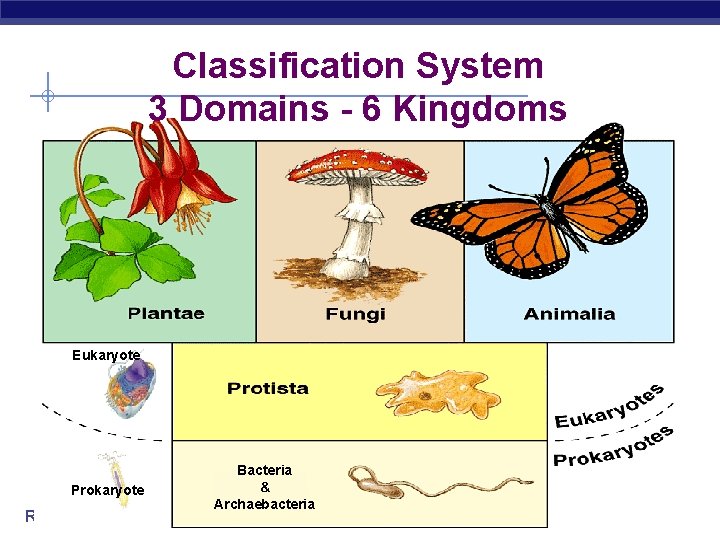
Classification System 3 Domains - 6 Kingdoms Eukaryote Prokaryote Regents Biology Bacteria & Archaebacteria
3 Domain/6 Kingdom system 1. Archaebacteria – ALL Prokaryotes Prokaryote § Kingdom Archae w Unicellular, cell wall w Auto AND hetertrophic w Live in harsh conditions – example high temp, high salt, low oxygen, extreme p. H w Oldest life forms in the fossil record 2. Eubacteria - ALL Prokaryotes § Kingdom Bacteria w Unicellular, cell wall w Auto AND heterotrophic w Some harmful – cause disease – ex. Strep throat, E. coli w Some helpful/beneficial – make vitamin K (in large int), yogurt Regents Biology
3 Domain - 6 Kingdom system 3. Eukaryota - separate organelles in their cells § Protists w Mostly unicellular; No cell wall w Auto AND heterotrophic w Are mobile (can move from place to place) w Ex: ameba, paramecium, algae, euglena § Fungi w Mostly multicellular; cell wall (chitin) w Heterotrophic – decomposers Eukaryote w Sessile – remain in on place w Ex: yeast, mushrooms, mold Regents Biology
3 Domain - 6 Kingdom system 3. Eukaryota - separate organelles in their cells § Plants w Multicellular; cell wall (cellulose) w Autotrophic - Photosynthesis w Sessile; has complex levels of organization w Ex: moss, ferns, flowers, trees § Animals w Multicellular; has complex levels of organization Eukaryote w Heterotrophic w Mobile at some stage in life cycle w Very diverse group – ex: sponges, insects, Regents Biology worms, birds, fish, humans
- Slides: 21