
Classification of Ocean Floor Deep Ocean Basins DeepOcean
Classification of Ocean Floor Deep Ocean Basins
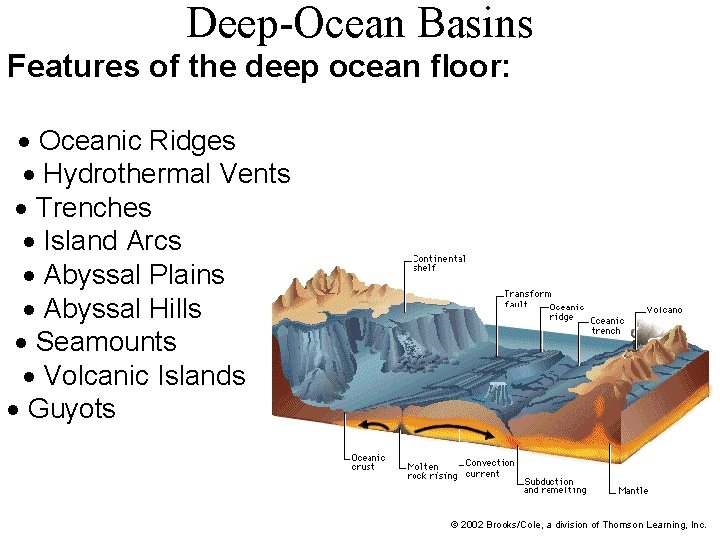
Deep-Ocean Basins Features of the deep ocean floor: Oceanic Ridges Hydrothermal Vents Trenches Island Arcs Abyssal Plains Abyssal Hills Seamounts Volcanic Islands Guyots © 2002 Brooks/Cole, a division of Thomson Learning, Inc.
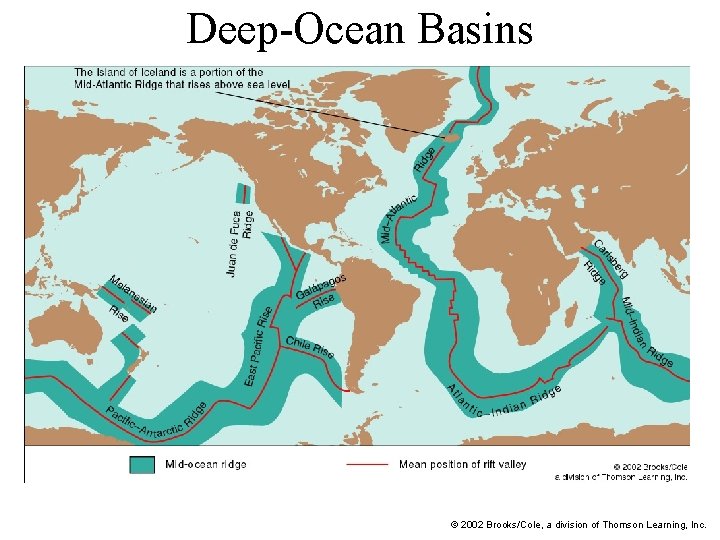
Deep-Ocean Basins An oceanic ridge is a mountainous chain of young, basaltic rock at an active spreading center of an ocean. • Long, underwater mountain ranges. • The largest tectonic feature on the earth. • More than 1500 km wide, 64, 000 km (40, 000 miles) long. • Rises 2 -3 km (up to 2 mi) high above the abyssal plain. • Has a central rift valley. • Composed of basalt rocks. • Faulted with strike-slip (transform) faults. • Shallow earthquakes occur along central rift. © 2002 Brooks/Cole, a division of Thomson Learning, Inc.
Deep-Ocean Basins © 2002 Brooks/Cole, a division of Thomson Learning, Inc.
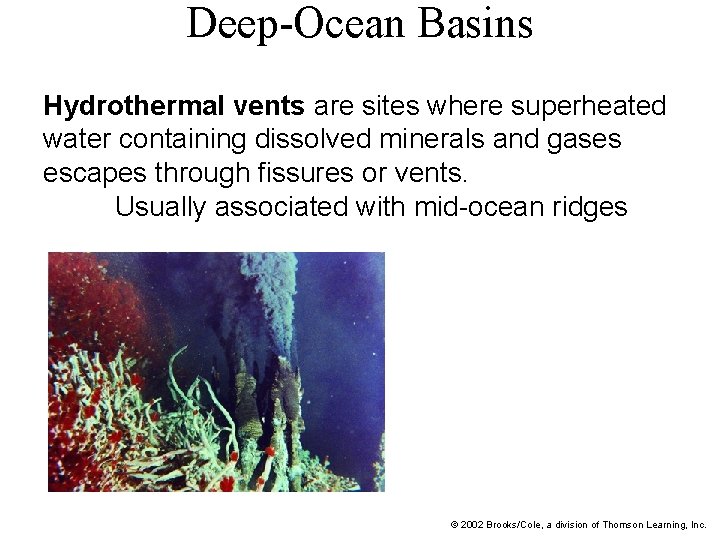
Deep-Ocean Basins Hydrothermal vents are sites where superheated water containing dissolved minerals and gases escapes through fissures or vents. Usually associated with mid-ocean ridges © 2002 Brooks/Cole, a division of Thomson Learning, Inc.
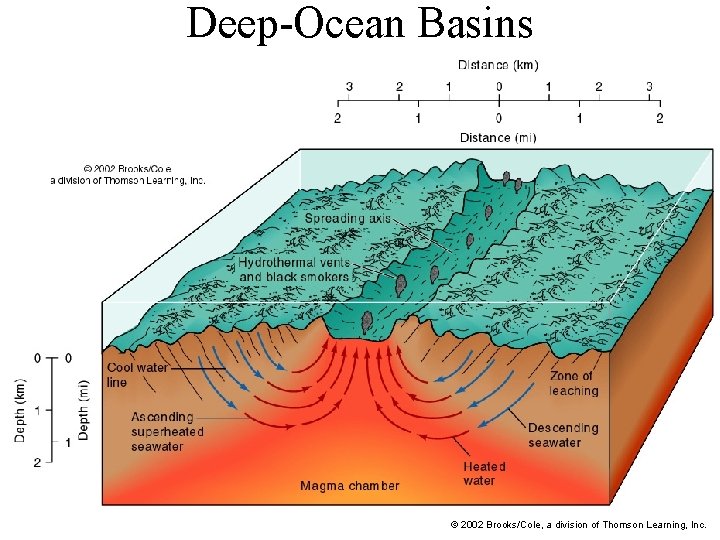
Deep-Ocean Basins © 2002 Brooks/Cole, a division of Thomson Learning, Inc.
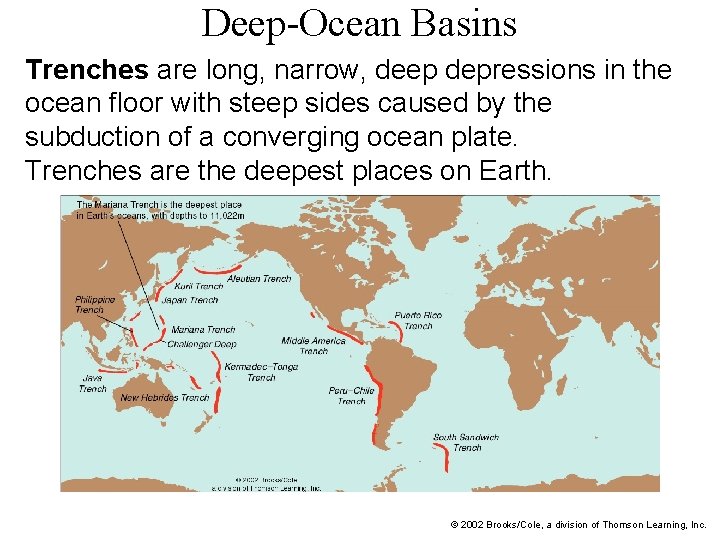
Deep-Ocean Basins Trenches are long, narrow, deep depressions in the ocean floor with steep sides caused by the subduction of a converging ocean plate. Trenches are the deepest places on Earth. © 2002 Brooks/Cole, a division of Thomson Learning, Inc.
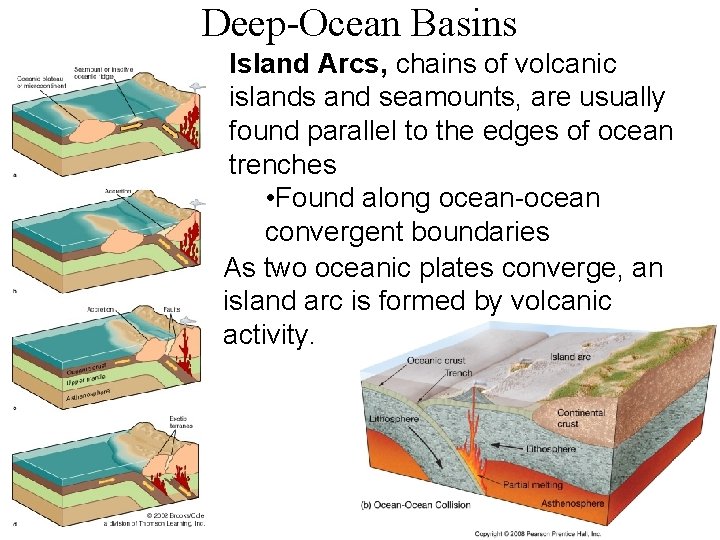
Deep-Ocean Basins Island Arcs, chains of volcanic islands and seamounts, are usually found parallel to the edges of ocean trenches • Found along ocean-ocean convergent boundaries As two oceanic plates converge, an island arc is formed by volcanic activity. © 2002 Brooks/Cole, a division of Thomson Learning, Inc.
Deep-Ocean Basins Abyssal Plain -Very flat area of the ocean floor at the edge of the continental rise. • Average depth is about 4 -6 km (2. 5 -4 mi). • Covered by a layer of sediment, mostly <1 km thick. • The flattest areas on the planet. © 2002 Brooks/Cole, a division of Thomson Learning, Inc.
Deep-Ocean Basins Abyssal hills are small, extinct volcanoes or rock intrusions found between the continental margins and oceanic ridges. © 2002 Brooks/Cole, a division of Thomson Learning, Inc.
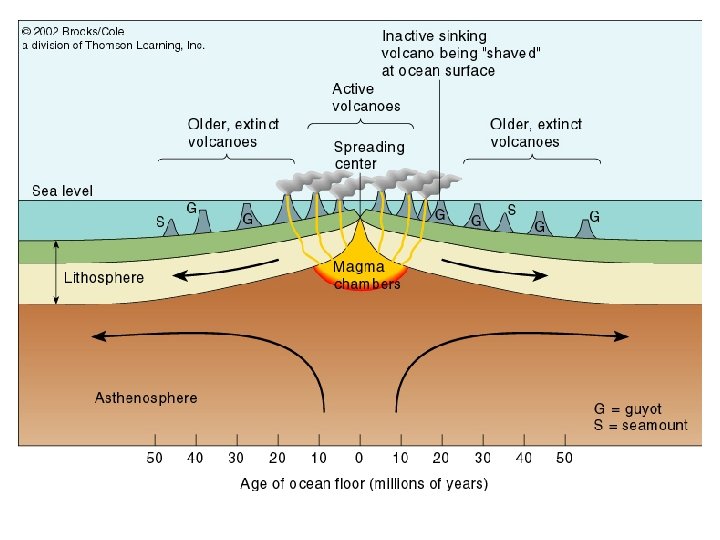
Deep-Ocean Basins Seamounts are volcanic projections from the ocean floor that do not rise above sea level (underwater volcanoes). • Associated with hot spots and mid-ocean ridges If seamounts break the surface of the ocean, they create volcanic islands • The biggest mountain on earth is Mauna Loa (Hawaii). © 2002 Brooks/Cole, a division of Thomson Learning, Inc.
Deep-Ocean Basins • Over time, wave & wind action erodes the peak of a seamount or volcanic island to form a flat-topped tablemount or guyot. • Guyots were once volcanic peaks above sea level. They were eroded by wave action as they sank beneath the surface of the water. • As seamount or guyot is being eroded, it is also being moved away from the ridge or hotspot. • Hot Spots: Surface expression of plumes of magma rising from a stationary source of heat in the mantle. © 2002 Brooks/Cole, a division of Thomson Learning, Inc.
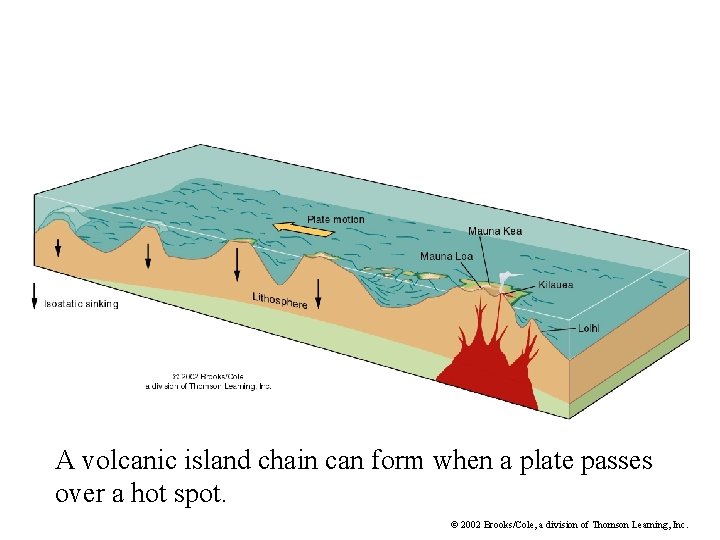
A volcanic island chain can form when a plate passes over a hot spot. © 2002 Brooks/Cole, a division of Thomson Learning, Inc.
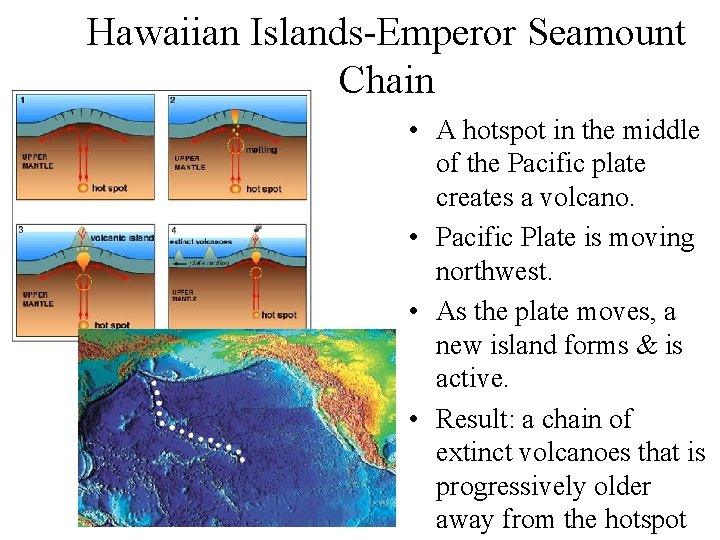
Hawaiian Islands-Emperor Seamount Chain • A hotspot in the middle of the Pacific plate creates a volcano. • Pacific Plate is moving northwest. • As the plate moves, a new island forms & is active. • Result: a chain of extinct volcanoes that is progressively older away from the hotspot
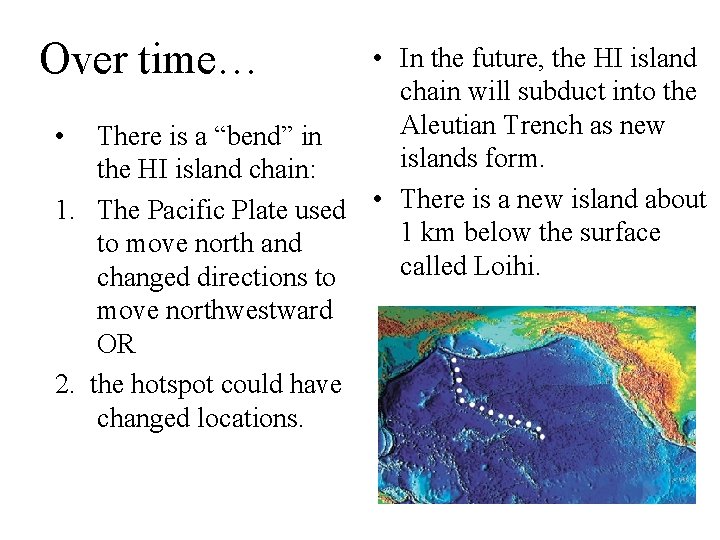
Over time… • In the future, the HI island chain will subduct into the Aleutian Trench as new • There is a “bend” in islands form. the HI island chain: 1. The Pacific Plate used • There is a new island about 1 km below the surface to move north and called Loihi. changed directions to move northwestward OR 2. the hotspot could have changed locations.
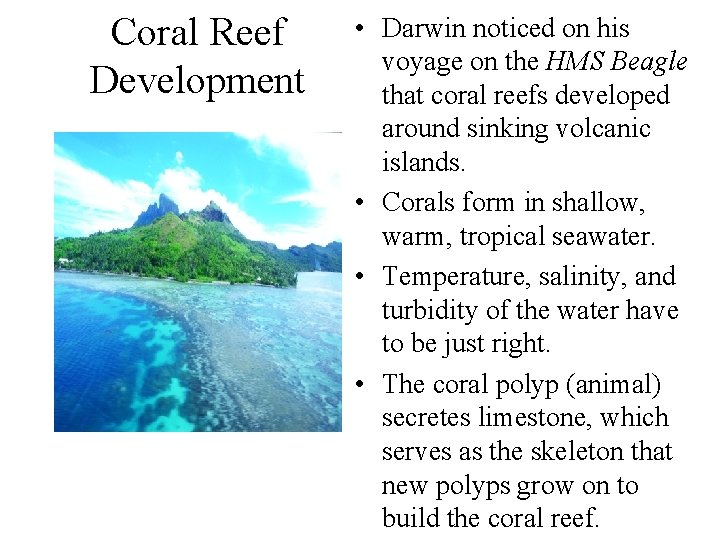
Coral Reef Development • Darwin noticed on his voyage on the HMS Beagle that coral reefs developed around sinking volcanic islands. • Corals form in shallow, warm, tropical seawater. • Temperature, salinity, and turbidity of the water have to be just right. • The coral polyp (animal) secretes limestone, which serves as the skeleton that new polyps grow on to build the coral reef.
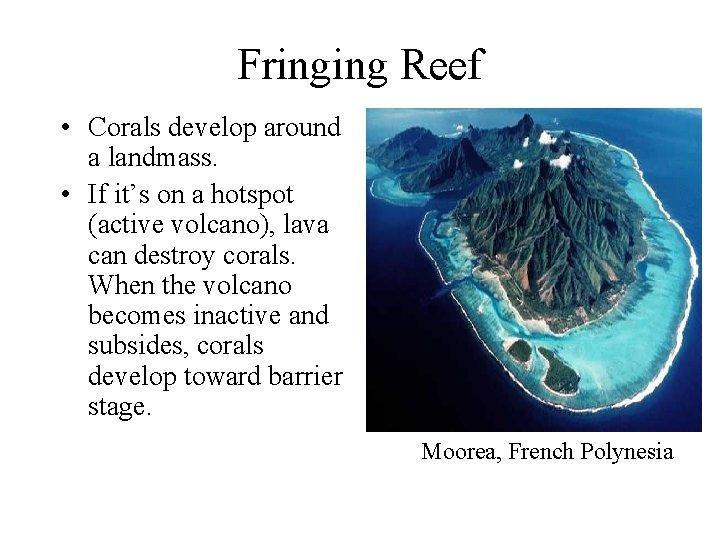
Fringing Reef • Corals develop around a landmass. • If it’s on a hotspot (active volcano), lava can destroy corals. When the volcano becomes inactive and subsides, corals develop toward barrier stage. Moorea, French Polynesia
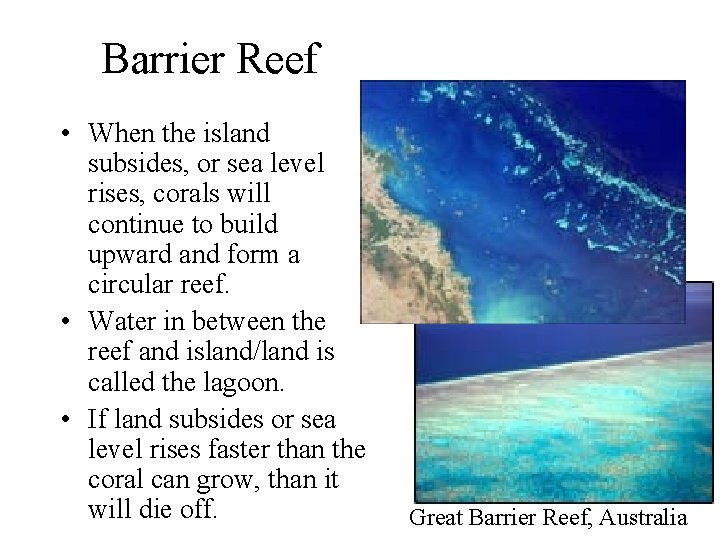
Barrier Reef • When the island subsides, or sea level rises, corals will continue to build upward and form a circular reef. • Water in between the reef and island/land is called the lagoon. • If land subsides or sea level rises faster than the coral can grow, than it will die off. Great Barrier Reef, Australia
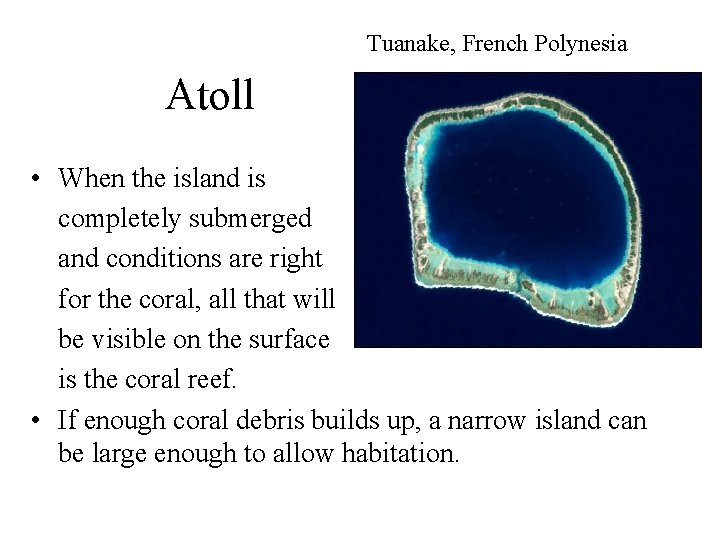
Tuanake, French Polynesia Atoll • When the island is completely submerged and conditions are right for the coral, all that will be visible on the surface is the coral reef. • If enough coral debris builds up, a narrow island can be large enough to allow habitation.
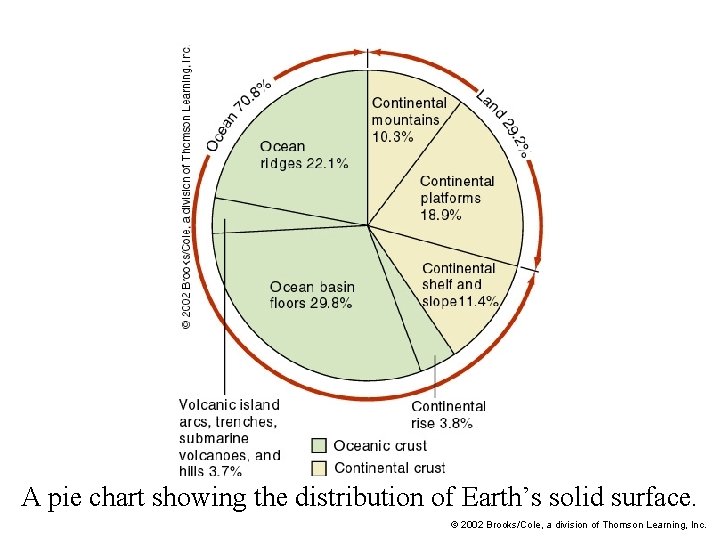
A pie chart showing the distribution of Earth’s solid surface. © 2002 Brooks/Cole, a division of Thomson Learning, Inc.
- Slides: 21