
CLASSIFICATION OF NATURAL DRUGS PURPOSE OF CLASSIFICATION 1



- Slides: 16
CLASSIFICATION OF NATURAL DRUGS
PURPOSE OF CLASSIFICATION 1. FOR SCIENTIFIC & SYSTEMATIC STUDY 2. AS DIFFICULT TO PUT IN UNIFORN MANNER TYPES OF CLASSIFICATION: - • ALPHABETICAL CLASSIFICATION • CHEMICAL CLASSIFICATION • TAXONOMICAL CLASSIFICATION • MORPHOLOGICAL CLASSIFICATION • PHARMACOLOGICAL CLASSIFICATION • CHEMOTAXANOMICAL CLASSIFICATION
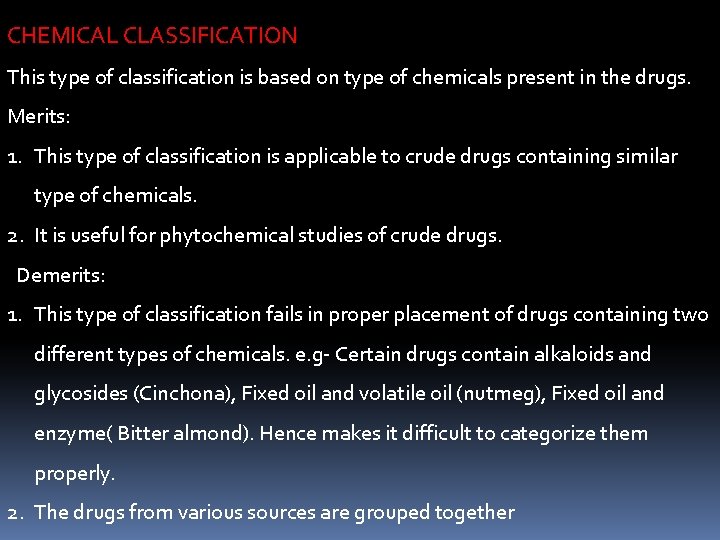
CHEMICAL CLASSIFICATION This type of classification is based on type of chemicals present in the drugs. Merits: 1. This type of classification is applicable to crude drugs containing similar type of chemicals. 2. It is useful for phytochemical studies of crude drugs. Demerits: 1. This type of classification fails in proper placement of drugs containing two different types of chemicals. e. g- Certain drugs contain alkaloids and glycosides (Cinchona), Fixed oil and volatile oil (nutmeg), Fixed oil and enzyme( Bitter almond). Hence makes it difficult to categorize them properly. 2. The drugs from various sources are grouped together
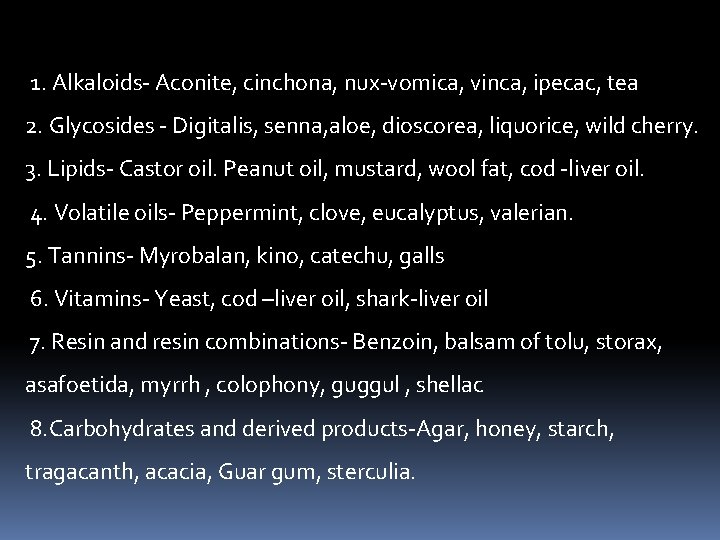
1. Alkaloids- Aconite, cinchona, nux-vomica, vinca, ipecac, tea 2. Glycosides - Digitalis, senna, aloe, dioscorea, liquorice, wild cherry. 3. Lipids- Castor oil. Peanut oil, mustard, wool fat, cod -liver oil. 4. Volatile oils- Peppermint, clove, eucalyptus, valerian. 5. Tannins- Myrobalan, kino, catechu, galls 6. Vitamins- Yeast, cod –liver oil, shark-liver oil 7. Resin and resin combinations- Benzoin, balsam of tolu, storax, asafoetida, myrrh , colophony, guggul , shellac 8. Carbohydrates and derived products-Agar, honey, starch, tragacanth, acacia, Guar gum, sterculia.
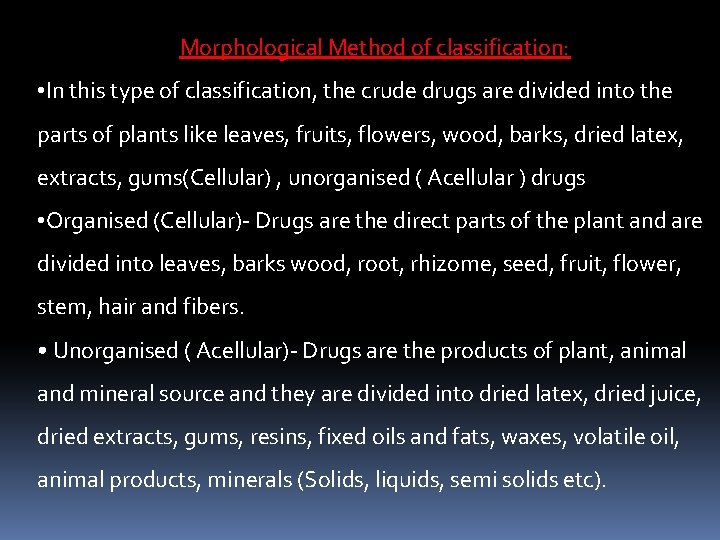
Morphological Method of classification: • In this type of classification, the crude drugs are divided into the parts of plants like leaves, fruits, flowers, wood, barks, dried latex, extracts, gums(Cellular) , unorganised ( Acellular ) drugs • Organised (Cellular)- Drugs are the direct parts of the plant and are divided into leaves, barks wood, root, rhizome, seed, fruit, flower, stem, hair and fibers. • Unorganised ( Acellular)- Drugs are the products of plant, animal and mineral source and they are divided into dried latex, dried juice, dried extracts, gums, resins, fixed oils and fats, waxes, volatile oil, animal products, minerals (Solids, liquids, semi solids etc).
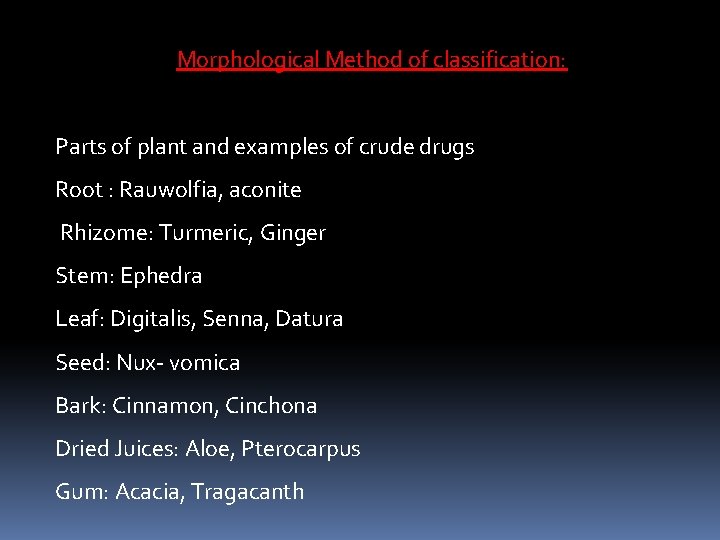
Morphological Method of classification: Parts of plant and examples of crude drugs Root : Rauwolfia, aconite Rhizome: Turmeric, Ginger Stem: Ephedra Leaf: Digitalis, Senna, Datura Seed: Nux- vomica Bark: Cinnamon, Cinchona Dried Juices: Aloe, Pterocarpus Gum: Acacia, Tragacanth
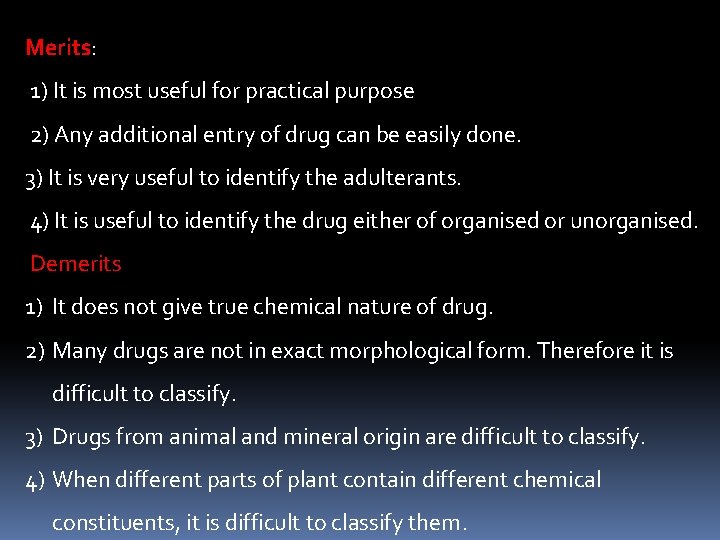
Merits: 1) It is most useful for practical purpose 2) Any additional entry of drug can be easily done. 3) It is very useful to identify the adulterants. 4) It is useful to identify the drug either of organised or unorganised. Demerits 1) It does not give true chemical nature of drug. 2) Many drugs are not in exact morphological form. Therefore it is difficult to classify. 3) Drugs from animal and mineral origin are difficult to classify. 4) When different parts of plant contain different chemical constituents, it is difficult to classify them.
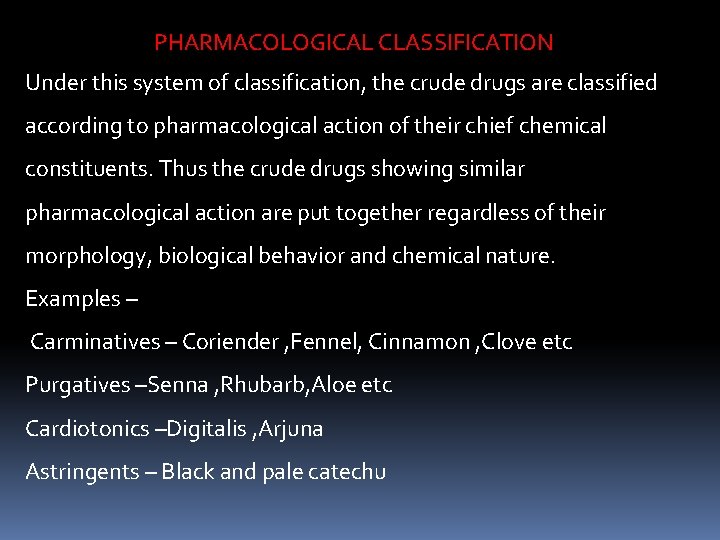
PHARMACOLOGICAL CLASSIFICATION Under this system of classification, the crude drugs are classified according to pharmacological action of their chief chemical constituents. Thus the crude drugs showing similar pharmacological action are put together regardless of their morphology, biological behavior and chemical nature. Examples – Carminatives – Coriender , Fennel, Cinnamon , Clove etc Purgatives –Senna , Rhubarb, Aloe etc Cardiotonics –Digitalis , Arjuna Astringents – Black and pale catechu
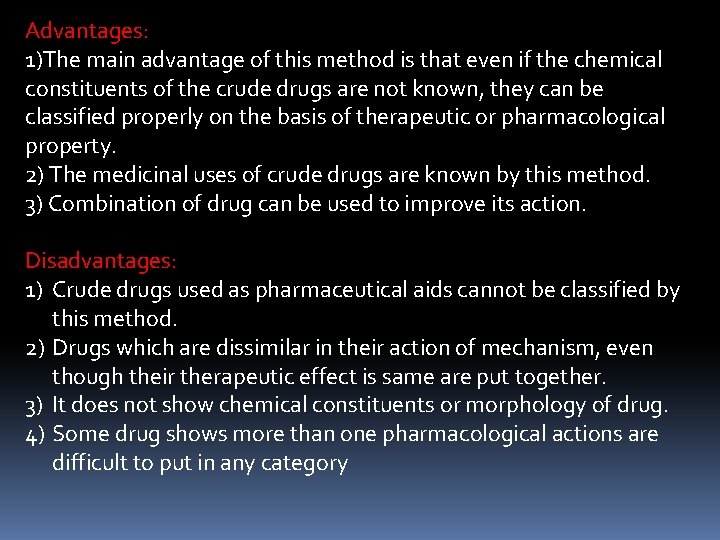
Advantages: 1)The main advantage of this method is that even if the chemical constituents of the crude drugs are not known, they can be classified properly on the basis of therapeutic or pharmacological property. 2) The medicinal uses of crude drugs are known by this method. 3) Combination of drug can be used to improve its action. Disadvantages: 1) Crude drugs used as pharmaceutical aids cannot be classified by this method. 2) Drugs which are dissimilar in their action of mechanism, even though their therapeutic effect is same are put together. 3) It does not show chemical constituents or morphology of drug. 4) Some drug shows more than one pharmacological actions are difficult to put in any category
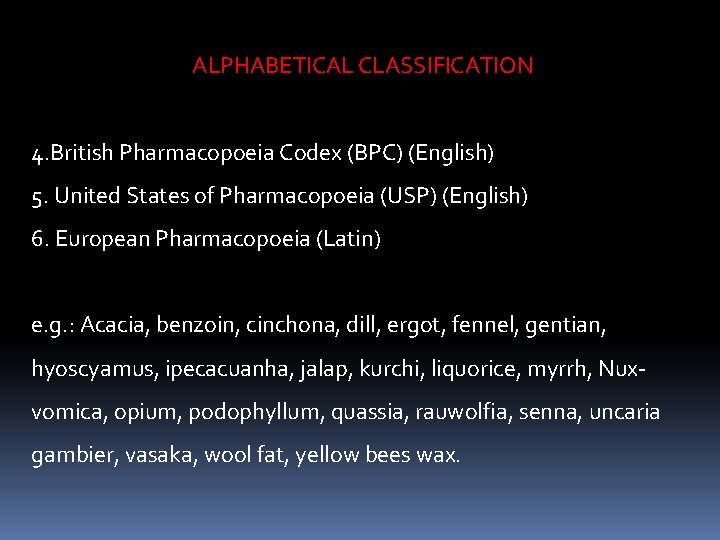
ALPHABETICAL CLASSIFICATION 4. British Pharmacopoeia Codex (BPC) (English) 5. United States of Pharmacopoeia (USP) (English) 6. European Pharmacopoeia (Latin) e. g. : Acacia, benzoin, cinchona, dill, ergot, fennel, gentian, hyoscyamus, ipecacuanha, jalap, kurchi, liquorice, myrrh, Nuxvomica, opium, podophyllum, quassia, rauwolfia, senna, uncaria gambier, vasaka, wool fat, yellow bees wax.
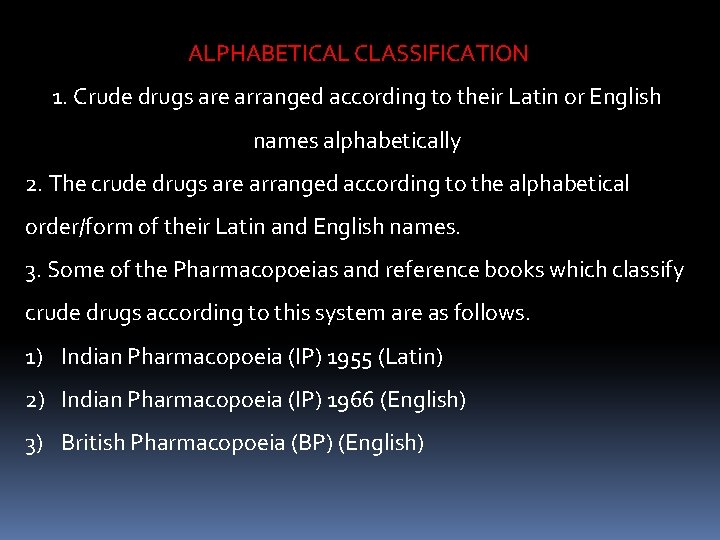
ALPHABETICAL CLASSIFICATION 1. Crude drugs are arranged according to their Latin or English names alphabetically 2. The crude drugs are arranged according to the alphabetical order/form of their Latin and English names. 3. Some of the Pharmacopoeias and reference books which classify crude drugs according to this system are as follows. 1) Indian Pharmacopoeia (IP) 1955 (Latin) 2) Indian Pharmacopoeia (IP) 1966 (English) 3) British Pharmacopoeia (BP) (English)
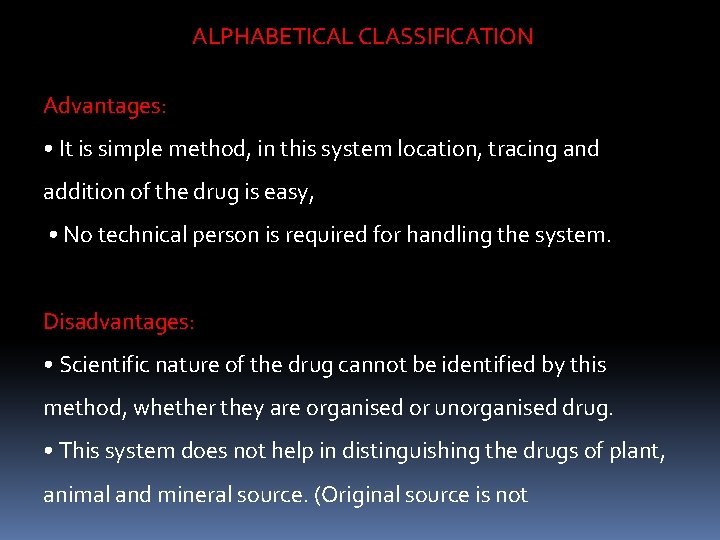
ALPHABETICAL CLASSIFICATION Advantages: • It is simple method, in this system location, tracing and addition of the drug is easy, • No technical person is required for handling the system. Disadvantages: • Scientific nature of the drug cannot be identified by this method, whether they are organised or unorganised drug. • This system does not help in distinguishing the drugs of plant, animal and mineral source. (Original source is not
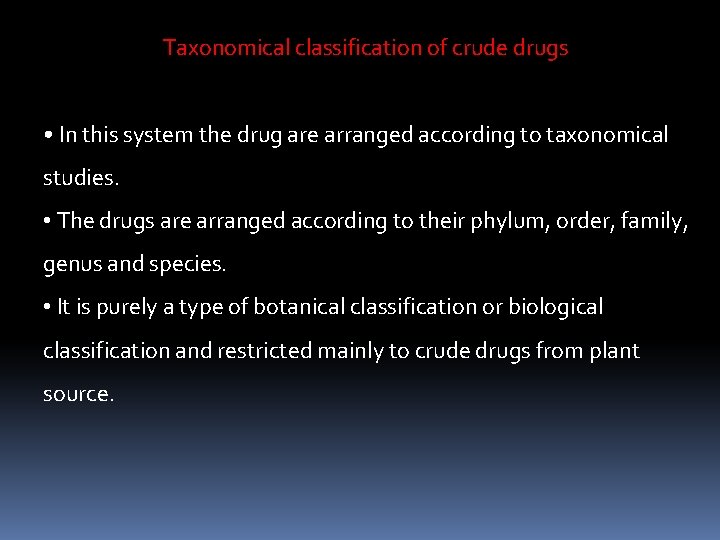
Taxonomical classification of crude drugs • In this system the drug are arranged according to taxonomical studies. • The drugs are arranged according to their phylum, order, family, genus and species. • It is purely a type of botanical classification or biological classification and restricted mainly to crude drugs from plant source.
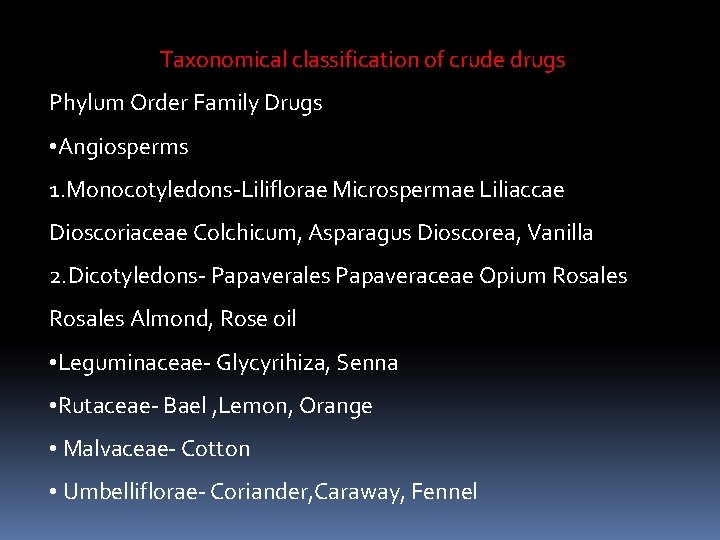
Taxonomical classification of crude drugs Phylum Order Family Drugs • Angiosperms 1. Monocotyledons-Liliflorae Microspermae Liliaccae Dioscoriaceae Colchicum, Asparagus Dioscorea, Vanilla 2. Dicotyledons- Papaverales Papaveraceae Opium Rosales Almond, Rose oil • Leguminaceae- Glycyrihiza, Senna • Rutaceae- Bael , Lemon, Orange • Malvaceae- Cotton • Umbelliflorae- Coriander, Caraway, Fennel
Taxonomical classification of crude drugs Advantages: • Easy for the classification of crude drugs • Disadvantages: • The system is criticized for its failure to recognize the organised / unorganised nature of crude drugs in their morphological studies. • The system fails to face into an account chemical nature of active constituent and therapeutic significance of crude drugs. • The drugs obtained from plants having alternate leaves, flowers, seeds, capsules (Hyocyamus, Datura, Bellodonna, Stromonium) are considered with other members of solanaceae.
Chemo- taxonomical classification of crude drugs • In this system of classification, the equal importance is given for taxonomical status and chemical constituents • There are certain types of chemical constituents which are characteristics of certain classes of plants. • Eg: Tropane alkaloids generally occur in most of the members of Solanaceae • Eg: Volatile oils occur in the members of Umbelliferae and Rutaceae.