
Classification of Matter This wellknown molecule is a








- Slides: 21
Classification of Matter This well-known molecule is a compound because it contains more than one element. Ordinary solid salt is a compound but not a molecule. It is built from interpenetrating lattices of sodium and chloride ions that extend indefinitely. A molecule but not a compound Ozone, O 3, is not a compound because it contains only a single element.
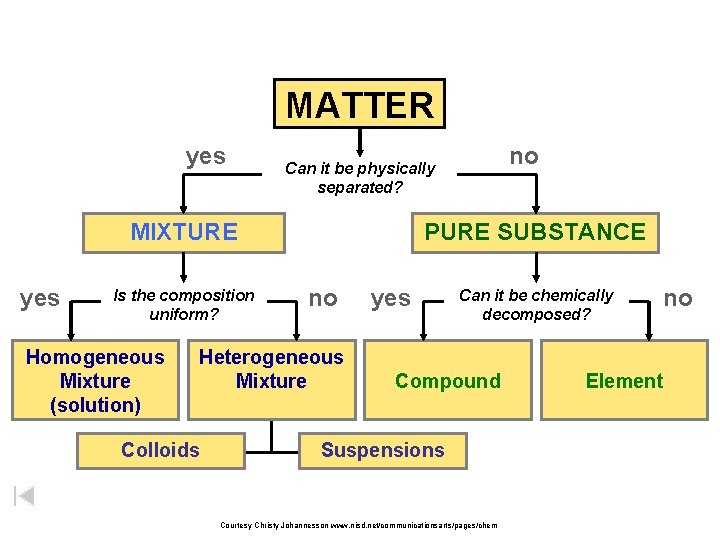
MATTER yes MIXTURE yes Is the composition uniform? Homogeneous Mixture (solution) PURE SUBSTANCE no Heterogeneous Mixture Colloids no Can it be physically separated? yes Can it be chemically decomposed? Compound Suspensions Courtesy Christy Johannesson www. nisd. net/communicationsarts/pages/chem no Element
Both elements and compounds have a definite makeup and definite properties. Elements only one kind of atom; atoms are bonded it the element is diatomic or polyatomic substance with definite makeup and properties Packard, Jacobs, Marshall, Chemistry Pearson AGS Globe, page (Figure 2. 4. 1) Compounds two or more kinds of atoms that are bonded Mixtures two or more kinds of and two or more substances that are physically mixed
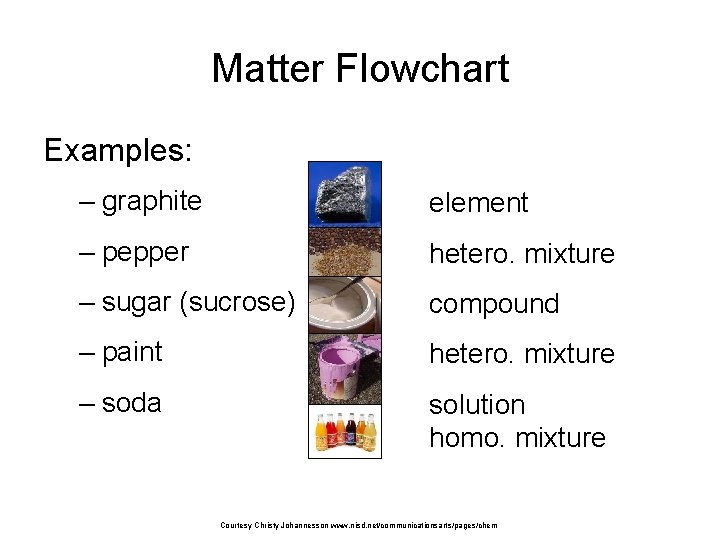
Matter Flowchart Examples: – graphite element – pepper hetero. mixture – sugar (sucrose) compound – paint hetero. mixture – soda solution homo. mixture Courtesy Christy Johannesson www. nisd. net/communicationsarts/pages/chem
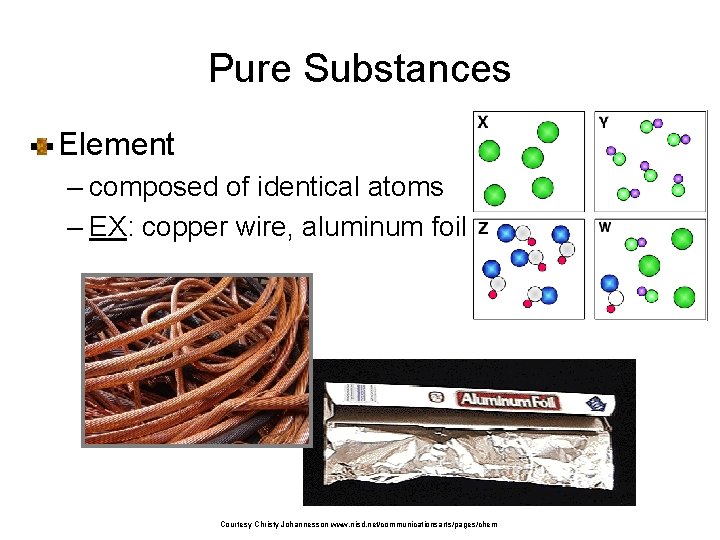
Pure Substances Element – composed of identical atoms – EX: copper wire, aluminum foil Courtesy Christy Johannesson www. nisd. net/communicationsarts/pages/chem
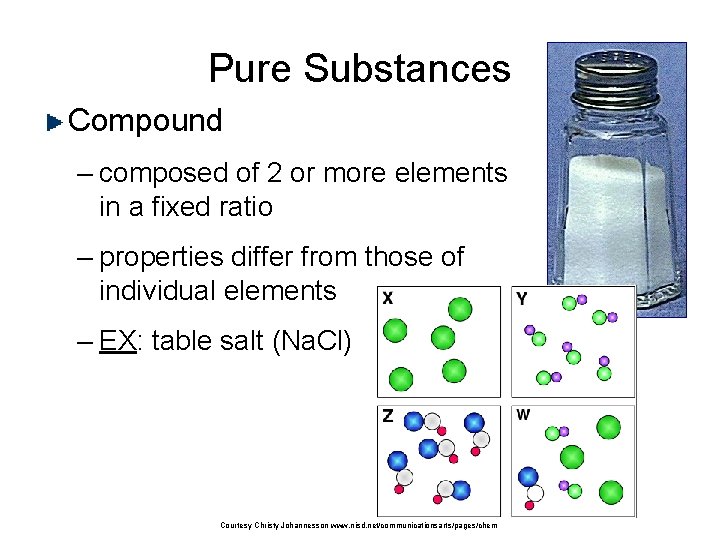
Pure Substances Compound – composed of 2 or more elements in a fixed ratio – properties differ from those of individual elements – EX: table salt (Na. Cl) Courtesy Christy Johannesson www. nisd. net/communicationsarts/pages/chem
Pure Substances For example… Carbon, C Oxygen, O Carbon monoxide, CO Carbon dioxide, CO 2 Two different compounds, each has a definite composition. Courtesy Christy Johannesson www. nisd. net/communicationsarts/pages/chem
Mixtures Variable combination of two or more pure substances. Heterogeneous Homogeneous Has different properties throughout Looks the same throughout Courtesy Christy Johannesson www. nisd. net/communicationsarts/pages/chem
Mixtures Solution – homogeneous – very small particles – NO Tyndall effect Tyndall Effect – when particles scatter light – particles don’t settle – EX: rubbing alcohol Courtesy Christy Johannesson www. nisd. net/communicationsarts/pages/chem
Mixtures Colloid – heterogeneous – medium-sized particles – Tyndall effect – particles don’t settle – EX: milk Courtesy Christy Johannesson www. nisd. net/communicationsarts/pages/chem
Mixtures Suspension – heterogeneous – large particles – Tyndall effect – particles settle – EX: fresh-squeezed lemonade Courtesy Christy Johannesson www. nisd. net/communicationsarts/pages/chem
Comparing Solution, Colloid and Suspension solution colloid suspension Homogeneous Look clear Small particles No Tyndall effect Air, brass, soda Particles don’t settle out Medium sized Particles Fog, whipped cream, butter Heterogeneous Tyndall Effect Cloudy Large particles Particles settle out Italian dressing, muddy water, fresh squeezed orange juice
Mixtures: Solution, Colloid or Suspension? Examples: – mayonnaise colloid – muddy water suspension – fog colloid – saltwater solution – Italian salad dressing suspension Courtesy Christy Johannesson www. nisd. net/communicationsarts/pages/chem
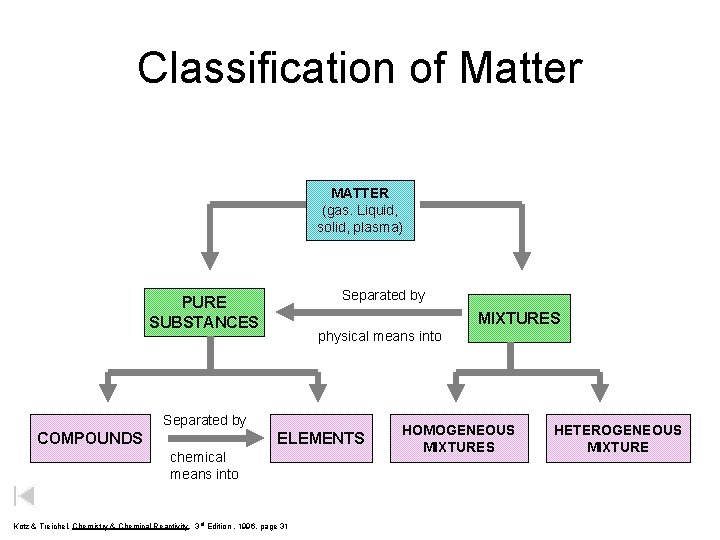
Classification of Matter MATTER (gas. Liquid, solid, plasma) Separated by PURE SUBSTANCES MIXTURES physical means into Separated by COMPOUNDS ELEMENTS chemical means into Kotz & Treichel, Chemistry & Chemical Reactivity, 3 rd Edition , 1996, page 31 HOMOGENEOUS MIXTURES HETEROGENEOUS MIXTURE
Elements, Compounds, and Mixtures hydrogen atoms oxygen atoms (a) an element (hydrogen) (b) a compound (water) hydrogen atoms Dorin, Demmin, Gabel, Chemistry The Study of Matter , 3 rd Edition, 1990, page 68 (c) a mixture (hydrogen and oxygen) (d) a mixture (hydrogen and oxygen)
Elements, Compounds, and Mixtures hydrogen atoms oxygen atoms (a) an element (hydrogen) (b) a compound (water) hydrogen atoms Dorin, Demmin, Gabel, Chemistry The Study of Matter , 3 rd Edition, 1990, page 68 (c) a mixture (hydrogen and oxygen) (d) a mixture (hydrogen and oxygen)
Mixture vs. Compound Different Alike Variable Composition Involve substances Topic No bonds between components Can be separated by physical means Mixture Different Fixed Composition Topic Contain two or more elements Can be separated into elements Compound Bonds between components Can ONLY be separated by chemical means
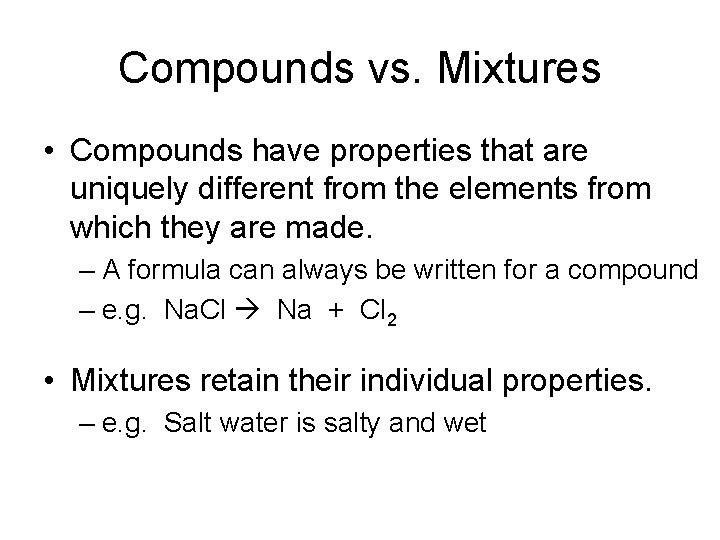
Compounds vs. Mixtures • Compounds have properties that are uniquely different from the elements from which they are made. – A formula can always be written for a compound – e. g. Na. Cl Na + Cl 2 • Mixtures retain their individual properties. – e. g. Salt water is salty and wet
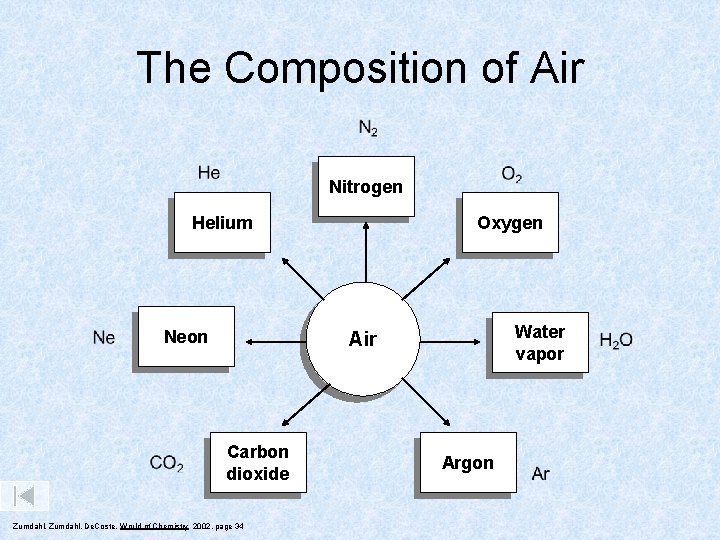
The Composition of Air Nitrogen Helium Neon Oxygen Water vapor Air Carbon dioxide Zumdahl, De. Coste, World of Chemistry 2002, page 34 Argon
Chart Examining Some Components of Air Nitrogen consists of molecules consisting of two atoms of nitrogen: N 2 Oxygen consists of molecules consisting of two atoms of oxygen: O 2 Water consists of molecules consisting of two hydrogen atoms and one oxygen atom: H 2 O Argon consists of individual argon atoms: Ar Carbon dioxide consists of molecules consisting of two oxygen atoms and one carbon atom: CO 2 Neon consists of individual neon atoms: Helium consists of individual helium atoms: Zumdahl, De. Coste, World of Chemistry 2002, page 35 Ne He
Reviewing Concepts Classifying Matter • Why does every sample of a given substance have the same properties? • Explain why the composition of an element is fixed. • Describe the composition of a compound. • Why can the properties of a mixture vary? • On what basis can mixtures be classified as solutions, suspensions, or colloids?