
Classification of Maps Department of City Regional Planning
- Slides: 43
Classification of Maps Department of City & Regional Planning Lahore College for Women University, Lahore Notes By: Saba Islam
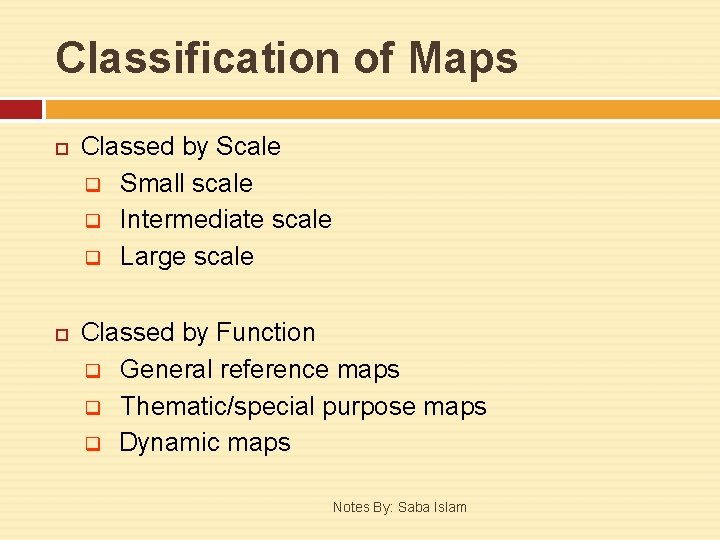
Classification of Maps Classed by Scale q Small scale q Intermediate scale q Large scale Classed by Function q General reference maps q Thematic/special purpose maps q Dynamic maps Notes By: Saba Islam
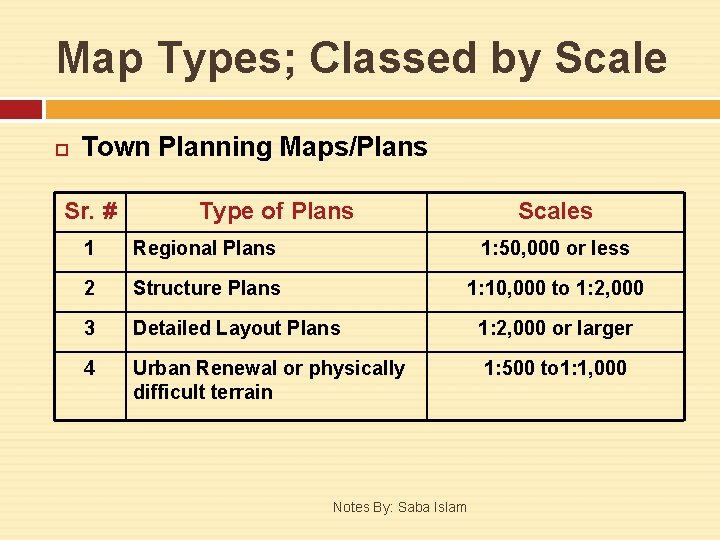
Map Types; Classed by Scale Town Planning Maps/Plans Sr. # Type of Plans Scales 1 Regional Plans 1: 50, 000 or less 2 Structure Plans 1: 10, 000 to 1: 2, 000 3 Detailed Layout Plans 1: 2, 000 or larger 4 Urban Renewal or physically difficult terrain 1: 500 to 1: 1, 000 Notes By: Saba Islam
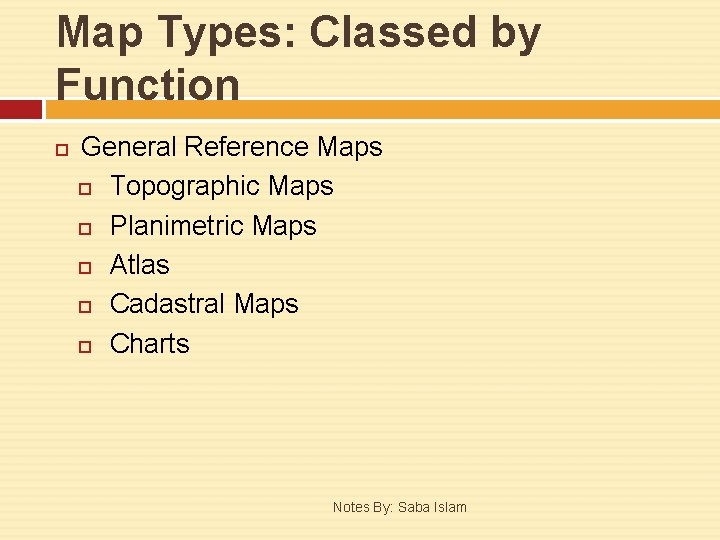
Map Types: Classed by Function General Reference Maps Topographic Maps Planimetric Maps Atlas Cadastral Maps Charts Notes By: Saba Islam
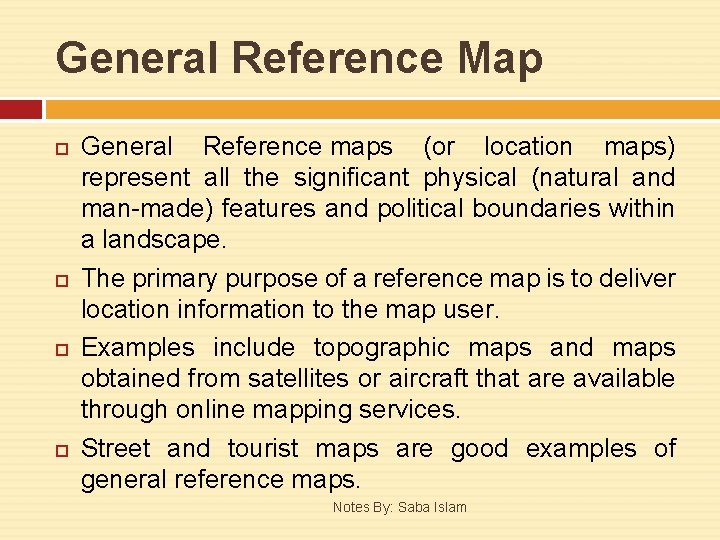
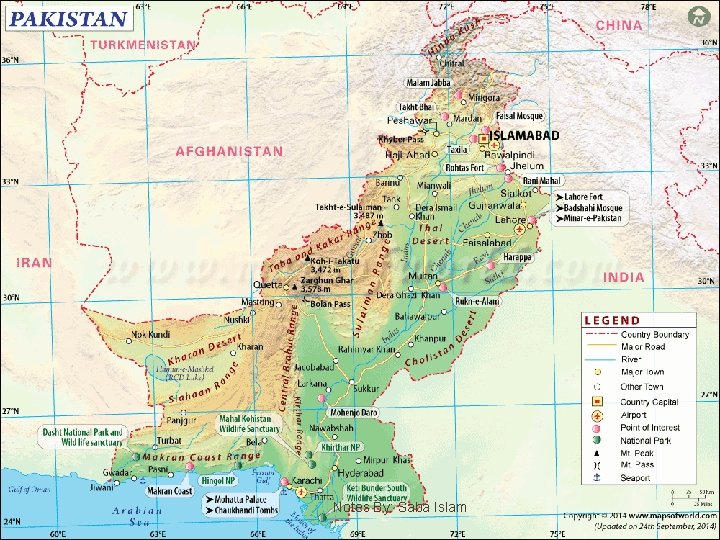
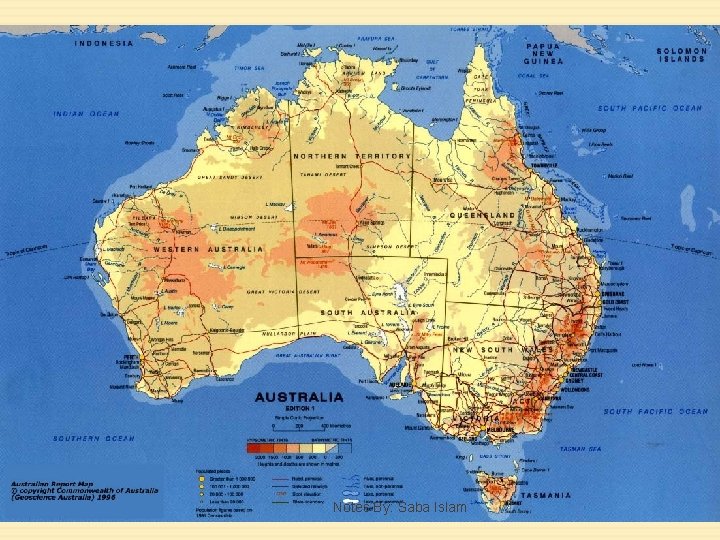
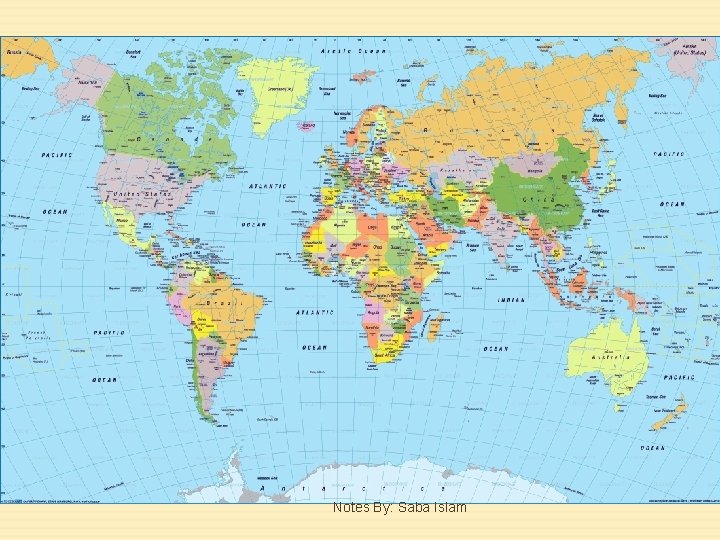
General Reference Map General Reference maps (or location maps) represent all the significant physical (natural and man-made) features and political boundaries within a landscape. The primary purpose of a reference map is to deliver location information to the map user. Examples include topographic maps and maps obtained from satellites or aircraft that are available through online mapping services. Street and tourist maps are good examples of general reference maps. Notes By: Saba Islam
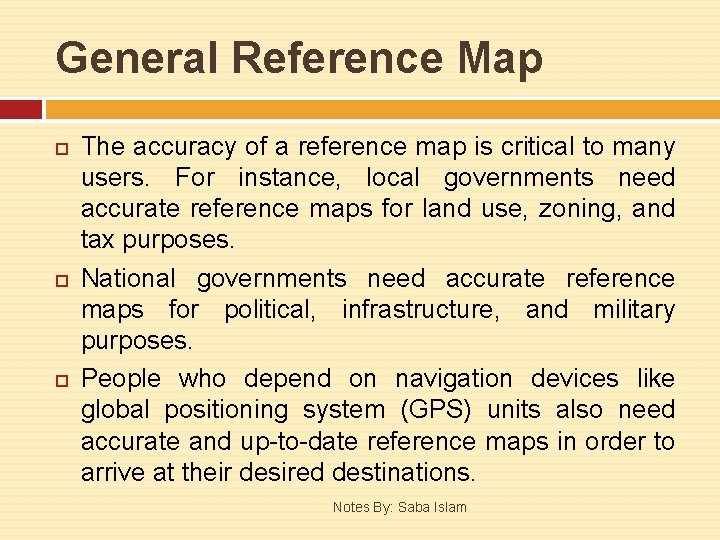
General Reference Map The accuracy of a reference map is critical to many users. For instance, local governments need accurate reference maps for land use, zoning, and tax purposes. National governments need accurate reference maps for political, infrastructure, and military purposes. People who depend on navigation devices like global positioning system (GPS) units also need accurate and up-to-date reference maps in order to arrive at their desired destinations. Notes By: Saba Islam
Notes By: Saba Islam
Notes By: Saba Islam
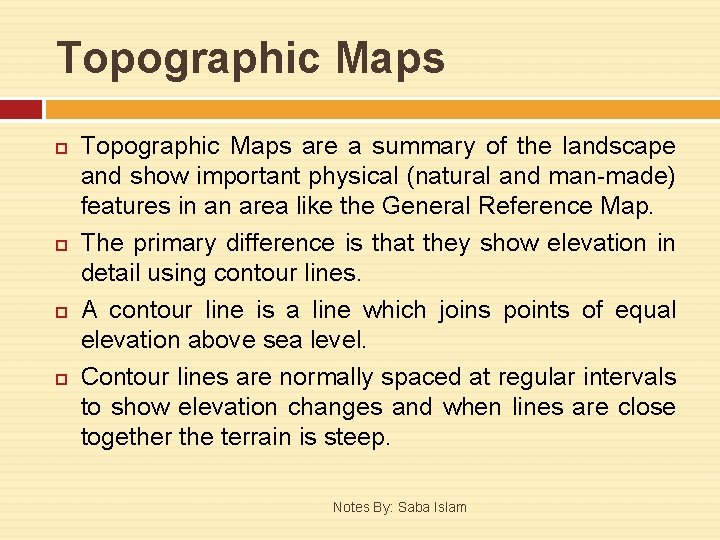
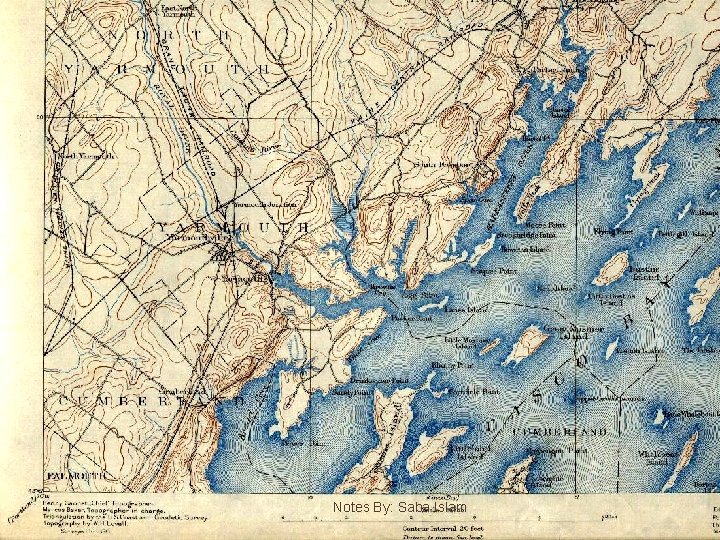
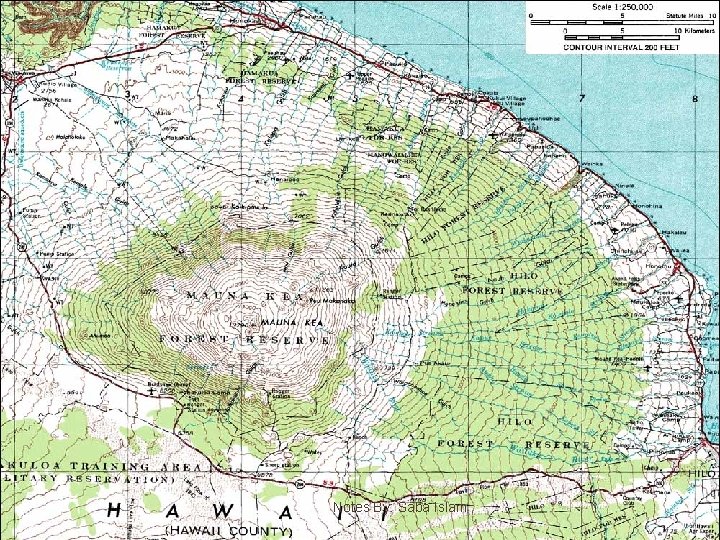
Topographic Maps Topographic Maps are a summary of the landscape and show important physical (natural and man-made) features in an area like the General Reference Map. The primary difference is that they show elevation in detail using contour lines. A contour line is a line which joins points of equal elevation above sea level. Contour lines are normally spaced at regular intervals to show elevation changes and when lines are close together the terrain is steep. Notes By: Saba Islam
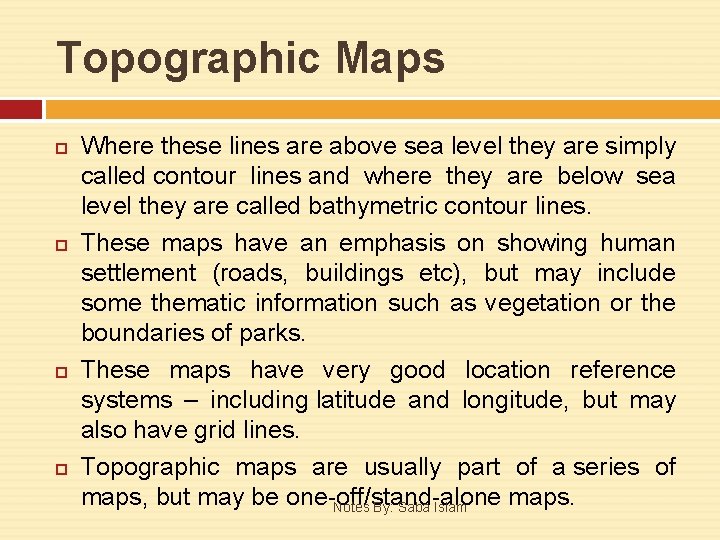
Topographic Maps Where these lines are above sea level they are simply called contour lines and where they are below sea level they are called bathymetric contour lines. These maps have an emphasis on showing human settlement (roads, buildings etc), but may include some thematic information such as vegetation or the boundaries of parks. These maps have very good location reference systems – including latitude and longitude, but may also have grid lines. Topographic maps are usually part of a series of maps, but may be one-off/stand-alone maps. Notes By: Saba Islam
Notes By: Saba Islam
Notes By: Saba Islam
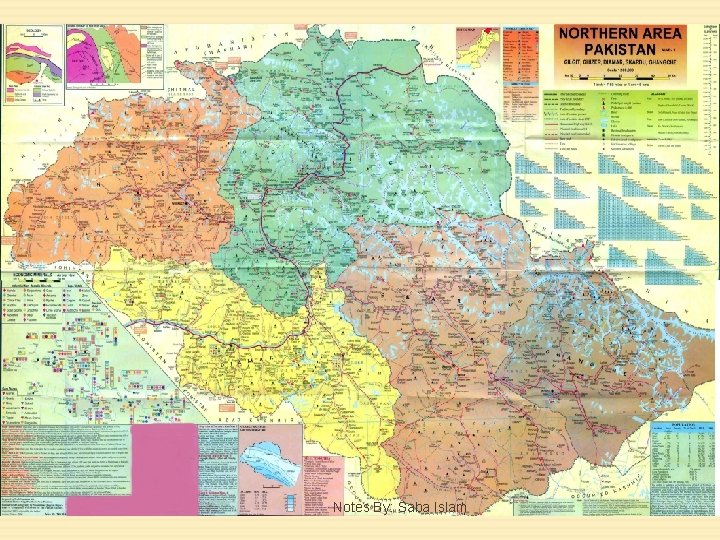
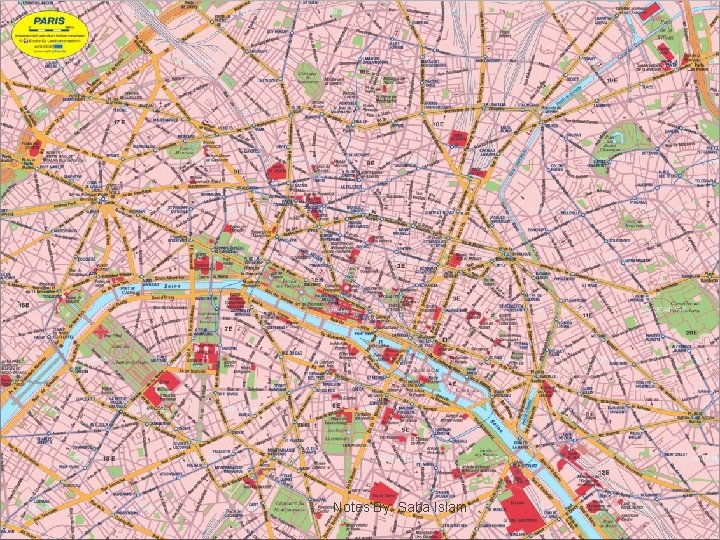
Planimetric Maps Planimetric maps are two-dimensional maps which are similar to topographic maps, but do not show any elevation. These maps tend to display natural features such as lakes and rivers, or man-made features such as roads and city boundaries. Notes By: Saba Islam
Notes By: Saba Islam
Notes By: Saba Islam
Atlas maps are small scale maps. Most of the topographical details are not shown because of small scale. They simply give general impression of an area. They give us extensive information in convenient form such as the distribution over the world of rainfall, temperature, vegetation and minerals etc. Notes By: Saba Islam
Notes By: Saba Islam
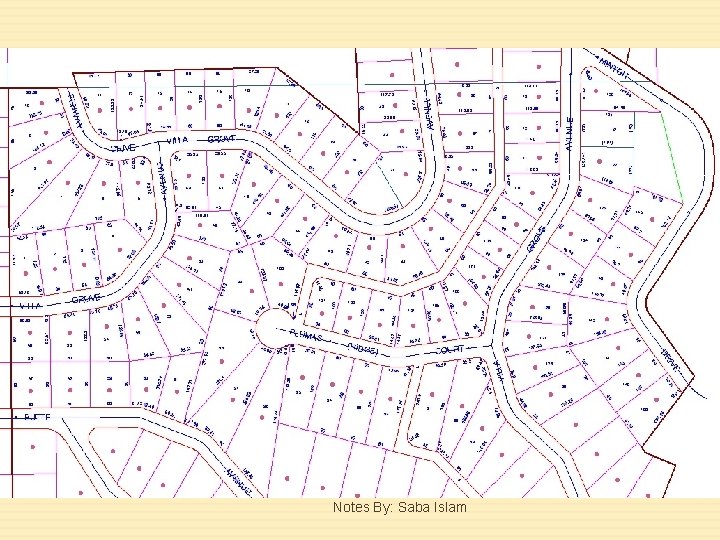
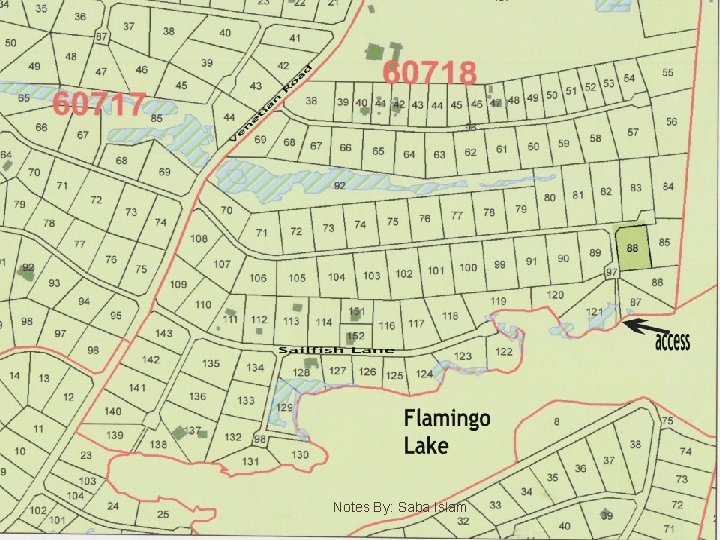
Cadastral Maps Cadastral plans represent the boundaries of individual land parcels in a given area, and usually contain details such as location, land ownership, tenure and obligations. The cadastre of a country is its register of property titles and is usually managed by government agencies. It may also record what the land can be used for (e. g. residential, commercial, national park etc. ) and may also show the location and shape of buildings. In some countries, it also records the value of a property; in these cases, the may also be Notes By: Sabacadastre Islam used for land taxation purposes.
Cadastral Maps The cadastral plan is produced by a registered/licensed surveyor who accurately measures and records the boundaries of each property. Cadastral maps are produced by joining together individual cadastral plans. A cadastral map is a general land administrative tool which has no real legislative basis (as a cadastral plan does). These maps are used by a broad range of people (public and professional) for real estate sales, valuation, planning etc. Notes By: Saba Islam
Notes By: Saba Islam
Notes By: Saba Islam
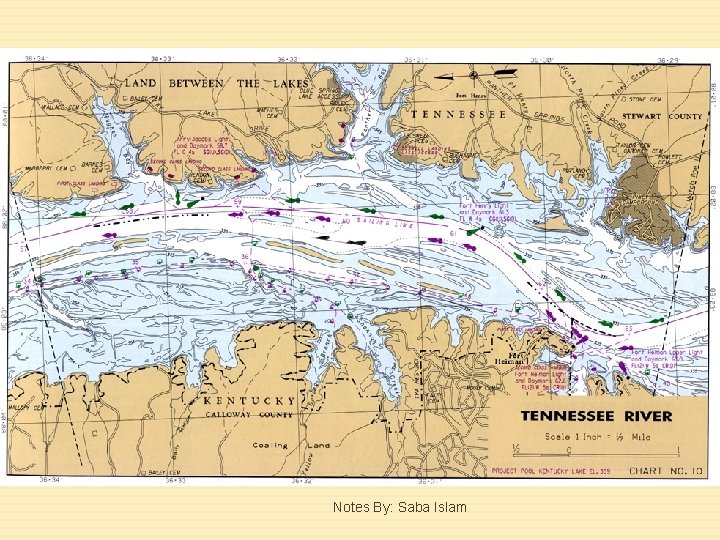
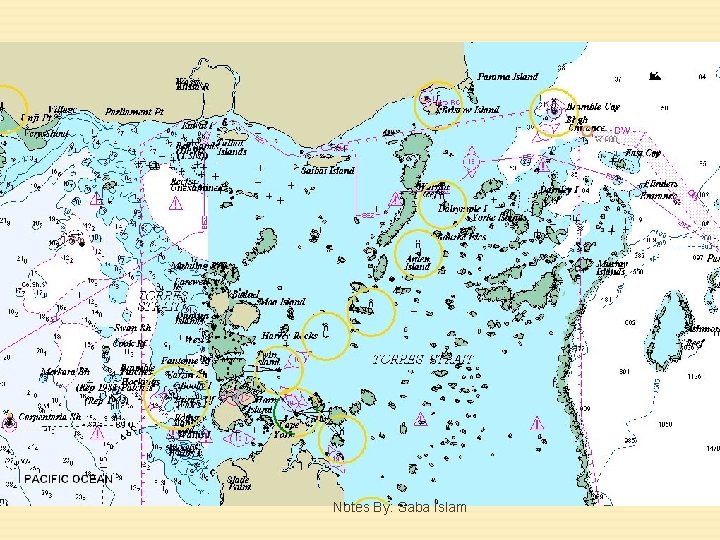
Charts Navigation Charts are produced as navigation aids for ships, boats and aircraft. With the start of map making 5, 000 years ago, a distinction gradually emerged regarding maps of land maps of the sea/ocean. For the land, they were called maps and for the sea/ocean, they were called charts. In the twentieth century, with the arrival of flight, the maps which were specifically made to aid aeroplane navigation were also called charts. Notes By: Saba Islam
Charts Both map and chart would show the coastline and its features. However the chart show great detail about the water and the water's edge, with little information about the land – the exact opposite of a map. Charts give specialist information which aids in navigation, especially navigation out-of-sight of land. This information include such things as water depth, location of lighthouses, significant coastal features (e. g. a cliff), and text notes (e. g. 'area usually covered in fog', 'strong tides occur in spring' etc). The features which are important to maps (eg main roads or inland towns) Notes are By: not shown. Saba Islam
Charts Like topographic maps, charts are typically produced by government mapping agencies. Marine navigation charts are usually produced by a country's Navy and possibly also civil defence bodies and/or port management authorities Air navigation charts are usually produced by a country's Airforce plus a civilian agency which is responsible for civilian air traffic control and regulation. Notes By: Saba Islam
Notes By: Saba Islam
Notes By: Saba Islam
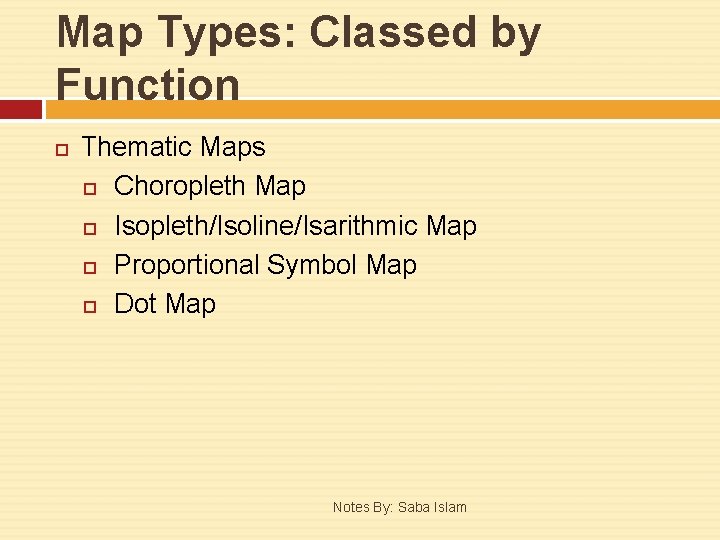
Map Types: Classed by Function Thematic Maps Choropleth Map Isopleth/Isoline/Isarithmic Map Proportional Symbol Map Dot Map Notes By: Saba Islam
Thematic Maps A thematic map is a map that focuses on a particular theme or special topic as opposite to reference map. While reference maps emphasize the location of geographic features, thematic maps are more concerned with how things are distributed across space. The detail portrayed on a thematic map may be physical, statistical, measured or interpreted. The reference and thematic maps are not always mutually exclusive. In other words, thematic maps often contain and By: Saba Islam information, and combine geographical. Notesreference
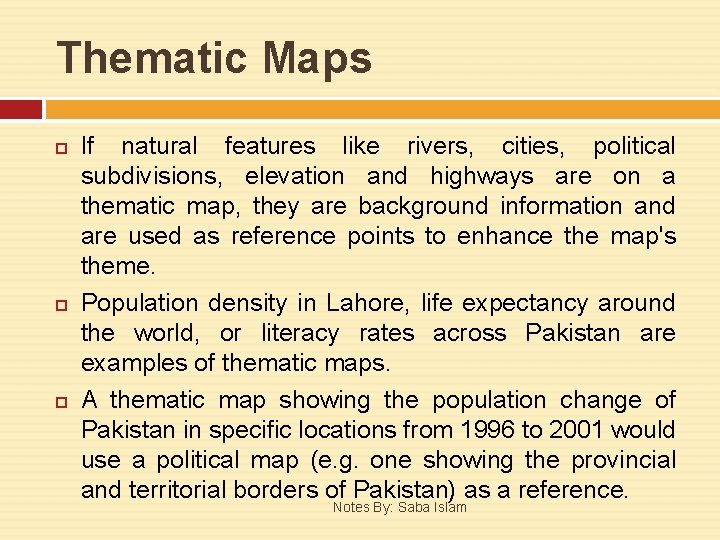
Thematic Maps If natural features like rivers, cities, political subdivisions, elevation and highways are on a thematic map, they are background information and are used as reference points to enhance the map's theme. Population density in Lahore, life expectancy around the world, or literacy rates across Pakistan are examples of thematic maps. A thematic map showing the population change of Pakistan in specific locations from 1996 to 2001 would use a political map (e. g. one showing the provincial and territorial borders of Pakistan) as a reference. Notes By: Saba Islam
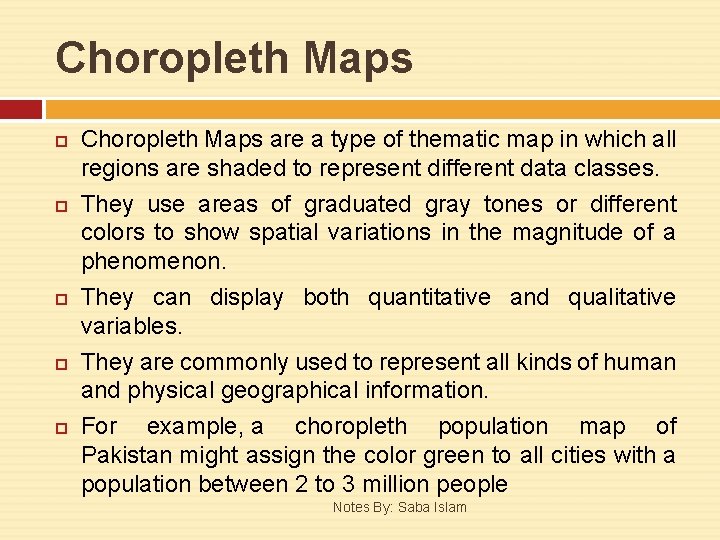
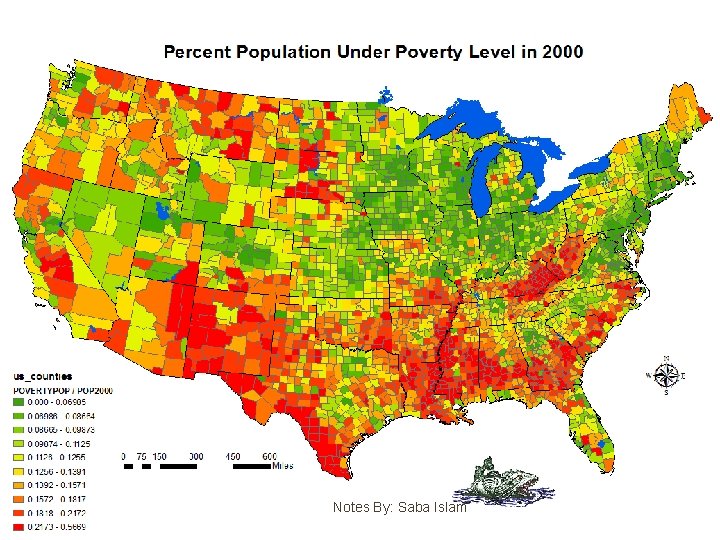
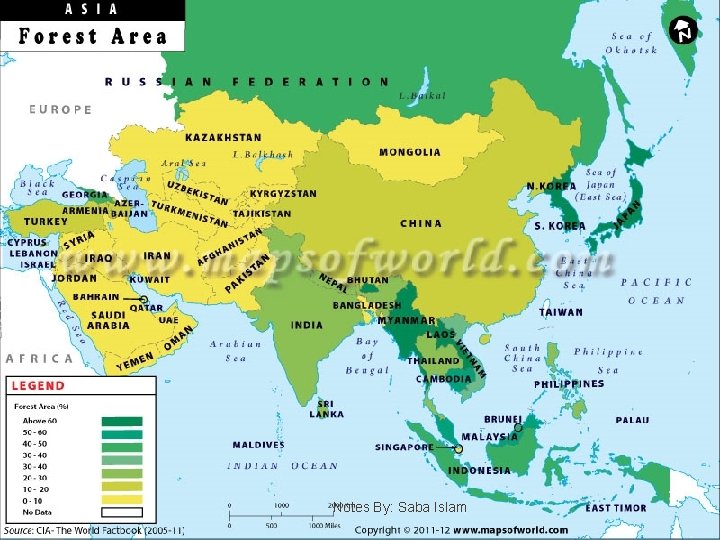
Choropleth Maps Choropleth Maps are a type of thematic map in which all regions are shaded to represent different data classes. They use areas of graduated gray tones or different colors to show spatial variations in the magnitude of a phenomenon. They can display both quantitative and qualitative variables. They are commonly used to represent all kinds of human and physical geographical information. For example, a choropleth population map of Pakistan might assign the color green to all cities with a population between 2 to 3 million people Notes By: Saba Islam
Notes By: Saba Islam
Notes By: Saba Islam
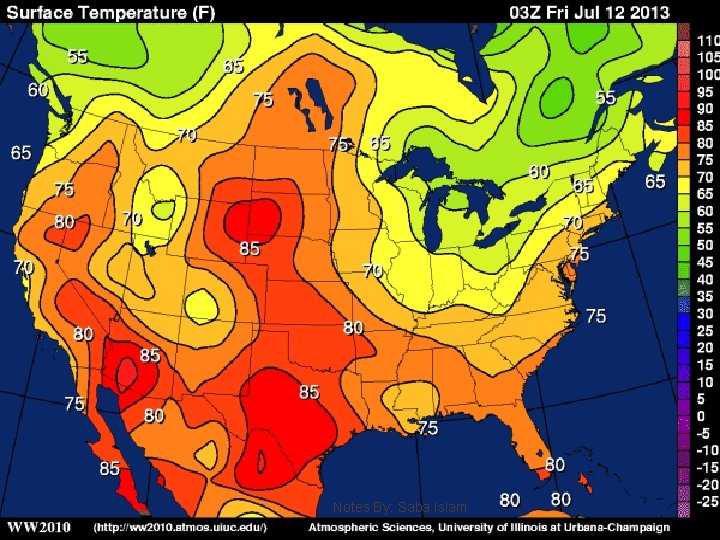
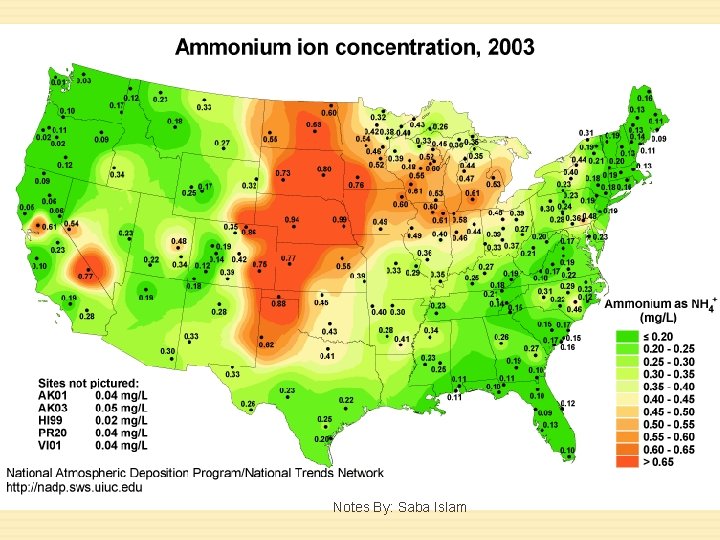
Isopleth/Isoline/Isarithmic Maps Isapleth maps use lines to connect points of equal value; these lines are called isopleths, or isolines. Each line-bounded area on this type of map represents a region with the same value. For example, on an elevation map, each elevation line indicates an area at the listed elevation. Isopleth maps also use color, except that the boundaries between color areas are defined by isolines representing points with equal data attribute values. Notes By: Saba Islam
Isopleth/Isoline/Isarithmic Maps The isopleths used for a particular purpose may have a particular name. For example, isotherms connect points of equal temperature, isobars connect points of equal air pressure, and isohyets connect points of equal precipitation. A typical weather or temperature map is an example of an isopleth map. Isopleths indicating differences in elevation are called topographic contour lines. Notes By: Saba Islam
Notes By: Saba Islam
Notes By: Saba Islam
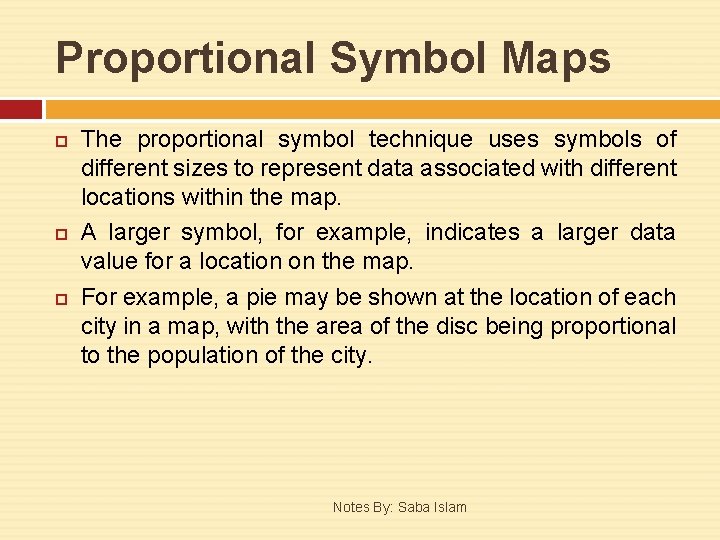
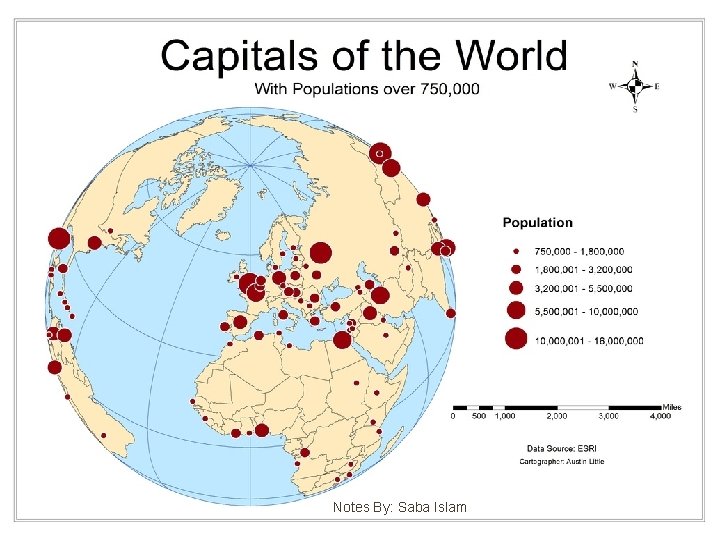
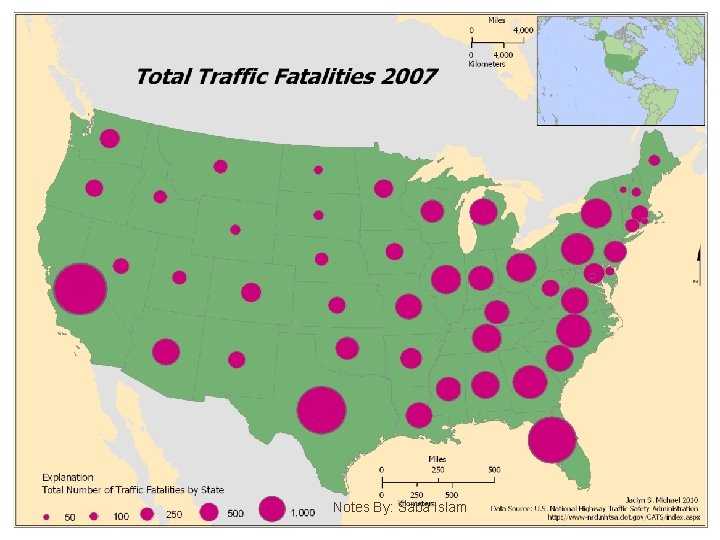
Proportional Symbol Maps The proportional symbol technique uses symbols of different sizes to represent data associated with different locations within the map. A larger symbol, for example, indicates a larger data value for a location on the map. For example, a pie may be shown at the location of each city in a map, with the area of the disc being proportional to the population of the city. Notes By: Saba Islam
Notes By: Saba Islam
Notes By: Saba Islam
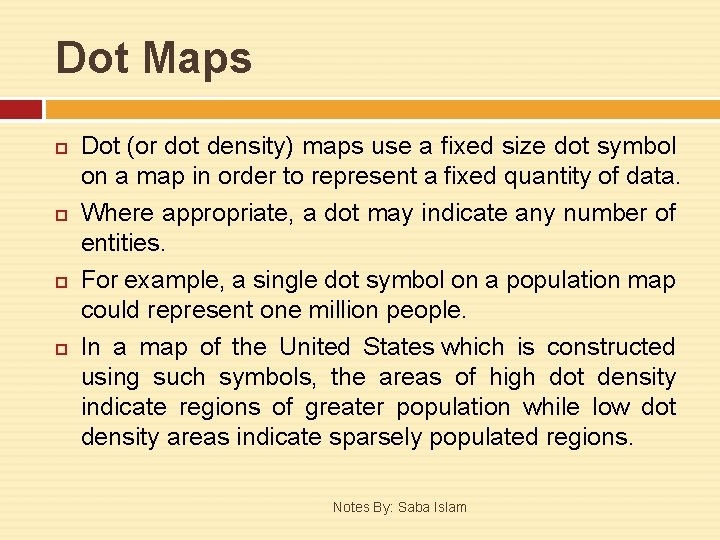
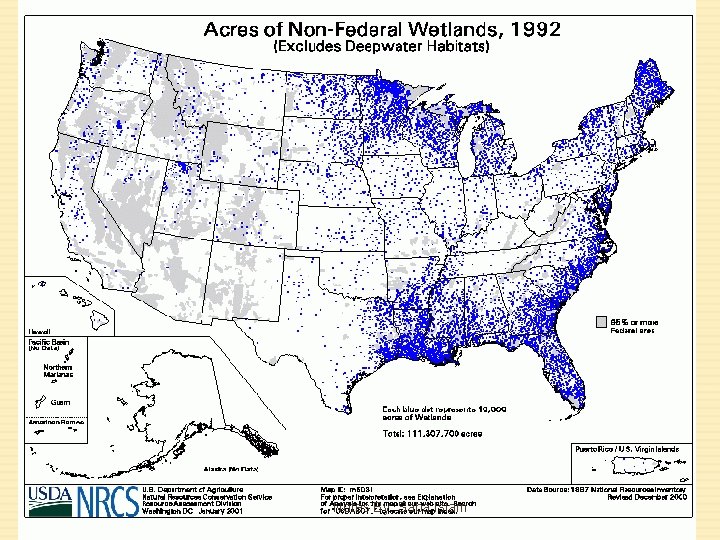
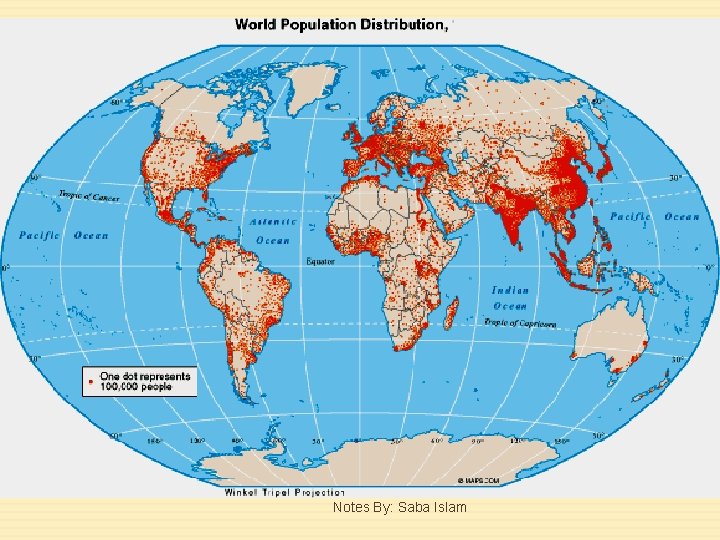
Dot Maps Dot (or dot density) maps use a fixed size dot symbol on a map in order to represent a fixed quantity of data. Where appropriate, a dot may indicate any number of entities. For example, a single dot symbol on a population map could represent one million people. In a map of the United States which is constructed using such symbols, the areas of high dot density indicate regions of greater population while low dot density areas indicate sparsely populated regions. Notes By: Saba Islam
Notes By: Saba Islam
Notes By: Saba Islam
Map Types; Classed by Function Dynamic Maps Dynamic maps are simply changeable or interactive representations of the earth. Both reference and thematic maps can be dynamic in nature, and such maps are an integral component to any GIS. The key point about dynamic maps is that more and more people, not just GIS professionals, have access to such maps. Unlike a hardcopy map that users cannot change, dynamic maps encourage and sometimes require user interaction. Notes By: Saba Islam Such interaction can include changing the scale or