
Classification of Living Things Diversity of Life By
Classification of Living Things Diversity of Life By: Mr. Lowe
What is classification? • Classification : The grouping of things according to shared characteristics or traits. • Taxonomy: Taxonomy The science of classifying organisms.

Early classification systems • The Greek Scientist Aristotle first classified living organisms as either plant or animal. • John Ray was the first to use the term “species”
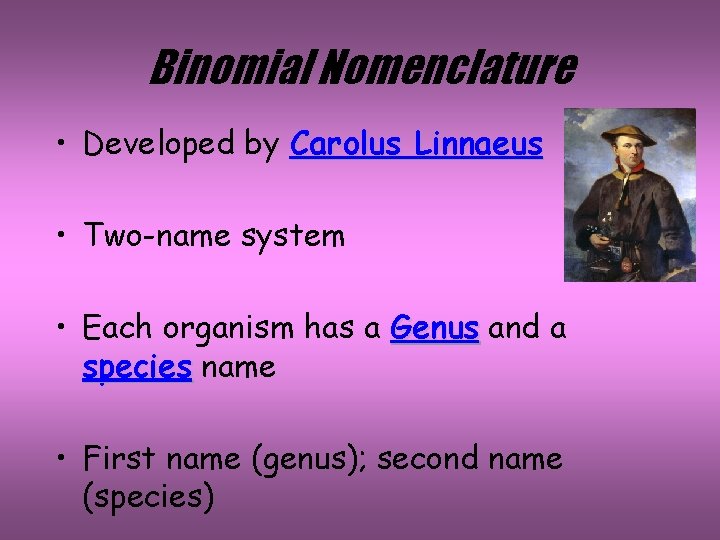
Binomial Nomenclature • Developed by Carolus Linnaeus • Two-name system • Each organism has a Genus and a species name • First name (genus); second name (species)

Linnaeus Classification Example 1. Round, separated petals 2. Large, broad petals 3. Bunched, pointed petals
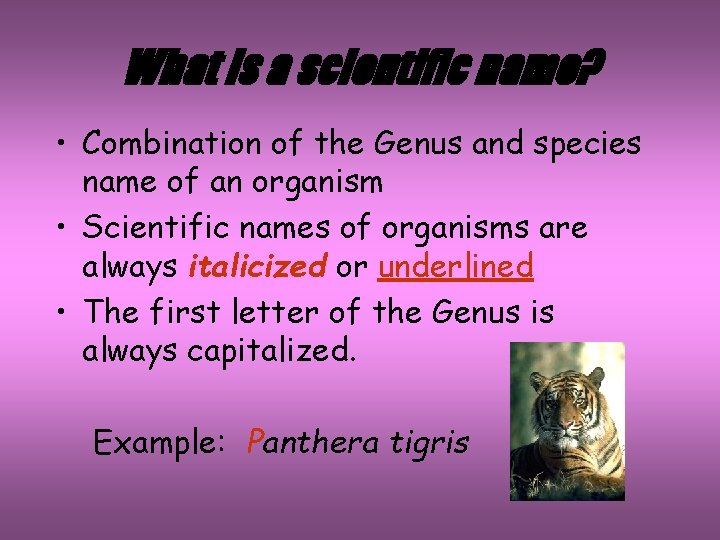
What is a scientific name? • Combination of the Genus and species name of an organism • Scientific names of organisms are always italicized or underlined • The first letter of the Genus is always capitalized. Example: Panthera tigris
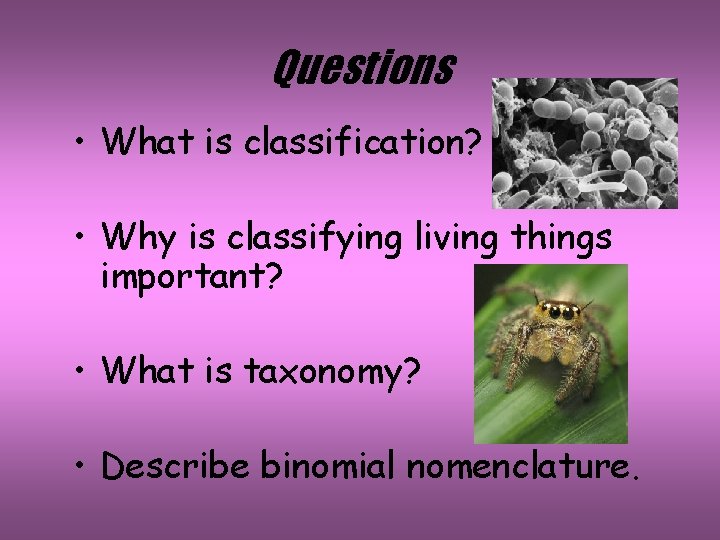
Questions • What is classification? • Why is classifying living things important? • What is taxonomy? • Describe binomial nomenclature.
Questions • Who developed a system for naming living organisms? • For what is John Ray known? • What is a scientific name of an organism and how is it written?
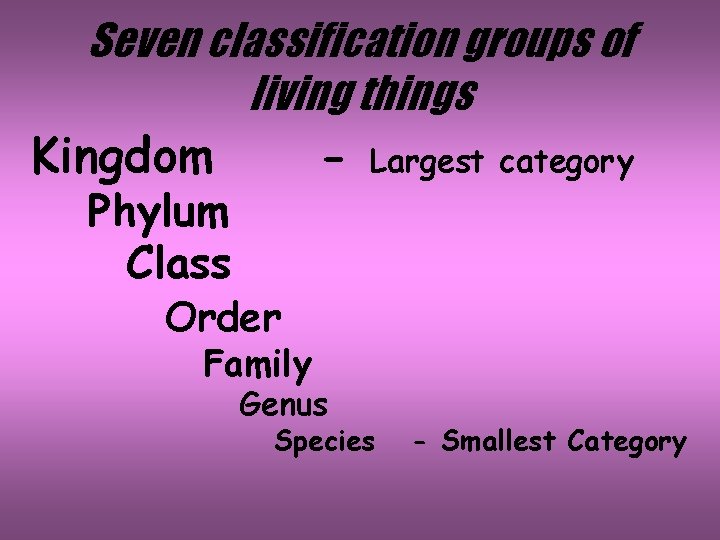
Seven classification groups of living things Kingdom - Largest category Phylum Class Order Family Genus Species - Smallest Category
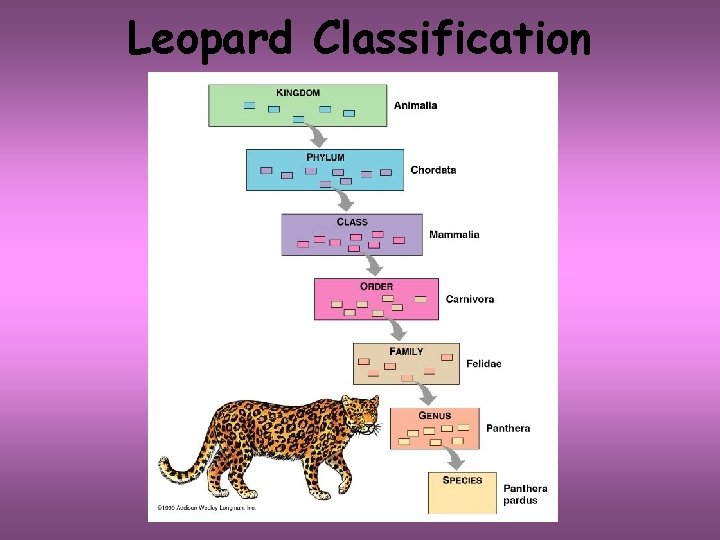
Leopard Classification
Mnemonic to help remember the Classification Groups! • King Poopoo Came Over For Great Spaghetti
Questions • What are the seven classification groups?
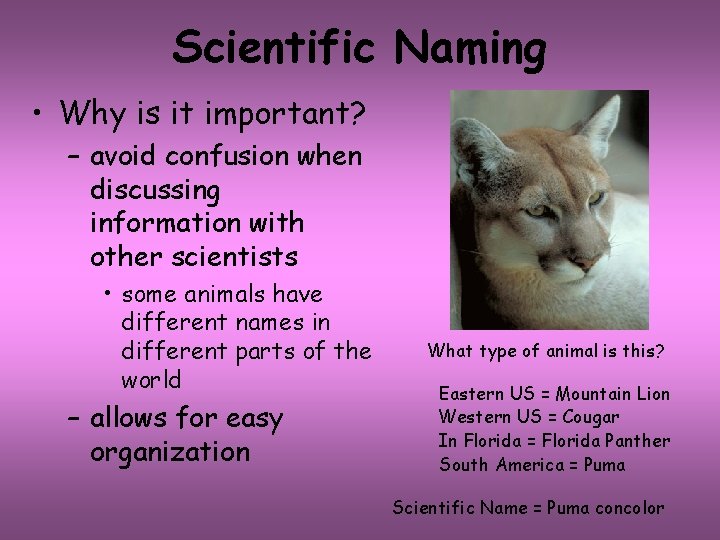
Scientific Naming • Why is it important? – avoid confusion when discussing information with other scientists • some animals have different names in different parts of the world – allows for easy organization What type of animal is this? Eastern US = Mountain Lion Western US = Cougar In Florida = Florida Panther South America = Puma Scientific Name = Puma concolor
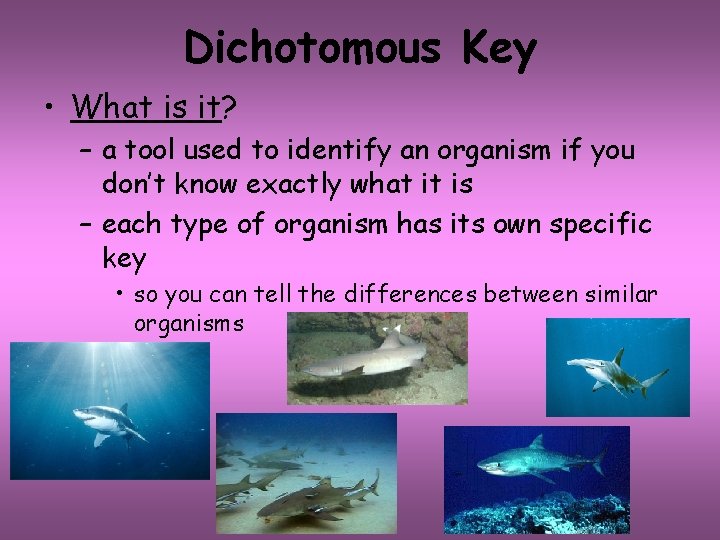
Dichotomous Key • What is it? – a tool used to identify an organism if you don’t know exactly what it is – each type of organism has its own specific key • so you can tell the differences between similar organisms
Dichotomous Key • How do they work? – made up of a detailed list of questions about identifying characteristics – each question has 2 possible answers – the questions gradually narrow down the list of possible organisms – eventually leads to an organism’s scientific name
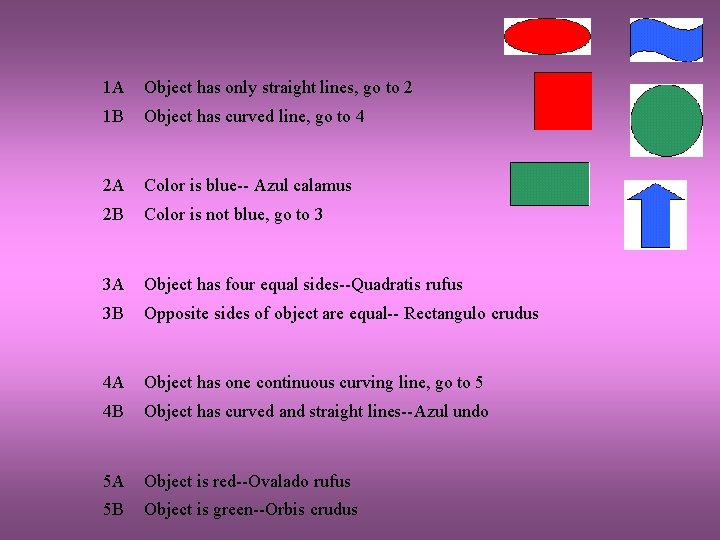
1 A Object has only straight lines, go to 2 1 B Object has curved line, go to 4 2 A Color is blue-- Azul calamus 2 B Color is not blue, go to 3 3 A Object has four equal sides--Quadratis rufus 3 B Opposite sides of object are equal-- Rectangulo crudus 4 A Object has one continuous curving line, go to 5 4 B Object has curved and straight lines--Azul undo 5 A Object is red--Ovalado rufus 5 B Object is green--Orbis crudus
- Slides: 16