
Classification of Igneous Rocks Mineral Composition of Igneous
- Slides: 14
Classification of Igneous Rocks
Mineral Composition of Igneous Rocks • Intrusive • Magma that cools and crystalizes below the Earth’s crust. • Crystals are large enough to see with just the eye. • Extrusive • Form on the Earth’s surface. • Crystal are too small to be seen with just the eye.
Mineral Content Classification • Basaltic • • AKA mafic Dark colour Lower levels of silica Mostly plagioclase and pyroxene
Mineral Content Classification • Granitic • • AKA felsic Light colour High levels of silica Mostly quartz and feldspar • Intermediate • Between basaltic and granitic rock • Mostly plagioclase feldspar and hornblende
Texture • Crystal or grain • • • Size Shape Distribution • Crystal size • Extrusive (coarse)- large – forms from slow cooling beneath the Earth’s crust • Intrusive (fine) – small – forms from quick cooling on the Earth’s surface
Porphyritic Rock • These rocks have 2 different crystal sizes • The reason this happens is that the magma cooled at different locations • The first cooling was below the Earth’s crust and the second cooling was either on the Earth’s surface or inside the crust.
Vesicular Rocks • The rocks appear like a sponge (vesicular texture) • The reason that happens is that the trapped gasses were not able to escape due to the thickness of the magma (very thick) • Trapped gasses produce holes
Thin Sections • Rocks are cut into thin sheets to make it possible to observe the size of mineral grains • Slice dimensions: 2 cm x 4 cm and 0. 03 mm thick (that is thinner than paper) • Petrographic microscope: used to observe thin sections and determineral composition
Igneous Rocks as Resources • Veins • Elements that were not incorporated into igneous rocks can deposit in the gaps in the minerals (veins) • Some of these important elements are: • • Gold Silver Lead Copper
Igneous Rocks as Resources • Pegmatites • Minerals deposited in fractures of rock • The minerals retain their shape • Pegmatites include: • Beryllium (Be) • Lithium (Li)
Igneous Rocks as Resources • Kimberlites • • • Initially found in Kimberly, South Africa They contain deposits of Diamonds can only form under EXTREME PRESSURE • The exact formation of Kimberlite is not clear but it is predicted to be produced when magma is intruded rapidly upward towards the Earth’s surface in tubes. • Diamond tubes are only found in certain locations on the Earth. Several are in South Africa.
Igneous rocks in construction • Granite is a popular construction materials for the following reasons • Strong • Resistant to weathering • Durable • Uses • Counter tops • Floors • Statues
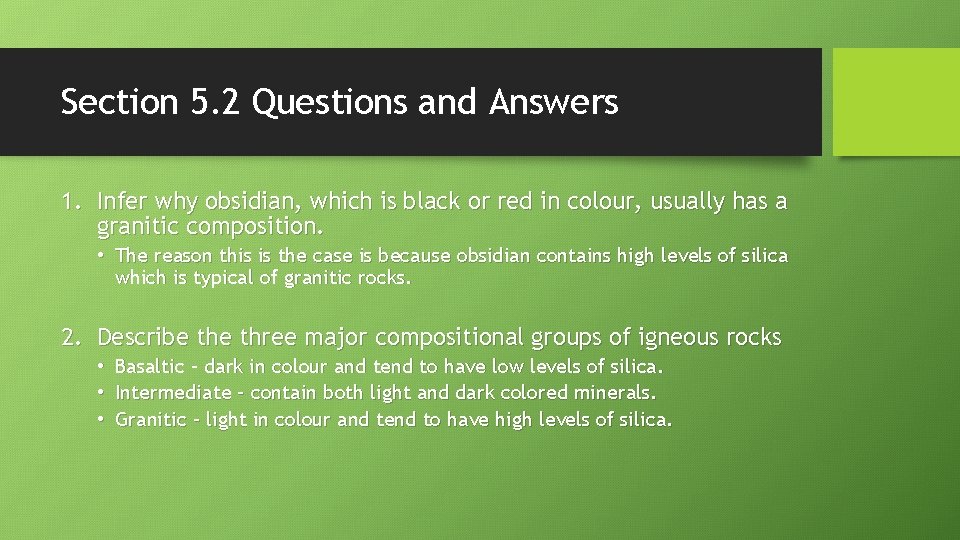
Section 5. 2 Questions and Answers 1. Infer why obsidian, which is black or red in colour, usually has a granitic composition. • The reason this is the case is because obsidian contains high levels of silica which is typical of granitic rocks. 2. Describe three major compositional groups of igneous rocks • • • Basaltic – dark in colour and tend to have low levels of silica. Intermediate – contain both light and dark colored minerals. Granitic – light in colour and tend to have high levels of silica.
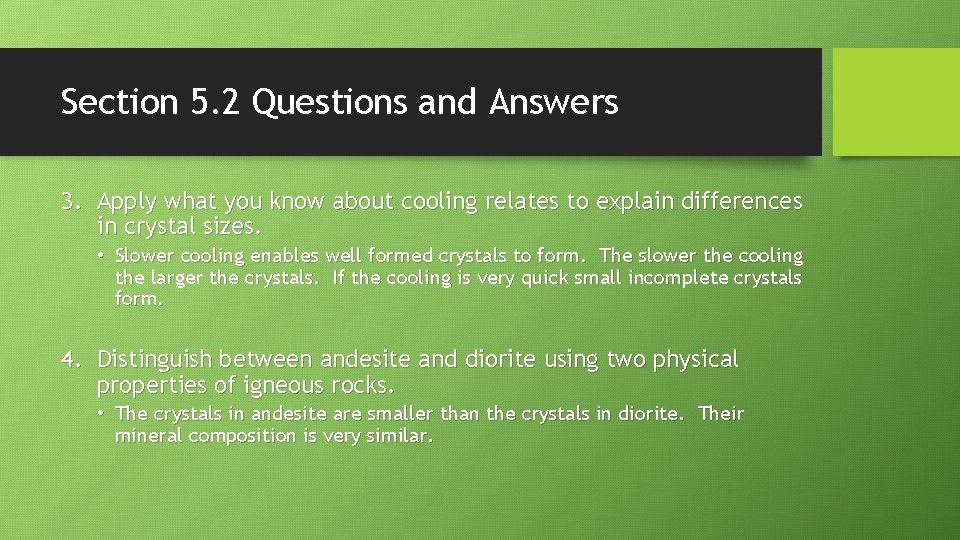
Section 5. 2 Questions and Answers 3. Apply what you know about cooling relates to explain differences in crystal sizes. • Slower cooling enables well formed crystals to form. The slower the cooling the larger the crystals. If the cooling is very quick small incomplete crystals form. 4. Distinguish between andesite and diorite using two physical properties of igneous rocks. • The crystals in andesite are smaller than the crystals in diorite. Their mineral composition is very similar.