
Classification of Flowers Foliage BY MRS SHEFFIELD Objectives
Classification of Flowers & Foliage BY: MRS. SHEFFIELD

Objectives �Classify various flowers and foliage by use in a floral arrangement �Compare shapes of flowers �Analyze the reason for using varying types of flowers and foliage in an arrangement
Flowers & Foliage �Components of a design �Have different shapes and forms �Influence the style of a floral design �Shapes play a specific role
Shapes 1. Line: creates motion 2. Form: distinct, focal point 3. Mass: add volume 4. Filler: help emphasize the main flower

Classification �Not limited to one group �Depends on: Openness of bloom Color intensity Texture and pattern Adjacent flowers Size and style
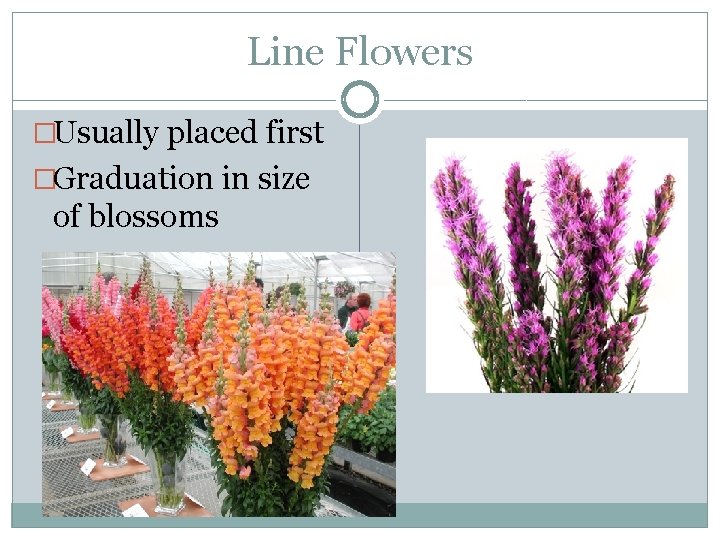
Line Flowers �Usually placed first �Graduation in size of blossoms
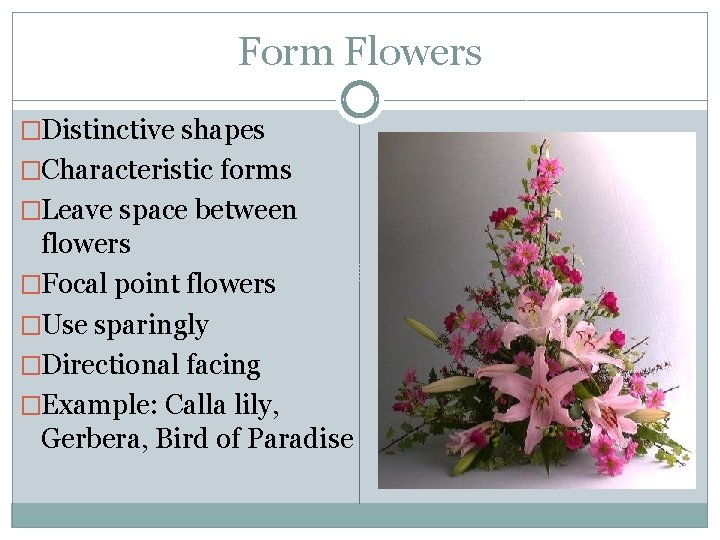
Form Flowers �Distinctive shapes �Characteristic forms �Leave space between flowers �Focal point flowers �Use sparingly �Directional facing �Example: Calla lily, Gerbera, Bird of Paradise
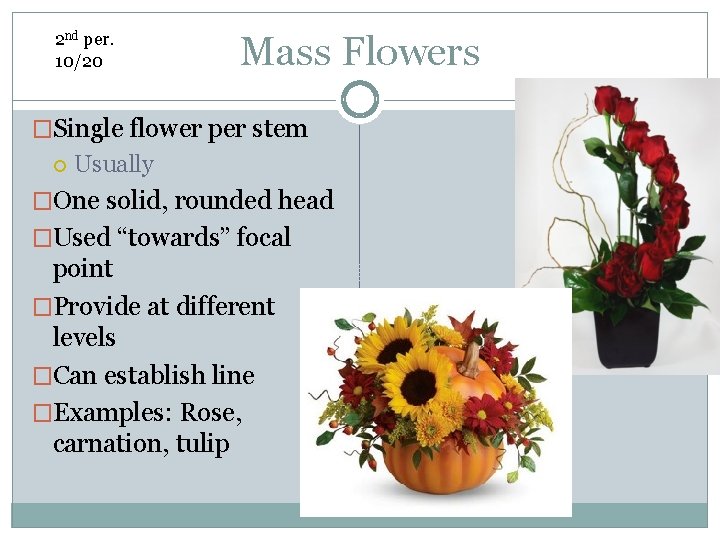
2 nd per. 10/20 Mass Flowers �Single flower per stem Usually �One solid, rounded head �Used “towards” focal point �Provide at different levels �Can establish line �Examples: Rose, carnation, tulip
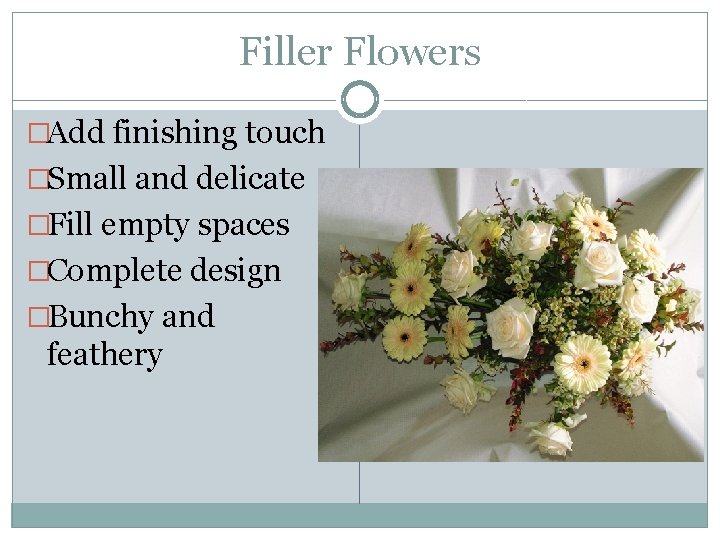
Filler Flowers �Add finishing touch �Small and delicate �Fill empty spaces �Complete design �Bunchy and feathery
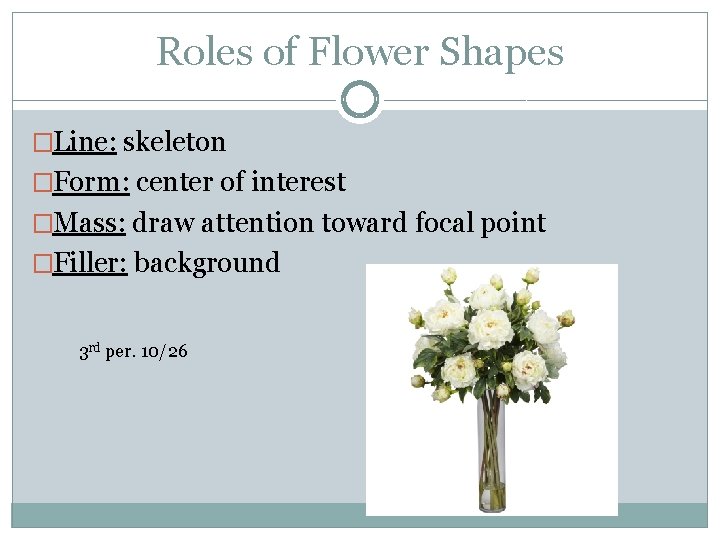
Roles of Flower Shapes �Line: skeleton �Form: center of interest �Mass: draw attention toward focal point �Filler: background 3 rd per. 10/26
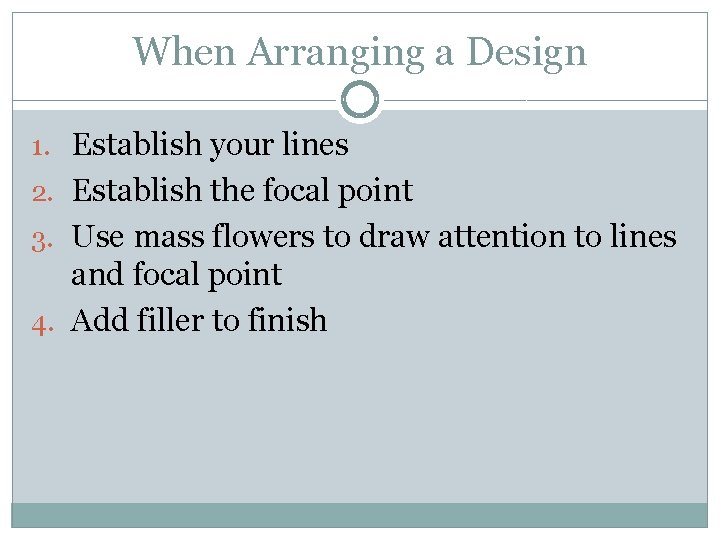
When Arranging a Design 1. Establish your lines 2. Establish the focal point 3. Use mass flowers to draw attention to lines and focal point 4. Add filler to finish

Classify Each of the Flowers:
- Slides: 12