
Classification of Entity Types LECTURE 4 Summary Previous



- Slides: 22
Classification of Entity Types LECTURE 4
Summary: Previous Lecture Database design using ER modeling Concepts of ER model ◦ Entities ◦ Relationships ◦ Attributes
Classification of Entity Types Ø The entity types can classified into v Strong entity type v Weak entity type
Strong Entity Type Ø Strong entity type v An entity type that is not existence-dependent on some other entity type e. g. Staff, Branch, Property. For. Rent, Client etc. v A characteristic of a strong entity type is that each entity occurrence is uniquely identifiable using the primary key attribute(s) of that entity type v For example, we can uniquely identify each member of staff using the staff. No attribute, which is the primary key for the Staff entity type
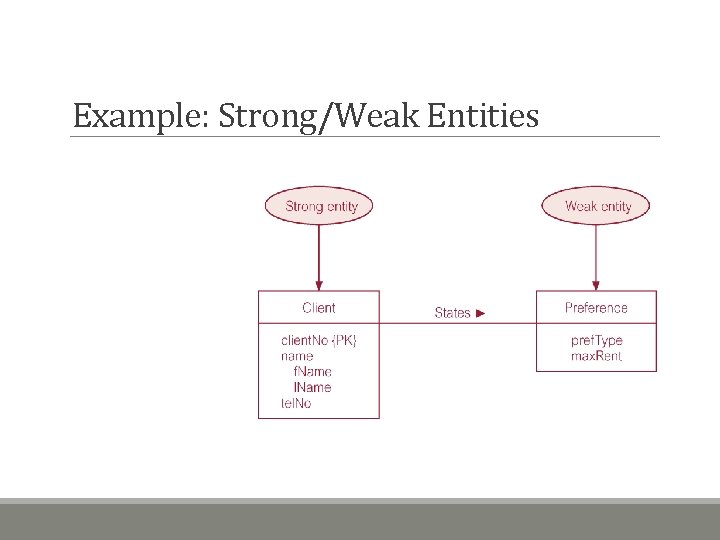
Weak Entity Type Ø Weak entity type v An entity type that is existence-dependent on some other entity type e. g. Preference etc. v A characteristic of a weak entity is that each entity occurrence cannot be uniquely identified using only the attributes associated with that entity type v For example, note that there is no primary key for the Preference entity, means that we cannot identify each occurrence of the Preference entity type using only the attributes of this entity v Sometimes referred to as child, dependent, or subordinate entities
Example: Strong/Weak Entities
Structural Constraints Ø We now examine the constraints that may be placed on entity types that participate in a relationship v The constraints should reflect the restrictions on the relationships as perceived in the ‘real world’ v Examples of such constraints include the requirements that a property for rent must have an owner and each branch must have staff v The main type of constraint on relationships is called multiplicity
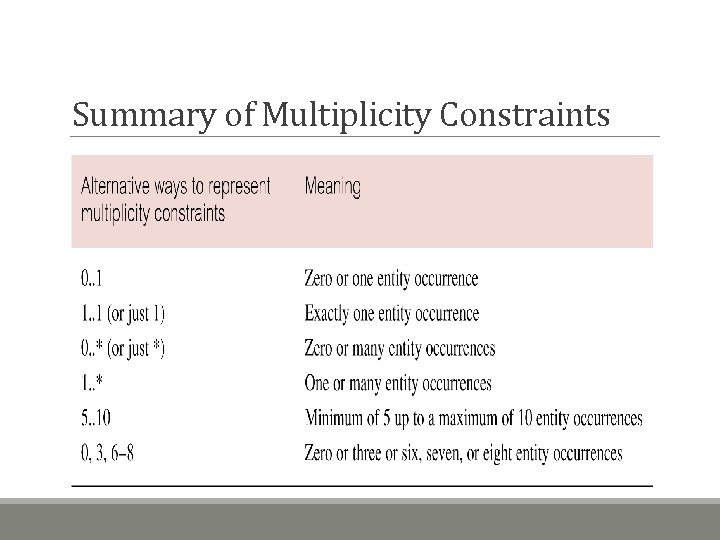
Multiplicity Ø The number (or range) of possible occurrences of an entity type that may relate to a single occurrence of an associated entity type through a particular relationship v Multiplicity constrains the way that entities are related v We must ensure that all appropriate enterprise constraints are identified and represented in an ER model
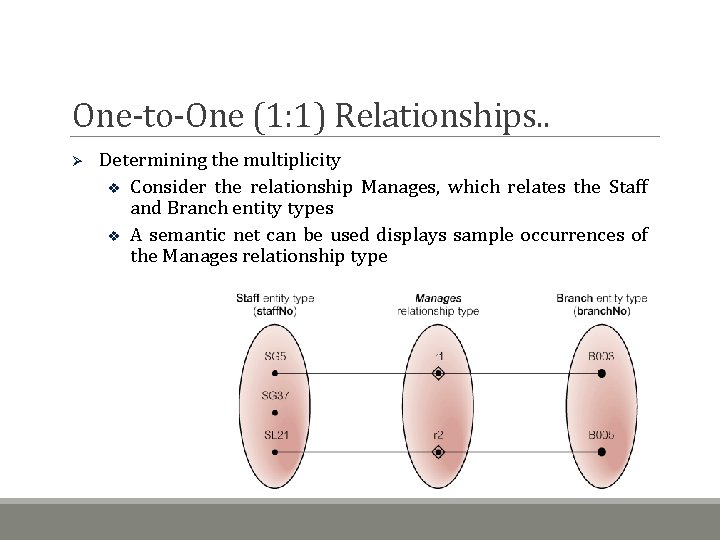
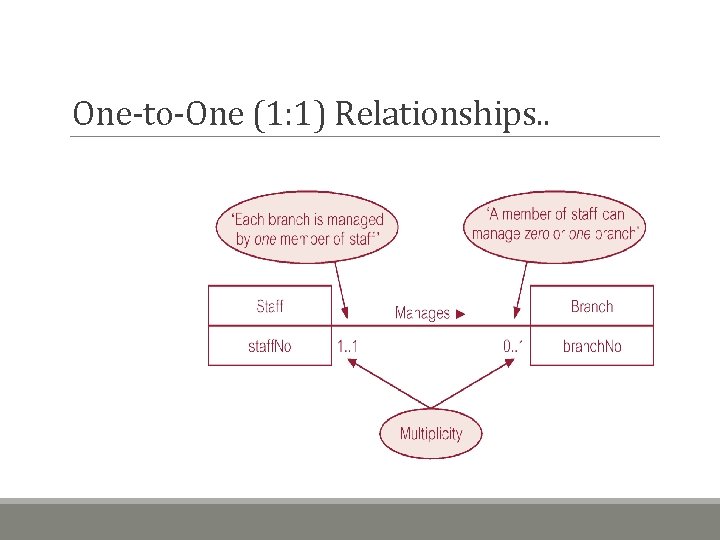
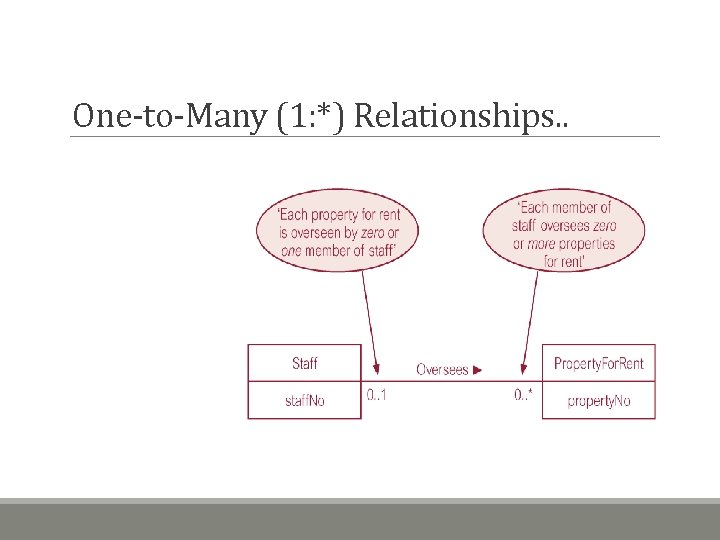
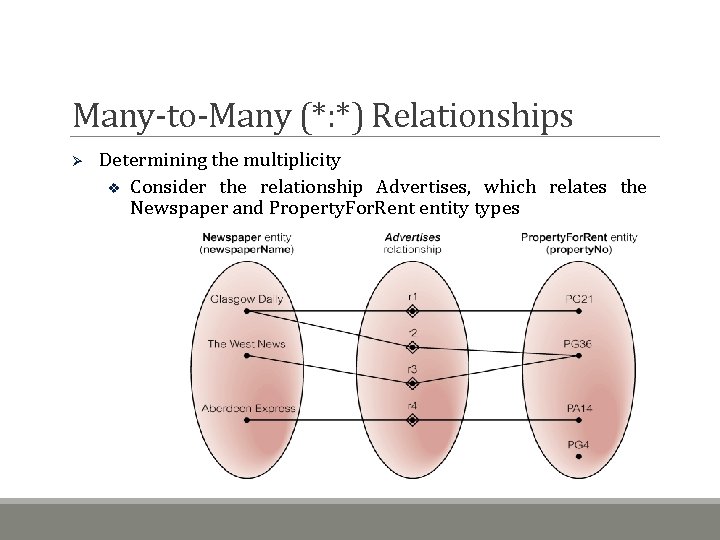
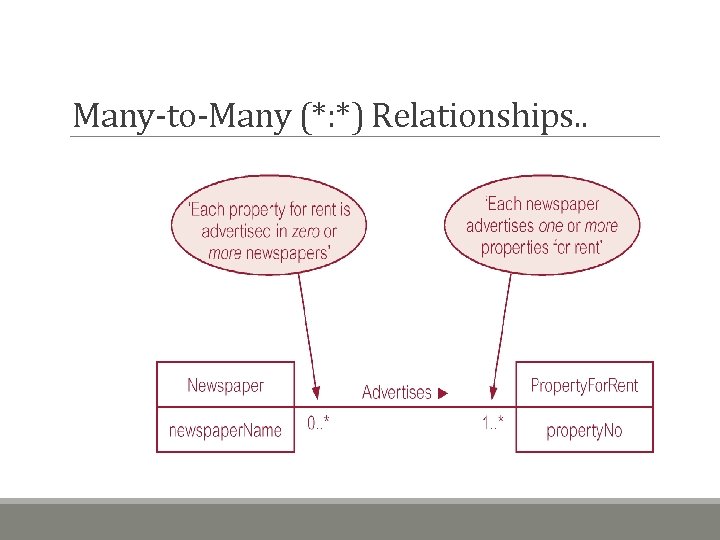
Structural Constraints. . Ø The most common degree for relationships is binary, binary relationships are generally referred to as being: v One-to-One (1: 1) § A member of staff manages a branch (1: 1) v One-to-Many (1: *) § A member of staff oversees properties for rent (1: *) v Many-to-Many (*: *) § A newspapers advertise properties for rent (*: *)
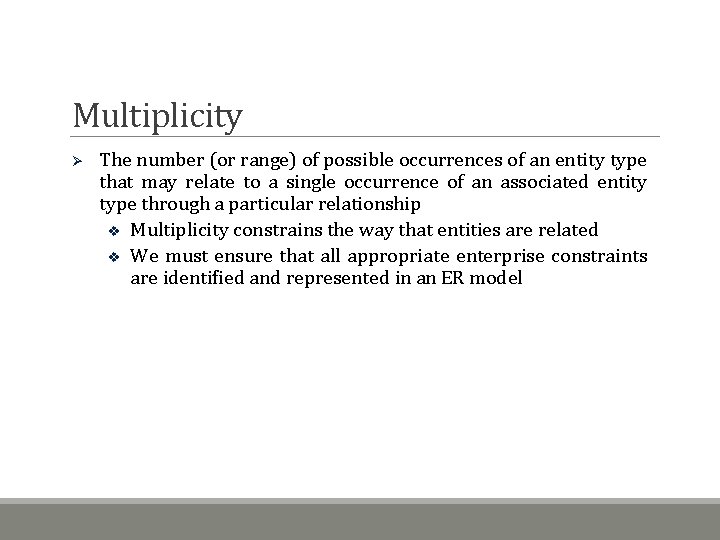
One-to-One (1: 1) Relationships. . Ø Determining the multiplicity v Consider the relationship Manages, which relates the Staff and Branch entity types v A semantic net can be used displays sample occurrences of the Manages relationship type
One-to-One (1: 1) Relationships. .
One-to-Many (1: *) Relationships Ø Determining the multiplicity v Consider the relationship Oversees, which relates the Staff and Property. For. Rent entity types
One-to-Many (1: *) Relationships. .
Many-to-Many (*: *) Relationships Ø Determining the multiplicity v Consider the relationship Advertises, which relates the Newspaper and Property. For. Rent entity types
Many-to-Many (*: *) Relationships. .
Summary of Multiplicity Constraints
Structural Constraints Ø Multiplicity actually consists of two separate constraints known as v Cardinality v Participation
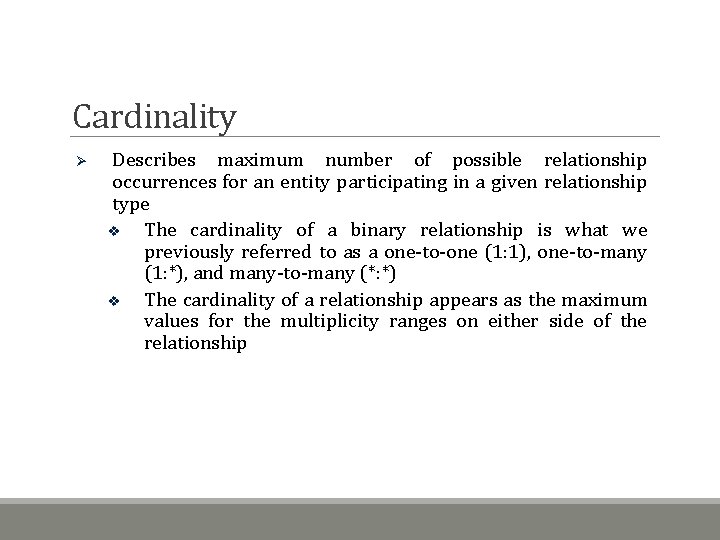
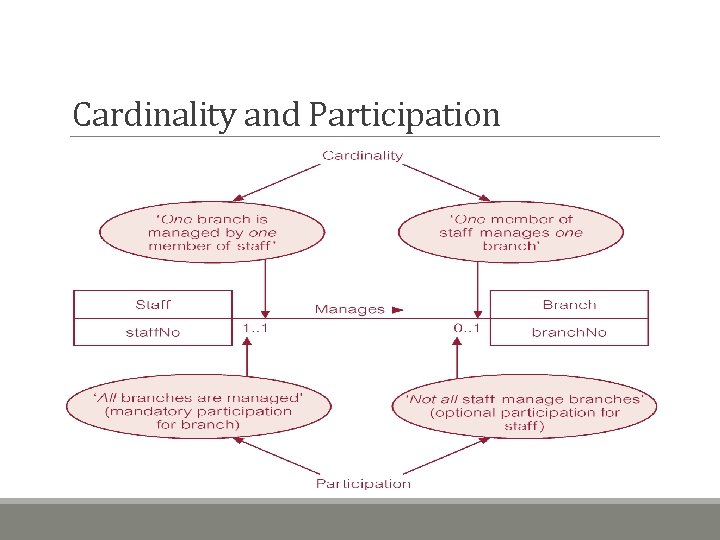
Cardinality Ø Describes maximum number of possible relationship occurrences for an entity participating in a given relationship type v The cardinality of a binary relationship is what we previously referred to as a one-to-one (1: 1), one-to-many (1: *), and many-to-many (*: *) v The cardinality of a relationship appears as the maximum values for the multiplicity ranges on either side of the relationship
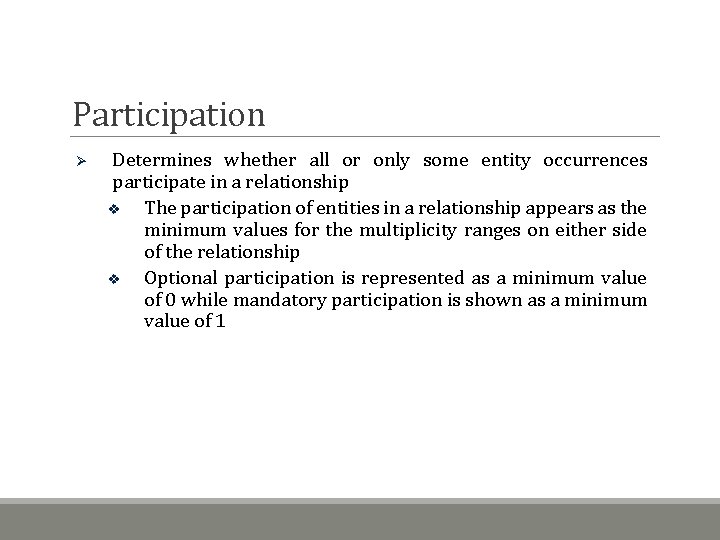
Participation Ø Determines whether all or only some entity occurrences participate in a relationship v The participation of entities in a relationship appears as the minimum values for the multiplicity ranges on either side of the relationship v Optional participation is represented as a minimum value of 0 while mandatory participation is shown as a minimum value of 1
Cardinality and Participation
Summary Classification of entities ◦ Attributes on relationships Structural constraints ◦ Multiplicity ◦ Binary
And